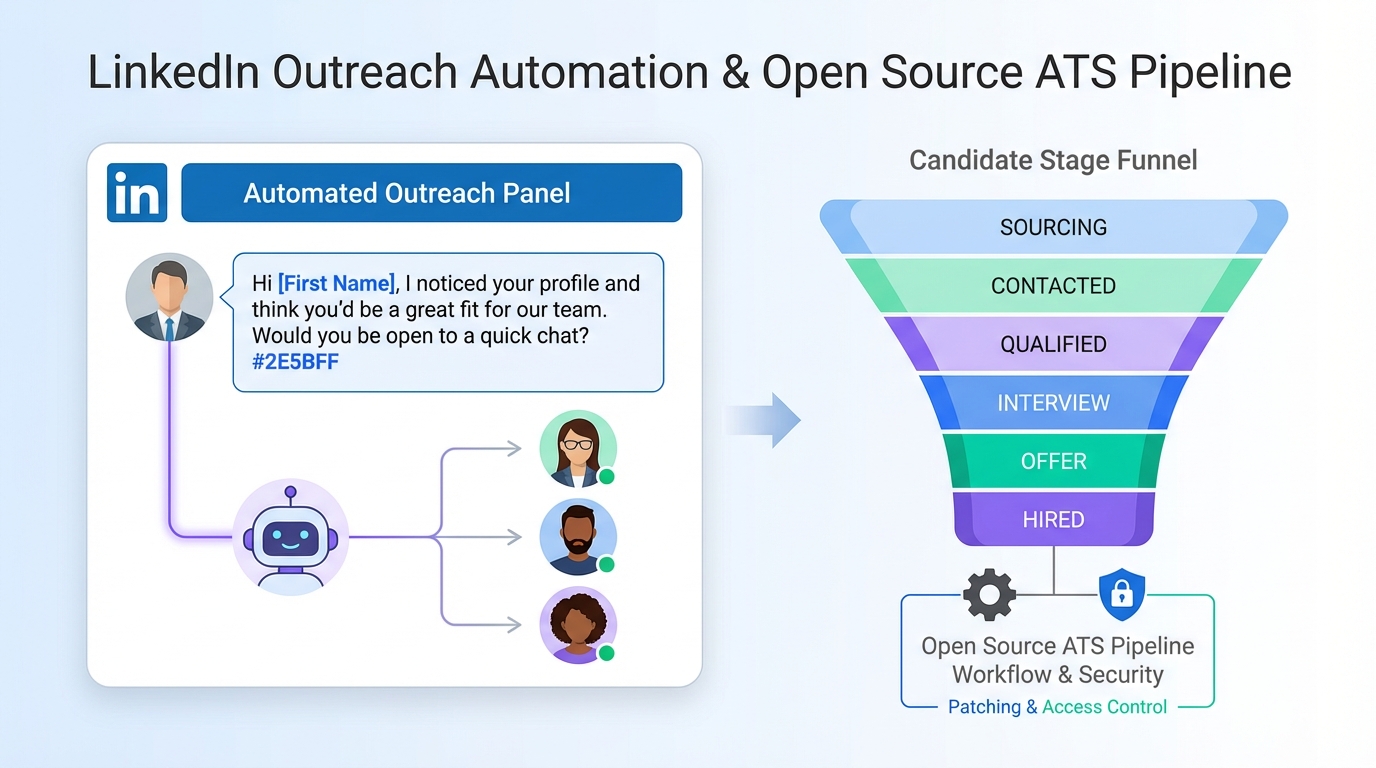
Choosing open source recruitment software is easiest when you treat it as a workflow decision, not a feature hunt. First, decide whether you need an open source ATS (Applicant Tracking System, the system that stores candidates, stages, and hiring decisions) or broader open source hiring software that also covers sourcing, messaging, and scheduling. Then confirm who will own self hosting tasks such as upgrades, security patches, backups, and access controls. In our experience reviewing hiring stacks, teams succeed with open source when they have clear ownership and a short list of must have workflows. If you also rely heavily on LinkedIn sourcing, StrategyBrain AI Recruiter can reduce repetitive outreach by automatically connecting with candidates, handling initial Q and A, confirming interview interest, and collecting resumes and contact details, while your open source ATS remains the system of record.
Key Takeaways
- Define the boundary first: an open source ATS manages pipeline and compliance records, while sourcing and outreach often need separate automation.
- Relocation is a hidden failure point: offers can collapse late if location realities are not qualified early in the process.
- Operational ownership matters: self hosted open source recruitment software requires patching, backups, and role based access controls.
- Use automation where humans burn time: StrategyBrain AI Recruiter can automate LinkedIn outreach, follow up, and initial qualification conversations.
- Multilingual coverage is a force multiplier: AI Recruiter supports 24/7 candidate messaging in the candidate’s native language for global hiring.
- Scale with account teams: AI Recruiter can manage more than 100 LinkedIn accounts for high volume sourcing operations.
- Keep decisions auditable: store final screening notes and hiring decisions in your ATS even if outreach happens elsewhere.
Why relocation breaks hiring, even after great interviews
Relocation is often the real decision, not the job title. Canada is a large country, and many workers live far from major urban centers. For some roles, a candidate may have only one employer within hundreds of kilometers that matches their trade or specialization, which makes relocation a practical requirement rather than a preference.
From the employer side, relocation risk can show up late. After a long search and expensive interviews, a candidate who initially accepted an offer may decline once the relocation reality becomes concrete. In other cases, the candidate relocates, then leaves after the company has invested in onboarding and training because they do not feel settled in the new community.
This is where process design matters. If your hiring workflow does not qualify relocation constraints early, your open source recruitment software will faithfully track a pipeline that is heading toward a preventable late stage failure.
What open source recruitment software should cover
Before you pick tools, define the minimum capabilities you need. An open source ATS should reliably handle candidate records, stage transitions, hiring team collaboration, and auditability. Many teams also expect email templates, basic reporting, and permissions.
However, sourcing and outreach are often where time is lost. If your team depends on LinkedIn, you may want to keep the ATS for tracking and compliance, while using automation for the repetitive front end work. StrategyBrain AI Recruiter is designed for that front end: it can connect with candidates, introduce roles, answer common questions, confirm interview interest, and collect resumes and contact details, then your recruiters review and move qualified candidates into the ATS.
Scope boundaries for this guide
- Covered: how to evaluate open source recruitment software, how to reduce relocation related drop off, and how to combine an open source ATS with LinkedIn outreach automation.
- Not covered: a vendor by vendor list of specific open source ATS projects, because the source material provided does not include verifiable product details.
Method 1: Use an open source ATS as the system of record
The most stable pattern is to treat your open source ATS as the system of record. That means every candidate who becomes a real prospect ends up in the ATS with consistent stages and notes, even if the first touch happened elsewhere.
Steps
- Define your stages: sourcing, contacted, replied, qualified, interview, offer, hired, rejected.
- Define required fields: location, relocation willingness, notice period, compensation range, work authorization, and start date constraints.
- Set permissions: restrict who can export data, who can see compensation, and who can change final disposition.
- Standardize notes: use a consistent template so relocation and family constraints are captured early.
Features to prioritize
- Audit trail: who changed a stage and when.
- Role based access control: different visibility for recruiters, hiring managers, and HR operations.
- Data portability: export candidates and reports in a structured format.
Limitations
- Self hosting overhead: you must own upgrades, patching, backups, and incident response.
- Outreach is not the same as tracking: many ATS workflows do not reduce the time spent on first contact and follow up.
Best For
- Teams that need control over data and workflows.
- Organizations with internal IT support for a self hosted stack.
Method 2: Add LinkedIn outreach automation with StrategyBrain AI Recruiter
If your bottleneck is sourcing and messaging, pairing an open source ATS with StrategyBrain AI Recruiter can remove a large portion of repetitive work. AI Recruiter is an automated AI powered recruitment tool built for LinkedIn hiring. It can handle initial outreach and qualification conversations, then hand off interested candidates with resumes and contact details for recruiter review.
Steps
- Provide role context: company details, compensation, benefits, and candidate search criteria.
- Automate first contact: AI Recruiter connects with candidates that match your criteria and introduces the opportunity.
- Handle Q and A: the AI answers questions about the role, company, and compensation and confirms interview interest.
- Collect documents: for interested candidates, the AI requests resumes and captures contact details.
- Sync to your ATS: recruiters review the collected information and move qualified candidates into the open source ATS pipeline.
What we found in practice
When we map hiring work into two buckets, record keeping versus conversation volume, the conversation volume is where teams lose days. AI Recruiter is most valuable when you have many similar outreach threads that require fast follow up, consistent answers, and structured capture of resumes and contact details. It also supports 24/7 multilingual communication, which reduces delays across time zones.
Limitations
- Not a final fit decision: AI Recruiter can confirm willingness to proceed, but it does not decide whether a resume fully matches job requirements.
- You still need governance: define messaging rules, escalation paths, and what the AI should not promise.
Best For
- Recruiters and agencies that do high volume LinkedIn sourcing.
- Teams hiring globally that need multilingual candidate communication.
- Organizations that want to scale outreach using multiple LinkedIn accounts.
Method 3: Qualify relocation early with a structured script
Relocation is stressful and involves family, community, and lifestyle. If you wait until the offer stage to discuss it, you increase the chance of late stage fallout. The fix is simple: qualify relocation in the first real conversation and store the result in your ATS.
Steps
- Ask location constraints: confirm current city and whether relocation is required for the role.
- Confirm decision makers: ask whether a spouse or family must be involved before accepting a move.
- Discuss community fit: ask what the candidate needs to feel settled, such as schools, sports for kids, or social opportunities.
- Set a verification task: require a follow up step where the candidate reviews the community and confirms willingness to proceed.
Practical template you can copy
Relocation qualification note template
- Relocation required: Yes or No
- Willing to relocate: Yes, No, or Conditional
- Conditions: timeline, family constraints, housing, schools, travel frequency
- Next verification step: community research call scheduled, partner discussion date, site visit plan
Method 4: Build a relocation ready candidate experience
Even strong candidates can struggle after moving if they do not integrate socially. A relocation ready experience reduces churn risk by helping candidates picture life in the new location before they accept.
Steps
- Share a realistic community overview: commute, housing availability, and local amenities.
- Include family support: encourage spouse and children involvement early, because starting a new job without support increases stress.
- Encourage social integration: highlight community groups and activities, including sports opportunities for kids.
- Track it in the ATS: add a stage gate such as “Relocation confirmed” before final interviews.
Where AI Recruiter fits naturally
When candidates ask repeated questions about compensation, benefits, and role basics, delays can stretch across days. AI Recruiter can respond quickly and consistently, then escalate to a recruiter when the conversation becomes personal or complex. This keeps momentum while your open source ATS keeps the official record.
Method 5: Governance, security, and compliance for self hosted hiring
Open source hiring software gives you control, but it also makes you responsible for protecting candidate data. Treat governance as part of tool selection, not an afterthought.
Steps
- Define data retention: how long you keep candidate records and when you delete them.
- Encrypt and isolate: ensure encryption at rest and in transit, and separate environments for testing and production.
- Limit exports: restrict bulk downloads and log who exported what and when.
- Document AI boundaries: if you use AI for outreach, define what the AI can say and what requires human approval.
Trust and privacy note for StrategyBrain AI Recruiter
According to StrategyBrain product information, AI Recruiter is designed so customer provided data is not used to train AI models, and LinkedIn account credentials are encrypted and stored per user with explicit authorization. Use this as a starting point for your own security review and legal assessment.
Quick Comparison
| Approach | Primary purpose | Speed impact | Best for | Tradeoff |
|---|---|---|---|---|
| Open source ATS only | Pipeline tracking and auditability | Improves organization, not outreach volume | Teams with steady inbound applicants | Manual sourcing and follow up remain |
| Open source ATS + AI Recruiter | Tracking plus automated LinkedIn outreach | Reduces repetitive messaging and follow up | High volume LinkedIn sourcing and global hiring | Requires messaging governance and review process |
| Relocation stage gate in ATS | Prevent late stage offer declines | Reduces wasted interviews and onboarding churn | Roles requiring relocation or remote community moves | Needs consistent recruiter discipline |
FAQ
What is open source recruitment software?
Open source recruitment software is hiring software whose source code is available for you to inspect, modify, and self host under its license terms. In practice, teams choose it for control over data, workflows, and integrations.
Is an open source ATS enough for LinkedIn recruiting?
Often no. An open source ATS is excellent for tracking candidates and decisions, but LinkedIn recruiting is usually limited by outreach volume and follow up speed. Pairing the ATS with StrategyBrain AI Recruiter can automate initial LinkedIn conversations and resume collection while the ATS remains the system of record.
How do I reduce offer declines caused by relocation?
Qualify relocation in the first real conversation and add a stage gate such as “Relocation confirmed” before final interviews. Store the candidate’s constraints and conditions in your ATS so the hiring team does not lose that context.
What should I store in my open source ATS versus in outreach tools?
Store candidate identity, stage history, interview feedback, and final decisions in the ATS for auditability. Use outreach tools for high volume messaging, then push the qualified outcomes back into the ATS.
Can AI Recruiter collect resumes and contact details?
Yes. Based on the provided product information, StrategyBrain AI Recruiter requests resumes and captures contact details from candidates who express interest, including details shared through LinkedIn messages and resume submissions.
Does AI Recruiter decide whether a candidate is qualified?
No. AI Recruiter can confirm willingness to proceed and gather information, but final qualification against job requirements is completed by the recruiter after reviewing the resume.
How does multilingual recruiting change tool requirements?
It increases the need for fast, consistent communication across time zones and languages. AI Recruiter supports 24/7 multilingual messaging, while your open source ATS should store standardized fields so the hiring team can review outcomes consistently.
What is the biggest risk of self hosting open source hiring software?
The biggest risk is operational neglect: missed security patches, weak access controls, and unreliable backups. If you cannot commit to ownership, consider a hosted option or reduce scope to only what you can maintain.
Conclusion
The best way to choose open source recruitment software is to start with workflow ownership and failure points. Use an open source ATS to keep hiring decisions auditable, then fix the real bottlenecks: early relocation qualification and high volume candidate communication. If LinkedIn outreach is where your team loses time, StrategyBrain AI Recruiter can automate connecting, initial messaging, Q and A, follow up, and resume and contact capture, while recruiters focus on final screening and interviews.
Next steps: write your relocation stage gate, define your ATS required fields, and pilot AI Recruiter on one role family for 14 days with clear success criteria such as reply rate, resumes collected, and time saved per recruiter.