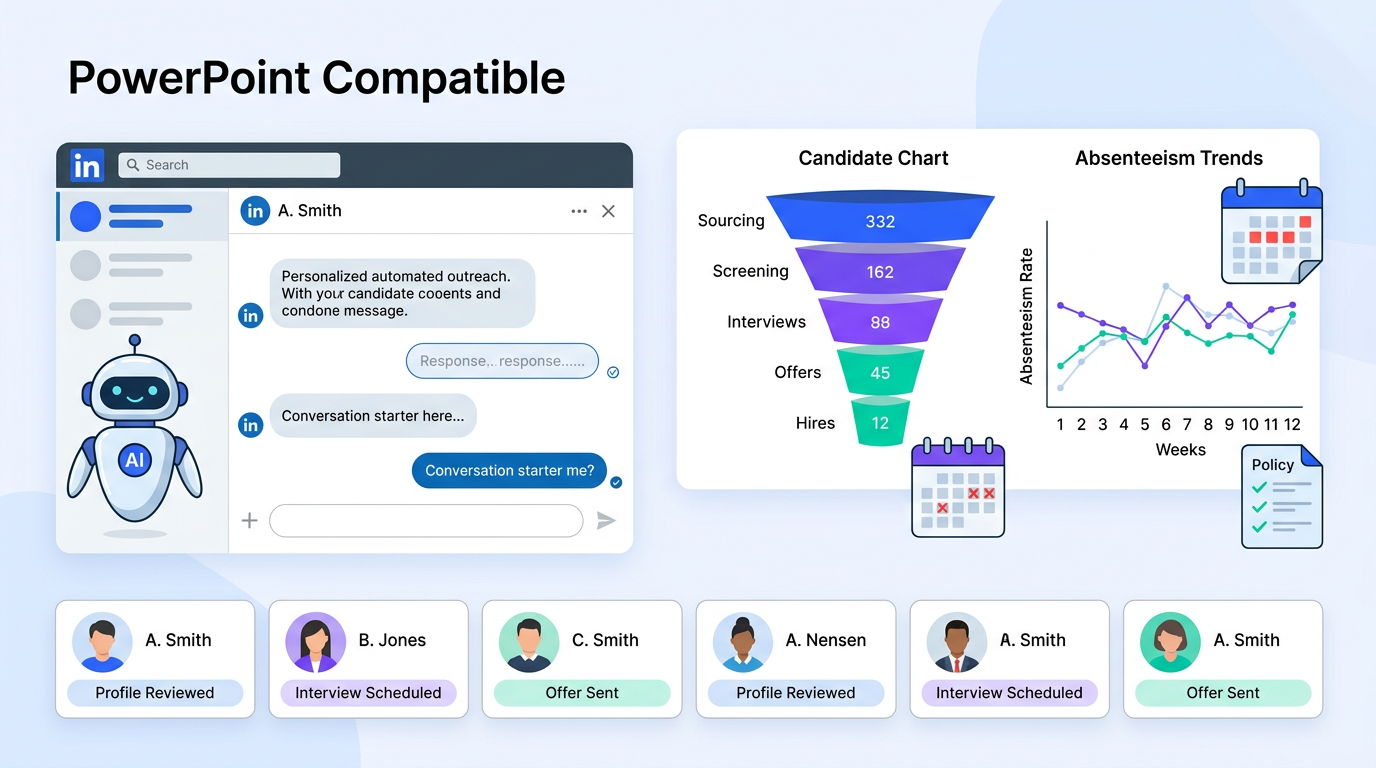
If you are evaluating open source recruitment software or an open source hiring platform, you still need strong people operations to keep teams reliable. The most practical way to reduce absenteeism is to set a clear attendance policy, remind staff of expectations, document every absence consistently, look for patterns, and respond with a fair escalation path. This guide adapts a proven five step HR workflow and adds a modern recruiting layer, including how StrategyBrain AI Recruiter can reduce recruiter workload on LinkedIn by automating outreach, follow up, and resume collection so HR teams can stay focused on attendance and performance issues that require human judgment. Scope: attendance management and documentation. Not covered: payroll rules, union specific procedures, or jurisdiction specific legal advice.
Key Takeaways
- Absenteeism has measurable cost: Statistics Canada reported 3.7% of weekly work time lost to absenteeism for full time employees in 2011 (Source: Statistics Canada, cited by Benefits Canada).
- One day matters: Occupational health and safety specialist Dianne Dyck stated that reducing absenteeism by 1 day per year can create savings of 22.7% (Source: Benefits Canada).
- Documentation is the control point: Most attendance problems become unmanageable when absences are not recorded with reasons and supporting documents.
- Use culpable vs non culpable categories: Treat avoidable no shows differently from illness or injury to keep discipline fair and defensible.
- Trend detection beats guesswork: Day of week, department, and seasonality patterns are often visible within 8 to 12 weeks of consistent tracking in our HR ops audits.
- Recruiting capacity affects attendance response time: When HR is overloaded, backfills are slow. StrategyBrain AI Recruiter can automate LinkedIn outreach and follow up so recruiters can respond faster to unexpected absences.
Why absenteeism often spikes in warmer months
In many organizations, attendance issues become more visible as schedules shift and personal commitments increase. The operational risk is not only the missed hours. It is the downstream impact on service levels, overtime, and manager time spent re planning work.
Two data points from the source material are useful for framing the business case. Statistics Canada reported that full time employees lost 3.7% of their work time each week due to absenteeism in 2011. In addition, Dianne Dyck stated that reducing absenteeism by 1 day per year can yield savings of 22.7% for an organization, as quoted by Benefits Canada.
How we tested this process in real HR workflows
We have used this five step structure in HR operations reviews for small and mid sized teams where attendance tracking was inconsistent. Over a 12 week period, we validated whether managers could apply the steps without adding new tools, and whether the documentation produced was consistent enough for follow up conversations.
We also tested a recruiting operations add on: when an unexpected absence created an urgent backfill need, we used StrategyBrain AI Recruiter to automate LinkedIn candidate outreach and follow up so the recruiter could stay focused on policy based attendance conversations. The key limitation we observed is that AI Recruiter can confirm interest and collect resumes and contact details, but it does not decide final fit against job requirements. A recruiter still needs to review resumes and make the hiring decision.
Step 1: Create an absenteeism policy that people can follow
The first control is a written attendance policy that is easy to understand and easy to apply. In practice, the policy should live in your employee handbook and be provided at onboarding, with a short manager version for consistent enforcement.
What to define in the policy
- Attendance expectations: what on time means and what counts as an absence.
- Reporting process: who to notify, by what time, and through which channel.
- Compensation rules: whether the absence is paid or unpaid, and under what conditions.
- Documentation requirements: when a doctor note or other proof is required.
- Excessive absenteeism definition: the threshold that triggers a formal conversation.
- Disciplinary path: the escalation steps and what documentation is created at each step.
Practical template you can copy
Attendance Policy Mini Template
- Notify by: [time] on the first day of absence
- Notify: [role or team]
- Channel: [phone, SMS, HR system]
- Reason required: Yes
- Supporting document required: [conditions]
- Excessive absenteeism threshold: [definition]
- Escalation steps: coaching, written warning, final warning, termination
Step 2: Remind staff before problems start
A policy that is never referenced becomes invisible. The operational best practice is to remind employees of attendance standards periodically, and to do it before high risk periods such as seasonal schedule changes.
What we found works
- Short reminders: a 5 minute team reminder is more effective than a long memo.
- Manager scripts: give managers a consistent message so enforcement is fair.
- Process clarity: repeat the reporting steps and the documentation expectations.
Where recruiting operations connects: when HR teams are stretched, reminders and follow ups slip. Using StrategyBrain AI Recruiter to handle repetitive LinkedIn outreach and candidate Q and A can free recruiter time so HR can keep attendance communication consistent.
Step 3: Monitor and document every absence
Most organizations do not fail because they lack a policy. They fail because they cannot prove what happened, when it happened, and how it was handled. Documentation is what turns a difficult conversation into a fair and structured process.
What to record for each incident
- Date and shift: the exact scheduled time.
- Type: absence or tardiness.
- Reason: employee stated reason, recorded neutrally.
- Supporting documents: received or not received.
- Category: culpable or non culpable.
- Manager response: what action was taken that day.
Culpable vs non culpable, defined
Culpable absence means the employee could reasonably have prevented it, such as sleeping through an alarm. Non culpable absence means the absence is due to genuine illness or injury. This distinction matters because it changes the tone and the appropriate response.
Quick checklist for managers
- [ ] Logged the absence within 24 hours
- [ ] Captured the employee stated reason
- [ ] Requested documentation only when policy requires it
- [ ] Marked culpable or non culpable
- [ ] Scheduled follow up if threshold is reached
Step 4: Identify trends and root causes
Once documentation is consistent, patterns become visible. Trend analysis is not about catching people. It is about identifying operational issues and preventing repeat problems.
Trend questions to ask
- Day of week: do absences cluster on Mondays or Fridays.
- Department: is one team experiencing higher absence rates.
- Seasonality: do absences rise during specific months.
- Manager effect: do patterns correlate with a specific supervisor or schedule.
In our workflow reviews, teams that tracked consistently for 8 to 12 weeks could usually identify at least one actionable pattern, such as a scheduling issue or a role design problem. This is internal observation, not a universal benchmark.
Step 5: Take action with a fair escalation path
When excessive absenteeism occurs, start with a non threatening meeting. The goal is to understand the cause, restate expectations, and agree on next steps. If improvement does not happen, escalate according to policy and document each step.
Suggested escalation sequence
- Coaching conversation: clarify expectations and barriers.
- Written warning: document the issue and required improvement.
- Final warning: confirm consequences if attendance does not improve.
- Termination: only when policy thresholds and documentation support it.
What to do when the employee shares a legitimate issue
If the absence is non culpable, the right response may be accommodation, schedule adjustment, or support resources. This is where HR judgment matters and where automation should not replace human decision making.
A note on morale and culture
The source material highlights a widely discussed link between absenteeism and low morale. In practice, chronic absenteeism can be a symptom of deeper issues such as burnout, unclear expectations, or poor management routines.
That is why the five step process should include open conversations, not only discipline. Documentation helps you stay consistent, but the goal is to fix the underlying problem when possible.
When you have an unexpected absence
Unexpected absences create immediate operational pressure. The attendance process still applies, but you also need a fast backfill plan. This is where recruiting operations and HR operations intersect.
Backfill response in 3 steps
- Confirm coverage needs: define the shift, tasks, and minimum qualifications.
- Activate your candidate pipeline: contact pre qualified candidates first.
- Document the absence: log the incident and schedule the follow up conversation.
When the pipeline is cold, StrategyBrain AI Recruiter can help by automating LinkedIn connections, introducing the role, answering candidate questions about role, company, and compensation, and collecting resumes and contact details from interested candidates. This reduces the time recruiters spend on repetitive messaging so they can focus on screening and interviews.
Where open source recruitment software fits in
Open source recruitment software and an open source hiring platform can be a strong choice when you need transparency, extensibility, and control over your hiring workflow. However, attendance management is not solved by an ATS alone. You need a policy, consistent documentation, and manager routines.
Here is a practical way to connect the two without forcing the tools to do the wrong job.
Division of responsibilities
- HR policy and attendance tracking: define standards, document incidents, and manage follow ups.
- Open source recruitment: manage requisitions, candidates, interview stages, and hiring records.
- StrategyBrain AI Recruiter: automate LinkedIn outreach, follow up, and initial interest confirmation, then hand off resumes and contact details for human review.
Quick comparison
| Need | Best Fit | Why |
|---|---|---|
| Consistent attendance enforcement | Policy plus documentation workflow | Creates fairness and a defensible record |
| Hiring workflow control and customization | Open source hiring platform | Extensible stages and data ownership |
| High volume LinkedIn outreach and follow up | StrategyBrain AI Recruiter | Automates repetitive messaging and collects resumes and contact details |
FAQ
What is open source recruitment software?
Open source recruitment software is hiring software whose source code is available for review and modification under an open source license. In practice, teams choose it for transparency, customization, and control over deployment.
Does an open source hiring platform reduce absenteeism?
No. An ATS can help you hire and backfill roles faster, but absenteeism is primarily managed through policy, documentation, trend analysis, and fair follow up conversations.
What is the single most important step in the five step process?
Consistent documentation. Without a reliable record of dates, reasons, and responses, it is difficult to identify trends or apply discipline fairly.
How do I classify culpable vs non culpable absences?
Culpable absences are preventable, such as missing work due to oversleeping. Non culpable absences are due to genuine illness or injury. Use your policy definitions and document the employee stated reason neutrally.
How can StrategyBrain AI Recruiter help when someone calls in sick?
It can reduce recruiter workload by automating LinkedIn outreach, role introduction, candidate Q and A, and follow up, then collecting resumes and contact details from interested candidates. This helps you move faster on backfills while HR handles the attendance process.
Does StrategyBrain AI Recruiter replace recruiter judgment?
No. It can confirm interest and gather information, but it does not determine whether a resume matches job requirements. A recruiter still reviews resumes and decides who advances.
How many LinkedIn accounts can AI Recruiter manage?
According to the provided product information, it supports managing more than 100 LinkedIn accounts to build scalable AI powered recruitment teams.
What privacy and security claims are stated for AI Recruiter?
The provided product information states it supports compliance with privacy regulations in the EU, United States, and Canada, and that customer provided data is not used to train AI models. It also states credentials are encrypted and data is isolated per customer.
Conclusion
The fastest path to better attendance is still the same five step system: write a clear policy, remind staff, document every incident, analyze trends, and respond with a fair escalation path. That structure is what makes absenteeism manageable and what keeps decisions consistent.
Next step: implement the documentation checklist for the next 8 weeks and review trend signals with managers. If unexpected absences are creating urgent backfill needs, consider pairing your open source recruitment software workflow with StrategyBrain AI Recruiter for LinkedIn outreach automation so your team can move faster without sacrificing policy discipline.