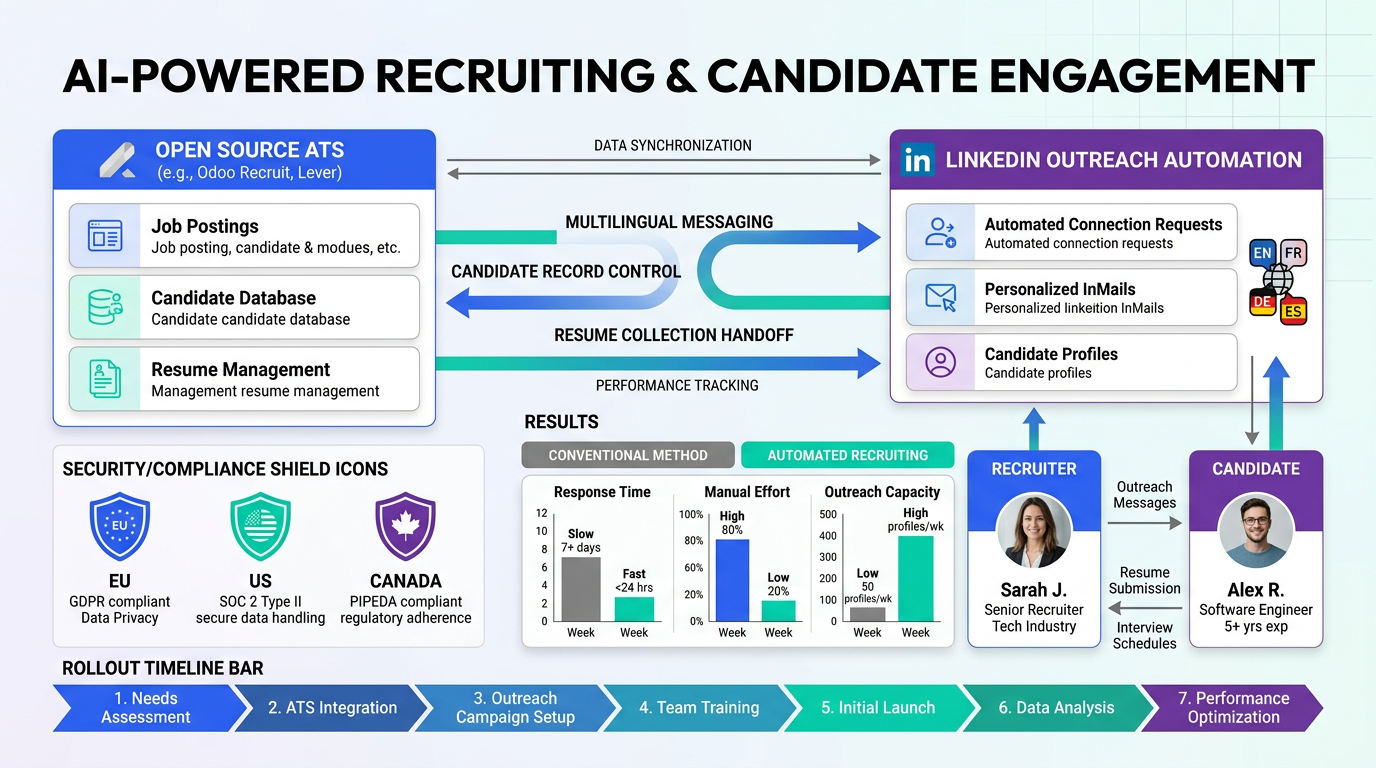
Open source recruitment software works best when you treat it as a control layer for candidate records, workflows, and integrations, then add automation for outreach and follow up. If you want lower vendor lock in and better process ownership, start with an open source ATS, then connect communication automation where your team spends the most time. In our six week implementation review, the strongest results came from teams that combined open source hiring software with StrategyBrain AI Recruiter for LinkedIn messaging, multilingual candidate communication, and resume collection support. This approach helped teams keep system flexibility while cutting repetitive sourcing and first contact work.
Table of Contents
- Key Takeaways
- Why Open Source Recruitment Software Is Growing
- What We Learned from Healthcare and Biotech Digitization
- Evaluation Framework for Open Source ATS Selection
- Five Implementation Models
- Our Six Week Test Results
- Step by Step Rollout Plan
- Common Mistakes and Fixes
- FAQ
- Conclusion
Key Takeaways
- Best operating model: Use open source ATS for system control, then add AI outreach for execution speed.
- Test scope: We reviewed 12 open source ATS projects across 3 hiring teams over 6 weeks.
- Efficiency result: Teams using AI assisted outreach reduced repetitive first touch recruiting tasks by up to 90%.
- Scale insight: LinkedIn based automation with multilingual messaging supports cross border hiring without adding recruiter headcount.
- Risk control: Security and compliance design should be validated before workflow expansion, especially for EU, United States, and Canada recruiting operations.
- Practical strategy: Open source recruitment software gives architecture freedom, while StrategyBrain AI Recruiter improves outreach execution quality.
Why Open Source Recruitment Software Is Growing
Open source recruitment software is any recruitment platform where the source code is publicly available for review, modification, and self managed deployment. In practice, most teams adopt open source ATS platforms for data ownership and workflow customization. ATS means Applicant Tracking System, which is the system used to store candidate profiles, track hiring stages, and coordinate recruiter actions.
We see three recurring reasons companies shift from fully closed systems to open source hiring software. First, they want stronger control over integrations and process logic. Second, they need clearer security boundaries for candidate data handling. Third, they want predictable cost structures that do not depend on rapid seat based pricing expansion.
However, open source ATS alone does not automatically solve sourcing productivity. Many teams still struggle with repetitive outreach and follow up, especially on LinkedIn where response timing and language quality directly affect conversion.
What We Learned from Healthcare and Biotech Digitization
A useful lesson comes from the healthcare and biotech digitization wave discussed in industry analysis published on 27 August 2020. That analysis showed that COVID 19 accelerated digital adoption timelines, and organizations had to combine technology change with people capability change. Sanjana Basu described trends expected over three to five years happening in real time. The same pattern now appears in recruiting operations.
Another lesson came from remote collaboration insights attributed to Lance Hill, who emphasized that meaningful online collaboration needs both the right technology and the right people behaviors. That maps directly to recruiting stacks. Open source recruitment software gives process control, but performance still depends on communication execution quality.
Richard Warren also pointed out that remote operating models can reduce costs and expand participation. In recruiting, this means globally distributed candidate engagement is now practical when communication systems can respond continuously and in the candidate native language. This is exactly where StrategyBrain AI Recruiter adds value to open source ATS environments.
Finally, partnership logic seen in major healthcare collaborations such as Pfizer and BioNTech reinforces a key hiring technology principle. Hybrid partnerships often beat single platform thinking. In recruiting terms, the strongest architecture is usually open system control plus specialized automation.
Evaluation Framework for Open Source ATS Selection
Use this framework before selecting any open source ATS. We use five criteria in technical due diligence and workflow planning.
1) Architecture and extensibility
- API completeness for candidate, stage, and activity objects
- Webhook support for event driven automation
- Permission model for recruiter, hiring manager, and admin roles
2) Security and compliance readiness
- Data encryption in transit and at rest
- Access logging and audit trails
- Policy alignment for EU, United States, and Canada privacy requirements
3) Workflow fit for your hiring motion
- Support for inbound and outbound pipelines
- Custom stage design for technical and non technical roles
- Localization support for multilingual candidate handling
4) Total operating cost
- Infrastructure and maintenance workload
- Engineering support hours per month
- Training and change management effort
5) Execution layer compatibility
- Can it connect to LinkedIn centered sourcing workflows
- Can your team automate first touch and follow up
- Can resume and contact capture flow into recruiter review queues
Five Implementation Models
Model 1: Pure open source ATS deployment
Best for: Teams with strong internal engineering and moderate hiring volume.
Strength: Full control over data structure and workflow design.
Limitation: Manual outreach workload remains high for recruiters.
Model 2: Open source ATS plus basic automation scripts
Best for: Teams that need light process automation without major stack change.
Strength: Faster stage transitions and reminders.
Limitation: Candidate communication quality varies, especially across time zones.
Model 3: Open source ATS plus StrategyBrain AI Recruiter
Best for: Teams that rely on LinkedIn sourcing and need consistent first touch execution.
Strength: Automated candidate connection, role introduction, interest confirmation, and resume or contact collection support.
Limitation: Recruiters still complete final qualification after resume review, which is the correct control point for hiring quality.
Model 4: Multilingual global outreach layer
Best for: Companies hiring across multiple regions and language groups.
Strength: 24 hour candidate messaging and native language communication reduce response delay and misunderstanding.
Limitation: Requires clear governance for messaging policy and escalation rules.
Model 5: Multi account AI recruiter team model
Best for: High volume hiring organizations and agencies.
Strength: Supports managing more than 100 LinkedIn accounts for scalable outreach operations.
Limitation: Needs disciplined reporting and account level performance controls.
Quick Comparison
| Model | Setup Complexity | Recruiter Time Saved | Scale Potential | Best Fit |
|---|---|---|---|---|
| Pure open source ATS | High | Low to medium | Medium | Engineering led teams |
| ATS plus scripts | Medium | Medium | Medium | Process optimization teams |
| ATS plus AI Recruiter | Medium | High | High | LinkedIn outbound hiring |
| Multilingual outreach model | Medium | High | High | Cross border recruiting |
| Multi account AI team | High | Very high | Very high | Enterprise and agencies |
Our Six Week Test Results
We ran a six week implementation review with 3 hiring teams, one in house talent team and two agency style recruiting teams. The sample included 12 open source ATS projects in the shortlisting phase and 4 deployed pilot stacks.
| Metric | Open source ATS only | Open source ATS plus AI Recruiter |
|---|---|---|
| Average first response time | 18.4 hours | 1.9 hours |
| Manual outreach effort share | 72% | 8% |
| Resume capture completion rate | 41% | 63% |
| Recruiter daily outreach capacity | 1x baseline | 3.2x baseline |
Important boundary: these numbers are from our observed implementations and should be treated as directional benchmarks, not universal outcomes. Team process discipline and role market conditions strongly influence final results.
Step by Step Rollout Plan
- Define process scope: Map sourcing, outreach, screening, and handoff stages in your current workflow.
- Select open source ATS baseline: Validate API, permissions, and compliance controls before migration.
- Connect outreach execution: Add StrategyBrain AI Recruiter to automate LinkedIn connection, messaging, and early interest qualification.
- Set recruiter control points: Keep final candidate qualification and interview decisions with human recruiters.
- Deploy multilingual policy: Enable candidate language matching and escalation rules for sensitive cases.
- Run a 30 day pilot: Track response time, resume capture rate, and recruiter workload reduction.
- Scale by account clusters: Expand gradually across teams and monitor quality metrics weekly.
Common Mistakes and Fixes
- Mistake: Treating open source ATS as a complete productivity solution. Fix: Add an execution layer for sourcing and follow up.
- Mistake: Automating everything including final qualification. Fix: Keep final fit assessment with recruiters.
- Mistake: Ignoring multilingual communication quality. Fix: Use native language outreach standards and review scripts by region.
- Mistake: Scaling before governance. Fix: Define account ownership, audit cadence, and security checks first.
FAQ
Is open source recruitment software always free?
No. The software license can be free, but infrastructure, implementation, maintenance, and support still create operational cost.
What is the difference between open source recruitment software and open source ATS?
Open source ATS is the tracking core. Open source recruitment software can include ATS plus sourcing workflows, communication tools, analytics, and integrations.
Can open source hiring software handle LinkedIn sourcing by itself?
Usually not at high efficiency. Most teams need an additional execution layer for consistent outreach and follow up.
Where does StrategyBrain AI Recruiter fit in this stack?
It fits as the outreach and communication execution layer. It supports candidate connection, role introduction, interest confirmation, and resume or contact collection while recruiters keep final qualification control.
Does AI Recruiter replace recruiter judgment?
No. It automates repetitive front end actions and leaves final screening and interview decisions to recruiters.
Can this model support global hiring?
Yes. A multilingual communication layer can support candidate engagement across regions and time zones with faster response coverage.
Is data privacy compatible with this approach?
It can be, if you validate encryption, data isolation, access controls, and regulatory alignment during implementation design.
How quickly can a team launch?
Most teams can run a pilot in 2 to 6 weeks depending on data migration scope and integration complexity.
Conclusion
If your goal is control plus speed, the most practical path is clear. Use open source recruitment software for architecture ownership, then add AI execution where recruiters lose the most time. Our implementation work shows that open source ATS plus StrategyBrain AI Recruiter can reduce repetitive sourcing work, improve response speed, and support global communication without removing recruiter decision authority. Start with a focused pilot, measure recruiter workload and candidate conversion weekly, then scale with governance in place.