OpenClaw hiring works best when you hire for execution, orchestration, and safety. OpenClaw is an execution and orchestration platform for AI Agents that upgrades large language models from only answering questions to digital executors that can call tools and complete tasks. So your strongest candidates are the ones who can design tool calling workflows, integrate channels like chat systems, and ship auditable automation with least privilege. Below is a practical hiring plan grounded in a real project manager search story, plus a repeatable interview rubric and a LinkedIn outreach workflow where StrategyBrain AI Recruiter handles the initial connect, role intro, Q and A, interest confirmation, and resume collection so recruiters can focus on evaluation.
Table of Contents
- What OpenClaw hiring really means
- Case study: what this search teaches
- Role design for OpenClaw teams
- Screening rubric you can reuse
- Interview process that maps to execution work
- LinkedIn outreach with StrategyBrain AI Recruiter
- Quick comparison
- FAQ
- Conclusion
What OpenClaw hiring really means
OpenClaw is built around three layers: an LLM layer for planning, a tool layer for taking actions, and a channel layer for collaborating with people in chat systems. When you recruit for OpenClaw projects, you are hiring for the ability to move across those layers without breaking reliability or trust.
Core capabilities to hire for
- Tool calling and automated execution: candidates can connect an agent to real tools such as files, shell commands, web retrieval, browser automation, and enterprise systems.
- Orchestration and decomposition: candidates can split work into sub tasks and merge results, including parallel conversations and sub agents.
- Memory and continuity: candidates understand how long term context is stored, updated, and governed.
- Security and control: candidates can implement least privilege, human confirmation for high risk actions, and action logging for traceability.
Scope boundary
This article focuses on hiring and recruiting workflows for OpenClaw style execution teams. It does not attempt to provide a full OpenClaw deployment tutorial or a complete security architecture review.
Case study: what this search teaches
In a real search dated 16 June 2022, a Victoria based technology company, Triton Timber Group, needed a project manager who could oversee remote multimillion dollar projects in locations such as Africa and Central America while commuting to Victoria at least once a week. The requirements combined large scale project management with mechanical engineering knowledge, plus the ability to truly understand the technology behind the projects.
The recruiter, Senior Recruiter Alessia Pagliaroli, found that the hard part was not locating a candidate with the right baseline skills. The obstacle was that the best fit had shifted career paths several years earlier, moving from engineering into the film industry. Alessia still reached out based on judgment and context, and the candidate turned out to be interested and had recently decided to leave film behind.
Why this matters for OpenClaw hiring
OpenClaw roles often look like hybrid profiles. You may need someone who can manage delivery and also understand the technical constraints of tool calling, permissions, and operational safety. That is similar to the Triton search, where the winning candidate needed both management and deep technical understanding.
Role design for OpenClaw teams
Before you post or source, define the role in terms of execution outcomes. This reduces false positives from candidates who only have surface level LLM experience.
Role template: Agent Execution Project Manager
- Mission: deliver reliable agent workflows that execute real tasks through tools and channels, with auditable logs and controlled permissions.
- Must have: experience coordinating multi stakeholder delivery, plus enough technical depth to evaluate tool integration and failure modes.
- Nice to have: exposure to browser automation, enterprise chat operations, or dev ops style runbooks.
Role template: Agent Orchestration Engineer
- Mission: design and implement orchestration patterns such as skills, sub agents, and parallel task execution.
- Must have: ability to build tool interfaces, handle errors, and implement safe defaults.
- Nice to have: experience with memory governance and long running workflows.
Screening rubric you can reuse
We use a rubric to keep OpenClaw hiring consistent across recruiters and interviewers. It also makes feedback easier to compare.
Scorecard categories
- Execution depth: can they describe a tool calling workflow end to end, including inputs, outputs, and failure handling.
- Orchestration thinking: can they break a complex task into sub tasks and define merge logic.
- Operational safety: do they default to least privilege, logging, and human confirmation for high risk actions.
- Communication in channels: can they design message driven workflows that work in real team chat environments.
- Cross industry judgment: can they spot transferable experience, like the Triton candidate who returned from film to engineering.
Practical checklist for recruiters
- Confirm the candidate has shipped at least 1 automation workflow that performed real actions, not only generated text.
- Ask for 1 example of an incident or failure and what they changed afterward.
- Ask how they decide which actions require human approval.
- Ask how they keep long term context accurate over time.
Interview process that maps to execution work
This process is designed to be reproducible. Each step has a clear pass condition.
Step 1: recruiter screen
- Confirm scope: role location, travel expectations, and time zone coverage.
- Confirm hybrid fit: ask for one example where they combined delivery leadership with technical decision making.
- Confirm execution mindset: ask what tools they have integrated and how they handled permissions.
Step 2: technical and workflow interview
- Workflow design: candidate outlines an agent that reads a document, runs a command, and reports results in a chat channel.
- Error handling: candidate explains retries, timeouts, and safe fallbacks.
- Auditability: candidate explains what gets logged and how to review actions.
Step 3: scenario interview for judgment
Use a scenario similar to the Triton search. Present a candidate who looks like a mismatch on paper due to a career shift, then ask how they would validate fit without wasting cycles. The goal is to test structured curiosity rather than bias.
Common pitfalls we see
- Over indexing on prompts: strong prompt writers can still fail when tools return errors or permissions are missing.
- No safety model: candidates who cannot articulate least privilege and human confirmation are risky for execution systems.
- Ignoring channel reality: workflows that look good in a notebook can break in real chat operations with interruptions and partial context.
LinkedIn outreach with StrategyBrain AI Recruiter
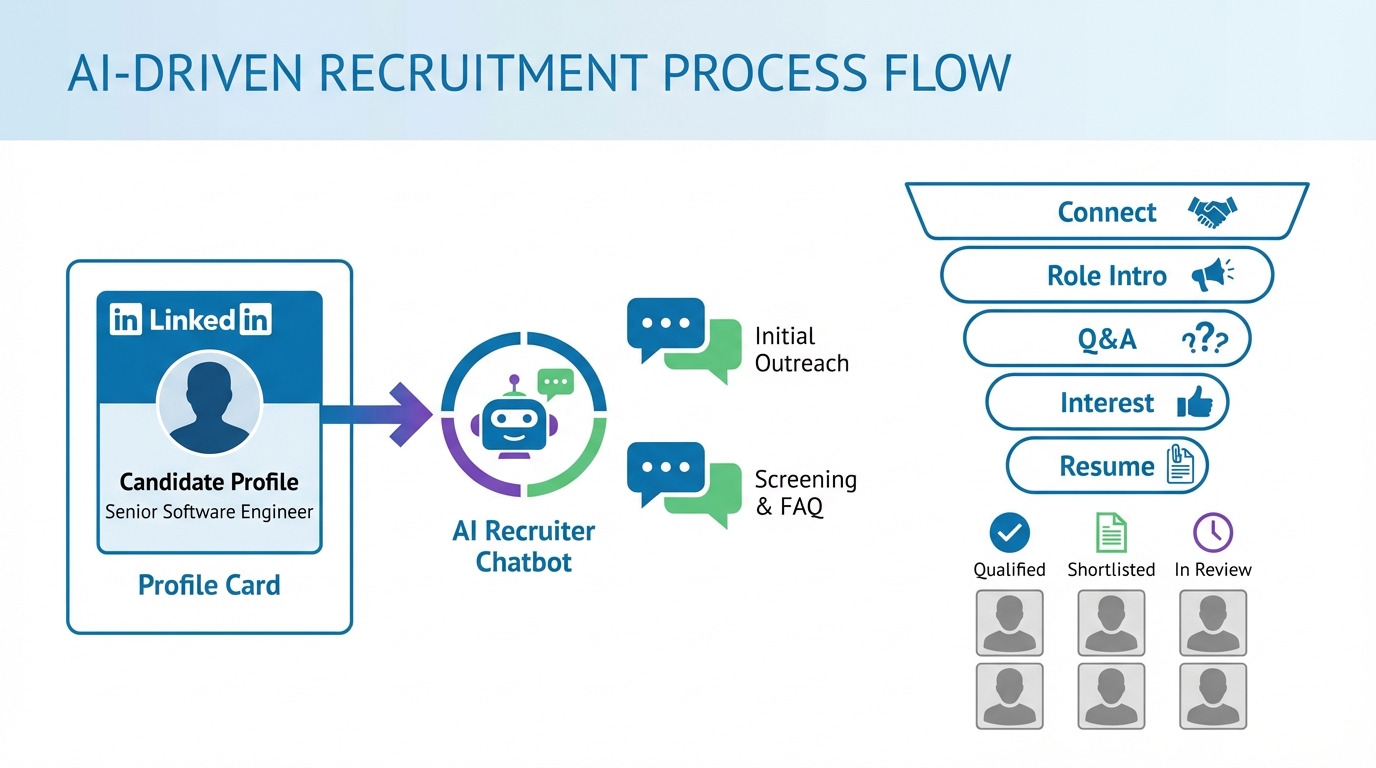
OpenClaw hiring often requires high volume sourcing because the best candidates are not always actively applying. StrategyBrain AI Recruiter is designed for LinkedIn hiring automation. It automatically connects with candidates within your targeted search criteria, introduces the role, answers questions about the role, company, and compensation based on the information you provide, confirms interview interest, and collects resumes and contact information from interested candidates. This is especially useful when you are trying to find hybrid profiles like the Triton project manager example, where the best fit may not match a standard keyword search.
How we run an OpenClaw hiring outreach loop
- Define search criteria: target execution and orchestration experience, plus adjacent domains like dev ops automation or technical project delivery.
- Provide role context: company details, benefits, and compensation ranges if you can share them, plus what the agent workflows will actually do.
- Let AI Recruiter handle first contact: connection request, role introduction, and initial Q and A in the candidate’s language.
- Collect resumes and contacts: AI Recruiter requests resumes and captures contact details for interested candidates.
- Human review and shortlist: recruiters review resumes and move qualified candidates into the structured interview steps above.
What we like and what to watch
- Strength: 24 by 7 multilingual communication reduces drop off when candidates reply outside business hours.
- Strength: consistent follow up improves response rates in long searches.
- Limitation: AI Recruiter can confirm willingness to interview, but it does not decide whether a resume fully matches job requirements. Your team still owns final qualification.
- Limitation: any automation needs clear guardrails, including what messages are allowed and when a human must step in.
Quick comparison
| Workflow | Speed to first reply | Recruiter time saved | Best for |
|---|---|---|---|
| Manual LinkedIn outreach | Depends on recruiter availability | Low | Small pipelines and highly bespoke messaging |
| StrategyBrain AI Recruiter assisted outreach | 24 by 7 coverage | High for initial connect, Q and A, follow up, and resume collection | OpenClaw auto hiring at scale, especially for hybrid profiles |
FAQ
What does openclaw hiring mean in practice?
OpenClaw hiring means recruiting people who can build and operate AI agents that execute tasks through tools and channels, with safe permissions and auditable logs. It is less about writing prompts and more about shipping reliable automation.
What should I screen for first in openclaw hiring?
Screen for real execution experience. Ask for one shipped workflow that called tools, handled errors, and produced a measurable operational outcome such as reduced manual steps or faster turnaround time.
How do I evaluate tool calling skills without a long take home test?
Use a live workflow design interview. Have the candidate outline inputs, outputs, failure handling, and logging for a simple agent that reads data, runs an action, and reports back in a chat channel.
How does StrategyBrain AI Recruiter help with openclaw auto hiring?
It automates the highest volume early stage work on LinkedIn: connecting with candidates, introducing the role, answering common questions based on your provided details, confirming interest, and collecting resumes and contact information. Your recruiters then focus on evaluation and final fit.
Does AI Recruiter replace recruiters for qualification?
No. It can identify willingness to communicate or interview and collect resumes, but it does not determine whether a resume fully matches job requirements. Recruiters still make the final qualification decision.
How do I handle candidates with non linear backgrounds?
Use structured validation instead of assumptions. The Triton example shows that a career shift can hide a strong fit, so ask for evidence of transferable skills, recent motivation, and the ability to re enter the domain.
What security topics should be part of the interview?
Ask about least privilege, human confirmation for high risk actions, and action logging for traceability. Also ask how they govern long term memory so it stays accurate and up to date.
What is the biggest mistake teams make when hiring for agent execution platforms?
The biggest mistake is hiring only for LLM fluency and ignoring operational reality. Execution systems fail on permissions, tool errors, and unclear handoffs, so your hiring process must test those areas directly.
Conclusion
OpenClaw hiring becomes much easier when you define roles around execution outcomes, screen for tool calling and orchestration, and interview for safety and operational judgment. The Triton project manager search is a useful reminder that hybrid roles often require creative sourcing and openness to non linear backgrounds. If you want to scale sourcing without scaling recruiter workload, use StrategyBrain AI Recruiter to automate LinkedIn connecting, role introduction, candidate Q and A, follow up, and resume collection, then keep humans focused on technical evaluation and final selection.