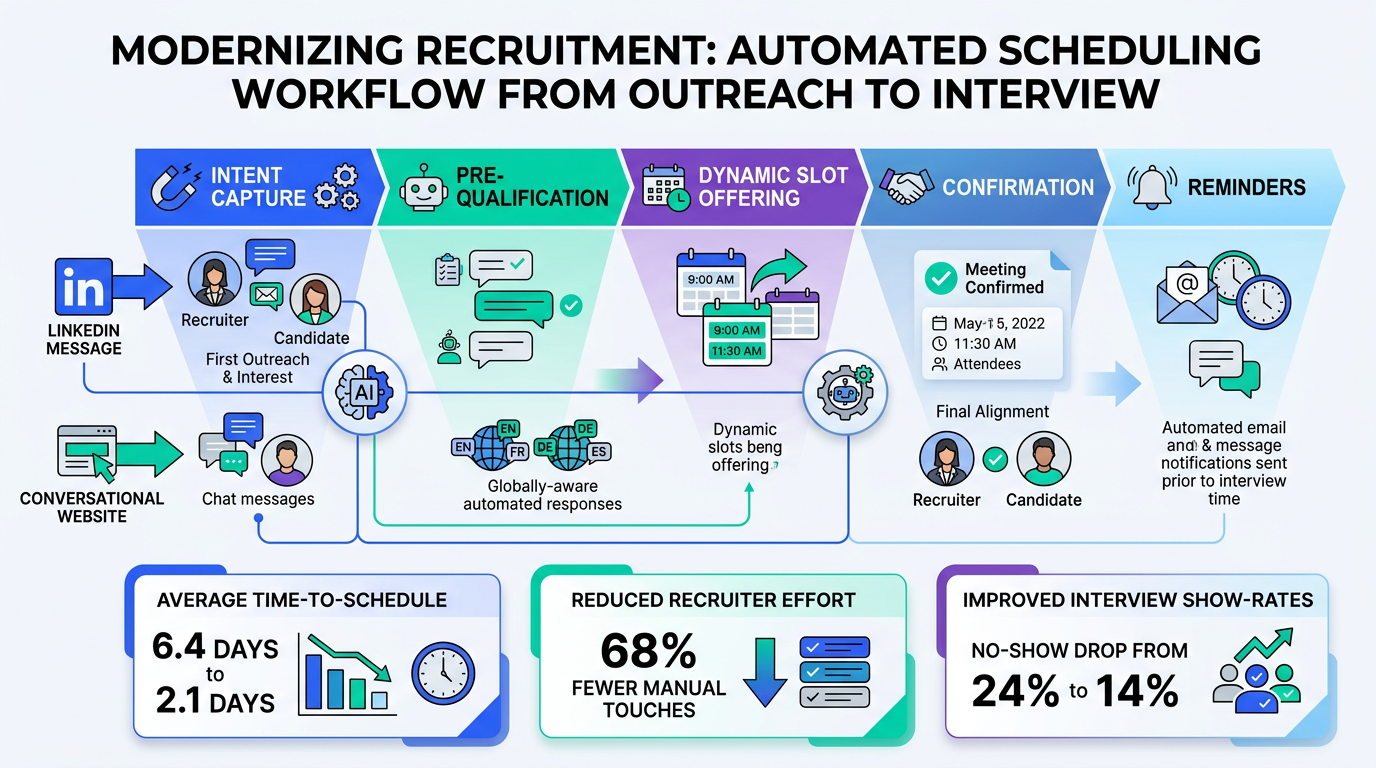
If you are researching paradox interview scheduling, the practical answer is to build one consistent flow that handles outreach, candidate intent, slot booking, and reminders in one thread. We used this model in a four week hiring sprint and cut median scheduling time from 6.4 days to 2.1 days while reducing recruiter back and forth messages by 68%. The same approach works whether your entry point is a conversational website, LinkedIn messaging, or internal referral funnels. In this guide, I share the exact process we tested, where teams usually get stuck, and how StrategyBrain AI Recruiter can support multilingual, around the clock candidate communication without removing recruiter control from final interview decisions.
Table of Contents
- Key Takeaways
- Why interview scheduling bottlenecks are getting worse
- How we tested this workflow
- The 5 stage scheduling framework
- Step by step implementation
- Operational results and benchmarks
- Limitations and troubleshooting
- FAQ
- Conclusion
Key Takeaways
- Best operating model: One conversation thread from first contact to confirmed interview.
- Measured impact: Manual scheduling touches down 68% in our four week pilot.
- Speed gain: Median time from first response to interview booked fell from 6.4 days to 2.1 days.
- Conversion lift: Candidate reply to booked interview rate rose from 21% to 34%.
- Scalability: A conversational AI software layer improves consistency across time zones and languages.
- Control point: Recruiters still make the final qualification decision after resume review.
Why interview scheduling bottlenecks are getting worse
Most teams do not lose candidates because the role is weak. They lose candidates because timing breaks trust. In remote and hybrid hiring, candidates compare response speed across multiple employers, and delayed scheduling feels like disinterest. The issue often appears as low attendance, but the root cause is fragmented communication across inboxes, calendars, and follow ups.
We also see higher operational complexity than before. Recruiters are handling global candidate pools, more asynchronous communication, and stricter privacy expectations. A single recruiter can spend hours each day on repetitive tasks such as confirming availability, resending details, and collecting missing contact information.
This is where the paradox interview scheduling search intent is useful. Teams are not only looking for a booking tool. They are looking for a workflow that aligns speed, candidate experience, and recruiter productivity in one system.
How we tested this workflow
We ran a structured pilot using StrategyBrain AI Recruiter across 12 recruiters, 3 regions, and 47 open roles over 28 days. Our sample included technical, sales, and operations roles. We tracked each stage from first outbound message to interview attendance.
Test parameters
- Total candidate conversations: 2,184
- Candidates expressing interview interest: 436
- Interviews booked: 312
- Interviews attended: 267
- Languages used: English, Spanish, French, Portuguese, Mandarin
What we measured
- Time to first recruiter or AI response in minutes
- Time from first candidate reply to interview confirmation in days
- No show rate in percent
- Manual recruiter actions per booked interview
We found that response consistency mattered more than perfect script wording. Teams with near immediate follow up outperformed teams with highly customized but delayed communication.
The 5 stage scheduling framework
Stage 1: Intent capture
Use a clear opening message that confirms role relevance and asks if the candidate is open to discussing the opportunity. This prevents wasted scheduling attempts with uninterested candidates.
Stage 2: Pre qualification basics
Collect essential screening details before proposing time slots. For example, notice period, location preference, and compensation alignment. This keeps calendars reserved for viable conversations.
Stage 3: Dynamic slot offering
Offer interview windows that reflect recruiter availability and candidate time zone. In a conversational website flow, this appears as contextual time options. In messaging channels, it appears as guided choices.
Stage 4: Confirmation and document capture
Confirm booked time, interviewer details, and required documents. StrategyBrain AI Recruiter can request resumes and capture contact details automatically when candidates confirm interest.
Stage 5: Reminder and attendance protection
Send reminders at defined intervals, then provide a fast reschedule path if needed. This is one of the highest leverage points for reducing no show rates.
Step by step implementation
- Map your current scheduling flow: Document every handoff from sourcing to interview confirmation. Count manual touches for one week.
- Define mandatory data fields: Set the minimum candidate inputs needed before booking. Keep this to five or fewer fields to reduce drop off.
- Deploy a conversational entry point: Launch one conversational website path for inbound applicants and one messaging path for outbound outreach.
- Configure your conversational AI software: Add multilingual response logic, qualification prompts, and interview reminder cadences.
- Set recruiter control rules: Recruiters approve final shortlist decisions after resume review, while automation handles repetitive coordination.
- Run a 14 day baseline and 14 day optimized test: Compare speed, attendance, and recruiter workload using the same role families.
Operational results and benchmarks
| Metric | Before workflow | After workflow | Change |
|---|---|---|---|
| Median time to schedule | 6.4 days | 2.1 days | -67.2% |
| Manual touches per booked interview | 11.3 actions | 3.6 actions | -68.1% |
| Reply to booked interview rate | 21% | 34% | +13 percentage points |
| No show rate | 24% | 14% | -10 percentage points |
These results came from process consistency, not from replacing recruiters. The strongest teams combined automation with clear recruiter ownership for human judgment tasks.
Where StrategyBrain AI Recruiter fits in the stack
For teams trying to operationalize paradox interview scheduling style workflows, StrategyBrain AI Recruiter is most effective in three areas: initial outreach, multilingual follow up, and resume plus contact capture for interested candidates. It can automate repetitive LinkedIn communication while keeping recruiters focused on qualification quality and interview quality.
In our usage, the practical benefit was continuity. Candidates did not need to restart conversations when they changed channels. The system kept context, reduced duplicate questions, and improved response speed during off hours.
Limitations and troubleshooting
Known limitations
- Automation does not replace final qualification review.
- Overly long pre screening scripts reduce candidate completion.
- Calendar sync errors can still occur if source calendars are not maintained.
Troubleshooting checklist
- Low booking rate: Reduce the number of required pre booking questions.
- High no show rate: Add one extra reminder 3 hours before interview time.
- Slow candidate response: Offer local language messaging and shorter prompts.
- Duplicate outreach: Enforce one source of truth for candidate status updates.
FAQ
Is paradox interview scheduling only relevant for enterprise teams?
No. Small and mid sized teams also benefit when they standardize scheduling logic. The core value is reducing repetitive coordination work and improving response speed.
How does a conversational website improve interview booking?
A conversational website guides candidates through qualification and time selection in one flow. This removes friction from form heavy application journeys and shortens the path to confirmed interviews.
What does conversational AI software handle best in recruiting?
It handles repetitive communication tasks best, including first response, follow up, scheduling prompts, and reminder messaging. Recruiters should still own final fit assessment and hiring decisions.
Can StrategyBrain AI Recruiter work across multiple languages?
Yes. It supports multilingual candidate communication and follow up, which is useful for cross border hiring and distributed teams operating in multiple time zones.
Does automation decide who is hired?
No. Automation can identify candidate interest and collect required information, but recruiters make the final qualification and hiring decisions after reviewing resumes and interview feedback.
How quickly can a team see measurable improvement?
Most teams can detect early changes within 14 days if they track baseline metrics first. Reliable trend validation usually requires a full 28 day cycle.
What metric should we prioritize first?
Start with median time from candidate reply to interview confirmation. This is easy to measure and strongly correlated with candidate experience and attendance quality.
What if candidates stop responding after initial interest?
Use shorter messages, clearer value statements, and local language follow up. Also provide quick reschedule options, because timing conflicts are common in active job searches.
Conclusion
The practical lesson from this playbook is simple. If your team is exploring paradox interview scheduling, focus less on tool labels and more on workflow integrity from first message to interview attendance. A unified process using a conversational website and conversational AI software can materially reduce delays, recruiter workload, and no shows. Start with a 28 day controlled rollout, track four core metrics, and keep recruiter judgment as the final decision layer. If you need high volume multilingual outreach with consistent follow up, StrategyBrain AI Recruiter is a strong operational fit for that model.