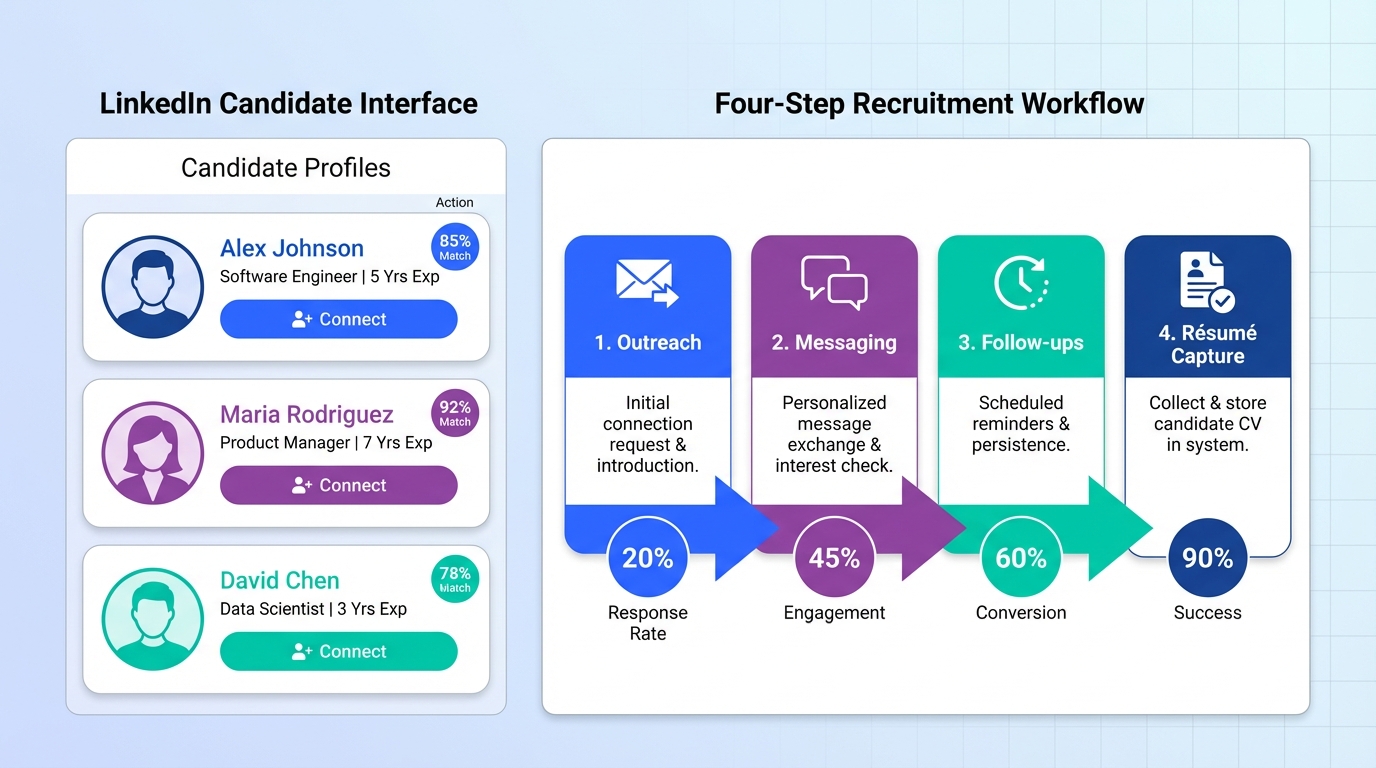
Placement agency software is the operating system for a recruiting or staffing firm. It centralizes candidate records, client requirements, outreach history, screening notes, and placement outcomes so recruiters can move faster without losing context. For agencies doing high volume outreach, we found the biggest bottleneck is not storing data, it is the manual work between first contact and getting a usable résumé and contact details. That is why many teams pair their core placement agency software with StrategyBrain AI Recruiter, which automates LinkedIn connections, job introductions, Q and A, follow ups, and résumé and contact capture so recruiters can focus on final qualification and client submissions.
Key Takeaways
- Define your workflow first: temp staffing software needs different tracking than permanent search, especially for temp to perm conversions.
- Capture the right evidence: store outreach, candidate intent, résumé receipt status, and contact details as structured fields, not only notes.
- Automate the repetitive LinkedIn layer: StrategyBrain AI Recruiter can handle first touch, follow ups, and résumé collection on LinkedIn while your core system remains the source of truth.
- Support multilingual and time zone coverage: 24/7 messaging reduces drop off when candidates reply outside recruiter hours.
- Plan for scale: if you manage multiple recruiters or desks, account level management matters, including the ability to manage more than 100 LinkedIn accounts for outreach teams.
- Be honest about limits: AI can confirm interest and collect documents, but final qualification against job requirements still needs recruiter review.
What placement agency software should do in a real agency
Most agencies buy tools for features, then discover the real problem is handoffs. A candidate replies, asks about compensation, wants to know benefits, then goes quiet. A recruiter follows up, then asks for a résumé, then waits again. The software that actually helps is the one that makes these transitions predictable and measurable.
Core capabilities to require
- Candidate record as a timeline: every message, call note, résumé version, and submission should be time stamped and searchable.
- Client and requisition structure: job requirements, compensation range, benefits, and interview process should be stored once and reused in outreach and screening.
- Temp and contract tracking: assignment start date, end date, extension history, and conversion to permanent should be first class fields.
- Compliance and consent fields: store consent status and data retention rules, especially if you recruit across regions.
- Reporting that matches agency economics: pipeline stage conversion, time to first response, time to résumé received, and placement yield per recruiter.
Where agencies still lose time
In our experience reviewing agency workflows, the biggest time sink is the manual outreach and follow up loop. Even the biggest recruitment agencies with strong brands still face the same operational math: if each recruiter spends hours per day on repetitive LinkedIn messaging, the desk cannot scale without adding headcount.
This is where StrategyBrain AI Recruiter fits naturally. It does not replace your placement agency software. It replaces the repetitive LinkedIn tasks that happen before a recruiter can make a real qualification decision.
Turning temp vs permanent realities into software requirements
The source material behind this guide comes from a job seeker focused discussion about temporary vs permanent work. That perspective is useful for agencies because it highlights what candidates worry about and what employers evaluate. When your software supports these realities, your recruiters can move faster with fewer misunderstandings.
1) Avoid gaps in a résumé without creating confusion
Candidates often worry that temporary roles will look jumpy. Your system should let recruiters label assignments clearly as contract or temporary, including start and end dates, so the candidate story is consistent when presented to clients.
2) Temp work is often about steady income
For many candidates, temping is a way to keep weekly pay coming in, including vacation pay paid out weekly in some arrangements. Your temp staffing software should track pay rate, bill rate, and assignment duration so recruiters can answer questions quickly and accurately.
3) Temp to perm is a distinct pipeline
Temporary to permanent conversions are not a normal permanent search. Hiring managers may treat the temp period as a working evaluation. Your placement agency software should support a conversion stage with clear triggers, including performance feedback, extension decisions, and conversion offer timing.
4) Candidates can pursue permanent roles during an assignment
Many candidates keep searching while on contract. Recruiters often ask them to commit to the contract length and structure interviews so they do not conflict. Your system should track candidate availability windows and notice period expectations so you can coordinate start dates without burning bridges.
How StrategyBrain AI Recruiter supports these realities on LinkedIn
When candidates ask questions about role details, compensation, or timing, delays can cause drop off. StrategyBrain AI Recruiter responds 24/7 in the candidate native language, introduces the opportunity, confirms interest, and collects résumés and contact details for candidates who want to proceed. Recruiters then review the résumé and decide fit, which keeps the human decision where it belongs.
How to choose placement agency software in 7 steps
Step 1: Map your workflow by placement type
- List your top 3 placement types: contract, temp, temp to perm, permanent.
- Write the stages for each type from sourcing to start date.
- Mark where candidates typically stall: first response, scheduling, résumé collection, references.
Step 2: Define your data model in plain language
Before you evaluate vendors, define the fields you must store. Examples include candidate intent, preferred start date, notice period, résumé received status, and contact details captured. If a tool cannot store these as structured fields, reporting will be unreliable.
Step 3: Decide what must be automated vs what must stay human
- Good to automate: initial outreach, follow ups, answering common role questions, collecting résumés and contact details.
- Keep human: final qualification against requirements, client relationship management, offer negotiation.
StrategyBrain AI Recruiter is designed for the automation side on LinkedIn. It can replace up to 90% of manual LinkedIn recruiting work according to the product information provided, while leaving final qualification to recruiters.
Step 4: Validate LinkedIn workflow support
If LinkedIn is a primary channel, test how your stack handles it. Many core systems store profiles but do not reduce the messaging workload. StrategyBrain AI Recruiter can manage more than 100 LinkedIn accounts for scalable outreach teams, which matters when you grow beyond a single desk.
Step 5: Test multilingual and after hours coverage
If you recruit across regions, require multilingual messaging and time zone coverage. StrategyBrain AI Recruiter supports 24/7 global multilingual communication, which reduces delays when candidates reply outside recruiter working hours.
Step 6: Review privacy and security requirements
Ask how candidate data is stored, encrypted, and whether it is used to train models. StrategyBrain AI Recruiter states that customer provided data is not used to train AI models and that credentials are encrypted and stored independently per user with explicit authorization.
Step 7: Run a two week pilot with measurable outcomes
We recommend a pilot that measures time to first response, time to résumé received, and number of qualified conversations per recruiter per day. Keep your core placement agency software as the system of record, then add the LinkedIn automation layer to see if the bottleneck moves.
Quick comparison: core system vs LinkedIn automation layer
| Capability | Placement agency software (core) | StrategyBrain AI Recruiter (LinkedIn layer) |
|---|---|---|
| System of record for candidates and clients | Yes | No, it feeds outcomes back to your process |
| Temp staffing software fields (assignment dates, extensions, conversion) | Should be yes | Not the primary purpose |
| Automated LinkedIn connections and outreach | Often limited | Yes, automated connections and introductions |
| Follow ups and candidate Q and A | Usually manual | Yes, 24/7 messaging and follow up |
| Résumé and contact capture | Stores documents once received | Yes, requests and captures résumé and contact details |
| Multilingual candidate communication | Varies by vendor | Yes, communicates in any global language |
| Scale across many recruiter accounts | Varies | Supports managing more than 100 LinkedIn accounts |
Scope note: this table compares roles in a stack, not specific third party vendors. It is designed to help you decide what belongs in your core placement agency software versus what belongs in an automation layer.
Implementation checklist for agencies
Use this checklist to implement placement agency software without breaking recruiter habits.
Workflow and data
- Define stages for permanent, contract, and temp to perm pipelines.
- Create structured fields for candidate intent, notice period, and availability windows.
- Standardize how you label temporary assignments to avoid résumé confusion.
LinkedIn operations
- Decide which roles will use LinkedIn automation and which will stay manual.
- Prepare job and company information that the AI can use, including compensation and benefits.
- Set a handoff rule: when StrategyBrain AI Recruiter captures a résumé and contact details, a recruiter reviews within 24 hours.
Quality and compliance
- Document consent and retention rules for candidate data.
- Confirm encryption and access controls for recruiter credentials.
- Train recruiters on what the AI does and does not do, especially that final qualification remains human.
FAQ
What is placement agency software?
Placement agency software is a system that manages the end to end recruiting and placement workflow, including candidate records, client requisitions, outreach history, submissions, and placement outcomes. For temp staffing software use cases, it also tracks assignments, extensions, and conversions.
Is temp staffing software different from a permanent recruiting system?
Yes. Temp staffing software needs assignment level tracking such as start and end dates, pay and bill rates, extensions, and temp to perm conversion stages. A permanent only system often lacks these fields or treats them as notes.
How do the biggest recruitment agencies scale outreach without adding headcount?
They standardize workflows and automate repetitive steps. In LinkedIn heavy workflows, automation can handle first touch messaging, follow ups, and document collection while recruiters focus on qualification and client management.
What does StrategyBrain AI Recruiter automate on LinkedIn?
StrategyBrain AI Recruiter automatically connects with candidates within your search criteria, introduces job opportunities, answers common questions about the role, company, compensation, and benefits, confirms interview interest, and collects résumés and contact information from interested candidates.
Does StrategyBrain AI Recruiter decide if a candidate is qualified?
No. It identifies willingness to communicate or interview and gathers the information needed to proceed. Recruiters still review the résumé and assess fit against job requirements.
How does it capture résumés and contact details?
When a candidate expresses interest, the AI requests a résumé and contact information. It supports email submissions and LinkedIn file uploads, and it captures contact details shared in messages so recruiters can follow up.
Can it support global hiring?
Yes. It provides 24/7 multilingual communication, using the candidate native language to reduce misunderstandings and keep conversations moving across time zones.
What should I pilot first when evaluating placement agency software?
Pilot the bottleneck. For many agencies, that is the time between first contact and receiving a résumé and contact details. Measure time to first response, time to résumé received, and qualified conversations per recruiter per day over 14 days.
Conclusion
The best placement agency software is the one that matches how agencies and candidates actually behave, especially in temp and temp to perm scenarios where timing, availability, and clear assignment labeling matter. Keep your core system as the source of truth for candidates, clients, and placements, then remove the biggest operational bottleneck with LinkedIn automation. If your team spends significant time on repetitive outreach and follow ups, StrategyBrain AI Recruiter is a practical way to automate connections, messaging, and résumé collection while recruiters stay responsible for final qualification and client outcomes.
Next step: map your pipeline stages, define the fields you must report on, then run a two week pilot that measures time to résumé received and qualified conversations per recruiter.