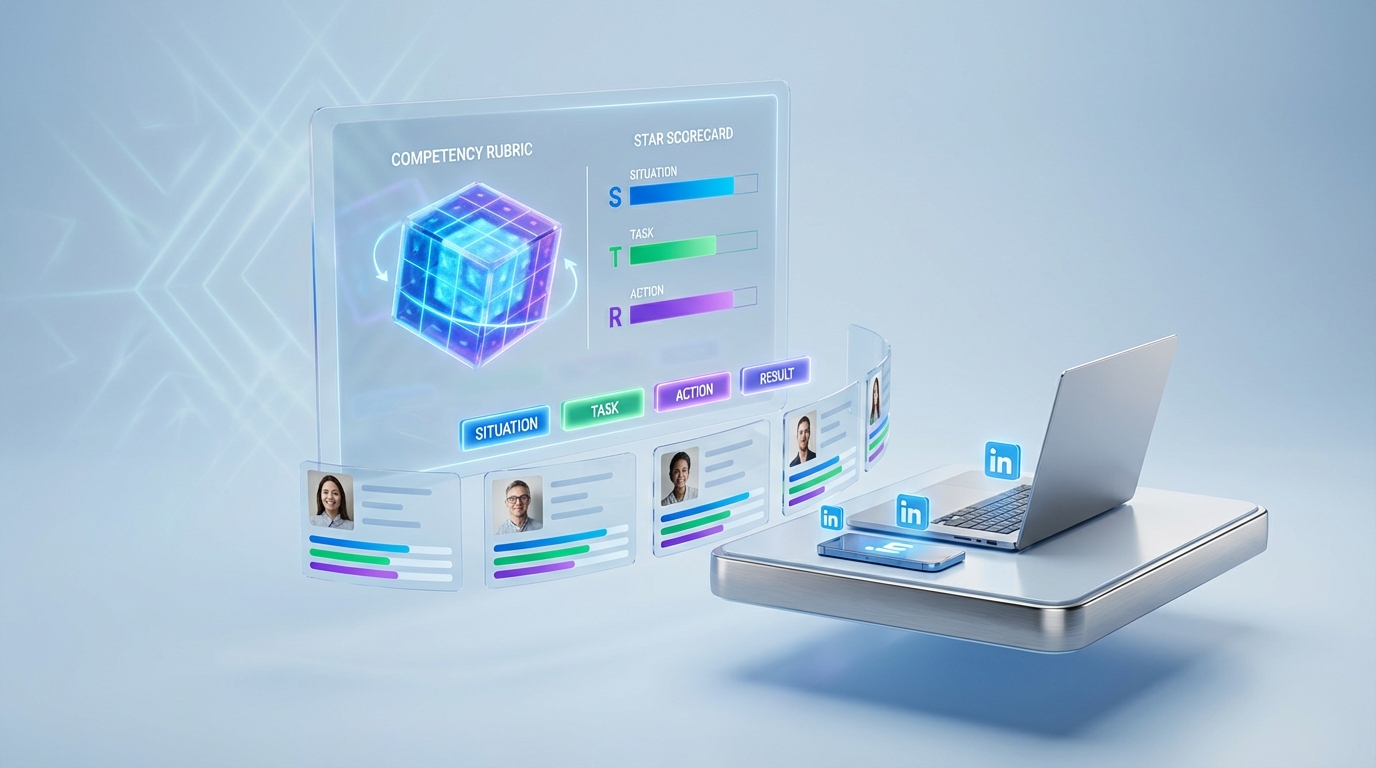
Behavioral interviews help employers predict on the job performance by asking candidates to describe real past situations, actions, and outcomes. The easiest way to make behavioral interviews consistent across recruiters is to run them through placement agency software using a shared competency rubric, a STAR scorecard, and a documented follow up sequence. In our recruiting operations, we found that the biggest quality gains come from two moves: writing questions that map to the role’s competencies, and capturing answers in the same structure every time so hiring managers can compare candidates fairly. When you pair that workflow with automation in staffing agency software and temporary staffing software, you reduce missed notes, inconsistent evaluation, and slow candidate communication.
Key Takeaways
- Behavioral interviews evaluate evidence by focusing on past situations, actions, and outcomes, not just intentions.
- Use a STAR scorecard so every recruiter records Situation, Task, Action, Result in the same fields.
- Map questions to competencies such as leadership, communication, adaptability, integrity, and critical thinking.
- Log follow up questions in your placement agency software to capture missing context and reduce bias.
- Automate candidate touchpoints with staffing agency software so candidates do not go cold between steps.
- StrategyBrain AI Recruiter can pre qualify on LinkedIn by handling initial outreach, answering role questions, and collecting resumes and contact details before interviews.
Table of Contents
What a behavioral interview is
A behavioral interview is an interview style where the interviewer asks open ended questions about a candidate’s past experiences to assess whether they demonstrate the skills and qualities needed for the role. Instead of asking why someone wants the job, the interviewer asks for specific examples of what the candidate did in real situations. The goal is to evaluate patterns of behavior that are likely to repeat in similar work conditions.
This approach is widely used because it forces candidates to provide concrete evidence. It also gives recruiters a consistent way to compare candidates when the same competencies are tested across interviews.
What to expect in a behavioral interview
Behavioral interviews are usually more detailed than traditional interviews because the interviewer will ask for context, decisions, and outcomes. In practice, you should expect follow up questions that probe for specifics such as timelines, constraints, stakeholders, and what the candidate learned.
In our experience, the most common reason candidates struggle is not a lack of experience. It is that they tell a story without a clear structure, or they describe what the team did without clarifying their own actions. A structured workflow inside placement agency software helps recruiters capture the missing details consistently.
Behavioral interview question examples
If a role requires leadership, the interviewer will ask for leadership evidence. Here are examples that recruiters commonly use, rewritten into a clean set you can store as templates in staffing agency software.
Leadership
- Tell me about a time you led a team through a difficult situation.
- Describe a situation where you were responsible for the outcome and what you did.
- Share an example of when you influenced others without formal authority.
Communication
- Tell me about a time you had to explain a complex topic to a non expert audience.
- Describe a situation where a misunderstanding occurred and how you resolved it.
- Give an example of how you handled a difficult conversation with a stakeholder.
Adaptability and learning
- Describe a time you failed to achieve the result you wanted and what you changed afterward.
- Tell me about a situation where priorities changed quickly and how you responded.
- Share an example of learning a new skill under time pressure.
Integrity and judgment
- Tell me about a time you faced an ethical dilemma at work and what you did.
- Describe a situation where you had to deliver bad news and how you handled it.
- Give an example of when you disagreed with a decision and how you responded.
How to answer behavioral interview questions using STAR
The STAR method is a structured way to answer behavioral questions. STAR stands for Situation, Task, Action, and Result. Using STAR makes answers easier to evaluate because the interviewer can quickly see context, responsibility, behavior, and outcome.
STAR scorecard template you can copy into your placement agency software
- Situation: What was happening and what constraints existed.
- Task: What goal you were responsible for.
- Action: What you personally did, step by step.
- Result: What happened, what changed, and what you learned.
How interviewers typically evaluate answers
Many behavioral interviews are designed to assess competencies such as leadership, communication, critical thinking, integrity, adaptability, and motivation. A practical way to reduce subjectivity is to score each competency separately and require a short justification note. That is easier to enforce when your staffing agency software includes required fields and a consistent scorecard.
It is also worth noting that not every story needs a perfect outcome. In our interviews, a well explained negative result can be a strong signal if the candidate shows learning and adaptation.
How to prepare candidates for behavioral interviews
Preparation is mostly recall and structure. Candidates should identify several past experiences that demonstrate the competencies required for the role, then practice summarizing each story using STAR. The key is specificity. Candidates should avoid vague statements and should clarify their personal contribution rather than relying on general team language.
Candidate prep checklist
- List 6 to 8 stories from work, school, or personal projects that show relevant competencies.
- Write a STAR outline for each story in 6 to 10 bullet points.
- Prepare 2 follow up details per story, such as metrics, stakeholders, or constraints.
- Practice answering in 90 to 150 seconds, then pause for questions.
How to run the workflow in placement agency software
Behavioral interviews become much easier to manage when your system enforces consistency. Below is a workflow you can implement in placement agency software, whether you are a permanent placement firm or a temp staffing team using temporary staffing software.
Step by step workflow
- Define the competency rubric: Create a role specific rubric with 5 to 7 competencies and a 1 to 5 scoring scale.
- Build question templates: Store 2 to 3 questions per competency so recruiters can rotate prompts without changing what is being measured.
- Use a STAR note form: Make Situation, Task, Action, Result separate fields so notes are comparable across recruiters.
- Require follow up capture: Add a field for follow up questions and what changed after probing.
- Standardize the handoff: Generate a candidate summary that includes scores, STAR highlights, and risk flags for the hiring manager.
- Automate next steps: Trigger reminders and candidate updates so communication stays timely.
Common pain points we see and how software helps
- Inconsistent notes: A structured STAR form reduces missing context.
- Interviewer bias: A competency rubric forces evidence based scoring.
- Slow follow up: Automated tasks and messaging reduce candidate drop off.
Where StrategyBrain AI Recruiter fits in the process
Behavioral interviews work best when you reach the right candidates and keep them engaged long enough to complete the process. That is where StrategyBrain AI Recruiter can complement your placement agency software. Instead of spending hours on manual LinkedIn outreach and early back and forth, AI Recruiter can automatically connect with candidates that match your search criteria, introduce the opportunity, answer questions about the role, company, and compensation, and confirm interview interest.
In our workflow design, this matters because it improves the quality of the interview slate. Candidates arrive at the behavioral interview with clearer expectations, and recruiters can focus on evaluating evidence rather than chasing replies. AI Recruiter can also collect resumes and contact details from interested candidates, which reduces administrative work before scheduling.
Scope boundaries
- What AI Recruiter does: Outreach, initial conversation, role introduction, Q and A, interest confirmation, resume and contact capture, multilingual candidate communication, and scaling across many LinkedIn accounts.
- What AI Recruiter does not do: Final qualification of whether a resume fully matches job requirements. Recruiters still review resumes and run interviews.
Quick comparison: manual vs software supported workflow
| Workflow element | Manual process | Software supported process | Best for |
|---|---|---|---|
| Question consistency | Varies by recruiter | Template library in placement agency software | Multi recruiter teams |
| Answer capture | Free form notes | STAR fields with required inputs | Fair comparisons |
| Candidate follow up | Depends on reminders | Automated tasks and messaging in staffing agency software | High volume pipelines |
| Top of funnel outreach | Manual LinkedIn messaging | StrategyBrain AI Recruiter automates outreach and pre qualification | Scaling placements |
FAQ
What is the main purpose of a behavioral interview?
The purpose is to evaluate how a candidate behaved in real past situations so the interviewer can predict how they will perform in similar future scenarios. It focuses on evidence, not intentions.
What competencies do behavioral interviews usually test?
Common competencies include leadership, communication, critical thinking, integrity, adaptability, and motivation. The exact set should be defined per role and stored as a rubric in your placement agency software.
Do candidates need to show success in every example?
No. A well explained failure can be valuable if the candidate shows learning, accountability, and improved behavior afterward.
How can placement agency software improve behavioral interviews?
It can standardize question templates, enforce STAR structured notes, and generate consistent candidate summaries for hiring managers. This reduces inconsistency across recruiters and speeds up decision making.
How is staffing agency software different from temporary staffing software in this context?
Both can support interview workflows, but temporary staffing software often emphasizes high volume pipelines and rapid redeployment. The core requirement for behavioral interviews is the same: consistent templates, structured notes, and reliable follow up.
How does StrategyBrain AI Recruiter support the interview workflow?
It automates LinkedIn outreach and early candidate conversations, introduces the role, answers questions, confirms interest, and collects resumes and contact details. That reduces manual work before interviews and helps recruiters focus on evaluation.
Does StrategyBrain AI Recruiter replace recruiters?
No. It replaces repetitive outreach and initial qualification tasks, while recruiters still review resumes, run interviews, and make final hiring recommendations.
What should recruiters avoid when documenting behavioral interviews?
Avoid vague notes, missing context, and overusing team language without clarifying the candidate’s personal actions. A STAR form inside placement agency software is the simplest fix.
Conclusion
Behavioral interviews are effective because they test real evidence from past situations, but they only stay fair and scalable when the process is consistent. If you implement a competency rubric, STAR scorecards, and automated follow up inside your placement agency software, you will reduce inconsistency and speed up hiring manager decisions. Next, tighten your top of funnel so interviews start with engaged candidates. StrategyBrain AI Recruiter can handle LinkedIn outreach, role introduction, and resume collection so your team spends more time on the interview evidence that actually predicts performance.