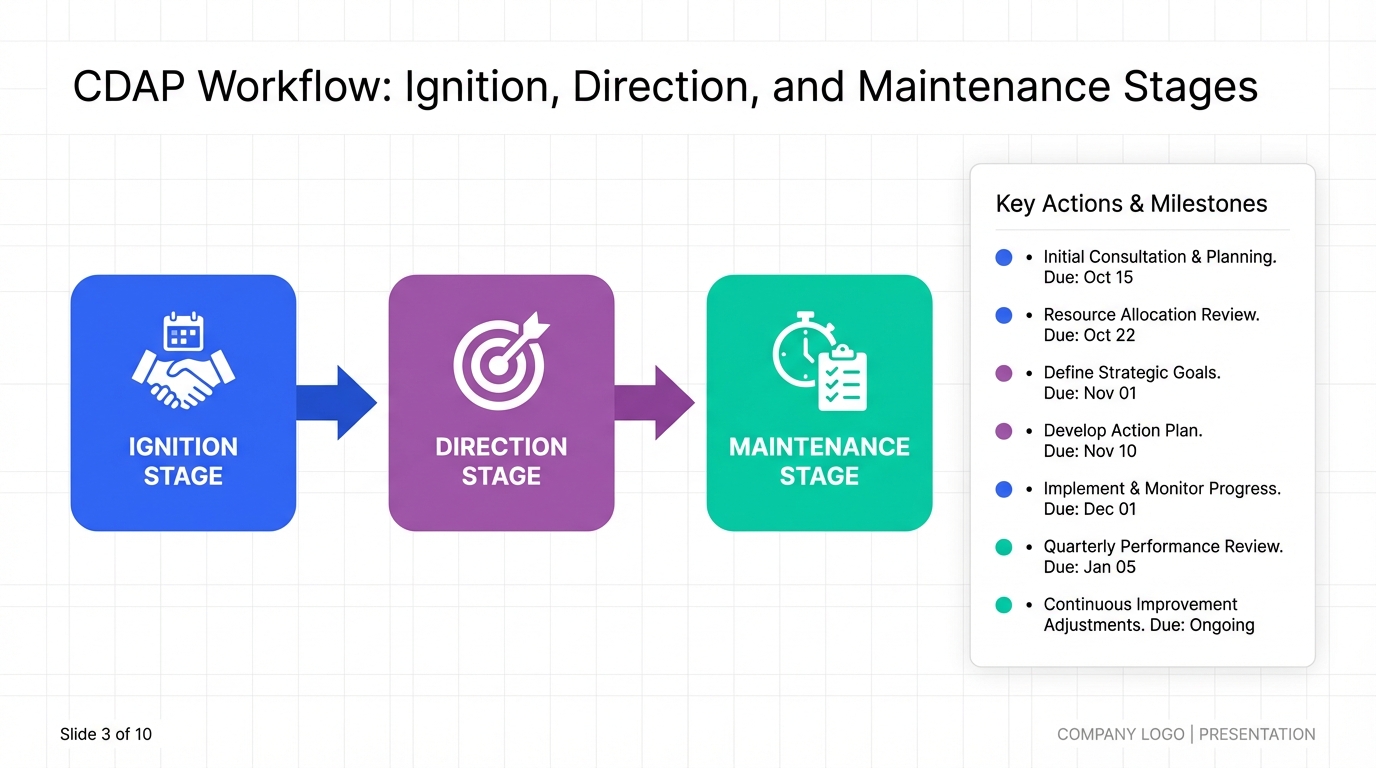
Placement agency software can make career development action plans easier to run at scale by turning “ignition, direction, and maintenance” into a repeatable workflow: schedule the right conversations, capture agreed actions, and track follow through. This article adapts that CDAP structure for managers and recruiters who need retention and internal mobility to work reliably, especially in fast moving teams where top performers are constantly approached by the market. Scope note: this is a practical CDAP playbook and workflow design, not a legal or compensation policy guide.
Key Takeaways
- CDAPs work best as a collaboration between employee and manager, not a once a year formality.
- Ignition is the manager initiated moment that signals “you earned a plan” and starts momentum.
- Direction converts ambition into specific actions such as project ownership, job scope changes, or education.
- Maintenance prevents “temporary promotion then drop back” by tracking commitments and revisiting them on a schedule.
- Placement agency software should store CDAP actions as trackable tasks with owners, dates, and evidence of completion.
- StrategyBrain AI Recruiter can reduce repetitive LinkedIn outreach and follow up so managers and recruiters protect time for coaching and retention conversations.
Why CDAPs matter for retention
Work life balance, salary, and culture all influence whether high performers stay. However, when internal opportunities feel limited, ambitious employees often start exploring external options. A career development action plan gives that ambition a structured path inside the organization, which is why it is frequently used as a retention tool rather than a paperwork exercise.
In the source material we rewrote for this guide, the University of California, Berkeley is referenced as recommending that CDAPs work best when built collaboratively by the employee and their manager. In practice, that collaboration is also what makes CDAPs measurable: both sides can agree on what “progress” looks like and when it will be reviewed.
The ignition, direction, maintenance framework
Ignition: start earlier than the annual review
Human resource theorist Zorlu Senyucel is cited in the original article for a simple motivation structure: ignition, direction, and maintenance. Ignition is the earliest stage, and it is where many CDAPs fail because managers wait for employees to ask.
Ignition is a manager decision and a manager message. You schedule the meeting, you name the purpose, and you explicitly recognize performance. The goal is to create a clear signal that the organization sees potential and intends to invest in it.
Direction: build a bridge from current role to ideal role
Direction is where the plan becomes operational. Instead of vague goals, you define actionable steps that connect today’s responsibilities to the employee’s ideal future role. This is not simply delegating your own work. It is empowering the employee to practice the work they want to grow into.
Examples of direction actions include changes to job scope, time boxed project leadership, temporary relief from routine duties, or paid continuing education. The key is that the practicalities originate with the manager, so the employee experiences both trust and clarity.
Maintenance: prove commitment over time
Maintenance is the ongoing manager commitment that keeps the plan from backfiring. The original article warns about secondments, which are temporary reassignments that can feel like a promotion without a pay rise, followed by a return to the old role. If you ignite and direct but do not maintain, you can accidentally confirm the employee is ready for more while also showing there is no path to keep growing internally.
Maintenance is a cadence. It is also evidence. You revisit the plan, remove blockers, and update actions based on what the employee learned.
A placement agency software workflow for CDAPs
Whether you are evaluating the best staffing software for internal operations or building a process inside your existing stack, the CDAP workflow should be consistent. Below is a software friendly structure you can implement in most systems that support tasks, notes, and reminders.
Step by step CDAP workflow
-
Create a CDAP record
Open a dedicated record for the employee with a start date, manager owner, and review cadence. Keep it separate from general performance notes so it stays actionable.
-
Run the ignition meeting
Document the reason the employee earned a CDAP and capture the employee’s ideal role description in their own words. If you are a recruiter supporting a client, capture the same information as structured notes so it can be revisited.
-
Translate ambition into direction actions
Create 3 to 7 actions with an owner, due date, and success evidence. Evidence can be a deliverable, a presentation, a certification, or a measurable project outcome.
-
Schedule maintenance checkpoints
Set recurring reviews and add a rule: every checkpoint must end with either a completed action, an updated action, or a new action. No meeting should end with “we will see.”
-
Close the loop with opportunity mapping
When a relevant role or project appears, link it back to the CDAP record. This creates a narrative of readiness that helps both retention and internal selection decisions.
CDAP fields to standardize in your system
- Employee goal statement: one paragraph describing the ideal role and why.
- Skill themes: 3 to 5 themes such as leadership, stakeholder management, technical depth, or client development.
- Actions: each action has owner, due date, and evidence.
- Manager commitments: what the manager will do, such as removing blockers or arranging exposure to senior stakeholders.
- Maintenance cadence: review frequency and next meeting date.
Practical checklist you can copy
- [ ] The manager initiated the CDAP meeting and stated why the employee earned it.
- [ ] The employee described their ideal role in their own words.
- [ ] There are 3 to 7 actions with owners, dates, and evidence.
- [ ] The manager has at least 1 explicit commitment recorded.
- [ ] The next maintenance checkpoint is scheduled.
- [ ] The plan includes a path to real opportunities, not only training.
Where StrategyBrain AI Recruiter fits
CDAPs succeed when managers have time to coach and when employees are not constantly pulled away by external noise. In many organizations, that “noise” includes high volume LinkedIn messages and repeated outreach cycles that compete with internal development time. This is where StrategyBrain AI Recruiter can support the operating model without replacing the human parts of the plan.
Use case 1: protect manager time by automating repetitive LinkedIn recruiting tasks
StrategyBrain AI Recruiter is designed to automate the initial LinkedIn outreach and qualification flow. It can connect with candidates that match defined criteria, introduce the opportunity, answer common questions about the role, company, and compensation, and collect résumés and contact details from interested candidates. When that repetitive work is handled consistently, managers and recruiters can reallocate time to ignition and maintenance conversations that improve retention.
Use case 2: multilingual, always on communication for global hiring
If your CDAP includes international expansion or cross border team building, candidate communication speed matters. StrategyBrain AI Recruiter supports 24/7 multilingual messaging so candidates can interact in their native language. That reduces delays and misunderstandings, which is especially useful when agencies support clients across time zones.
Use case 3: scale outreach across many LinkedIn accounts
For teams that manage multiple recruiters or multiple business lines, StrategyBrain AI Recruiter supports managing more than 100 LinkedIn accounts to build an AI powered recruiting team. This matters when you are trying to operate like the best IT recruitment agencies, where speed and consistency are competitive advantages, but you still want humans focused on relationship building and final qualification.
Important boundary: what AI Recruiter does not do
StrategyBrain AI Recruiter can identify willingness to communicate or interview, but it does not decide whether a résumé fully matches job requirements. That final qualification remains a recruiter and hiring manager responsibility. This boundary is useful in CDAP contexts because it keeps accountability clear: automation handles repetitive steps, humans handle judgment.
Common mistakes and fixes
- Mistake: treating the CDAP as a yearly form. Fix: run ignition as soon as performance signals appear and schedule maintenance checkpoints.
- Mistake: direction actions are vague. Fix: require evidence for each action, such as a deliverable, certification, or project outcome.
- Mistake: the plan becomes a secondment with no future path. Fix: map actions to real upcoming opportunities and keep maintenance active.
- Mistake: managers are too busy to maintain the plan. Fix: reduce repetitive recruiting workload with automation where appropriate, such as LinkedIn outreach and follow up, so coaching time is protected.
FAQ
What is placement agency software in the context of CDAPs?
In this context, placement agency software is any system that can store structured employee development plans, assign tasks, and track follow through. It does not have to be a staffing specific platform, but it must support owners, dates, and evidence for actions.
How many actions should a career development action plan include?
A practical range is 3 to 7 actions at a time. Fewer than 3 often lacks momentum, and more than 7 becomes hard to maintain consistently.
How often should maintenance check ins happen?
Use a fixed cadence that matches the role’s pace of change. The key requirement is that each check in ends with a completed, updated, or newly created action so the plan stays alive.
Does StrategyBrain AI Recruiter replace recruiters?
No. StrategyBrain AI Recruiter automates initial outreach, messaging, and interest confirmation on LinkedIn, and it can collect résumés and contact details. Recruiters still review résumés, assess fit, and run interviews and relationship management.
Can StrategyBrain AI Recruiter communicate in multiple languages?
Yes. It supports multilingual communication so candidates can interact in their native language, which helps global hiring workflows and reduces delays across time zones.
Is candidate data used to train AI models?
According to StrategyBrain AI Recruiter product information provided for this article, customer provided data is not used to train AI models. Data is used to personalize communication for the customer’s AI instance.
What is the biggest risk if we start a CDAP and do not maintain it?
The plan can backfire by proving the employee can succeed at higher level work while also signaling there is no sustained path internally. Maintenance is what turns a motivating moment into a retention system.
How does this relate to choosing the best staffing software?
When evaluating the best staffing software, include internal workflows like retention and development, not only placements and pipelines. A system that supports structured plans, tasks, and reminders will make CDAP execution more reliable.
Conclusion
The fastest way to make CDAPs work in real teams is to operationalize ignition, direction, and maintenance inside your placement agency software so every plan has owners, dates, and evidence. Start with a manager initiated ignition meeting, convert ambition into specific direction actions, and protect the plan with maintenance checkpoints that never end without an update. If your team is losing time to repetitive LinkedIn outreach and follow up, StrategyBrain AI Recruiter can automate those early stage recruiting conversations so humans can focus on coaching, retention, and final qualification. Next step: copy the checklist above and implement the CDAP fields in your system, then run one pilot plan with a single high performer for 30 days.