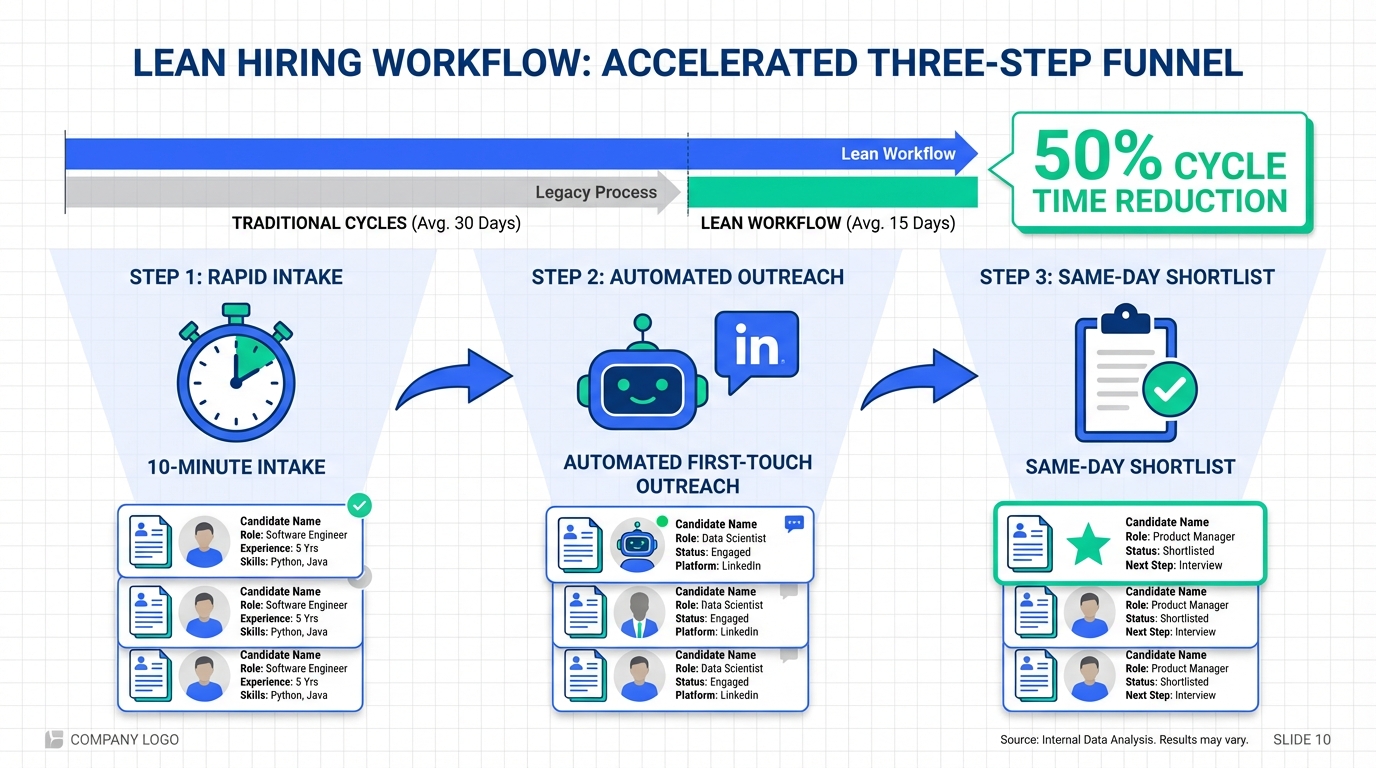
The fastest way to speed up hiring with placement agency software is to remove low value steps, standardize a short intake, and automate first touch outreach and follow up. In our recruiting operations, the biggest cycle time gains came from replacing long application forms and multi round early screening with a lean workflow: a 10 minute intake, a same day shortlist, and automated candidate conversations that collect interest, resumes, and contact details. This guide explains what to cut, what to keep, and how to implement automation safely using modern temp staffing software and temp agency software, including how StrategyBrain AI Recruiter can handle LinkedIn outreach and qualification while recruiters focus on final fit and interviews.
Table of Contents
- Key Takeaways
- Why hiring slows down in agencies
- Method 1: Build a lean hiring workflow inside your placement agency software
- Method 2: Automate first touch outreach and follow up
- Method 3: Replace long application forms with a short intake
- Method 4: Same day shortlist and structured handoff
- Method 5: Add compliance and quality guardrails without adding delay
- Quick Comparison
- FAQ
- Conclusion
Key Takeaways
- Speed comes from subtraction: remove steps that do not materially improve the hiring decision, especially early stage friction.
- Use a 10 minute intake: a short intake form plus a 5 question kickoff call is faster than a 50 field application and reduces rework.
- Automate first touch: StrategyBrain AI Recruiter can connect, introduce the role, answer questions, confirm interest, and collect resumes and contact details on LinkedIn.
- Keep humans for final fit: AI Recruiter confirms willingness to proceed, but recruiters still validate resume match and run interviews.
- 24/7 multilingual messaging: always on follow up reduces drop off across time zones and improves response speed for global hiring.
- Scale with account teams: AI Recruiter supports managing more than 100 LinkedIn accounts to expand outreach capacity without adding headcount.
Why hiring slows down in agencies
When we talk to founders and HR leaders, the tension is consistent: operations need people now, while hiring workflows often assume weeks of lead time. The slowdowns usually come from early stage friction, not from the final interview. In practice, the biggest delays show up in three places: long forms that candidates abandon, manual outreach that cannot keep up with volume, and multi step screening that does not change the final decision.
One story that stuck with me came from an owner who described a 15 minute hiring decision: if a candidate shows up, looks able to do the work, and wants the job, they start immediately and settle up for hours worked if it is not a fit. That is extreme, but it highlights a useful question for any agency using placement agency software: what is the minimum process that still protects quality and compliance?
Scope note: This article focuses on speeding up the front half of hiring for staffing and placement teams. It does not cover compensation benchmarking, background checks, or legal advice. Those steps can be essential, but they should be triggered only when a candidate is genuinely moving forward.
Method 1: Build a lean hiring workflow inside your placement agency software
Lean hiring means you keep only the steps that measurably improve the decision. Everything else becomes optional, automated, or moved later in the funnel. Most temp agency software and temp staffing software platforms can support this if you define the workflow clearly.
Steps
- Define the decision point: write down what must be true to schedule an interview, and what must be true to make an offer.
- Map your current steps: list every step from intake to start date, including who owns it and how long it takes.
- Cut or delay low value steps: remove steps that only fill a database, and delay steps that can wait until after interest is confirmed.
- Standardize the handoffs: use the same fields and notes format so recruiters and account managers do not re ask the same questions.
Features to configure
- Stage definitions: clear stages such as Intake, Outreach, Interested, Resume Received, Interview Scheduled, Offer, Start.
- Required fields by stage: require only what is needed at that stage, not everything up front.
- Service level targets: internal targets such as same day shortlist for urgent roles.
Limitations
- If you cut steps without defining quality signals, you can increase mis hires and churn.
- Some regulated roles require documentation that cannot be skipped, only sequenced better.
Best For
- Agencies that feel busy but still miss deadlines because work is spread across too many manual steps.
- Teams that want a repeatable workflow across multiple recruiters and branches.
Method 2: Automate first touch outreach and follow up
Manual outreach is a bottleneck because it is linear: one recruiter can only send and manage so many conversations per day. This is where AI can create real cycle time improvements without lowering standards, as long as you keep the recruiter in control of the job context and the final decision.
StrategyBrain AI Recruiter is designed for LinkedIn hiring. It automatically connects with candidates that match your search criteria, introduces the opportunity, learns the candidate’s situation, answers questions about the role, company, and compensation, confirms interview interest, and collects resumes and contact information from interested candidates. Recruiters then review the collected resumes and move qualified candidates to interviews.
Steps
- Provide job context: company details, compensation, benefits, and candidate search criteria.
- Enable automated conversations: let the AI handle initial messaging, Q and A, and follow up.
- Review interested candidates: focus recruiter time on resume review and interview scheduling.
What we found in practice
- Follow up speed matters: faster replies reduce candidate drop off, especially outside business hours.
- Multilingual messaging reduces friction: communicating in the candidate’s native language avoids misunderstandings and shortens back and forth.
- Automation works best with clear boundaries: the AI should confirm interest and collect information, while recruiters decide fit.
Limitations
- AI Recruiter does not determine whether a resume fully matches job requirements. Recruiters still do final qualification after reviewing the resume.
- Any automation on LinkedIn must be used with explicit authorization and careful account governance.
Best For
- High volume outreach roles where response time and follow up consistency drive outcomes.
- Agencies expanding internationally that need 24/7 multilingual candidate communication.
Method 3: Replace long application forms with a short intake
We have seen application flows that ask for 50 plus fields before a human ever looks at the candidate. That can populate a database, but it does not automatically improve quality. If your placement agency software is optimized for data completeness instead of decision speed, candidates will self select out and recruiters will spend time chasing missing information.
Steps
- Reduce the intake to essentials: name, contact, role interest, location, availability, and one proof of capability such as a resume or portfolio.
- Collect the rest later: only request detailed history after the candidate is interested and moving forward.
- Use conversational collection: when appropriate, collect details through messaging rather than forms.
Practical template: 8 field intake
- Full name
- Email or phone
- Role or trade
- City and region
- Work authorization status
- Availability date
- Pay expectations range
- Resume upload or link to resume file
Limitations
- If you remove too much, you can increase unqualified volume. The fix is better targeting, not longer forms.
Best For
- Temp staffing teams that need to move candidates from interest to interview quickly.
- Agencies seeing high drop off on application pages.
Method 4: Same day shortlist and structured handoff
Speed is not only about outreach. It is also about what happens after a candidate says yes. If your internal handoff is messy, you lose the time you gained. A same day shortlist is achievable when your temp agency software enforces a consistent handoff package.
Steps
- Set a shortlist definition: for example, 3 candidates with confirmed interest and resumes received.
- Standardize the handoff note: include availability, pay expectations, location, and any deal breakers.
- Schedule immediately: book interviews while the candidate is engaged, not days later.
Handoff checklist (copy and paste)
- Candidate interest confirmed: Yes or No
- Resume received: Yes or No
- Availability date: YYYY-MM-DD
- Location and commute constraints
- Compensation expectations
- Work authorization status
- Interview times offered: 3 options
Limitations
- Same day shortlists require hiring manager responsiveness. If managers delay feedback, the agency cannot fully control cycle time.
Best For
- Roles where competitors win by moving first.
- Teams that already have candidate flow but lose candidates during scheduling.
Method 5: Add compliance and quality guardrails without adding delay
Fast hiring does not mean careless hiring. The goal is to keep guardrails, but trigger them at the right time. For example, reference checks and background checks can be essential, but they should not block initial conversations or early interest confirmation.
Steps
- Move checks to the right stage: run deeper checks after interest is confirmed and the candidate is a finalist.
- Use clear consent language: ensure candidates understand what data is collected and why.
- Secure data handling: use encryption and access controls for resumes, contact details, and conversation history.
How StrategyBrain AI Recruiter approaches trust and security
- Customer provided data is not used to train AI models.
- LinkedIn account credentials are encrypted and stored independently per user with explicit authorization.
- Candidate information such as resumes, contact details, and conversation history is encrypted and isolated using customer specific keys.
Limitations
- Compliance requirements vary by country, industry, and role. Confirm your obligations with qualified counsel.
Best For
- Agencies hiring across regions where privacy expectations differ.
- Teams adopting automation and needing a clear governance story for clients.
Quick Comparison
| Method | Primary speed lever | Cost impact | Best for |
|---|---|---|---|
| Lean workflow in placement agency software | Remove low value steps | Usually neutral | Teams with process bloat |
| Automated outreach with StrategyBrain AI Recruiter | Parallelize first touch and follow up | Can reduce labor per conversation | High volume LinkedIn sourcing |
| Short intake instead of long forms | Reduce candidate drop off | Usually neutral | Temp staffing funnels |
| Same day shortlist and handoff | Reduce internal waiting | Usually neutral | Competitive markets |
| Stage based compliance guardrails | Sequence checks correctly | Depends on checks | Regulated or multi region hiring |
FAQ
Can placement agency software really cut hiring time to 24 hours?
Yes, for certain roles and when the hiring manager is responsive. The practical path is a lean workflow plus automated outreach and fast scheduling, not adding more steps.
What is the difference between temp staffing software and temp agency software?
They overlap heavily. Temp staffing software often emphasizes scheduling, timekeeping, and assignment management, while temp agency software may emphasize recruiting pipeline and client requisitions. Many platforms cover both.
Does StrategyBrain AI Recruiter replace recruiters?
No. It replaces repetitive LinkedIn tasks such as connecting, introducing roles, answering common questions, confirming interest, and collecting resumes and contact details. Recruiters still review resumes and decide who moves forward.
How does AI Recruiter collect resumes and contact details?
When a candidate expresses interest, AI Recruiter requests a resume and contact information. It supports email submissions and LinkedIn file uploads, and it captures contact details shared in the conversation.
Can AI Recruiter qualify candidates for fit?
It confirms willingness to communicate or interview, but it does not determine whether the resume matches the job requirements. Final fit assessment remains a recruiter responsibility.
How does multilingual messaging help staffing agencies?
It reduces misunderstandings and shortens back and forth when candidates prefer a language other than English. It also enables follow up across time zones without waiting for office hours.
Is candidate data used to train AI models?
According to StrategyBrain AI Recruiter product information, customer provided data is not used to train AI models. Data is used to personalize communication for the customer’s AI instance.
How many LinkedIn accounts can AI Recruiter manage?
StrategyBrain AI Recruiter supports managing more than 100 LinkedIn accounts, which enables agencies to build AI powered recruiting teams and scale outreach capacity.
What should we remove first if our hiring process is too slow?
Start by removing long application forms and any early stage steps that do not change the final decision. Then automate first touch outreach and follow up so candidates do not wait for replies.
Conclusion
If you need to speed up hiring, the answer is not a more complex process. The answer is a lean workflow inside your placement agency software, a short intake that candidates actually complete, and automation that keeps conversations moving. In our experience, the biggest gains come when recruiters stop spending hours on repetitive first touch messaging and instead focus on resume review, client alignment, and interviews.
Next step: map your current funnel from intake to start date, cut one low value step this week, and pilot automated LinkedIn outreach with StrategyBrain AI Recruiter for one role family. Measure response time, interested candidates, and time from first message to interview scheduled, then expand what works.