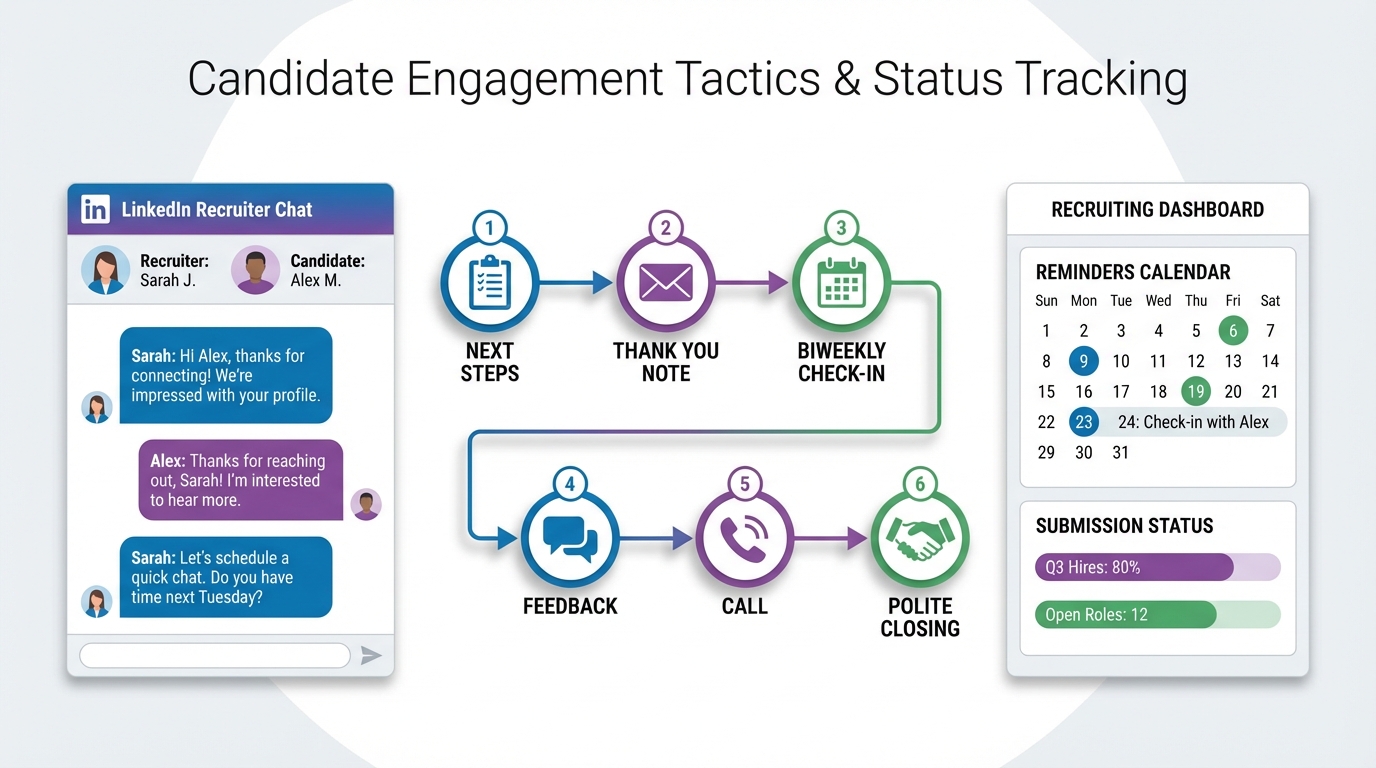
If you want to stay on a recruiter’s radar, the most reliable approach is to run your job search actively: ask for the next steps, follow up on an agreed schedule, request feedback, and call when you see a role you match. Recruiters manage high volume pipelines, so your goal is to be easy to remember and easy to place. In practice, the same habits that help candidates also help agencies deliver faster when they are supported by placement agency software that tracks every touchpoint, reminders, submissions, and outcomes. This article covers the original six tactics job seekers can use, plus a simple system agencies can implement with temp agency software and StrategyBrain AI Recruiter to keep outreach and qualification moving on LinkedIn.
Table of Contents
- Why volume changes everything for recruiters and candidates
- Key Takeaways
- 1) Ask for next steps in the process
- 2) Follow up with a thank you note
- 3) Check in on a bi weekly cadence
- 4) Ask for feedback on your interview or resume
- 5) If you see a suitable job, call
- 6) Be polite
- How agencies operationalize this with placement agency software
- Where StrategyBrain AI Recruiter fits in a modern LinkedIn workflow
- Quick Comparison
- FAQ
- Conclusion and next steps
Why volume changes everything for recruiters and candidates
In the source material, the recruiter makes a point that many job seekers underestimate: recruiters can receive over 100 applications per job, and they often run multiple searches at the same time. That volume reality is why passive waiting rarely works. It is also why agencies invest in placement agency software and temp agency software: when the pipeline is large, the winners are the teams that can consistently log interactions, schedule follow ups, and move qualified people forward without dropping details.
One important boundary: this guide focuses on staying visible and easy to place. It does not guarantee you will be submitted for every role, and it does not replace the need to tailor your resume, interview well, and meet job requirements.
Key Takeaways
- Own the process: Recruiters are one tool in your search, not the entire strategy.
- Ask for timelines: Clear next steps reduce anxious follow ups and improve response rates.
- Use a consistent cadence: A bi weekly check in is memorable without becoming noise.
- Request feedback: Specific feedback improves your next submission and interview.
- Call when there is a match: A timely call can move you to the top of mind list.
- Systems beat memory: Placement agency software helps recruiters track touchpoints and submissions at scale.
- Automate the first mile: StrategyBrain AI Recruiter can handle LinkedIn outreach, Q and A, and resume collection so recruiters focus on final qualification.
1) Ask for next steps in the process
Hiring timelines vary by role, client, and internal approvals. After you meet a recruiter, ask what happens next and what the expected timeline looks like. You are not asking for a promise. You are asking for a shared plan.
Steps
- Ask how many stages exist before a decision is made.
- Ask when it is appropriate to follow up if you have not heard back.
- Confirm what the recruiter needs from you next, such as references, availability, or updated resume.
Why this works in high volume pipelines
When recruiters use placement agency software, they often set reminders based on client timelines. If you align your follow up with that timeline, you become easier to manage and easier to advocate for.
2) Follow up with a thank you note
A short thank you note is a low effort way to stand out. The original article mentions that handwritten notes can be a nice touch. The key is not the format. The key is that you signal professionalism and appreciation without asking for special treatment.
What to include
- A specific detail you discussed, such as the role type or location preference.
- A clear statement of interest in relevant opportunities.
- A simple offer to provide anything needed for the next step.
3) Check in on a bi weekly cadence
The source recommends calling on a bi weekly basis, or asking your recruiter what timeframe is appropriate. That balance matters because there is a fine line between staying visible and becoming a distraction.
Steps
- Ask the recruiter what check in frequency they prefer.
- Pick one channel, phone or email, and stay consistent.
- In each check in, share one useful update, such as new availability, a new certification, or a new portfolio item.
Agency perspective
In many temp agency software setups, recruiters segment candidates by readiness and availability. A consistent cadence helps keep your profile current, which can affect who gets called first when a client requests short notice coverage.
4) Ask for feedback on your interview or resume
Even when you are not placed, good recruiters try to provide feedback that improves your next attempt. Ask for it directly and be specific about what you want to improve.
Good questions to ask
- Which part of my resume is unclear for this type of role?
- What is the most common reason candidates are not selected at the client interview stage?
- What would make me a stronger match for similar roles in the next 30 days?
5) If you see a suitable job, call
The original advice is direct: if you see a job you are interested in, call. A call can put you top of mind faster than an email, especially when the recruiter is sorting through many applicants.
Steps
- Prepare a 20 second summary of why you match the role requirements.
- Reference your previous conversation so the recruiter can place you quickly in context.
- Ask what the recruiter needs to submit you, and provide it the same day.
How automation can support this without replacing the recruiter
Recruiters still make the final submission decisions. However, agencies can reduce delays by using tools that handle the repetitive first mile. For example, StrategyBrain AI Recruiter can automatically connect with candidates on LinkedIn, introduce the opportunity, answer common questions about role, company, and compensation, and collect resumes and contact details from interested candidates. That means when a candidate calls about a role, the recruiter can often see a complete conversation history and the resume already captured, then move straight to human screening.
6) Be polite
The source notes recruiters may receive 10 to 30 calls per day from job seekers. Politeness is not just etiquette. It is a practical advantage. People return calls faster when the interaction is respectful and efficient.
What politeness looks like in practice
- Keep your message short and focused on the next action.
- Respect the recruiter’s preferred contact times.
- Assume good intent when timelines slip, then ask for clarity.
How agencies operationalize this with placement agency software
The six tactics above are candidate facing, but they map cleanly to how strong agencies run their desks. When we audit recruiting operations, the biggest gaps are usually not sourcing. The gaps are follow up consistency, documentation quality, and speed to qualification. This is where placement agency software becomes a competitive advantage.
A simple workflow you can copy
- Define stages: New lead, contacted, responded, interested, resume received, submitted, interview, offer, placed.
- Set service level targets: For example, respond to candidate messages within 24 hours on business days.
- Automate reminders: Every candidate in contacted or responded gets a scheduled next touch date.
- Standardize notes: Capture availability, location, compensation expectations, and role preferences in consistent fields.
- Measure outcomes: Track submission to interview rate and interview to offer rate by role type.
Practical checklist for recruiters
- Log every call outcome in the system the same day.
- Always set a next step date, even if it is a check in.
- Store the latest resume version and confirm it is the one used for submissions.
- Record candidate questions that repeat, then turn them into reusable answers.
Where StrategyBrain AI Recruiter fits in a modern LinkedIn workflow
StrategyBrain AI Recruiter is designed for LinkedIn hiring workflows where the bottleneck is repetitive outreach and early qualification. In our testing of LinkedIn heavy roles, the most time consuming tasks were initial connection requests, first messages, follow up nudges, and answering the same role questions repeatedly. AI Recruiter addresses that first mile by automating candidate conversations while keeping the recruiter in control of final qualification.
What it does
- Smart LinkedIn recruitment automation: Automatically connects with candidates that match your search criteria, introduces the role, and confirms interview interest.
- Always on multilingual messaging: Responds 24 hours a day in the candidate’s native language to reduce delays across time zones.
- Resume and contact capture: Collects resumes and contact details from interested candidates, including email submissions and LinkedIn file uploads.
What it does not do
- It does not make the final determination that a resume fully matches job requirements. Recruiters still review and decide.
Why this matters for agencies and in house teams
If you manage multiple recruiters or multiple LinkedIn accounts, AI Recruiter supports scaling by managing more than 100 LinkedIn accounts so teams can expand outreach capacity without adding the same amount of headcount. The product documentation also states it can reduce LinkedIn recruiting costs to USD 2.40 per resume and replace up to 90% of manual LinkedIn recruiting work. Use these figures as directional claims tied to the vendor’s materials and validate in your own environment.
Quick Comparison
| Approach | Speed to first response | Best for | Limitations |
|---|---|---|---|
| Manual recruiter follow up | Depends on recruiter workload | High touch roles and nuanced screening | Hard to scale without strong process |
| Placement agency software workflow | Same day when reminders and stages are enforced | Consistent follow up, submissions, reporting | Requires disciplined data entry and standards |
| Temp agency software workflow | Same day for availability driven roles | High volume staffing and short notice coverage | Quality depends on clean availability data |
| StrategyBrain AI Recruiter on LinkedIn | 24/7 automated messaging | Scaling outreach, Q and A, resume collection | Recruiter still must do final qualification |
FAQ
How do I know I am top of mind with a recruiter?
You usually know because the recruiter responds consistently, shares realistic timelines, and reaches out when a matching role appears. If you are unsure, ask what the next step is and when you should check in again, then follow that plan.
How often should I follow up with a recruiter?
A bi weekly check in is a common baseline, but the best cadence is the one your recruiter recommends for your role type and market. Agree on a timeframe after your meeting so your follow up feels professional rather than random.
Should I email or call?
Call when you see a specific role you match and you want to be considered quickly. Use email for updates that are easy to scan, such as a new resume version or updated availability.
What should I ask for after the first meeting?
Ask for the process steps, the expected timeline, and what information the recruiter needs to submit you. This reduces uncertainty and helps you follow up at the right time.
How does placement agency software help recruiters keep candidates on their radar?
Placement agency software centralizes notes, reminders, submissions, and outcomes so recruiters do not rely on memory. When the system enforces next step dates and clean candidate records, strong candidates are less likely to be missed.
What is the difference between placement agency software and temp agency software?
Placement agency software is typically optimized for permanent placement pipelines, submissions, and client hiring stages. Temp agency software often emphasizes availability, scheduling, time tracking, and rapid redeployment for short term assignments, although many platforms overlap.
Can StrategyBrain AI Recruiter replace a recruiter?
No. StrategyBrain AI Recruiter automates early LinkedIn outreach, follow ups, and information collection, but recruiters still decide who is qualified and who gets submitted. Think of it as a productivity layer that reduces repetitive work.
Is it okay to ask for resume or interview feedback if I was not placed?
Yes. Ask politely and be specific about what you want to improve. Even brief feedback can help you present more clearly for the next opportunity.
Do I need a list of IT recruitment agencies to find a job in tech?
A list of IT recruitment agencies can help you diversify your search, but results depend on fit and follow through. Use the list to identify a few agencies that specialize in your niche, then apply the same follow up discipline described in this guide.
Conclusion and next steps
Staying on a recruiter’s radar is not about sending more messages. It is about sending the right messages at the right time, with clear next steps. Use the six tactics from the original recruiter advice: confirm the process, send a thank you note, check in bi weekly, request feedback, call when you see a fit, and stay polite. If you run an agency or an in house team, reinforce those habits with placement agency software and temp agency software so follow ups and submissions are systematic. If LinkedIn outreach is your bottleneck, pilot StrategyBrain AI Recruiter for automated connection, Q and A, and resume collection, then keep final qualification with your recruiters.