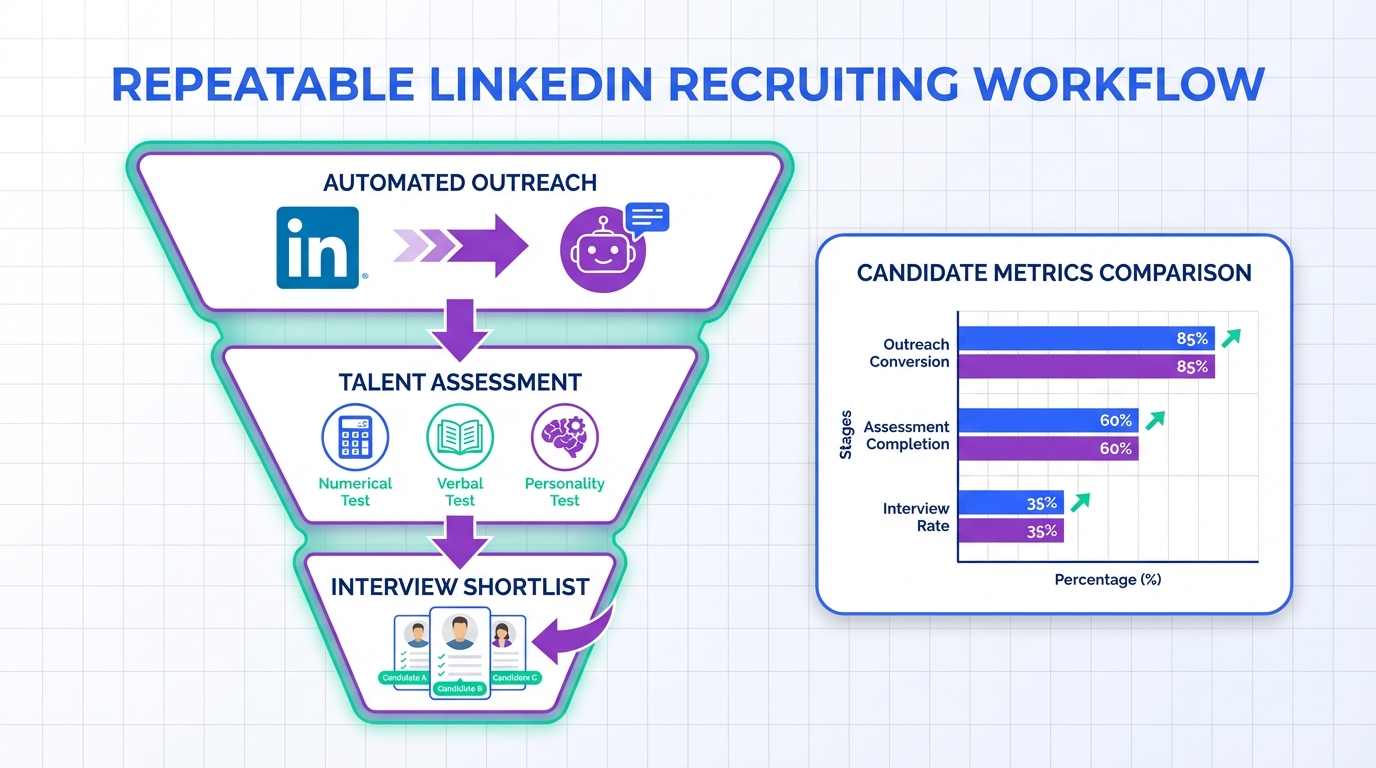
Talent assessment is a crucial part of the hiring process because it helps screen out unsuitable applicants and gives an objective way to benchmark candidates against the same job requirements. If you are selecting placement agency software, the most practical outcome to aim for is a workflow where assessments are consistently administered, results are captured in a comparable format, and only the right applicants move forward to interviews. In our day to day recruiting operations, we use assessments to predict job performance and behaviors, then we pair those results with structured interviews. To reduce the time spent on repetitive outreach and early back and forth, we also use StrategyBrain AI Recruiter to automate initial LinkedIn connecting, role introduction, and interest confirmation so recruiters can spend more time reviewing assessment outcomes and interviewing.
What talent assessment means in hiring
Talent assessment, also called pre employment assessment, is a set of tests used to determine whether an applicant is a good fit for a job. The intent is not to label someone as universally pass or fail. Instead, it is to measure job relevant capabilities and preferences, then compare candidates against the same benchmark.
In practice, assessments help hiring teams do three things. First, they predict on the job performance and behaviors. Second, they provide a more objective platform to compare candidates. Third, they reduce the number of interviews spent on clearly mismatched applicants, which matters for both in house teams and agencies.
Common types of pre employment assessments
Talent assessment may include one or more test types. Below are the most common categories and what they are designed to measure.
Verbal reasoning
Candidates read a passage and answer multiple choice questions such as True, False, and Cannot say. This is typically used to evaluate comprehension and inference under time constraints.
Numerical reasoning
Candidates interpret a statistical table and answer multiple choice questions. In many setups, candidates can use scratch paper for calculations but are not permitted to use a calculator.
Checking tests
These tests measure how quickly and accurately a candidate can compare given information. They are often used for roles where attention to detail is a core requirement.
Calculation tests
These tests measure speed and accuracy for basic arithmetic such as addition, subtraction, multiplication, and division.
Inductive assessment
Also referred to as abstract reasoning or diagramming style tests, this category measures problem solving skills. Candidates who perform better than others in this test tend to show stronger conceptual and analytical capacity for pattern based work.
Personality questionnaire
These questions assess behavioral preferences such as how a person likes to work and how they deal with problems, feelings, and emotions. The goal is to understand default work style tendencies, not to diagnose.
Motivation questionnaire
This questionnaire explores which situations may increase or decrease motivation and job satisfaction. It helps teams anticipate how workplace conditions could affect engagement.
Situational judgments
These tests assess a candidate’s ability to choose the most appropriate course of action in workplace scenarios. They help interviewers understand how a candidate might handle situations they could encounter on the job.
How to use assessments in a repeatable hiring workflow
Assessment value depends on consistency. If your process changes from role to role without a clear reason, results become hard to interpret and even harder to defend. A repeatable workflow also makes it easier to operationalize inside placement agency software used by staffing teams and recruitment technology companies.
Step by step workflow
- Define the role benchmark
Write down the capabilities and behaviors you expect from the ideal candidate, then decide which assessment types map to those requirements. - Choose when the assessment happens
Decide whether candidates take the test before the first interview, after an initial screen, or only for finalists. The key is to apply the same timing for the same role family. - Standardize scoring and interpretation
Document what good looks like for each assessment and how results influence next steps. This avoids ad hoc decisions and reduces bias. - Decide what candidates will be told
After the test, candidates may be told results immediately or not at all, depending on company policy. Set this policy in advance and apply it consistently. - Use results to narrow interviews
Use assessment outcomes to decide who advances to interviews. This is where you get the time savings and higher signal interviews.
Practical checklist you can copy
- Confirm the assessment measures job relevant skills or behaviors for the role.
- Confirm the same assessment package is used for the same role family.
- Confirm scoring rules are written down and shared with interviewers.
- Confirm candidate communication policy is documented and followed.
- Confirm assessment results are stored in a consistent format for comparison.
Where placement agency software fits
In an agency environment, assessments are often one part of a broader screening system that includes sourcing, outreach, qualification, and interview coordination. The reason placement agency software matters is that it can enforce consistency across recruiters and across job orders.
When we evaluate systems in this category, we look for operational support rather than marketing claims. That includes the ability to track which assessment was used, store results, and connect those results to interview decisions. This is also where many recruitment technology companies differentiate, not by inventing new tests, but by making the workflow easier to run at scale.
If you are comparing vendors or even scanning lists like top 10 recruitment companies, treat those lists as a starting point. Your real selection criteria should be whether the software supports your assessment workflow, your compliance needs, and your recruiter capacity.
How StrategyBrain AI Recruiter supports the front end of the process
Assessments work best when you can reliably get the right candidates into the funnel. The bottleneck for many teams is not the test itself. It is the manual time spent connecting with candidates, introducing the role, answering basic questions, and confirming interview interest. This is where StrategyBrain AI Recruiter fits naturally into an assessment driven workflow.
What we use it for in practice
- Smart LinkedIn recruitment automation that automatically connects with candidates within your targeted search criteria, introduces the opportunity, and confirms interest before a recruiter invests time.
- Always on candidate messaging with 24/7 responses and multilingual communication, which helps reduce delays when candidates reply outside business hours.
- Early information capture by collecting résumés and contact details from interested candidates so the recruiter can move directly into assessment and interview steps.
How it connects to assessment based screening
Once the AI confirms interest and captures the résumé, your team can route candidates into the appropriate assessment package. This keeps the assessment stage focused on evaluation rather than chasing replies. It also helps agencies scale outreach across multiple LinkedIn accounts, which is useful when you are running several searches at once and need consistent candidate flow.
Limitations and guardrails
Assessments and automation both have limits. Being explicit about those limits is part of building a trustworthy hiring process.
- Assessments are not the whole decision. They indicate fit against defined benchmarks, but they do not replace interviews, reference checks, or role specific evaluation.
- Pass or fail is relative. A company can set its own criteria depending on what kind of employee it is looking to hire, and those criteria can differ between roles.
- Automation does not equal final qualification. StrategyBrain AI Recruiter can identify willingness to communicate or interview and collect information, but final qualification against job requirements still needs recruiter review.
Quick comparison table
| Workflow element | What it does | Primary outcome | Where it fits |
|---|---|---|---|
| Talent assessment | Measures skills, reasoning, behaviors, motivation, and judgment using standardized tests | Objective benchmark for interview selection | Screening and shortlisting |
| Placement agency software | Operational system to run consistent recruiting workflows and track screening steps | Repeatability and auditability across recruiters | End to end recruiting operations |
| StrategyBrain AI Recruiter | Automates LinkedIn connecting, role introduction, Q and A, interest confirmation, and résumé capture | Less manual outreach time and faster candidate flow into assessments | Top of funnel sourcing and qualification |
FAQ
What is talent assessment in hiring?
Talent assessment, also called pre employment assessment, is a set of tests used to determine whether an applicant is a good fit for a job. It helps predict on the job performance and behaviors and provides an objective way to benchmark candidates.
Which assessment types are most common?
Common types include verbal reasoning, numerical reasoning, checking tests, calculation tests, inductive assessment, personality questionnaires, motivation questionnaires, and situational judgments. Teams choose based on what the role requires.
Do candidates always get their assessment results?
Not always. After the applicant has taken the test, they may be told their results immediately or they may never be told, depending on company policy.
Is pass or fail a fixed standard in assessments?
No. Pass or fail is relative, and a company can set its own criteria depending on what kind of employee it is looking to hire. Criteria can also differ between roles.
How does placement agency software help with assessments?
Placement agency software helps by standardizing when assessments are used, storing results consistently, and linking outcomes to interview decisions. This improves repeatability across recruiters and job orders.
How does StrategyBrain AI Recruiter fit into an assessment workflow?
StrategyBrain AI Recruiter automates the LinkedIn outreach and early qualification steps, including connecting, introducing the role, answering questions, confirming interest, and collecting résumés and contact details. That helps move interested candidates into assessments faster.
Does StrategyBrain AI Recruiter replace recruiter judgment?
No. It can identify willingness to communicate or interview and capture information, but it does not determine whether a résumé fully matches job requirements. Recruiters still make the final qualification decision.
Are assessments based on evidence?
In the source material used for this guide, talent assessment tests are described as being based on case studies of hiring and retention and analysis of employee data. Your internal validation should still confirm the assessment is job relevant for your roles.
Conclusion
Talent assessment is crucial because it adds an objective benchmark to the hiring process and helps predict on the job performance and behaviors, which reduces wasted interviews and improves decision quality. If you are evaluating placement agency software, prioritize systems that make assessment administration and result tracking consistent across recruiters. Then, to remove the biggest time sink at the top of the funnel, consider pairing that workflow with StrategyBrain AI Recruiter so LinkedIn outreach, candidate Q and A, interest confirmation, and résumé capture happen with less manual effort. Next step: document your role benchmarks, choose the assessment package per role family, and define exactly how results change who advances to interviews.