Recruiting and applicant tracking software is the simplest way to make different hiring models work without losing candidates in spreadsheets, inboxes, or chat threads. Whether you run a contingency search, a retained search, temporary recruitment, or a newer model like RPO, the ATS becomes the system of record for apply tracking, interview stages, and compliance notes. In this guide, we keep the original “menu” idea, but we translate it into an operational view: what each model expects, where it breaks down, and why use an applicant tracking system to reduce friction. We also show how StrategyBrain AI Recruiter can handle LinkedIn outreach and early qualification so recruiters spend more time reviewing qualified resumes and less time chasing replies.
What this guide covers and what it does not
This article explains common recruiting service models and how recruiting and applicant tracking software supports each one. It is written for hiring managers, HR leaders, and recruiters who want a clearer operating picture, not just definitions.
It does not provide legal advice, and it does not claim that one model is always best. Your best choice depends on role urgency, market scarcity, internal capacity, and how disciplined your hiring process is.
Key definitions: ATS, apply tracking, and recruiting models
Applicant Tracking System (ATS)
An Applicant Tracking System (ATS) is software that stores candidate records and manages hiring stages such as application received, screening, interview, offer, and hire. It also centralizes notes, resumes, and communication logs so teams can collaborate without losing context.
Apply tracking
Apply tracking is the operational practice of tracking every applicant and prospect from first touch to final outcome. In a strong ATS workflow, apply tracking includes source, stage history, decision reasons, and time stamps for key actions.
Recruiting models
Recruiting models are the commercial and operational ways recruiting services are delivered. The classic “menu” includes contingency, retained, and temporary recruitment, with newer options like Recruitment Process Outsourcing (RPO), hourly recruiting, and recruiting consulting.
Model 1: Contingency recruiting
Contingency recruiting is a low-commitment model where the client typically pays only if a hire is made. The recruiter takes on the risk that their time, marketing spend, and candidate relationships will convert into a placement.
Where contingency succeeds
- Fast-moving hiring teams that schedule interviews quickly and give feedback within 48 hours.
- Clear compensation ranges that match the market for the role and location.
- Consistent communication between recruiter and hiring manager so candidates do not stall.
Where contingency becomes inefficient
- Slow decision cycles that cause candidate drop-off.
- Unclear requirements that shift after sourcing begins.
- Fragmented apply tracking where multiple parties submit the same candidate and ownership becomes unclear.
In our experience auditing recruiting operations, contingency workflows break most often at handoffs. That is exactly why use an applicant tracking system even when you “only” have a few open roles: it prevents duplicate submissions, preserves stage history, and makes ownership visible.
Model 2: Retained search
Retained search is a high-commitment model. The client commits to timelines and typically pays a deposit that represents a meaningful portion of the service fee. In return, the recruiter is expected to deliver a more consultative, “white glove” process.
What retained search usually includes operationally
- Structured intake covering role outcomes, team context, and culture fit signals.
- Active pipeline management with scheduled updates and documented candidate status.
- Interview coordination support and candidate care through offer and close.
How an ATS supports retained search
Retained search benefits from deeper documentation. Recruiting and applicant tracking software helps by storing scorecards, interview feedback, and decision rationale in one place. It also reduces risk when multiple stakeholders are involved because the “source of truth” is not a single recruiter’s inbox.
A practical note: retained search can be harder to deliver in smaller markets where specialized expertise is limited. In those cases, the ATS becomes even more important because every candidate interaction is valuable and should be captured cleanly for apply tracking and follow-up.
Model 3: Temporary recruitment
Temporary recruitment is designed for speed and operational coverage. A company may need 1 person or 10 people quickly and may not want to handle hiring, onboarding, and payroll. In many temporary arrangements, the staffing provider becomes the employer of record and supplies workers to the client site.
Why temporary recruitment can feel “fast”
- Short time-to-start because the priority is readiness and availability.
- Operational outsourcing of payroll and some compliance responsibilities.
- Repeatable screening for common roles where requirements are stable.
Where apply tracking still matters
Even when the staffing provider handles payroll, the client still needs visibility into who was requested, who started, who no-showed, and who is eligible for conversion. Recruiting and applicant tracking software can store these outcomes and keep a consistent record across departments.
Newer models: RPO, hourly recruiting, and consulting
New recruiting models keep appearing because organizations want flexibility. Some models take more setup time, but they can reduce the inefficiencies that show up in the classic three-model menu.
Recruitment Process Outsourcing (RPO)
Recruitment Process Outsourcing (RPO) is when an external provider runs part or all of your recruiting process. The operational requirement is process clarity. Without a shared ATS workflow, RPO can become a reporting exercise instead of a hiring engine.
Hourly recruiting
Hourly recruiting is a service model where recruiting work is billed by time rather than by placement. This model can work well when you need help with sourcing, screening, or scheduling, but you want control over final decisions. An ATS is essential here because it defines what “done” means for each hour of work and keeps apply tracking auditable.
Recruiting consulting
Recruiting consulting focuses on improving the system: intake, scorecards, interview loops, and candidate experience. The best consulting outcomes are measurable only if your recruiting and applicant tracking software captures consistent data such as stage conversion rates and time in stage.
Where recruiting and applicant tracking software fits in every model
No matter which model you choose, the ATS should do three jobs reliably: capture candidates, track decisions, and preserve communication context. When teams ask “why use an applicant tracking system,” we answer with operational outcomes, not buzzwords.
The three non-negotiables we look for
- Single candidate record that prevents duplicates and preserves history across roles.
- Stage discipline so every candidate has a current status and a next action.
- Communication logging so outreach, replies, and follow-ups are visible to the team.
Common failure pattern
The most common breakdown we see is “shadow recruiting” where sourcing happens in LinkedIn messages, email threads, and spreadsheets, while the ATS only receives the final resume. That gap creates poor apply tracking and makes it hard to answer basic questions like who was contacted, when, and with what outcome.
A practical LinkedIn workflow using StrategyBrain AI Recruiter
LinkedIn is often where recruiting starts, but it is also where apply tracking gets messy. We have seen teams lose qualified candidates simply because follow-up was inconsistent across time zones or because early conversations never made it into the ATS.
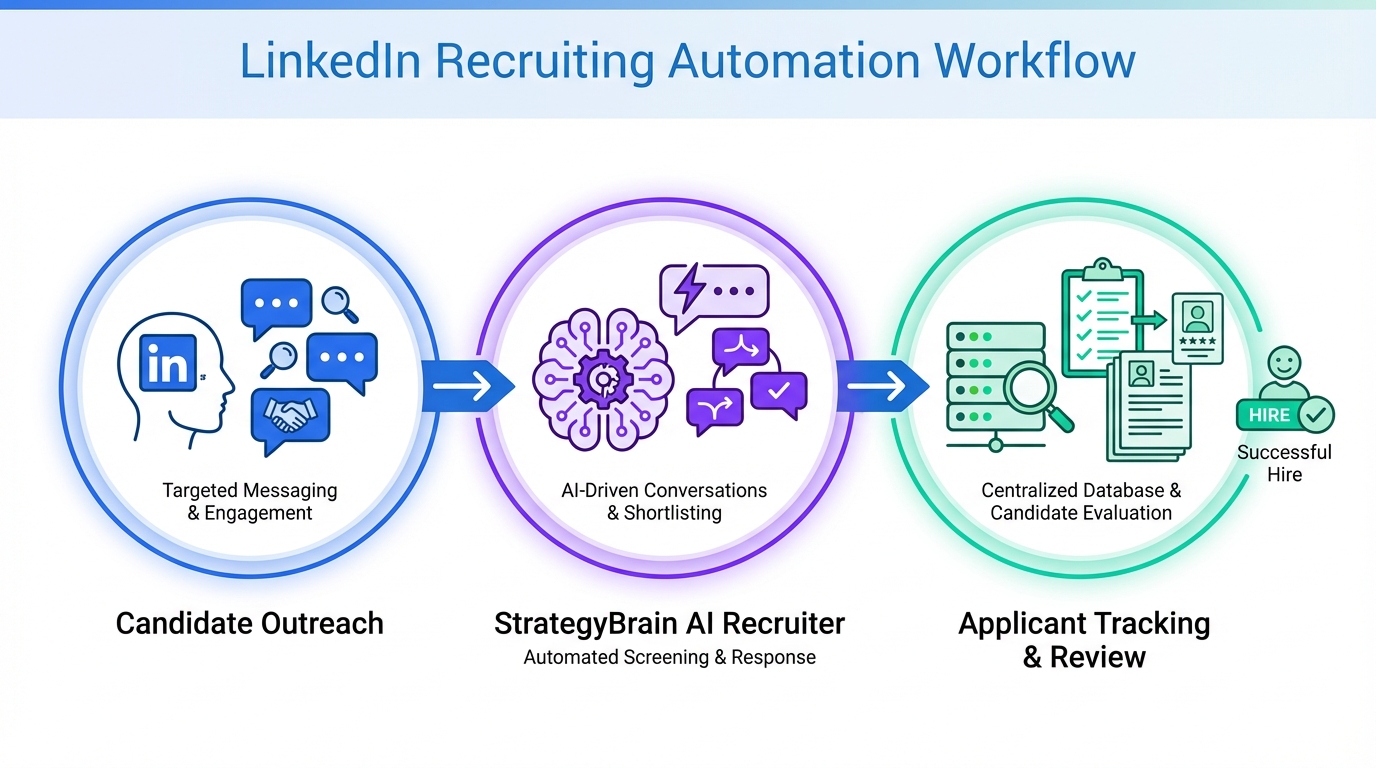
StrategyBrain AI Recruiter is designed to automate the early LinkedIn workflow while keeping recruiters in control of final qualification. It can automatically connect with candidates that match your search criteria, introduce the opportunity, answer common questions about the role, company, and compensation, confirm interview interest, and collect resumes and contact details from interested candidates.
Step-by-step workflow (what we recommend)
- Define the intake packet: role summary, compensation, benefits, and candidate search criteria.
- Run automated outreach: AI Recruiter initiates connections and starts conversations on LinkedIn.
- Maintain 24/7 responsiveness: the system replies and follows up in the candidate’s native language to reduce misunderstandings.
- Capture resumes and contacts: interested candidates share a resume and contact details, which are recorded for recruiter review.
- Recruiter reviews and advances: recruiters evaluate resume fit and move qualified candidates into interviews.
How this improves apply tracking
- Fewer dropped conversations because follow-up is consistent and time-zone independent.
- Cleaner handoff because resumes and contact details are collected before the recruiter steps in.
- Scalable outreach because AI Recruiter can support managing more than 100 LinkedIn accounts for teams that need volume.
Limitations we would plan for
- AI Recruiter does not decide final fit: it identifies willingness to communicate or interview, but recruiters still evaluate whether the resume matches requirements.
- Process discipline is still required: you need clear stages and ownership in your recruiting and applicant tracking software so the ATS remains the system of record.
ATS selection checklist by model
Below is a copyable checklist we use when mapping an ATS to a recruiting model. It is intentionally practical and focused on execution.
Universal checklist (works for every model)
- Candidate identity controls: duplicate detection and merge rules.
- Stage definitions: written entry and exit criteria for each stage.
- Audit trail: time stamps for stage changes and key decisions.
- Collaboration: structured feedback fields, not only free-text notes.
- Reporting: time-to-fill, time-in-stage, and source performance.
Contingency-specific checklist
- Fast submission workflow: submit candidate, confirm ownership, and schedule next action in 5 minutes.
- Client feedback loop: a defined SLA such as 48 hours for interview feedback.
- Pipeline visibility: shared view of who is active, stalled, or rejected.
Retained search-specific checklist
- Structured intake: scorecards and role success profile stored in the ATS.
- Stakeholder management: interview panel coordination and consolidated feedback.
- Candidate care: consistent communication logs and next-step commitments.
Temporary recruitment-specific checklist
- Availability tracking: start dates, shift constraints, and readiness status.
- Outcome tracking: started, no-show, completed assignment, eligible for conversion.
- High-volume workflows: bulk actions and fast screening notes.
LinkedIn-heavy sourcing checklist
- Message-to-record discipline: every serious conversation becomes a candidate record.
- Follow-up automation: consistent nudges and replies, especially across time zones.
- Resume capture: a defined step for collecting resumes and contact details before scheduling.
Quick comparison table
| Hiring model | Primary risk | What the ATS must do well | Where StrategyBrain AI Recruiter fits |
|---|---|---|---|
| Contingency | Slow feedback and duplicate submissions | Fast stage updates and ownership clarity for apply tracking | Automates LinkedIn outreach and follow-up so pipeline stays active |
| Retained | Complex stakeholder alignment | Structured intake, scorecards, and communication logging | Handles early candidate conversations and collects resumes before recruiter review |
| Temporary | High volume and operational churn | Bulk workflows and outcome tracking | Useful when sourcing via LinkedIn for recurring roles and fast starts |
| RPO and hourly recruiting | Process ambiguity and reporting overhead | Clear stages, audit trail, and measurable throughput | Scales outreach across many LinkedIn accounts for distributed teams |
FAQ
Why use an applicant tracking system if we already recruit on LinkedIn?
Because LinkedIn messages are not a reliable system of record. An ATS preserves apply tracking, stage history, and decision rationale so you can collaborate, report, and stay consistent even when sourcing happens in multiple channels.
What is the difference between recruiting and applicant tracking software and a CRM?
An ATS is optimized for applicants and hiring stages, while a recruiting CRM is optimized for long-term talent pools and nurturing. Many teams use both, but the ATS should remain the source of truth for applications and hiring decisions.
Which recruiting model benefits most from an ATS?
All models benefit, but contingency and high-volume temporary recruiting tend to feel the impact fastest because small delays and duplicates create immediate inefficiency. Retained search benefits through deeper documentation and stakeholder alignment.
How does StrategyBrain AI Recruiter help with apply tracking?
It reduces the gap between outreach and record creation by automating early LinkedIn conversations, follow-up, and resume collection. Recruiters can then review interested candidates and keep the ATS updated with clean, consistent stages.
Does AI Recruiter replace recruiters?
No. It automates repetitive LinkedIn tasks such as connecting, introducing roles, answering common questions, confirming interest, and collecting resumes. Recruiters still evaluate fit and run interviews and closing.
Can AI Recruiter communicate with candidates in different languages?
Yes. It supports multilingual communication and can respond around the clock, which helps when candidates reply outside your team’s working hours.
How many LinkedIn accounts can AI Recruiter manage?
It supports managing more than 100 LinkedIn accounts, which enables organizations to build AI-powered recruiting teams for scalable hiring.
How does AI Recruiter handle resumes and contact details?
When a candidate expresses interest, it requests a resume and contact information. If the candidate shares details in the conversation, those details are captured and displayed for recruiter review.
Is candidate data used to train AI models?
No. Candidate information and customer-provided data are not used to train AI models, and data is encrypted and isolated per customer environment.
Conclusion and next steps
The “menu” of recruiting models still holds up: contingency is speed with risk on the recruiter, retained is commitment with deeper service, and temporary recruitment is operational coverage at volume. What changed is the expectation of execution. Recruiting and applicant tracking software is now the baseline for reliable apply tracking, collaboration, and reporting across every model.
If your sourcing is LinkedIn-heavy, the fastest operational win is to close the gap between outreach and ATS records. A practical next step is to map your stages, define ownership, and use StrategyBrain AI Recruiter to automate early LinkedIn outreach, multilingual follow-up, and resume collection so recruiters can focus on qualification and interviews.