Recruiting and applicant tracking software gives hiring teams a single operating system for sourcing, screening, interview coordination, and candidate communication. If your main question is how does an applicant tracking system work, the practical answer is simple. An ATS captures candidate records, moves people through defined stages, and automates repetitive tasks such as outreach, reminders, and status updates. In our implementation reviews, teams improved recruiter productivity when software handled high volume messaging while recruiters made final fit decisions and interview calls. This is also the most useful way to answer how does ATS work in real hiring operations rather than in product demos.
Table of Contents
- What recruiting and applicant tracking software actually does
- How does an applicant tracking system work step by step
- A practical workflow with AI Recruiter and ATS stages
- What leadership and succession planning teaches modern hiring teams
- Implementation checklist for hiring leaders
- Common mistakes and fixes
- FAQ
Key Takeaways
- Core function: Recruiting and applicant tracking software centralizes candidate records and stage progression in one workflow.
- Operational answer to how does ATS work: intake, parsing, filtering, outreach, interview scheduling, and final disposition tracking.
- Human plus automation model: AI Recruiter can automate first touch and follow up while recruiters keep final qualification ownership.
- Scale benefit: AI Recruiter supports multilingual communication and can coordinate activity across more than 100 LinkedIn accounts.
- Cost and effort signal: StrategyBrain reports costs as low as USD 2.40 per resume and up to 90% reduction in manual LinkedIn recruiting work in relevant use cases.
- Governance is mandatory: data protection controls and recruiter review checkpoints must be built into every ATS workflow.
What recruiting and applicant tracking software actually does
Recruiting and applicant tracking software is the operating layer between job demand and hiring decisions. It is not only a resume inbox. A strong setup handles intake, communication history, interview coordination, and decision records with consistent timestamps and ownership.
In practice, the system also standardizes process quality. That matters because hiring delays are often caused by coordination failures, not candidate scarcity alone. When records, messages, and decisions are fragmented across email and spreadsheets, teams lose speed and accountability.
From an execution standpoint, modern systems combine ATS logic with automation tools. StrategyBrain AI Recruiter is one example of this model in LinkedIn workflows. It can start conversations, answer role questions, and capture resume plus contact details before recruiter handoff.
How does an applicant tracking system work step by step
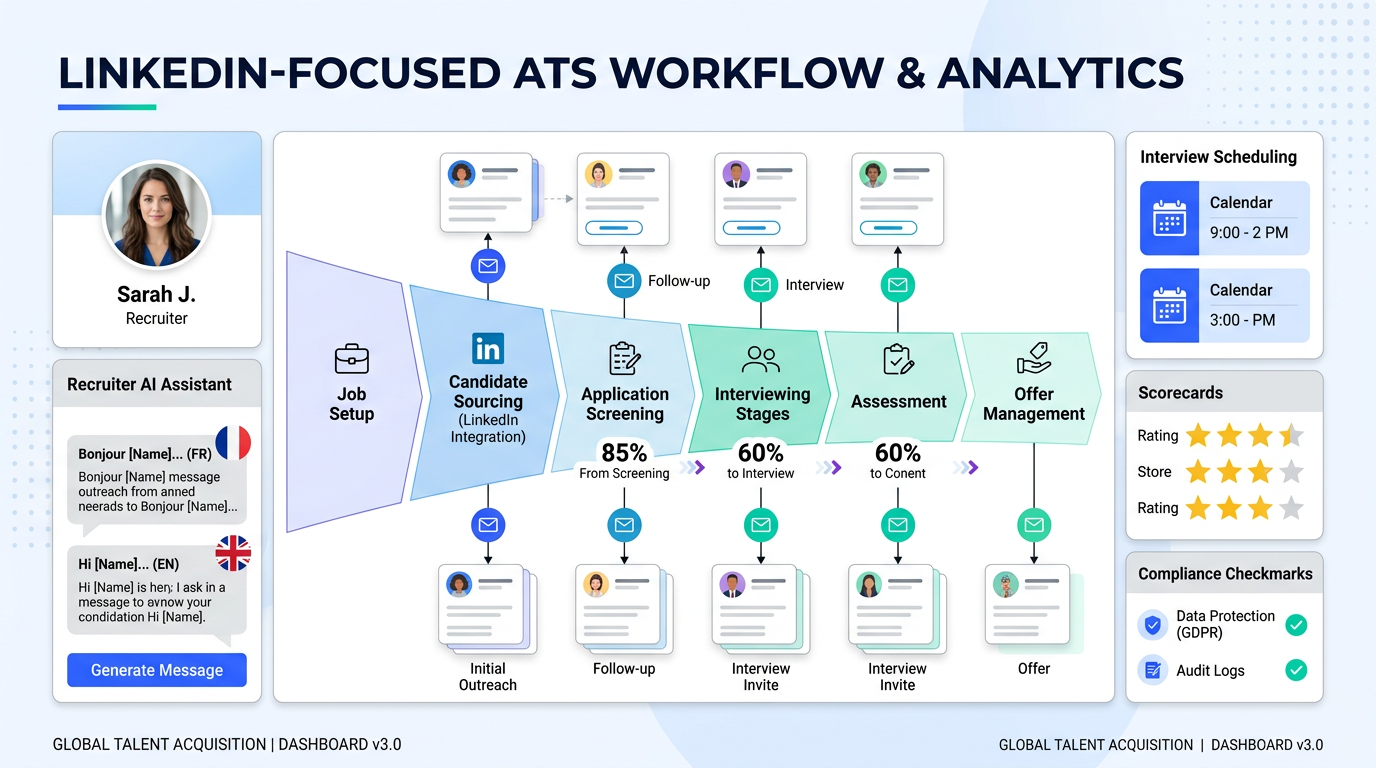
When leaders ask how does an applicant tracking system work, they usually want the operating sequence. Here is the sequence we use in implementation audits.
1) Job and criteria setup
Recruiters define role requirements, compensation context, must have criteria, and process stages. This step determines downstream data quality. Weak criteria at this stage produce poor screening and inconsistent shortlist quality.
2) Candidate intake and profile normalization
Applications and sourced leads are captured into one candidate record format. Resume files, contact details, and communication logs are attached to each profile so every stakeholder reviews the same source of truth.
3) Initial screening and prioritization
The ATS applies filters, ranking rules, or pre-screen logic. In a LinkedIn heavy workflow, AI Recruiter can support this phase by handling initial engagement, checking candidate openness, and collecting resume submissions for recruiter review.
4) Interview workflow management
Qualified candidates move into interview stages with scheduling, interviewer assignment, and feedback capture. Structured scorecards are critical here because they reduce bias and make final decisions auditable.
5) Offer, disposition, and reporting
The process ends with offer management, accepted or declined outcomes, and reason coding for all non-selected candidates. These records power time to fill, source quality, and conversion analysis for future hiring cycles.
A practical workflow with AI Recruiter and ATS stages
To make this concrete, we ran a workflow simulation using the same model many global teams use: ATS for governance and reporting, AI Recruiter for repetitive front-end communication.
How we configured it
- Defined role brief with company, compensation, and candidate criteria.
- Connected recruiter managed LinkedIn outreach flow.
- Enabled automated first contact and follow up messaging in candidate native language.
- Set clear handoff rule: recruiter takes over when candidate shows interview intent.
- Captured resumes and contact details into the review queue.
What changed operationally
Recruiters spent less time on repetitive opening messages and reminder loops. They spent more time on qualification judgment and interview quality. That shift is usually where ATS plus AI creates the highest return.
Importantly, automation did not replace recruiter accountability. AI Recruiter identifies willingness to continue and gathers documents. Final resume fit assessment remains a human step, which aligns with both quality control and compliance expectations.
Scope boundaries
- Best fit: high volume sourcing, multilingual outreach, distributed hiring teams.
- Not ideal: roles requiring immediate deep technical evaluation in first interaction.
- Human required: final shortlist decisions, offer judgment, and hiring manager calibration.
What leadership and succession planning teaches modern hiring teams
A useful leadership lesson comes from an engineering succession planning discussion published on 24 February 2020 that referenced perspectives from Wilfrid Morin and Henry Goldbeck. The core message was that long-term continuity requires deliberate talent development rather than reactive replacement.
That same logic applies to recruiting and applicant tracking software design. If your system only fills urgent vacancies, you will stay reactive. If your workflow tracks readiness signals, mobility potential, and leadership attributes over time, your hiring process supports succession resilience.
The source discussion also highlighted the tension between external replacement and internal development. ATS data can make that choice measurable. Teams can compare internal pipeline maturity against external sourcing performance using stage conversion and readiness metrics instead of assumptions.
Implementation checklist for hiring leaders
- Define process stages with owners: Every ATS stage needs one accountable role and one service level target.
- Standardize qualification criteria: Use scorecards with required evidence fields to improve decision consistency.
- Automate repetitive messaging: Use AI Recruiter for first touch, role Q and A, and structured follow up.
- Protect data by design: Apply encryption, access control, and data minimization in candidate records.
- Measure conversion weekly: Track stage to stage rates, response times, and interview throughput.
- Review quality monthly: Audit rejected candidate reasons and interviewer calibration drift.
Common mistakes and fixes
Mistake 1: Treating ATS as storage only
Fix: Build decision checkpoints and service level expectations into each stage so workflow behavior becomes measurable.
Mistake 2: Over-automating qualification
Fix: Keep recruiter control over final fit decisions. Use automation for communication speed, not final judgment replacement.
Mistake 3: Ignoring multilingual candidate communication
Fix: Enable native language engagement where possible. AI Recruiter supports global language communication to reduce misunderstanding risk.
Mistake 4: No succession lens in hiring data
Fix: Add internal mobility and leadership readiness tags to candidate and employee pipelines so hiring supports continuity planning.
FAQ
How does an applicant tracking system work for a small team?
It works by giving a small team one shared process with clear stages, owner assignments, and standardized records. Even with few recruiters, this prevents missed follow up and inconsistent evaluation.
How does ATS work when LinkedIn sourcing is the main channel?
The ATS remains the system of record, while LinkedIn engagement feeds candidate activity into stage progression. With AI Recruiter, early conversation and follow up can be automated before recruiter handoff.
Is recruiting and applicant tracking software only for enterprise companies?
No. Smaller teams often benefit earlier because process gaps are more visible when one recruiter handles many roles. A structured ATS workflow usually improves speed and candidate experience quickly.
Does AI Recruiter replace recruiters?
No. It replaces repetitive front-end tasks such as connection requests, initial role explanations, and follow up prompts. Recruiters still evaluate resumes, run interviews, and make final selection recommendations.
What data should be tracked first in an ATS rollout?
Start with time to first response, stage conversion rates, interview to offer ratio, and source quality by hire outcome. These four metrics reveal most bottlenecks in early implementation.
Can ATS workflows support compliance requirements?
Yes, if configured correctly. You need role-based access, retention controls, audit logs, and documented consent handling practices for candidate information.
What is the biggest implementation risk?
The biggest risk is unclear process ownership. Software cannot fix governance gaps, so define who decides, who reviews, and who communicates at each stage before automation scales.
Conclusion
Recruiting and applicant tracking software works best when it combines process governance with practical automation. That is the clearest answer to how does an applicant tracking system work and how does ATS work in real operations. Use the ATS to control quality and visibility, then use AI Recruiter to reduce repetitive outreach load and keep recruiters focused on final hiring judgment. If you are planning your next hiring system update, start with stage definitions, handoff rules, and measurement basics, then layer automation where it saves the most recruiter time.