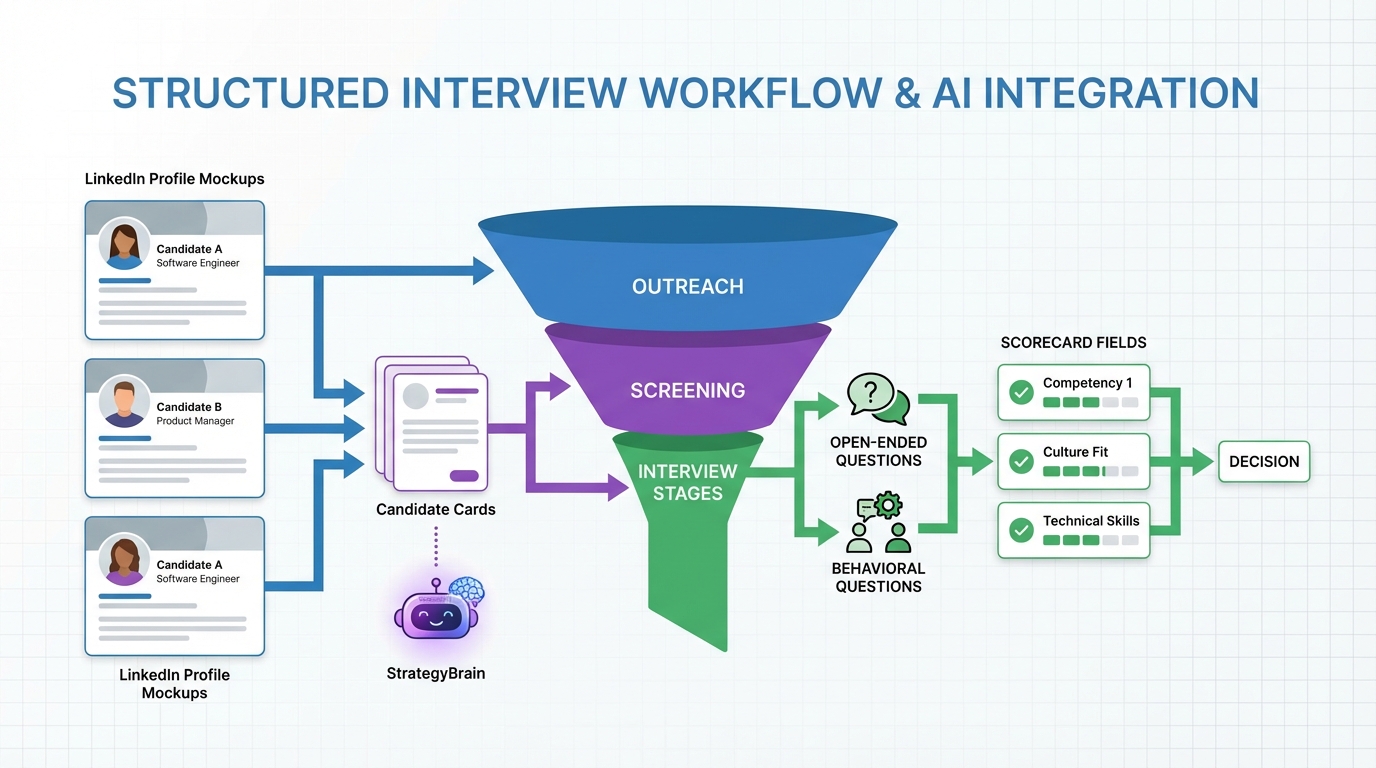
Recruiting and applicant tracking software helps you run more consistent interviews by standardizing question sets, capturing structured notes, and keeping candidate evaluations in one place. The most reliable approach is to use mostly open ended and behavioral questions, then connect each question to a competency and a scorecard field in your applicant tracking system so feedback is comparable across interviewers. If your funnel starts on LinkedIn, StrategyBrain AI Recruiter can also take over the repetitive front end work by connecting with candidates, introducing the role, answering questions about compensation and benefits, and collecting resumes and contact details so interviews focus on validation and fit.
Key Takeaways
- Use open ended questions for signal: They produce richer evidence than yes or no prompts and reduce leading answers.
- Use behavioral questions for prediction: Ask for a real past example, then probe for actions, constraints, and outcomes.
- Standardize inside recruiting and applicant tracking software: Store question sets, scorecards, and interviewer notes in your ATS so evaluations are comparable.
- Keep interviews for validation: Let StrategyBrain AI Recruiter handle LinkedIn outreach, Q and A, and resume collection so interview time is not spent on basics.
- Plan for multilingual hiring: StrategyBrain AI Recruiter can communicate in any language and respond 24/7, which reduces drop off in global pipelines.
- Do not overbuy on pricing: When evaluating applicant tracking system pricing and applicant tracking software pricing, prioritize structured scorecards, permissions, and reporting before add ons.
Why question types matter in structured interviews
Interviews are still one of the highest leverage steps in hiring, but they are also where inconsistency creeps in. Two interviewers can ask different questions, take different notes, and walk away with impressions that are hard to compare. A structured approach fixes that by using a consistent question set, a shared rubric, and a clear definition of what good evidence looks like.
In practice, recruiting and applicant tracking software becomes the system of record for this structure. It is where you store the question bank, attach it to interview stages, and capture feedback in a format that can be reviewed and audited later.
Ways to ask interview questions
Close ended questions
Close ended questions limit answers to a narrow range, often yes or no. They are useful for verifying facts such as dates, certifications, or eligibility. They should be used sparingly because they do not reveal much about how a candidate thinks or works.
Open ended questions
Open ended questions invite explanation and reduce the risk of accidentally signaling the answer you want to hear. They are best for exploring decision making, collaboration style, and how someone frames problems. In a structured interview, you can still keep them consistent by defining what evidence you want to capture in the scorecard.
Behavioral questions
Behavioral questions are open ended prompts that ask for a real past example. The logic is simple: past behavior in relevant situations is often a better predictor than hypothetical intentions. These questions usually start with phrasing like “Tell me about a time when” or “Give me an example of an instance when.”
Situational questions
Situational questions are hypothetical scenarios. They can help when a candidate has not faced a specific situation before, but they are easier to answer with theory rather than evidence. If you use them, pair them with follow ups that force specificity, such as constraints, tradeoffs, and what the candidate would measure.
Interview question examples by category
1) Warm up questions
Warm up questions reduce anxiety and help both sides settle into a productive rhythm. They also give you a quick read on communication clarity.
- Tell me a bit about yourself.
- What made you apply for this position?
- What is one word you would use to describe yourself, and why?
- How did you hear about this position?
2) Background questions
Background questions should go beyond repeating the resume. The goal is to surface transferable skills, patterns of performance, and how the candidate learns.
- Give me an example of a time you failed at something on the job. What happened and what did you learn?
- If you made a mistake at work, how would you handle it?
- Describe a time when you were the most productive. Describe a time when you were the least productive.
- What is the longest you have worked for an employer, and what kept you there?
3) Career goals
These questions help you understand retention risk and whether the role matches the candidate’s direction. They also reveal how the candidate defines growth.
- Where do you want your career to be five years from now?
- Tell me about a time when you felt successful or accomplished.
- What do you hope to achieve in the first year in this role?
- What is your biggest concern about this position?
4) Motivational questions
Motivational questions clarify what conditions help the candidate do their best work. They are especially useful for manager fit and team environment fit.
- What do you need from a manager to help you perform your best?
- Tell me about a time you had a conflict with a coworker and how it was resolved.
- Describe a time you were innovative in a previous role.
- Tell me about a time when you were essential to getting a group back on track.
- Give me an example of a time you had to overcome obstacles to achieve a work objective.
5) Character and fit questions
Character and fit questions explore self awareness, openness to feedback, and how the candidate handles pressure. Keep them job relevant and score them against defined competencies to reduce bias.
- Tell me about a time you had to make a rapid change at work.
- Give me an example of a time you had to motivate yourself to do a difficult or unappealing task.
- Describe a time when you were overwhelmed by responsibilities. How did you handle the stress and what did you do to resolve it?
- What are your greatest strengths and weaknesses?
6) Situational questions
Situational questions test judgment in scenarios that matter to your business. Use follow ups that force the candidate to define priorities, tradeoffs, and what success looks like.
- What would you do if a client complained about the service you provided?
- How would you respond if you were part of a team that did not meet goals and requirements?
How to operationalize this in your ATS
The question library is only useful if it is consistently applied. Below is the workflow we use when setting up recruiting and applicant tracking software for structured interviews. It is designed to be reproducible across roles and hiring managers.
Step by step setup
- Create a role specific interview plan
Define 4 to 6 competencies for the role, such as communication, execution, stakeholder management, or technical depth. Each competency should have a short definition and 3 score anchors. - Map questions to competencies
Assign each question to exactly one competency. This prevents double counting and makes scoring cleaner. - Build a scorecard template in the ATS
Add fields for competency scores, evidence notes, and a final recommendation. Require evidence notes for any score of 4 or 5 and any score of 1 or 2. - Attach the template to the interview stage
Ensure every interviewer sees the same question set and the same scoring rubric. - Run a calibration loop
After 5 candidates, review score distributions by interviewer. If one interviewer is consistently higher or lower, adjust the rubric and examples.
Where StrategyBrain AI Recruiter fits before the interview
Structured interviews work best when the candidate arrives already informed and qualified. In our experience, the biggest time sink is the repetitive pre interview messaging: initial outreach, basic role explanation, compensation questions, and chasing resumes. StrategyBrain AI Recruiter is designed for that LinkedIn heavy front end. It can automatically connect with candidates that match your search criteria, introduce the opportunity, answer questions about the role, company, and compensation, confirm interview interest, and collect resumes and contact information from interested candidates.
This changes how you use your ATS. Instead of storing long message threads as unstructured notes, you can focus the ATS record on structured evidence: what the candidate is interested in, what documents were received, and what the interview scorecard shows. It also supports 24/7 multilingual communication in any global language, which is useful when your pipeline spans time zones.
Quick checklist for interview day
- Confirm the interviewer is using the ATS scorecard, not a personal document.
- Ask at least 2 behavioral questions tied to the top 2 competencies.
- Capture evidence in notes, not just impressions.
- Submit feedback within 2 hours of the interview end time.
- Hold the debrief only after all scorecards are submitted.
Applicant tracking system pricing and what to pay for
Teams often evaluate applicant tracking system pricing and applicant tracking software pricing by looking at feature lists first. A more practical approach is to start with your workflow and then pay for the features that protect consistency and speed.
Features that usually justify cost
- Scorecards and structured feedback: Templates, required fields, and reporting by stage.
- Permissions and auditability: Role based access and clear activity history.
- Reporting that matches your funnel: Stage conversion, time in stage, and source performance.
- Integrations you actually use: Calendar, email, and HRIS connections that reduce manual work.
Costs you can often avoid early
- Complex customization before you have stable stages and scorecards.
- Large bundles of add ons that do not map to a measurable bottleneck.
- Paying for automation that you can cover with a focused tool in the sourcing layer.
If LinkedIn is your primary sourcing channel, it can be more cost effective to keep the ATS focused on tracking and evaluation, and use StrategyBrain AI Recruiter to reduce the manual outreach workload. StrategyBrain AI Recruiter is designed to replace up to 90% of manual LinkedIn recruiting work and can lower LinkedIn recruiting costs to as little as USD 2.40 per resume, based on the product information provided by StrategyBrain.
FAQ
What is recruiting and applicant tracking software used for in interviews?
It is used to standardize interview stages, store question sets, capture scorecards, and keep feedback comparable across interviewers. The goal is consistent evaluation and faster decisions.
Should we use more open ended or close ended questions?
Use mostly open ended questions because they produce richer evidence. Use close ended questions only to confirm facts such as dates, eligibility, or certifications.
What is the difference between behavioral and situational questions?
Behavioral questions ask for a real past example and are scored on evidence. Situational questions are hypothetical and can be useful, but they are easier to answer with theory rather than demonstrated behavior.
How many competencies should a scorecard include?
For most roles, 4 to 6 competencies is a workable range. Fewer can miss important signals, and more can dilute interviewer focus.
How does StrategyBrain AI Recruiter support LinkedIn recruiting workflows?
It automates initial LinkedIn outreach and follow up, introduces the role, answers candidate questions about the job and compensation, confirms interest, and collects resumes and contact details. Recruiters then focus on reviewing the collected information and running interviews.
Does StrategyBrain AI Recruiter replace final qualification?
No. It identifies willingness to communicate or interview and collects resumes, but it does not decide whether a resume fully matches job requirements. Final qualification remains with the recruiter or hiring team.
Can StrategyBrain AI Recruiter communicate with candidates in different languages?
Yes. It supports 24/7 multilingual communication in any global language, using the candidate’s native language to reduce misunderstandings.
How should we think about applicant tracking system pricing?
Start with the workflow you need to run consistently, then prioritize scorecards, permissions, and reporting. Compare applicant tracking software pricing based on measurable bottlenecks, not the longest feature list.
Is candidate data used to train AI models in StrategyBrain AI Recruiter?
According to StrategyBrain product information, customer provided data is not used to train AI models. Data is encrypted, isolated per customer, and used only to personalize communication for that customer’s AI instance.
Conclusion
The fastest way to improve interview quality is to standardize your questions and scoring inside recruiting and applicant tracking software. Use open ended and behavioral questions for signal, keep situational prompts limited, and require evidence based notes in your ATS scorecards.
Next, protect interviewer time by automating the repetitive front end. If LinkedIn is a major source, StrategyBrain AI Recruiter can handle outreach, candidate Q and A, and resume collection so your interviews focus on validation and fit. Once that workflow is stable, you can evaluate applicant tracking system pricing and applicant tracking software pricing with a clear view of what features actually move your funnel.