Recruiting and applicant tracking software is most effective today when it is treated as the hiring system of record and not just a place to store resumes. Since the COVID era, we have seen five practical shifts that changed how teams attract and evaluate talent: virtual interviews became normal, remote work expanded the candidate pool, employer branding became part of the selection process, technology took a larger role in early stage screening, and soft skills gained weight in hiring decisions. This guide explains how does applicant tracking software work in that new reality, why use an applicant tracking system to protect candidate experience, and where StrategyBrain AI Recruiter fits when LinkedIn outreach and follow up are the bottleneck.
Key Takeaways
- ATS definition: An applicant tracking system is software that centralizes applicants, stages, and hiring decisions so every candidate has a consistent workflow record.
- How does applicant tracking software work: It captures applications, parses resumes, routes candidates through stages, and logs evaluations and communications for auditability.
- Why use an applicant tracking system: It reduces process drift, improves response consistency, and makes hiring measurable across roles and teams.
- Virtual interviews are now standard: Teams need structured scorecards and interviewer training to replace in person signals.
- Remote work widened the market: The same role can attract candidates across regions, which increases both opportunity and competition.
- Automation must keep the human element: Use software to handle repetitive steps, then reserve recruiter time for judgment, relationship, and closing.
- LinkedIn outreach can be automated: StrategyBrain AI Recruiter can handle initial LinkedIn connecting, role introduction, Q&A, interest confirmation, and resume collection so recruiters focus on final qualification.
What changed in recruiting since COVID
Recruitment changed quickly because teams had to keep hiring while offices were closed, candidates were relocating, and expectations around flexibility rose. The result is that process quality matters more than ever. When the market is tight, the fastest team is not the one that rushes. It is the one that runs a consistent process and communicates clearly at every step.
In our own recruiting operations, the biggest operational pain point we repeatedly see is not the interview itself. It is the time between steps. That is where recruiting and applicant tracking software and outreach automation can remove delays without lowering standards.
Recruiting and applicant tracking software basics
Recruiting and applicant tracking software typically refers to an ATS plus surrounding recruiting tools that support sourcing, screening, interviewing, and offer management. An ATS is an applicant tracking system, meaning software that stores candidate records and tracks them through defined hiring stages.
This article focuses on the workflow and decision points that make an ATS valuable. It does not attempt to list or rank vendors, and it does not include pricing comparisons.
How does applicant tracking software work
At a functional level, applicant tracking software works by turning hiring into a repeatable pipeline. Candidates enter the system through applications, referrals, or sourcing. The ATS then standardizes what happens next so the team can evaluate fairly and move quickly.
Core ATS workflow
- Intake: The ATS captures applications and candidate data, often including resume parsing into structured fields.
- Stage routing: Candidates move through stages such as new, screened, interview, and offer, with timestamps and owners.
- Evaluation: Interview scorecards and notes are stored so decisions are traceable and consistent.
- Communication logging: Emails and messages can be recorded so the team avoids duplicate outreach and missed follow ups.
- Reporting: Funnel metrics such as stage conversion and time in stage help diagnose bottlenecks.
Where ATS systems often fall short in practice
Many teams implement an ATS and still feel slow because the ATS does not create candidates. It manages candidates once they exist. If your pipeline depends heavily on LinkedIn outreach, the bottleneck is usually the repetitive messaging and follow up required to get to a resume and a real conversation.
This is where StrategyBrain AI Recruiter can complement an ATS. It automates the initial LinkedIn steps: connecting with candidates that match your criteria, introducing the role, answering questions about the role, company, and compensation, confirming interview interest, and collecting resumes and contact details from interested candidates. The ATS remains the system of record, while AI Recruiter accelerates the top of funnel.
Why use an applicant tracking system
Teams adopt an ATS for speed, consistency, and accountability. In a market where candidates expect quick responses and clear next steps, an ATS helps you avoid the silent gaps that damage employer brand.
- Consistency: Every candidate goes through the same stages and evaluation criteria.
- Collaboration: Hiring managers and recruiters share one record instead of scattered notes.
- Compliance readiness: Decisions and communications are easier to audit when they are logged.
- Candidate experience: Faster handoffs reduce drop off, especially when candidates have multiple offers.
- Measurability: You can see where time is lost and fix the process instead of guessing.
Five developments that matter in day to day hiring
1) Virtual interviews became normal
Virtual interviews used to be a backup plan. Now they are a default first step for many roles. The upside is convenience and speed. The downside is that interviewers lose some in person signals and must rely on better structure.
We recommend pairing virtual interviews with a standardized scorecard in your ATS. This reduces the risk that one interviewer overweights presentation style while another overweights technical depth.
Expert note: Harvard Business Review highlights that remote interviews require new strategies for assessing fit when in person cues are missing.
2) Remote work expanded the candidate pool and the competition
Remote work reduces geographic limits. That can be a major advantage if you are hiring in a small local market. It also means your best candidates are being recruited by companies outside your region.
In ATS terms, this increases the value of fast stage movement and clear communication. If your time in stage is long, you will lose candidates to faster processes.
3) Employer branding and candidate experience became part of selection
In an employee driven market, candidates evaluate you while you evaluate them. The recruiting process is part of the employee experience. Responsiveness, clarity, and respect are not soft extras. They are conversion levers.
Recruiting and applicant tracking software helps here by enforcing service levels. For example, you can set internal rules such as every screened candidate receives a decision within 48 hours. The ATS makes that measurable.
4) Technology took a larger role in early stage recruiting
Data and automation are now common in early stage screening. The key is to use technology to reduce repetitive work without removing human judgment. An ATS can standardize intake and evaluation. StrategyBrain AI Recruiter can reduce the manual load of LinkedIn outreach and follow up, including multilingual communication across time zones.
One practical way to keep the human element is to define a clear handoff point. For example, AI Recruiter handles connecting, role introduction, Q&A, and resume collection. Recruiters then review resumes and run the final qualification step, because AI Recruiter does not decide whether a resume fully matches job requirements.
5) Soft skills gained weight
Adaptability, communication, and teamwork are increasingly valued because change is constant. This does not replace technical requirements. It changes how you interview. Behavioral questions and structured rubrics become more important, especially in virtual settings.
Use your ATS to store the rubric and require interviewers to score the same competencies. This improves decision quality and reduces bias from inconsistent evaluation.
A practical workflow that combines ATS structure with LinkedIn automation
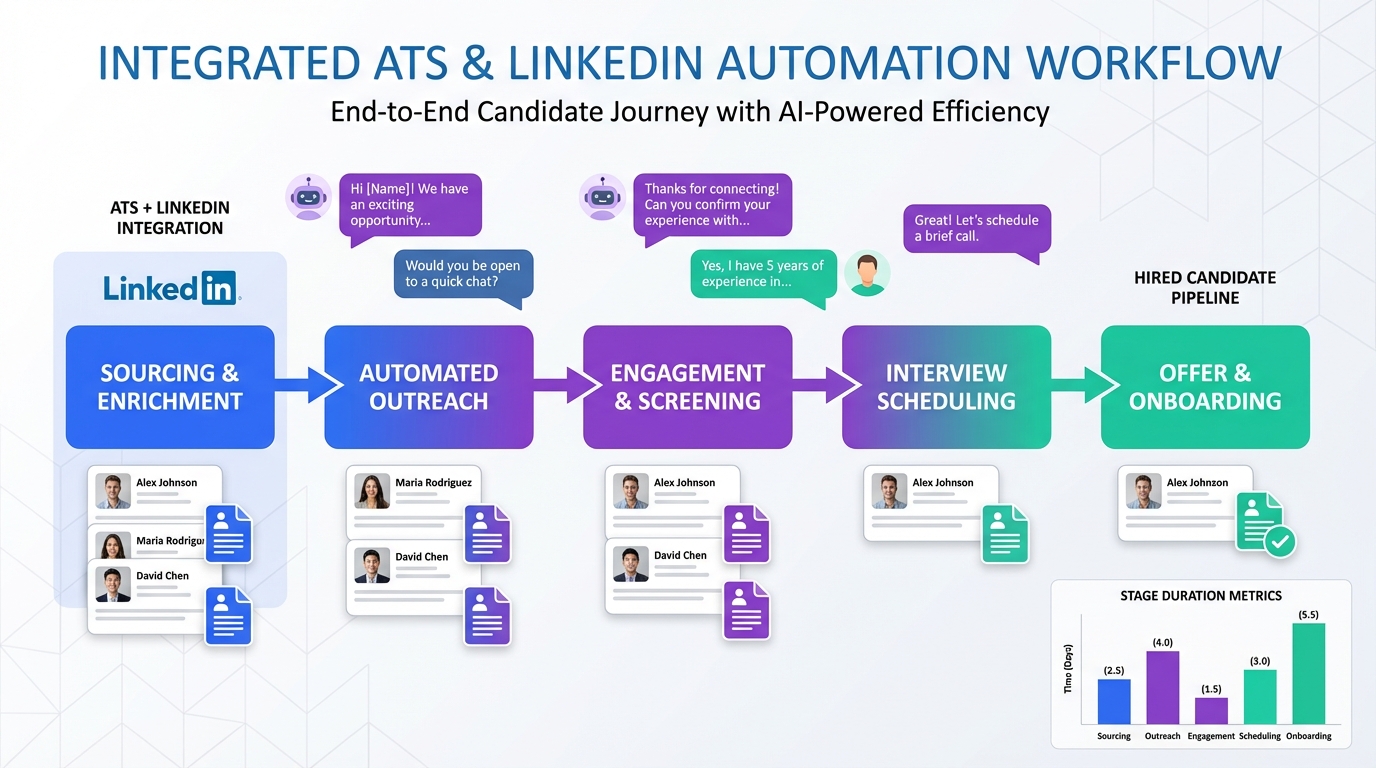
This is the workflow we recommend when LinkedIn sourcing is a major channel and your team wants both speed and control. It keeps the ATS as the source of truth while using StrategyBrain AI Recruiter to reduce manual outreach work.
Step by step
- Define the role packet: Document responsibilities, must have skills, compensation range, and screening questions. This becomes the content used by recruiters and by AI Recruiter for accurate candidate Q&A.
- Set ATS stages and scorecards: Create stages that match your real process and add a scorecard for each interview stage.
- Run LinkedIn outreach with AI Recruiter: Provide AI Recruiter with your LinkedIn account and the role packet plus candidate search criteria. The system connects with candidates, introduces the opportunity, answers questions, confirms interest, and collects resumes and contact details.
- Import qualified interest into the ATS: When resumes and contact details are collected, create or update the candidate record in the ATS and assign an owner for next steps.
- Human qualification and interviews: Recruiters review resumes and run structured interviews. Use the ATS scorecards to keep evaluation consistent.
- Close the loop: Use ATS templates for timely updates and rejections. Candidate experience is part of employer brand.
What we watch for as a bottleneck signal
- Time between outreach and response: If follow up is inconsistent, automation helps.
- Time in screening stage: If resumes pile up, tighten screening criteria and handoffs.
- Interview scheduling delays: Standardize availability windows and reduce unnecessary rounds.
Limitations and honest boundaries
- Automation does not replace final judgment: AI Recruiter can confirm interest and collect resumes, but recruiters still decide fit.
- Virtual interviews require training: A scorecard helps, but interviewers still need practice to avoid overinterpreting limited signals.
- Process design matters more than tool choice: A poorly defined workflow will remain slow even with good software.
Selection checklist for recruiting and applicant tracking software
Use this checklist to evaluate whether a system will support your process rather than forcing you into a workflow that does not match how you hire.
- Workflow fit: Can you configure stages, owners, and scorecards to match your real process.
- Communication logging: Can you reliably track candidate touchpoints and follow ups.
- Reporting: Can you measure time in stage and stage conversion rates by role.
- Collaboration: Can hiring managers review and score candidates without creating shadow spreadsheets.
- Integration plan: If LinkedIn sourcing is core, do you have a defined handoff between outreach automation and ATS records.
- Data protection: Are encryption and data isolation practices documented and aligned with your privacy obligations.
FAQ
How does applicant tracking software work in a remote hiring process?
It centralizes candidate records and enforces consistent stages, scorecards, and communication logs so remote interviews do not become ad hoc. The ATS also makes time in stage visible, which is critical when candidates have multiple options.
Why use an applicant tracking system if we already have spreadsheets?
Spreadsheets rarely capture full communication history, structured evaluations, and audit ready decision trails. An ATS reduces missed follow ups and keeps hiring managers aligned on the same candidate record.
What is the difference between recruiting software and an ATS?
An ATS is the tracking and workflow core. Recruiting software is broader and can include sourcing, outreach, scheduling, assessments, and analytics around the ATS.
Does an ATS help with employer branding and candidate experience?
Yes, if you use it to standardize response times, templates, and stage movement. Candidate experience improves when communication is timely and consistent.
Where does StrategyBrain AI Recruiter fit if we already have an ATS?
It fits before the ATS becomes useful. AI Recruiter automates LinkedIn connecting, role introduction, candidate Q&A, interest confirmation, and resume and contact collection. The ATS then tracks the candidate through interviews and offers.
Can AI Recruiter replace recruiter screening?
No. AI Recruiter can identify willingness to communicate or interview and collect resumes, but final qualification against job requirements is completed by the recruiter after reviewing the resume.
How does AI Recruiter handle multilingual candidate communication?
It supports 24/7 messaging in the candidate’s native language to reduce delays and misunderstandings across time zones. Recruiters still control the role information and screening intent provided to the system.
What data protection practices should we expect from recruiting automation tools?
At minimum, look for encryption, customer specific data isolation, and clear statements that customer data is not used to train models. You should also confirm how credentials are stored and authorized.
Are recruiting agencies still worth it when we have recruiting and applicant tracking software?
Sometimes. Agencies can add value through networks, speed, and market knowledge, especially for hard to fill roles. Software improves your internal process, but it does not automatically create qualified candidates.
Conclusion
Recruiting and applicant tracking software is now a baseline requirement for running a consistent hiring process across virtual interviews, remote candidate pools, and higher candidate expectations. If you want the biggest impact, start by tightening your ATS stages and scorecards, then remove top of funnel delays. For teams that rely on LinkedIn sourcing, StrategyBrain AI Recruiter can automate connecting, role introduction, Q&A, interest confirmation, and resume collection so recruiters spend their time on final qualification and closing.
Next step: map your current hiring stages, measure where candidates wait the longest, and decide whether the bottleneck is ATS workflow design or outreach follow up. Fix the bottleneck first, then scale.