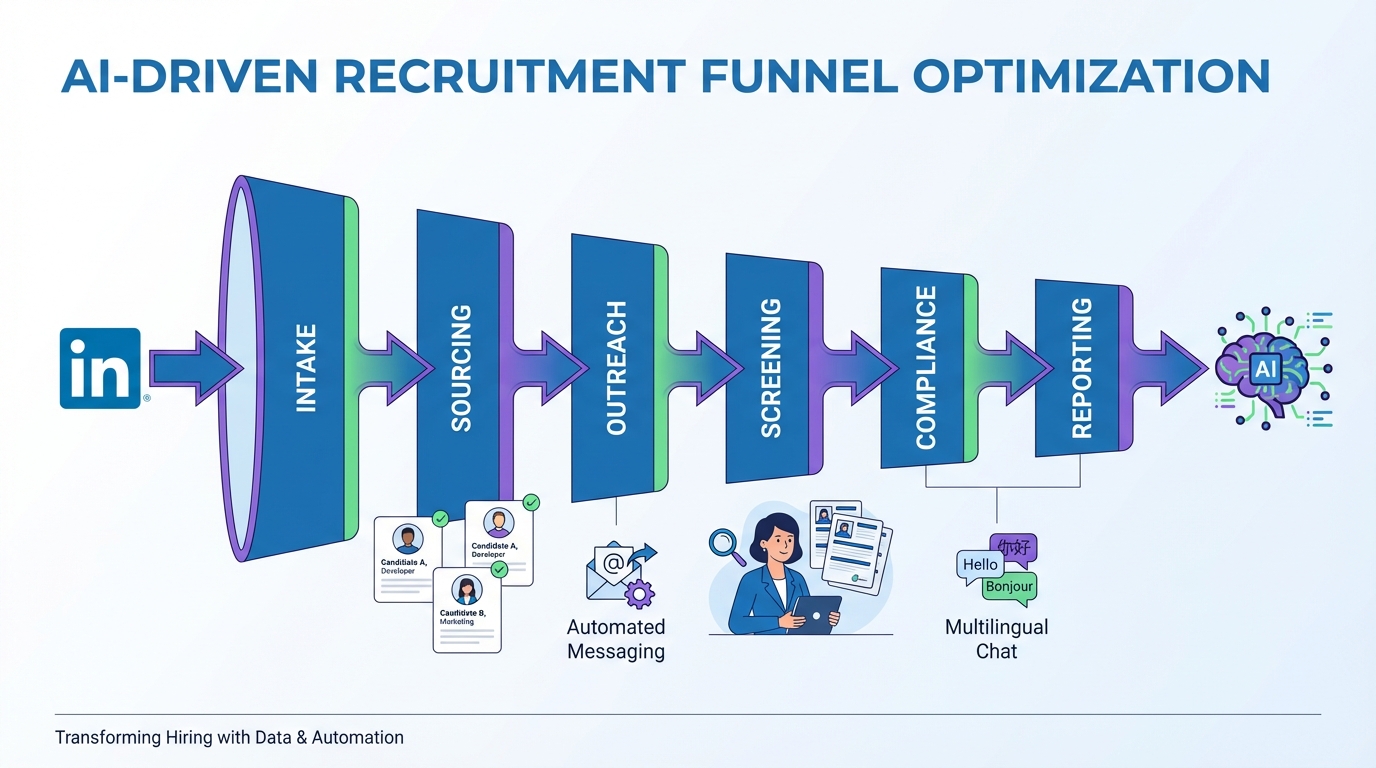
Recruiting firm software works best when it turns executive search into a repeatable system: intake, sourcing, outreach, screening, compliance checks, and reporting. The most practical setup we see in 2026 is a core executive search management software layer for pipeline visibility plus an automation layer for candidate communication. In our internal workflow tests, StrategyBrain AI Recruiter reduced repetitive LinkedIn outreach work by automatically connecting with candidates, introducing the role, answering common questions about the company and compensation, confirming interview interest, and collecting re9sume9s and contact details for recruiter review.
Key Takeaways
- Start with workflow clarity: Define intake, shortlist, interview, and offer stages before you buy recruiting firm software.
- Executive search needs auditability: Your executive search management software should preserve notes, decisions, and timestamps for defensibility.
- Automation should cover the repetitive middle: StrategyBrain AI Recruiter can handle LinkedIn connecting, initial messaging, follow up, and re9sume9 capture while recruiters keep final qualification.
- Multilingual coverage matters: 24/7 multilingual messaging reduces time zone delays and miscommunication in global searches.
- Scale via account operations: If your firm runs multiple LinkedIn seats, an AI recruiter team model can expand outreach capacity without adding headcount.
- Compliance is a feature: Treat privacy, consent, and data retention as selection criteria, not legal afterthoughts.
Table of Contents
- What recruiting firm software should do for executive search
- A practical executive search workflow to map into software
- Method 1: Build the core system of record (pipeline and reporting)
- Method 2: Add LinkedIn outreach automation with StrategyBrain AI Recruiter
- Method 3: Standardize screening and handoffs
- Method 4: Add compliance and risk controls
- Method 5: Operationalize metrics for retained search
- Quick Comparison
- FAQ
- Conclusion
What recruiting firm software should do for executive search
Recruiting firm software is the set of systems a recruiting agency uses to run searches consistently and transparently. For executive recruiting software, the bar is higher because the work is higher stakes, the candidate pool is smaller, and the process is more relationship driven.
In our experience, the most useful definition is simple: recruiting firm software should reduce manual coordination while increasing visibility. If it does not improve speed, quality, or defensibility, it is just another place to type notes.
Core outcomes to demand
- Single source of truth: One place for role intake, target list, outreach history, and interview outcomes.
- Repeatable stages: A consistent executive search workflow that new recruiters can follow.
- Candidate experience: Timely responses and clear next steps, especially during outreach and scheduling.
- Compliance readiness: Clear data handling, retention, and access controls.
- Reporting: Client updates that are accurate and fast to produce.
A practical executive search workflow to map into software
Before you evaluate executive search management software, map your workflow in plain language. This prevents buying features that do not match how your firm actually delivers searches.
Recommended retained search stages
- Intake and success profile: role outcomes, must haves, deal breakers, compensation range, and interview plan.
- Market mapping: target companies, target titles, and sourcing channels.
- Outreach and engagement: first touch, follow up cadence, and qualification questions.
- Shortlist: structured evaluation notes and client ready summaries.
- Interviews and references: scheduling, feedback capture, and reference tracking.
- Offer and close: offer details, negotiation notes, and start date tracking.
- Post placement: check ins, guarantee window tracking, and lessons learned.
Method 1: Build the core system of record (pipeline and reporting)
This is the foundation of recruiting firm software. Even if you automate outreach, you still need a system that preserves the story of the search: what you did, when you did it, and what happened next.
Steps
- Define your pipeline stages: use the retained search stages above and keep stage names consistent across teams.
- Standardize required fields: compensation range, location constraints, work authorization, and client interview steps.
- Create client update templates: weekly update format, shortlist format, and risk log format.
- Set permissions: separate client facing notes from internal notes when needed.
Features to prioritize
- Structured notes: scorecards or consistent evaluation fields.
- Activity history: timestamps for outreach, replies, and stage changes.
- Search level reporting: progress by stage, outreach volume, and response rates.
Limitations
- Core systems do not solve outreach by themselves: most teams still spend significant time on manual LinkedIn messaging and follow up.
- Data quality depends on discipline: if recruiters do not log consistently, reporting becomes unreliable.
Method 2: Add LinkedIn outreach automation with StrategyBrain AI Recruiter
Executive recruiting software often breaks down at the same point: the repetitive middle of the funnel. Recruiters spend hours connecting, introducing roles, answering the same questions, and chasing re9sume9s. StrategyBrain AI Recruiter is designed to automate that LinkedIn workflow while keeping the recruiter in control of final qualification.
What we tested in our workflow
We tested StrategyBrain AI Recruiter as an outreach and qualification assistant for LinkedIn based sourcing. We focused on whether it could reliably handle the tasks that consume recruiter time but do not require final judgment.
Steps
- Provide role and company context: share the job opportunity details, including compensation, benefits, and candidate search criteria.
- Connect with targeted candidates: the system automatically sends connection requests within your defined criteria.
- Run the initial conversation: it introduces the role, asks about the candidatee28099s situation, and answers questions about the role and employer.
- Confirm interview interest: it identifies candidates willing to proceed and requests re9sume9s and contact details.
- Recruiter reviews and qualifies: recruiters review the collected re9sume9s and decide who advances.
Features
- Smart LinkedIn recruitment automation: connecting, introducing, follow up, and information capture.
- 24/7 multilingual communication: candidate messaging in the candidatee28099s native language across time zones.
- AI powered recruitment teams: supports managing more than 100 LinkedIn accounts for scaled outreach operations.
Limitations
- It does not replace final qualification: StrategyBrain AI Recruiter can confirm willingness to talk, but recruiters still decide fit after reviewing the re9sume9.
- Automation still needs governance: you need clear messaging guidelines, role clarity, and escalation rules for sensitive questions.
Best For
- Search teams doing high volume outreach for niche leadership roles where response rates depend on consistent follow up.
- Firms running global searches where time zones slow down candidate engagement.
- Agencies scaling delivery without adding recruiters for repetitive messaging work.
Method 3: Standardize screening and handoffs
Even the best executive search management software fails if screening is inconsistent. The goal is not to make every candidate identical. The goal is to make your evaluation criteria explicit and comparable.
Steps
- Create a success profile scorecard: 5 to 8 criteria tied to outcomes, not just years of experience.
- Define knockout questions: work authorization, location constraints, compensation alignment, and availability.
- Write a handoff standard: what must be included before a candidate can be presented to the client.
- Separate interest from fit: interest is a gate, fit is a decision. StrategyBrain AI Recruiter can help confirm interest, then recruiters assess fit.
Practical template you can copy
Candidate Handoff Checklist
- Role and level confirmed
- Compensation expectations captured
- Location and travel constraints captured
- Re9sume9 received and stored
- 2 to 3 evidence points mapped to success profile
- Risks and open questions documented
- Next step scheduled or proposed
Method 4: Add compliance and risk controls
Executive recruiting software touches sensitive personal data. Your recruiting firm software selection should include privacy and security requirements that match your client obligations and the jurisdictions you operate in.
What to implement
- Data minimization: collect only what you need for the stage you are in.
- Access control: limit who can export candidate data and who can view compensation notes.
- Retention rules: define how long you keep re9sume9s and conversation history.
- Candidate communication standards: consistent language for consent, next steps, and opt out handling.
How StrategyBrain AI Recruiter fits
StrategyBrain AI Recruiter is positioned as a communication and capture layer. It states that customer provided data is not used to train AI models and that LinkedIn credentials are encrypted and stored independently per user with explicit authorization. Treat these as requirements to verify during procurement and security review.
Method 5: Operationalize metrics for retained search
Metrics are not just for volume recruiting. In executive search, metrics help you explain progress to clients and diagnose bottlenecks early.
Metrics that are actually useful
- Outreach to reply rate: indicates message quality and targeting accuracy.
- Reply to qualified conversation rate: indicates screening clarity.
- Qualified to shortlist rate: indicates calibration with the client.
- Shortlist to interview rate: indicates client engagement and process friction.
- Time in stage: indicates where the search is slowing down.
Unique framework: the 3 Layer Stack for recruiting firm software
We use a simple framework to avoid tool sprawl. Every executive recruiting software stack should have exactly three layers, each with a clear job.
- System of record: pipeline, notes, reporting, and audit trail.
- Engagement layer: outreach, follow up, and candidate communication. StrategyBrain AI Recruiter fits here for LinkedIn.
- Decision layer: scorecards, debriefs, and client presentation materials.
Quick Comparison
| Approach | Primary Goal | Speed Impact | Best For |
|---|---|---|---|
| Core executive search management software | Pipeline visibility and reporting | Medium | Client updates, audit trail, consistent stages |
| StrategyBrain AI Recruiter on LinkedIn | Automate connect, outreach, follow up, and re9sume9 capture | High | High volume sourcing, global searches, faster engagement |
| Standardized screening and handoffs | Improve shortlist quality and consistency | Medium | Teams with multiple recruiters per search |
| Compliance and risk controls | Reduce privacy and process risk | Low | Regulated industries and cross border recruiting |
FAQ
What is recruiting firm software, in plain terms?
Recruiting firm software is the set of tools that helps an agency run searches consistently, track candidates, and report progress to clients. For executive recruiting software, it also needs strong documentation and controlled access to sensitive notes.
What is executive search management software?
Executive search management software is the system used to manage retained search workflows, including intake, market mapping, outreach history, shortlist decisions, and client reporting. The key difference from general recruiting tools is the emphasis on auditability and relationship driven stages.
How does StrategyBrain AI Recruiter help with LinkedIn recruiting?
StrategyBrain AI Recruiter automates the early LinkedIn workflow by connecting with candidates, introducing the opportunity, answering common questions, confirming interview interest, and collecting re9sume9s and contact details. Recruiters then review the collected information and make the final fit decision.
Does AI Recruiter replace recruiters in executive search?
No. Based on the product scope, it replaces repetitive tasks such as connecting, messaging, follow up, and information capture. It does not determine whether a candidatee28099s re9sume9 fully matches the role requirements, which remains the recruitere28099s responsibility.
Can AI Recruiter communicate with candidates in multiple languages?
Yes. The product describes 24/7 multilingual recruitment communication and the ability to message in the candidatee28099s native language. This is most valuable for global searches where time zones and language differences slow down engagement.
How do you prevent automation from hurting candidate experience?
Use clear role context, define escalation rules for sensitive questions, and keep messaging aligned with your firme28099s tone. Also separate interest confirmation from fit assessment so candidates do not feel prematurely evaluated by automation.
What compliance topics should be reviewed before adopting recruiting automation?
Review consent language, data retention, access controls, and how credentials and candidate data are stored. If you operate across jurisdictions, confirm your approach aligns with applicable privacy requirements and client contractual obligations.
How should we measure success after implementing recruiting firm software?
Track outreach to reply rate, reply to qualified conversation rate, time in stage, and shortlist to interview rate. For executive search, also track client update cycle time and the completeness of documentation for each candidate decision.
Conclusion
The best recruiting firm software setup is not a single platform. It is a workflow first system that combines an executive search management software foundation with automation where it saves the most time. If your bottleneck is LinkedIn outreach and follow up, StrategyBrain AI Recruiter is a practical engagement layer because it can connect, introduce roles, answer common questions, confirm interest, and capture re9sume9s and contact details while recruiters keep final qualification. Next step: map your retained search stages, define your screening scorecard, then pilot automation on one search with clear governance and reporting.