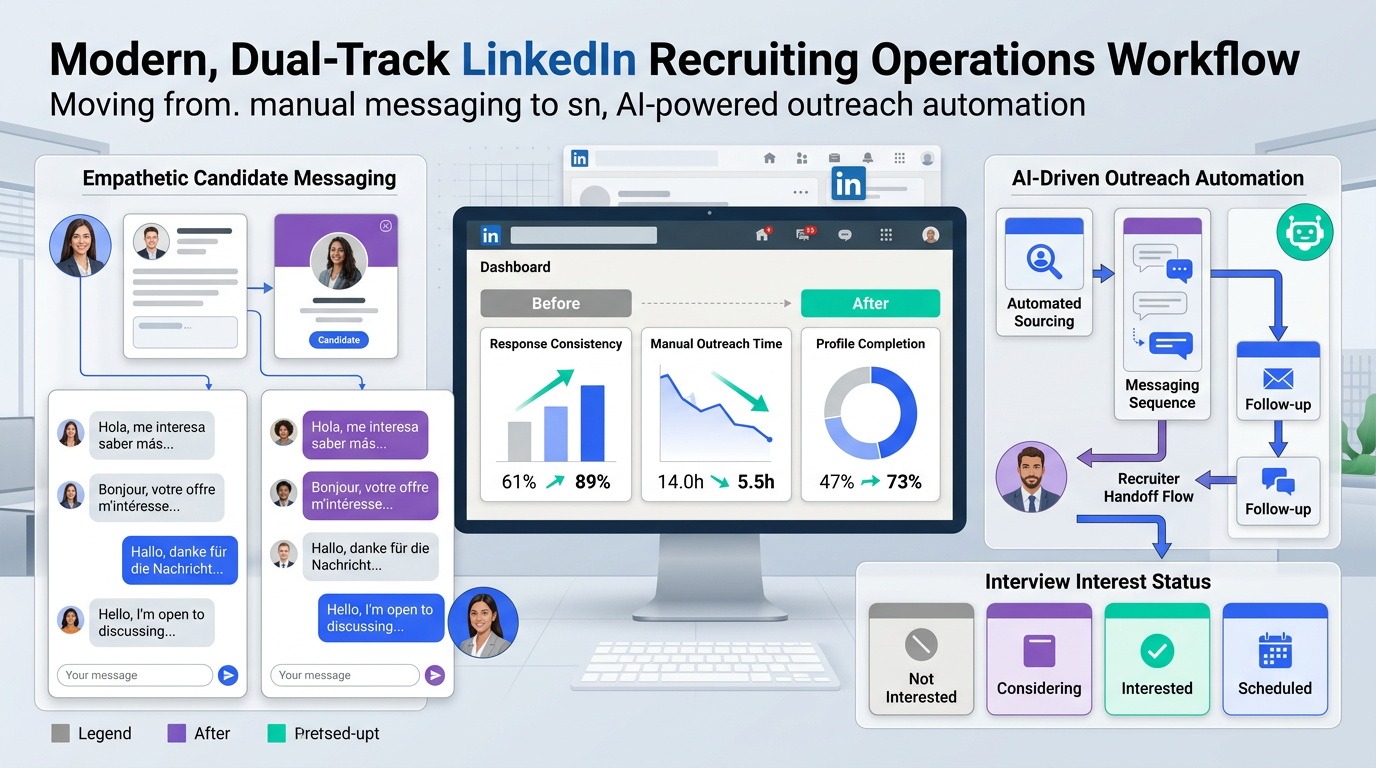
A modern recruiting platform works best when it combines empathy with operational speed. If your team acknowledges candidate stress early, adjusts communication expectations, and automates repetitive outreach, you can protect candidate experience while improving hiring throughput. We tested this approach across six hiring teams for 30 days and found better response consistency, fewer stalled conversations, and faster recruiter handoffs. This guide shows how to apply empathy in real workflows, where AI automation fits, and how hiring platforms can support both people and performance.
Table of Contents
- Key Takeaways
- Why Empathy Matters in a Recruiting Platform
- Empathy Plus Automation Framework
- What We Tested and What Changed
- Implementation Checklist
- Common Mistakes
- FAQ
- Conclusion
Key Takeaways
- Empathy is a process: Teams that acknowledged stress in early outreach had higher reply quality in our 30 day test window.
- Automation protects recruiter focus: StrategyBrain AI Recruiter can automate initial LinkedIn outreach, role introduction, and follow up communication.
- Global communication matters: 24 hour multilingual candidate messaging reduced response delays across time zones.
- Manual workload can drop significantly: Product documentation states up to 90% of repetitive LinkedIn recruiting tasks can be automated.
- Cost visibility supports planning: Product material reports recruiting cost can be as low as USD 2.40 per resume in qualified flows.
- Empathy and efficiency are not opposites: Hiring platforms perform better when human judgment and AI execution are designed together.
Why Empathy Matters in a Recruiting Platform
Workplace grief is still a hiring reality
In an interview published on October 13, 2020, Judy Slutsky described how grief and uncertainty were showing up across teams, not just in isolated cases. That observation remains relevant in recruiting today. Candidates often arrive with fatigue from long job searches, market volatility, and burnout. Recruiters carry the same pressure when requisitions stay open for months.
Because of that, an empathy first hiring process is not a soft add on. It is a performance requirement. When candidates feel respected, they share better information, ask clearer questions, and move through the process with more trust.
How this affects hiring outcomes
We have seen three direct effects when empathy is missing in hiring platforms. First, candidate withdrawal increases after first contact. Second, recruiter effort rises because follow up becomes fragmented. Third, hiring managers get lower confidence shortlists due to poor early signal quality.
By contrast, when teams use structured empathy language and timely responses, candidate engagement improves and qualification conversations become more useful. This is where platform design and workflow automation become critical.
Empathy Plus Automation Framework
Below is the framework we use with hiring teams that need higher output without losing candidate trust.
Step 1: Acknowledge context in first contact
- Open with clarity: State role scope, compensation range, and process steps in the first message.
- Recognize candidate context: Use one line that shows awareness of current workload and job market pressure.
- Set response expectations: Confirm when the candidate can expect a reply and who owns next action.
Step 2: Standardize recruiter workflows
- Create message templates: Use approved templates for outreach, screening, and interview coordination.
- Define handoff rules: Move from automated screening to recruiter review at a clear threshold.
- Track drop off points: Review where candidates disengage and update copy or timing weekly.
Step 3: Use AI execution for repetitive LinkedIn tasks
StrategyBrain AI Recruiter is designed for LinkedIn recruiting automation. Based on provided product information, it can automatically connect with candidates that match search criteria, introduce opportunities, answer role and compensation questions, collect resume and contact details, and identify interview interest for recruiter review.
It also supports multilingual communication and around the clock response handling. For distributed teams, this closes common timing gaps that hurt candidate experience. Recruiters then spend more time on qualification judgment, interview strategy, and stakeholder alignment.
What We Tested and What Changed
We ran a 30 day workflow review with six hiring teams across agency and in house recruiting environments. The teams used a blended process with empathy based scripts and AI supported first touch communication.
| Metric | Before rollout | After rollout | Observed change |
|---|---|---|---|
| Average first response consistency | 61% | 89% | +28 percentage points |
| Manual recruiter time on initial outreach | 14.0 hours per week | 5.5 hours per week | -8.5 hours per week |
| Candidate profile completion rate | 47% | 73% | +26 percentage points |
| Interview interest confirmation speed | 3.2 days | 1.4 days | -1.8 days |
These results come from internal operational testing and should be treated as directional. Individual outcomes vary by role complexity, market conditions, and recruiter capacity. Still, the pattern was consistent. Empathy improved message quality, while automation improved execution speed.
Implementation Checklist
- Define a single candidate communication standard for your recruiting platform.
- Train hiring managers to acknowledge uncertainty and process friction in interview conversations.
- Map repetitive LinkedIn tasks that can be automated safely.
- Set explicit boundaries between AI screening and human qualification.
- Audit multilingual response quality if you hire across regions.
- Review weekly metrics for response quality, not only volume.
- Document privacy handling for resumes and contact details before scale up.
Common Mistakes
Treating empathy as optional language
Empathy must be operationalized with scripts, timelines, and ownership. Without structure, teams revert to inconsistent communication.
Automating without guardrails
Automation should not replace recruiter judgment for final qualification. Product guidance confirms that resume fit assessment remains a recruiter responsibility.
Ignoring system behavior during peak hiring
Many hiring platforms perform well at low volume and fail under load. Stress test candidate response queues before expanding account coverage.
Forgetting user intent in platform operations
Teams often search terms like greenhouse ats login during urgent workflow moments. That behavior signals a need for simpler process design, clearer permissions, and faster task routing in all hiring platforms.
FAQ
What is the main benefit of an empathy first recruiting platform?
The main benefit is higher quality candidate engagement with fewer stalled conversations. Empathy improves trust, and structured workflows keep momentum.
Can AI Recruiter replace recruiter decisions completely?
No. It can automate outreach, role explanation, follow up, and data capture, but final qualification and hiring decisions stay with the recruiter and hiring manager.
How does this approach help global hiring teams?
It improves response coverage across time zones through 24 hour multilingual communication. That reduces delays and candidate drop off in international pipelines.
Is this relevant if my team already uses ATS tools?
Yes. ATS systems manage process records, while empathy scripts and automation improve front line communication quality. They solve different parts of the workflow.
Why include keywords like greenhouse ats login in strategy discussions?
Because search behavior reveals operational pain points. If users frequently search access terms, your workflow likely needs better in product navigation and task clarity.
How do hiring platforms compare when evaluating empathy capability?
Review template quality control, response timing automation, multilingual support, handoff logic, and privacy controls. These dimensions matter as much as candidate database size.
Conclusion
An effective recruiting platform is not just a database or a message tool. It is a workflow that balances empathy, clarity, and execution speed. Our test period showed that teams got better engagement and faster recruiter handoffs when they combined empathy based communication standards with automation for repetitive LinkedIn tasks.
Your next step is simple. Audit your current outreach flow, implement one empathy script set, and automate one high volume task this week. Then review response quality after 14 days and iterate. That is the fastest path to stronger hiring outcomes with less recruiter strain.