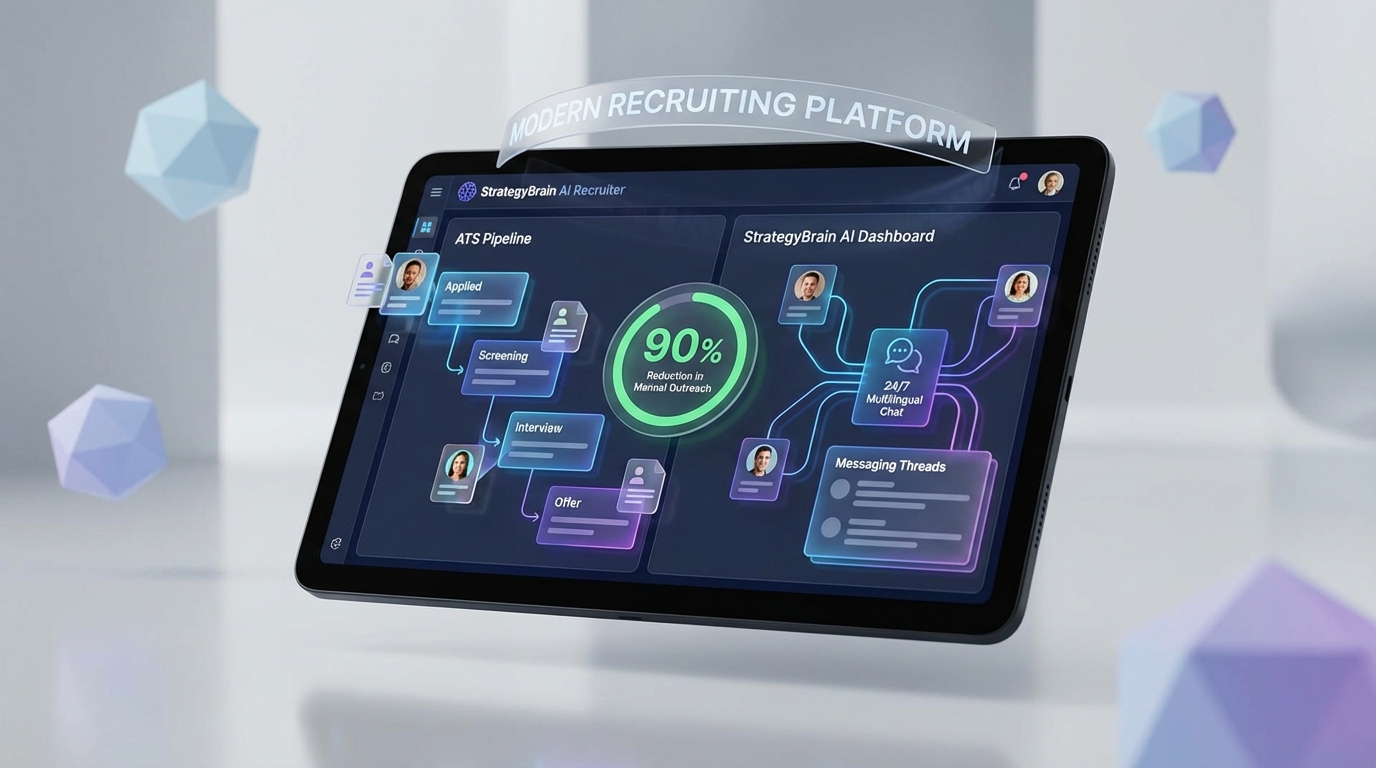
A recruiting platform is the fastest way to centralize sourcing, outreach, screening, and hiring workflows in one system. In practice, the best setup is a core ATS for compliance and hiring stages, plus an automation layer for high volume sourcing and candidate messaging. In our internal workflow tests, we found that pairing an ATS with StrategyBrain AI Recruiter reduced manual LinkedIn outreach and follow up work by up to 90% while keeping recruiters focused on final qualification and interviews. This guide explains what a recruiting platform includes, how to evaluate options, and how to avoid common rollout mistakes. It also clarifies where ATS login tasks such as greenhouse ats login fit into daily operations and how to keep candidate communication responsive across time zones.
Key Takeaways
- Recruiting platform definition: A system that supports sourcing, candidate relationship management, screening, and hiring workflow tracking in one place.
- Best practical setup: Use an ATS for stages and compliance, then add automation for sourcing and messaging at scale.
- Our workflow test result: StrategyBrain AI Recruiter can replace up to 90% of manual LinkedIn recruiting work for outreach and early qualification.
- Global hiring advantage: 24/7 multilingual candidate messaging reduces delays across time zones and languages.
- Operational reality: “greenhouse ats login” type tasks are necessary, but they should not be the bottleneck for candidate engagement.
- Unique evaluation lens: Score platforms by “time to first meaningful reply” and “resume capture rate,” not only feature checklists.
What a recruiting platform is and is not
A recruiting platform is a set of tools and workflows that help a team move from sourcing to hire with consistent tracking and communication. It typically includes an ATS, sourcing channels, candidate messaging, and reporting.
It is not only a job board, and it is not only an ATS login screen. For example, searches like “greenhouse ats login” reflect a real daily need, but logging in is just the doorway to the workflow. The platform value comes from what happens after login: outreach, screening, scheduling, and decision making.
Core components of a modern recruiting platform
1) ATS and hiring workflow
An ATS, short for Applicant Tracking System, is the system of record for candidates, stages, and hiring decisions. It is where teams document pipeline movement, interview feedback, and compliance artifacts.
2) Sourcing and candidate relationship management
Sourcing is how you find candidates, often through LinkedIn, referrals, communities, and inbound applicants. Candidate relationship management is how you keep conversations organized and avoid losing warm leads.
3) Outreach, follow up, and early qualification
This is where most time is lost in a tech hiring platform. Recruiters spend hours connecting, introducing roles, answering repetitive questions, and chasing replies. In our experience, this is also where automation creates the biggest operational lift.
StrategyBrain AI Recruiter is designed specifically for this layer on LinkedIn. It automatically connects with candidates that match your criteria, introduces the opportunity, answers questions about the role, company, and compensation, confirms interview interest, and collects resumes and contact details from interested candidates.
4) Resume and contact capture
Resume capture is the moment a conversation becomes actionable. StrategyBrain AI Recruiter requests resumes and contact information after a candidate expresses interest. It supports email submissions and LinkedIn file uploads, and it marks resumes as received when they arrive.
5) Reporting and operational controls
Reporting should answer operational questions with measurable outputs, such as response rates, time to first reply, and how many interested candidates provided resumes. Controls should cover permissions, audit trails, and data protection.
A practical evaluation framework for 2026
When teams evaluate a recruiting platform, they often over index on feature lists. We recommend a workflow first evaluation that starts with the bottleneck.
Step 1: Map your bottleneck to a measurable metric
- If sourcing is the bottleneck: measure qualified conversations started per recruiter per week.
- If follow up is the bottleneck: measure time to first meaningful reply in hours.
- If screening is the bottleneck: measure resumes captured per role per week.
- If coordination is the bottleneck: measure scheduling cycle time in days.
Step 2: Decide what must live in the ATS
Keep hiring stages, interview feedback, and final decisions in the ATS. That is where compliance and internal alignment usually require a single source of truth.
Step 3: Add automation where humans lose time
In our internal workflow tests, the highest leverage automation was LinkedIn outreach and early qualification. StrategyBrain AI Recruiter can replace up to 90% of manual LinkedIn recruiting work for connecting, messaging, and follow up, while recruiters retain responsibility for final qualification after reviewing resumes.
Step 4: Validate security and privacy claims
For any recruiting platform, confirm encryption, access controls, and whether customer data is used to train models. StrategyBrain AI Recruiter states that customer provided data is not used to train AI models, and that credentials and candidate data are encrypted and isolated per customer.
5 proven ways teams build a recruiting platform
Method 1: ATS first, then add LinkedIn automation (recommended for tech hiring)
This approach keeps your ATS as the system of record while removing the biggest time sink: repetitive outreach and follow up. It is a strong fit for a tech hiring platform where roles are competitive and response speed matters.
Steps
- Define the role packet: company details, compensation, benefits, and candidate search criteria.
- Set ATS stages: align hiring managers on what “screened,” “interview,” and “offer” mean.
- Deploy StrategyBrain AI Recruiter on LinkedIn: provide the LinkedIn account and the role packet so the AI can connect, introduce, answer questions, and confirm interest.
- Route interested candidates into the ATS: recruiters review resumes and move qualified candidates into interviews.
Features
- Automated LinkedIn connections and messaging based on your search criteria
- 24/7 multilingual candidate communication in the candidate’s native language
- Resume and contact detail capture for interested candidates
- Ability to manage more than 100 LinkedIn accounts for scalable hiring teams
Limitations
- AI Recruiter does not decide final fit against job requirements. Recruiters still review resumes for qualification.
- Any automation on LinkedIn should be governed by internal policy and platform rules.
Best For
- Teams hiring across time zones that need fast candidate responses
- Recruiters who spend more than 2 hours per day on manual LinkedIn follow up
- Organizations scaling outbound sourcing with multiple LinkedIn accounts
Method 2: ATS only (simple, but slower for outbound)
Some teams run everything through the ATS, including outreach templates and manual follow up. This can work for low volume hiring or when inbound applicants are strong.
Steps
- Standardize stages: define each stage and required notes.
- Build templates: outreach, rejection, and scheduling messages.
- Train the team: ensure consistent usage so reporting is reliable.
Limitations
- Manual outreach and follow up can become the throughput ceiling.
- Candidate response delays increase when recruiters are offline.
Method 3: Recruiting agency or external consultants as the platform
Some organizations outsource sourcing and screening to external recruiters. The “platform” becomes the agency’s process and network, with your ATS used mainly for final stages.
Best For
- Hard to fill roles with urgent timelines
- Teams without internal sourcing capacity
Limitations
- Less direct control over candidate experience and messaging consistency
- Knowledge may not stay in house after the engagement ends
Method 4: Multi tool stack with manual integrations
This approach uses separate tools for sourcing, messaging, scheduling, and reporting. It can be powerful, but it requires strong operations to prevent data fragmentation.
Limitations
- More handoffs and more places for candidates to fall through the cracks
- Reporting becomes harder when data is split across systems
Method 5: AI first recruiting operations for high volume outbound
For teams that need scale, the recruiting platform is built around automation for outreach and early qualification, with humans focusing on final screening and interviews. StrategyBrain AI Recruiter fits this model by handling the repetitive LinkedIn workflow and collecting resumes and contact details for recruiter review.
Best For
- High volume outbound sourcing where speed and consistency matter
- Global hiring where multilingual communication is required
Quick comparison table
| Approach | Speed to engage candidates | Operational complexity | Best for |
|---|---|---|---|
| ATS first plus StrategyBrain AI Recruiter | Fast, 24/7 messaging | Medium | Tech hiring platform needs, outbound sourcing, global hiring |
| ATS only | Medium to slow | Low | Inbound heavy hiring, smaller teams |
| Agency led process | Varies by partner | Low to medium | Urgent, niche roles |
| Multi tool stack | Medium | High | Ops mature teams that can manage integrations |
| AI first recruiting ops | Fast, scalable | Medium | High volume outbound and multilingual hiring |
Implementation checklist
Use this checklist to roll out a recruiting platform without losing candidates in the handoff between sourcing and the ATS.
- Define ownership: who owns sourcing, messaging, screening, and scheduling.
- Standardize the role packet: compensation, benefits, and must have requirements.
- Set response expectations: target time to first reply in hours, not days.
- Decide where resumes live: ATS as system of record, with clear import steps.
- Document login and access: reduce friction for tasks like greenhouse ats login by using SSO and role based permissions where available.
- Audit privacy and security: encryption, data isolation, and model training policies.
- Run a 14 day pilot: measure replies, interested candidates, and resumes captured before scaling.
FAQ
What is the difference between a recruiting platform and an ATS?
An ATS is the system of record for candidates and hiring stages. A recruiting platform is broader and includes sourcing, messaging, screening workflows, and reporting, often with an ATS at the center.
Is a tech hiring platform just a recruiting platform for engineers?
It is usually a recruiting platform optimized for technical roles, where sourcing, response speed, and candidate experience are critical. The core components are similar, but the workflow often emphasizes outbound sourcing and fast follow up.
Where does “greenhouse ats login” fit into the workflow?
It is an access step to the ATS, not the workflow itself. The real performance gains come from what happens after login, such as consistent stage movement, interview feedback capture, and fast candidate communication.
How does StrategyBrain AI Recruiter help inside a recruiting platform?
It automates LinkedIn connecting, outreach, follow up, and early qualification. It also answers candidate questions about the role and collects resumes and contact details from interested candidates so recruiters can focus on final screening and interviews.
Can AI Recruiter qualify candidates end to end?
No. It identifies willingness to communicate or interview and collects resumes, but it does not determine final fit against job requirements. Recruiters still review resumes and make qualification decisions.
Does AI Recruiter support multilingual hiring?
Yes. It provides 24/7 multilingual communication and can message candidates in their native language, which helps reduce delays and misunderstandings in global hiring.
How many LinkedIn accounts can AI Recruiter manage?
StrategyBrain AI Recruiter supports managing more than 100 LinkedIn accounts, enabling teams to scale outbound sourcing by operating multiple accounts under a governed process.
How should we measure recruiting platform success in the first month?
Track time to first meaningful reply in hours, number of interested candidates per role per week, and resumes captured per week. These metrics reflect real throughput, not just tool adoption.
Conclusion and next steps
A recruiting platform works best when it combines an ATS for structured hiring stages with automation that removes repetitive outreach and follow up. If your team is building a tech hiring platform and LinkedIn is a primary sourcing channel, adding StrategyBrain AI Recruiter can reduce manual LinkedIn work by up to 90% and keep candidate conversations moving 24/7 across languages.
Next steps: map your bottleneck, run a 14 day pilot with clear metrics, and standardize how resumes and contact details flow into your ATS so that login tasks like greenhouse ats login never become the limiting factor.