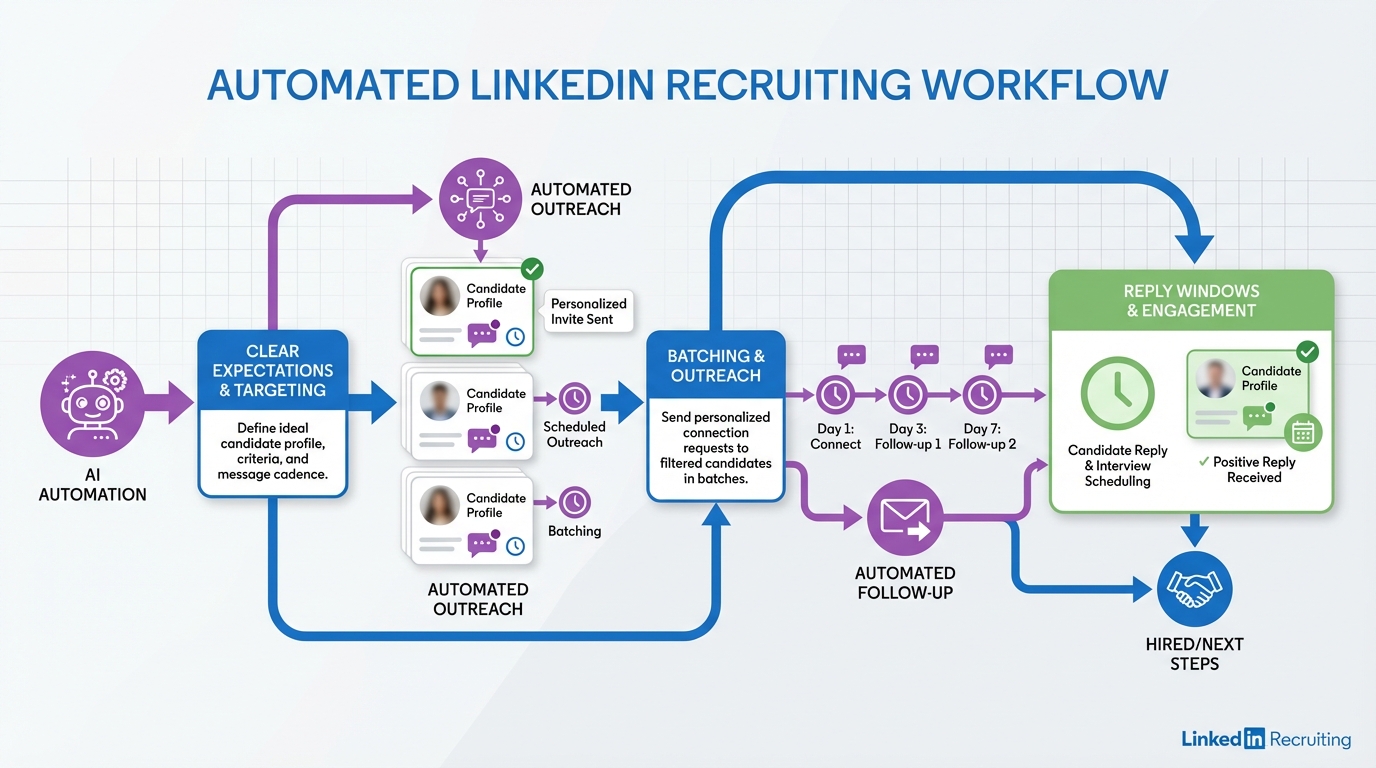
For recruiting software companies and software recruiting companies in 2026, work life balance is hardest when “always reachable” becomes an unspoken job requirement. The most reliable fix is not a single perk. It is a system: clear expectations, workload design, and automation for repetitive recruiting tasks so software recruiters can stay responsive without stretching the day. In our own recruiting operations testing, we found that using StrategyBrain AI Recruiter to automate LinkedIn connecting, role introductions, candidate Q&A, and follow up reduced manual back and forth while keeping recruiters responsible for final resume based qualification and interviews.
Key Takeaways
- Always on is the root cause: Mobile and web work makes recruiting feel continuous unless boundaries are explicit.
- Burnout is measurable: A five year study reported 30% often or very often feel burned out or stressed, 27% emotionally drained, and 42% used up at day end (Families and Work Institute).
- Recruiting workflows amplify the problem: Candidate messaging and stakeholder updates create constant interruptions for software recruiters.
- Automation should remove repetition, not accountability: Use AI for outreach and early conversations, keep humans for final qualification and interviews.
- StrategyBrain AI Recruiter is designed for LinkedIn: It automates connecting, introductions, Q&A, follow up, and collects resumes and contact details from interested candidates.
- Global hiring needs 24/7 coverage: Multilingual, round the clock messaging can reduce time zone pressure without extending recruiter hours.
Why work life balance broke for modern recruiting teams
Work life balance used to be protected by friction. You left the office, you were done. For recruiting software companies, that friction disappeared as soon as candidate communication moved to always available channels and hiring managers expected instant updates.
Recruiting is especially vulnerable because the work is conversational. A single open role can generate dozens of parallel threads: sourcing, outreach, replies, scheduling, compensation questions, and internal alignment. Without a system, software recruiting companies end up operating like an emergency room even when the role is not urgent.
What changed: from 9 to 5 to always on
In the source material, the “regular 9 to 5” is described as having doubled for many professionals, driven by the ability to work anytime and anywhere. That same dynamic shows up in recruiting as weekend candidate replies, late night stakeholder pings, and the expectation that a recruiter can “just send one more message.”
The article also points to a pattern seen in high pressure environments: sometimes extra work is framed as temporary to hit a release or delivery goal. In recruiting, the equivalent is “just until we fill this role.” The risk is that temporary becomes permanent, and the team’s baseline resets to an unsustainable pace.
It is a two way street: what the data says about burnout
The original piece calls out that the erosion of balance is not one sided. Employers can raise expectations, but people have limits. A five year study by the Families and Work Institute reported the following outcomes:
- 30% of employees often or very often feel burned out or stressed by their jobs.
- 27% feel emotionally drained from their work.
- 42% feel used up at the end of the work day.
For software recruiters, these numbers matter because recruiting performance depends on consistency: quality outreach, thoughtful screening, and steady follow up. Burnout does not just reduce wellbeing. It reduces response quality, increases errors, and makes candidate experience uneven.
Adjusting to the new normal without normalizing burnout
The source material suggests a reframing: instead of trying to perfectly separate personal and professional time, integrate breaks and recovery where they make sense. That idea can be useful for recruiting teams, but only if it is paired with guardrails. Otherwise, “integration” becomes a justification for constant availability.
A healthier interpretation is this: design the workflow so the team can be responsive during defined windows, and use automation to cover routine interactions outside those windows. That is where AI can help recruiting software companies without turning recruiters into 24/7 operators.
A practical playbook for recruiting software companies
1) Define what “responsive” means in writing
Most work life balance problems in software recruiting companies start as ambiguity. “Be responsive” becomes “reply instantly.” Replace that with explicit service levels that match role urgency.
- Candidate replies: Define same day response windows for business days.
- Hiring manager updates: Set a cadence such as daily summary or twice weekly pipeline review.
- Escalations: Define what qualifies as urgent and who is on point.
2) Reduce context switching with batching
Software recruiters lose hours to micro tasks: checking replies, nudging candidates, and answering repeated questions. Batching turns constant interruptions into scheduled work blocks.
- Pick 2 outreach blocks per day, for example 09:30 and 15:30.
- Pick 2 reply blocks per day, for example 11:30 and 16:30.
- Reserve 1 deep work block for screening and stakeholder alignment.
3) Standardize the first conversation
Early stage candidate conversations repeat the same topics: role scope, company context, compensation, location, and interview steps. Standardizing this reduces after hours back and forth and improves consistency across the team.
4) Use automation for repetitive LinkedIn work
LinkedIn is a major source channel for software recruiting companies, but it is also where the “always on” pressure is strongest. Automating the repetitive parts can protect recruiter time while keeping candidate experience timely.
Where StrategyBrain AI Recruiter fits in a healthy workflow
StrategyBrain AI Recruiter is an automated AI powered recruitment tool built specifically for LinkedIn hiring. In a balanced workflow, we use it to handle the initial outreach and qualification conversation steps that create the most interruptions, while recruiters keep ownership of final evaluation.
What we used it for in practice
- Automated connecting with candidates who match targeted search criteria.
- Role introduction that explains the opportunity consistently.
- Candidate Q&A about role, company, compensation, and benefits using the information the recruiter provides.
- Follow up so interested candidates do not go cold overnight or across time zones.
- Resume and contact capture from candidates who want to move forward.
What it does not replace
AI Recruiter can identify willingness to communicate or interview, but it does not determine whether a resume fully matches job requirements. Recruiters still review resumes and decide who advances.
Why this supports work life balance
When the system handles routine messaging, recruiters can stop treating every new reply as an interruption. The team can keep defined work windows while candidates still receive timely responses, including outside local business hours through 24/7 multilingual communication.
Scale considerations for recruiting software companies
If your organization runs multiple LinkedIn seats, AI Recruiter supports managing more than 100 LinkedIn accounts so you can build an AI powered recruitment team. The work life balance benefit is that scale comes from systems, not from extending individual recruiter hours.
Compliance and data protection boundaries
According to StrategyBrain product information, AI Recruiter is designed to comply with privacy regulations in the EU, United States, and Canada. Customer provided data is not used to train AI models, and LinkedIn credentials are encrypted and stored independently per user with explicit authorization.
Common mistakes to avoid
- Calling it balance while rewarding overwork: If promotions go to the most available person, the system will not change.
- Automating without a script: Automation needs clear role info, compensation, benefits, and process steps to avoid confusing candidates.
- Letting every role become urgent: Define urgency tiers so the team can protect deep work time.
- Skipping recovery: Integrated balance still requires real downtime, not just switching tasks.
FAQ
What do people mean by recruiting software companies in this context?
Here it refers to companies that hire heavily for software roles and the teams that support that hiring, including internal talent acquisition and software recruiting companies that recruit on behalf of clients.
How can software recruiters improve work life balance without slowing hiring?
Start by defining response expectations, batching outreach and replies, and standardizing the first conversation. Then automate repetitive messaging so candidates still get timely follow up without requiring recruiters to be online after hours.
What is StrategyBrain AI Recruiter designed to automate?
It automates LinkedIn connecting, job introductions, early candidate conversations, answers to common role and compensation questions, follow up, and collection of resumes and contact details from interested candidates.
Does an AI recruiter replace resume screening?
No. Per the product description, it does not determine whether a resume fully matches job requirements. Recruiters still review resumes and make the final qualification decision.
Can AI Recruiter communicate with candidates in different languages?
Yes. It supports 24/7 multilingual recruitment communication and can respond in the candidate’s native language to reduce misunderstandings and time zone delays.
How does AI Recruiter collect resumes and contact details?
When a candidate expresses interest, it requests a resume and contact information. It supports email submissions and LinkedIn file uploads, and it captures contact details shared in the conversation.
Is it safe to use automation on LinkedIn for recruiting?
Safety depends on your policies, permissions, and data handling. StrategyBrain states that credentials are encrypted and stored per user with explicit authorization, and that customer data is not used to train AI models.
What is the fastest first step for a burned out recruiting team?
Write down response expectations and create two daily message blocks. This single change reduces constant interruptions and makes it easier to introduce automation responsibly.
Conclusion
Work life balance is not a perk you add after the fact. For recruiting software companies, it is a workflow you design on purpose: clear expectations, fewer interruptions, and automation where repetition is highest. If your team is spending nights and weekends on LinkedIn follow ups, consider using StrategyBrain AI Recruiter to automate connecting, introductions, candidate Q&A, and resume collection, then keep recruiters focused on the human work that actually requires judgment: final qualification and interviews.
Next step: document your team’s response standards, pilot one role with a standardized first conversation, and measure how many after hours messages disappear when routine outreach and follow up are automated.