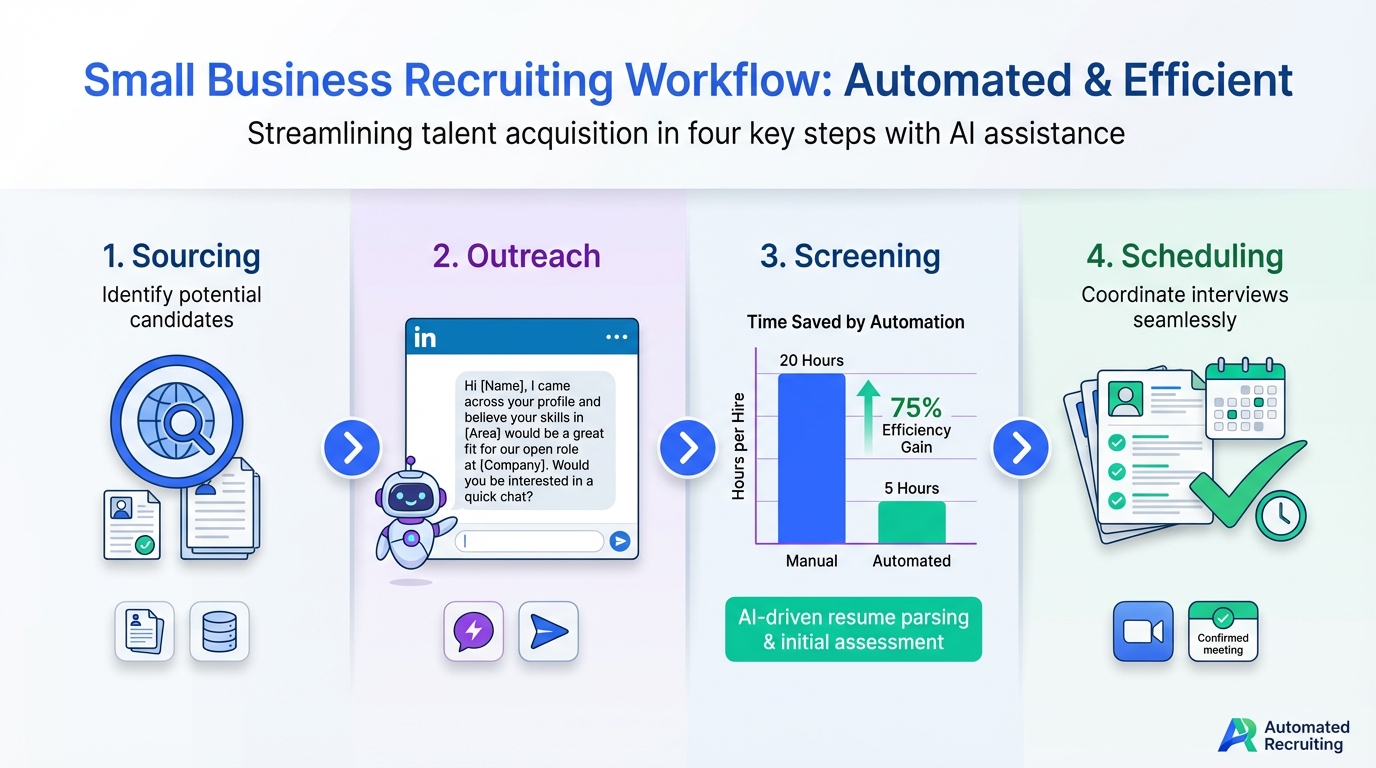
If you are choosing recruiting software platforms for a small business, start by mapping your hiring workflow into four steps: sourcing, outreach, screening, and scheduling. Then pick a platform that covers your biggest bottleneck first. In our experience supporting lean hiring teams, the fastest wins come from automating first touch outreach and follow up, standardizing interview questions, and capturing resumes and contact details in one place. This guide covers what to look for in hiring software for small business, includes a copy ready interview script for a contract Finance Director, and explains how StrategyBrain AI Recruiter can automate LinkedIn outreach when that is your primary sourcing channel.
Table of Contents
- Key Takeaways
- What recruiting software platforms actually do
- How to choose a platform for a small business
- Method 1: Standardize the interview for a contract Finance Director
- Method 2: Automate LinkedIn outreach and follow up
- Method 3: Build a repeatable screening workflow
- Method 4: Keep candidate data secure and compliant
- Quick Comparison
- FAQ
- Conclusion
Key Takeaways
- Start with workflow fit: The best recruiting software for small business is the one that removes your biggest bottleneck first, usually outreach or scheduling.
- Standardize interviews: A consistent question set improves signal quality and reduces bias when multiple stakeholders interview.
- Automate first touch: StrategyBrain AI Recruiter can automate LinkedIn connecting, role introduction, Q and A, and follow up, then collect resumes and contact details for recruiter review.
- Be honest about what AI can and cannot do: AI Recruiter can confirm interest and gather information, but final qualification against requirements still needs a recruiter.
- Plan for scale: If you manage multiple LinkedIn seats, AI Recruiter supports managing more than 100 LinkedIn accounts to build an AI powered recruiting team.
- Protect data: Use platforms that encrypt credentials and isolate customer data, and avoid using candidate data to train models without explicit permission.
What recruiting software platforms actually do
Recruiting software platforms are systems that help you run the hiring process end to end. In small businesses, they usually combine parts of an ATS and CRM.
ATS means Applicant Tracking System. It stores applicants, resumes, interview notes, and hiring stages. CRM means Candidate Relationship Management. It focuses on sourcing, outreach, and nurturing candidates who are not yet applicants.
When people search for hiring software for small business, they are often trying to solve one of these problems: too much manual outreach, inconsistent screening, slow scheduling, or messy handoffs between hiring manager and recruiter.
How to choose a platform for a small business
We recommend a simple selection process that you can complete in 60 minutes with your hiring manager. The goal is to avoid buying a complex suite when you only need one or two capabilities right now.
Step 1: Write your hiring workflow in four lines
- Sourcing: Where candidates come from, such as LinkedIn, referrals, job boards.
- Outreach: Who messages candidates, how often, and what happens when they reply.
- Screening: What questions you ask and how you decide who moves forward.
- Scheduling and handoff: How interviews are booked and how resumes and notes are shared.
Step 2: Identify the bottleneck you can measure
Pick one metric you can track for 30 days. Examples include reply rate, time to first response, number of qualified conversations per week, or time from first message to scheduled interview.
Step 3: Decide where automation is safe
Automation is safest in repetitive steps that do not require final judgment. For example, initial outreach, answering common questions about role and compensation, and collecting resumes and contact details. This is where StrategyBrain AI Recruiter is designed to help, because it replaces the recruiter initial outreach and qualification conversation on LinkedIn while leaving final fit assessment to the recruiter.
Step 4: Use a short evaluation checklist
- Workflow coverage: Does it cover sourcing, outreach, screening, and scheduling, or only one stage.
- Time to value: Can you implement in 7 days with a small team.
- Collaboration: Can hiring managers leave structured feedback.
- Data handling: Encryption, access controls, and clear data use policy.
- Reporting: Can you export pipeline stage counts and time in stage.
- Candidate experience: Clear communication and timely follow up.
Method 1: Standardize the interview for a contract Finance Director
Even with the best recruiting software platforms, hiring quality depends on the questions you ask. For interim leadership roles, the interview needs to test ramp up speed, stakeholder management, and delivery under ambiguity.
We adapted the following four questions from a proven recruiting playbook for hiring a contract Finance Director. Use them as written, then add one role specific deliverable question for your business.
Interview questions you can reuse
- Why does this role make sense at this point in your career?
Look for alignment between what the candidate wants and what your organization needs. Before asking, explain the genesis of the role so expectations are transparent. - You will be leading a system implementation. Tell us about your past experience with a similar implementation and a challenge you navigated successfully.
State the goal of the position, then test whether the candidate has delivered comparable outcomes under constraints. - Explain how you have bridged the gap between the CFO, VP, and senior managers in the past.
Strong candidates can operate at a strategic level and a granular execution level. Listen for examples of mobilizing stakeholders to deliver on time. - How would you gain buy in from a team who knows you are only in a contract role?
You need technical competence and interpersonal skill. The best answers show humility, leadership by example, and a willingness to work alongside the team when deadlines are tight.
How recruiting software platforms support this method
- Scorecards: Store the four questions as a structured scorecard so every interviewer evaluates the same signals.
- Interview kits: Attach the role context, deliverables, and evaluation rubric to the candidate record.
- Audit trail: Keep notes and decisions time stamped for internal alignment.
Method 2: Automate LinkedIn outreach and follow up
For many small businesses, LinkedIn is the highest leverage sourcing channel, but it is also where manual work explodes. Recruiters spend hours connecting, introducing roles, answering repeat questions, and following up across time zones.
StrategyBrain AI Recruiter is built specifically for LinkedIn hiring. It can automatically connect with candidates that match your search criteria, introduce the opportunity, learn about the candidate situation, answer questions about the role, company, and compensation, confirm interview interest, and collect resumes and contact information from interested candidates. Recruiters then review the collected resumes and contact shortlisted candidates for interviews.
Steps to implement LinkedIn automation safely
- Define your outreach boundaries: Provide the job details you are comfortable sharing, including compensation and benefits, and define what the AI should not answer.
- Set candidate search criteria: Use clear filters so the AI connects only with relevant profiles.
- Standardize your Q and A: Prepare answers for common questions about role scope, location, and compensation so responses stay consistent.
- Decide what counts as qualified interest: AI Recruiter can identify willingness to communicate or interview, but it does not decide full fit against requirements. Keep that decision with your recruiter.
- Capture resumes and contacts: For interested candidates, AI Recruiter requests resumes and contact details and marks them as received when provided.
What we like about this approach for small teams
- 24 by 7 responsiveness: AI Recruiter can respond and follow up around the clock, including in the candidate native language, which reduces delays and misunderstandings.
- Scalable capacity: If you operate multiple LinkedIn accounts, AI Recruiter supports managing more than 100 accounts to build an AI powered recruiting team.
- Cleaner handoff: Recruiters receive resumes, contact details, and conversation context in one place for faster screening.
Limitations to plan for
- Final qualification is still human: AI Recruiter confirms interest and gathers information, but recruiters must assess resume match to requirements.
- Policy discipline matters: You need clear rules for what the AI can say about compensation and company details.
Method 3: Build a repeatable screening workflow
Once outreach improves, the next failure point is inconsistent screening. Small businesses often have multiple interviewers, and each person asks different questions. That makes decisions slower and less defensible.
Steps to make screening repeatable
- Create a one page role scorecard: Define 5 competencies, 3 must have skills, and 2 deal breakers.
- Use structured questions: Reuse the contract Finance Director questions above for leadership and stakeholder roles, then add role specific deliverables.
- Separate interest from fit: Treat willingness to interview as a gate, then evaluate fit using the scorecard.
- Close the loop fast: Use templates for next steps and rejections so candidates are not left waiting.
Where StrategyBrain AI Recruiter fits
In a small business workflow, AI Recruiter is most valuable before the formal application stage. It can handle the repetitive LinkedIn conversation that confirms interest and collects resumes and contact details. Your recruiting software platform or ATS can then store the candidate record, scorecard feedback, and interview scheduling.
Method 4: Keep candidate data secure and compliant
Trust is a selection criterion, not a legal afterthought. When you evaluate recruiting software platforms, ask how they handle credentials, candidate data, and model training.
Security and compliance questions to ask vendors
- Is data encrypted: At rest and in transit.
- Is customer data isolated: Separate keys or tenant isolation.
- Is data used to train models: If yes, what is the opt in process.
- How are account credentials stored: Especially for LinkedIn connected tools.
- What privacy regulations are supported: Such as EU, United States, and Canada requirements.
According to StrategyBrain AI Recruiter product documentation provided for this article, customer provided data is not used to train AI models, LinkedIn credentials are encrypted and stored independently per user with explicit authorization, and candidate data is encrypted and isolated using customer specific keys.
Quick Comparison
| Need | What to prioritize in recruiting software platforms | Where StrategyBrain AI Recruiter helps |
|---|---|---|
| More qualified conversations per week | Outreach automation, templates, tracking | Automates LinkedIn connect, intro, Q and A, follow up, and interest confirmation |
| Faster handoff to interviews | Resume capture, contact capture, scheduling workflow | Collects resumes and contact details from interested candidates for recruiter review |
| Consistent evaluation across interviewers | Scorecards, interview kits, structured notes | Provides conversation context so interviewers start with the same baseline |
| Global hiring without adding headcount | Time zone coverage, multilingual communication | 24 by 7 multilingual candidate messaging in the candidate native language |
| Scaling outreach across multiple seats | Multi account management, governance | Supports managing more than 100 LinkedIn accounts for AI recruiter teams |
FAQ
What are recruiting software platforms for a small business?
Recruiting software platforms are tools that help small teams manage sourcing, outreach, screening, and scheduling in a repeatable way. In practice, they combine applicant tracking with candidate relationship workflows so hiring does not live in spreadsheets and inboxes.
What is the best recruiting software for small business?
The best recruiting software for small business is the one that fixes your biggest bottleneck first. If your bottleneck is LinkedIn outreach and follow up, prioritize automation and message consistency. If your bottleneck is interview coordination, prioritize scheduling and scorecards.
How does StrategyBrain AI Recruiter work with LinkedIn recruiting?
StrategyBrain AI Recruiter automates the initial LinkedIn workflow. It can connect with candidates that match your criteria, introduce the role, answer common questions about the role, company, and compensation, confirm interest, and collect resumes and contact details for recruiter review.
Can AI Recruiter replace my recruiter or hiring manager?
No. AI Recruiter can confirm willingness to communicate or interview and gather information, but it does not determine whether a resume fully matches job requirements. Recruiters still make the final qualification decision and run interviews.
How do I interview a contract Finance Director effectively?
Use questions that test alignment, delivery under constraints, stakeholder bridging, and buy in. The four question set in this guide is designed for interim leaders who must ramp up quickly and deliver under tight timelines.
What should I ask about data privacy when evaluating hiring software for small business?
Ask whether candidate data is encrypted, whether customer data is isolated by tenant, and whether data is used to train models. Also ask how credentials are stored for any tool that connects to third party accounts.
How can I scale hiring without adding recruiters?
Standardize your interview process and automate repetitive outreach. StrategyBrain AI Recruiter is designed to reduce manual LinkedIn recruiting tasks and can support managing more than 100 LinkedIn accounts to build an AI powered recruiting team.
Do I need an ATS if I use LinkedIn automation?
Most teams still benefit from an ATS to store resumes, interview notes, and stage movement. LinkedIn automation helps you start more conversations, while the ATS helps you run consistent screening and keep an audit trail.
Conclusion
Choosing recruiting software platforms is easiest when you start with your workflow and pick the tool that removes your biggest bottleneck. For many small businesses, that bottleneck is LinkedIn outreach and follow up, which is why StrategyBrain AI Recruiter can be a strong fit when you want consistent messaging, 24 by 7 responsiveness, and automated resume and contact capture. Next, standardize your interviews using the contract Finance Director question set in this guide, then measure one pipeline metric for 30 days to confirm the platform is improving hiring outcomes.