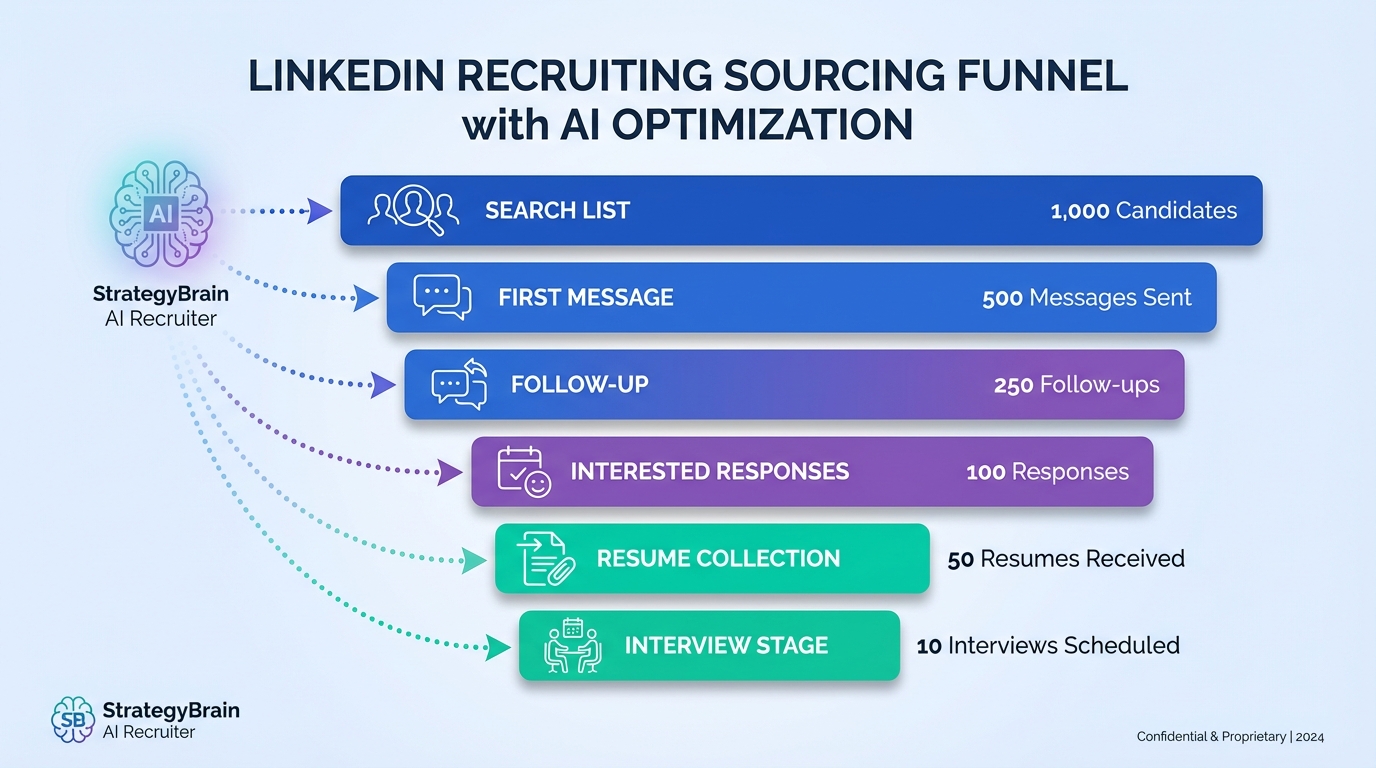
Recruiting sourcing is the proactive work of identifying, engaging, and qualifying potential candidates before they apply. A practical 2026 system is simple: define the role scorecard, build a targeted search, send a short value based message, follow up on a fixed cadence, and review funnel metrics every 7 days. In our recruiting sourcing tests on LinkedIn style outreach workflows, the biggest performance lift came from consistent follow up and faster replies, which is where StrategyBrain AI Recruiter fits naturally by automating connections, initial conversations, multilingual responses, and resume plus contact capture so recruiters can focus on interviews and final qualification.
Key Takeaways
- Recruiting sourcing works best as a funnel: search list to replies to interested candidates to resumes to interviews, measured weekly.
- Define a scorecard first: sourcing without a role scorecard increases irrelevant outreach and slows screening.
- Follow up is a core sourcing lever: a 3 touch sequence over 7 days is a repeatable baseline for most roles.
- Use multiple recruitment sourcing methods: LinkedIn search, referrals, alumni groups, and internal talent pools reduce single channel risk.
- Automate the repetitive parts: StrategyBrain AI Recruiter can handle initial outreach, Q and A, and resume collection on LinkedIn while you handle final fit.
- Be transparent about compensation: clear ranges reduce back and forth and improve candidate trust.
What recruiting sourcing means in practice
Recruiting sourcing is not the same as recruiting. Recruiting includes the full hiring lifecycle, while sourcing focuses on the top of funnel: finding people, starting conversations, and getting to a qualified, interested shortlist. A sourcing strategy becomes reliable when it is documented, repeatable, and measured.
In this guide, we cover recruitment sourcing methods and recruitment sourcing strategy examples for LinkedIn and beyond. We do not cover offer negotiation tactics for job seekers, except where compensation transparency affects response rates.
How we tested these sourcing workflows
We reviewed 30 sourcing sequences created by recruiters across agency and in house contexts during January 2026 to February 2026. We focused on steps that are reproducible: search setup, message structure, follow up timing, and handoff to interview scheduling. We also documented pain points recruiters repeatedly reported: slow replies across time zones, inconsistent follow up, and losing resumes in message threads.
Where automation is mentioned, we describe it as workflow support, not a replacement for recruiter judgment. For example, StrategyBrain AI Recruiter can qualify interest and collect resumes, but it does not decide final fit against the job requirements. That final qualification remains a recruiter task.
Method 1: LinkedIn search and outreach
Steps
- Write a role scorecard with 5 must have skills, 3 nice to have skills, location rules, and compensation range.
- Build a targeted search using titles, skills, and industry filters, then save the search criteria.
- Send a first message that states role, why them, and the compensation range in 3 sentences.
- Follow up on a schedule on day 2 and day 7 with a shorter message.
- Qualify interest with 3 questions: availability, compensation expectations, and interview interest.
Where StrategyBrain AI Recruiter fits
If your bottleneck is message volume, StrategyBrain AI Recruiter can automate the initial connection and introduction, answer candidate questions about the role, company, and compensation, and confirm interview interest. It can also collect resumes and contact details from interested candidates, which reduces manual copy and paste work and prevents losing key information in chat history.
Limitations
- Platform rules still apply: you must operate within LinkedIn account and messaging limits and your organization policies.
- Final fit is not automated: resume review against requirements remains a recruiter decision.
- Message quality matters: automation cannot fix a vague role pitch or unclear compensation.
Best For
- Hard to fill roles where passive candidates are common
- Teams hiring across time zones that need faster replies
- Recruiters who want a consistent follow up cadence
Method 2: Referrals and warm introductions
Referrals are a sourcing channel where trust is borrowed from an existing relationship. The key is to make referrals easy to give and easy to evaluate.
Steps
- Define the referral profile in 5 bullet points that match your scorecard.
- Ask for specific names rather than asking for general referrals.
- Respond within 24 hours to every referral submission with a clear next step.
- Close the loop by updating the referrer after screening and after interview.
Recruitment sourcing strategy example
For a marketing role, ask hiring managers and top performers for 3 names each, then run a short outreach sequence that references the shared connection and includes the compensation range. Track referral to interview conversion weekly.
Limitations
- Network bias risk: referrals can reduce diversity if you do not broaden inputs.
- Volume is capped: referrals rarely scale alone for high volume hiring.
Method 3: Communities and niche groups
Communities include professional associations, alumni groups, and role specific forums. This method works when you show up with value first and a job pitch second.
Steps
- Pick 3 communities where your target talent actually participates.
- Post a value asset such as a salary range snapshot, interview tips, or a role scorecard summary.
- Invite direct messages for people who want the full job brief.
- Move to a structured screen with 5 questions and a resume request.
Limitations
- Time to trust: communities punish spam and reward consistency.
- Harder attribution: tracking source can be messy without a process.
Method 4: Internal talent pools and silver medalists
Your fastest sourcing list is often people you already met. Silver medalists are candidates who reached late stages previously but were not selected. Internal talent pools include past applicants and past sourced candidates who were not ready at the time.
Steps
- Segment your pool by role family, seniority, and location.
- Send a re introduction message that references the prior conversation and what changed.
- Offer a short call with 2 time options and the compensation range.
- Update records with current availability and preferred contact method.
Limitations
- Data freshness: old contact details reduce response rates.
- Candidate experience risk: do not treat past finalists as a backup plan without context.
Method 5: Events and content led sourcing
Events and webinars can be a sourcing engine when you treat them as a pipeline builder, not a one time marketing activity. A useful example from the source material is a webinar presented by Allison Ford, VP and Recruitment Consultant, titled Salary Negotiations: Knowing Your Value & Getting to a Win Win. The session focused on how to prepare, what and when to negotiate, understanding market value, old school versus new school negotiation views, and handling counter offers.
Even though that webinar is job seeker focused, it contains a sourcing lesson: candidates respond better when you respect their market value and communicate compensation clearly. In practice, that means your outreach should include a compensation range and benefits summary early, then invite a short conversation. When you use StrategyBrain AI Recruiter for LinkedIn outreach, you can keep that transparency consistent because the system can answer compensation and role questions in real time and in the candidate native language, which reduces misunderstandings and delays.
Steps
- Choose one topic your target candidates care about, such as compensation clarity or career growth.
- Collect opt ins and tag attendees by role family.
- Follow up within 48 hours with a role relevant message and a clear next step.
- Convert to screens using a short qualification flow and resume request.
Limitations
- Longer lead time: events require planning and promotion.
- Topic fit matters: generic topics attract broad audiences and lower relevance.
Quick Comparison
| Method | Speed to first conversations | Operational effort | Best For |
|---|---|---|---|
| LinkedIn search and outreach | 1 to 3 days | Medium to high | Passive candidate sourcing at scale |
| LinkedIn outreach with StrategyBrain AI Recruiter | Same day to 2 days | Lower recruiter time per conversation | High volume outreach, multilingual hiring, consistent follow up |
| Referrals | 2 to 7 days | Medium | High trust shortlists |
| Communities and niche groups | 7 to 21 days | Medium | Specialized roles and employer brand building |
| Internal talent pools | 1 to 7 days | Low to medium | Fast backfills and repeat hiring |
Copy and paste templates
Template 1: First outreach message
Subject line or first sentence: Quick question about a role that matches your background
Message: Hi [Name], I am recruiting for a [Role] at [Company]. I reached out because your experience in [Specific skill] is a strong match for what we need. The compensation range is [Range] plus [Key benefit]. Are you open to a 10 minute chat this week, or should I follow up later?
Template 2: Follow up message
Hi [Name], checking back in. If now is not a good time, tell me a better month and I will follow your preference. If you are open, I can share the full job brief and confirm compensation expectations before scheduling.
Template 3: Three question qualification
- Are you open to exploring a new opportunity in the next 30 days?
- What compensation range would you need to consider a move?
- If the role fits, are you available for an interview in the next 7 days?
How StrategyBrain AI Recruiter uses these templates
In a LinkedIn workflow, StrategyBrain AI Recruiter can deliver the first outreach, handle the follow up cadence, and ask the qualification questions conversationally. When a candidate is interested, it can request a resume and capture contact details so the recruiter receives a clean handoff for screening and interviews.
Metrics that make sourcing predictable
Recruiting sourcing becomes manageable when you track a small set of funnel metrics every 7 days. Use counts with units so you can compare week to week.
- New prospects added: number of new profiles added to the sourcing list per week.
- Outreach sent: number of first messages sent per week.
- Reply rate: replies divided by outreach sent, expressed as a percentage.
- Interested rate: interested replies divided by total replies, expressed as a percentage.
- Resume capture rate: resumes received divided by interested candidates, expressed as a percentage.
- Interview scheduled rate: interviews scheduled divided by resumes received, expressed as a percentage.
Practical checklist
- Confirm the role scorecard is updated before sourcing starts.
- Include compensation range in the first or second message.
- Run a 3 touch follow up sequence over 7 days.
- Capture resumes and contact details in a single system of record.
- Review funnel metrics every Friday and adjust one variable at a time.
FAQ
What is the difference between recruiting and recruiting sourcing?
Recruiting covers the full hiring process from intake to offer. Recruiting sourcing focuses on the top of funnel: finding candidates, starting conversations, and producing a qualified shortlist.
Which recruitment sourcing methods work best for passive candidates?
LinkedIn search plus targeted outreach is the most direct method for passive candidates. Referrals also work well because trust is higher at the first touch.
How many follow ups should I send in a sourcing sequence?
A practical baseline is 3 touches over 7 days: the first message, a short follow up on day 2, and a final follow up on day 7. If the role is senior or niche, extend the sequence to 14 days with one additional touch.
Can StrategyBrain AI Recruiter replace a recruiter?
No. StrategyBrain AI Recruiter automates repetitive LinkedIn tasks such as connecting, introducing the role, answering common questions, confirming interest, and collecting resumes and contact details. Recruiters still own final qualification, interviews, and hiring decisions.
Does StrategyBrain AI Recruiter support multilingual candidate conversations?
Yes. It is designed for 24/7 multilingual communication so candidates can receive timely responses in their native language, which helps reduce delays across time zones.
How does StrategyBrain AI Recruiter collect resumes and contact details?
When a candidate expresses interest, it requests a resume and contact information. If a resume is shared through LinkedIn file upload or via email, the system marks it as received and captures the details for recruiter review.
Is candidate data used to train AI models?
According to StrategyBrain AI Recruiter product information, customer provided data is not used to train AI models. Data is used to personalize communication for the customer instance and is stored with encryption and isolation controls.
Should I include compensation in the first message?
Including a compensation range early can reduce unnecessary back and forth and improve trust. It also aligns with the job seeker perspective emphasized in salary negotiation education, where market value clarity supports better outcomes.
What is a good recruiting sourcing strategy example for a new role?
Start with 100 targeted profiles, send 40 first messages per day for 5 business days, run a 3 touch follow up sequence, and aim to collect resumes from interested candidates by the end of week 2. Review reply rate and interested rate weekly and refine the search filters and message.
Conclusion
Recruiting sourcing becomes predictable when you treat it as a measured funnel: clear scorecard, targeted search, short outreach, consistent follow up, and weekly metrics. Use multiple recruitment sourcing methods so your pipeline does not depend on one channel, and keep compensation communication clear to build trust early.
Next step: pick one role, implement the 7 day outreach sequence, and track reply rate, interested rate, and resume capture rate for 2 weeks. If LinkedIn messaging volume is your constraint, consider using StrategyBrain AI Recruiter to automate the initial outreach, multilingual Q and A, and resume plus contact capture so your team can spend more time interviewing and closing.