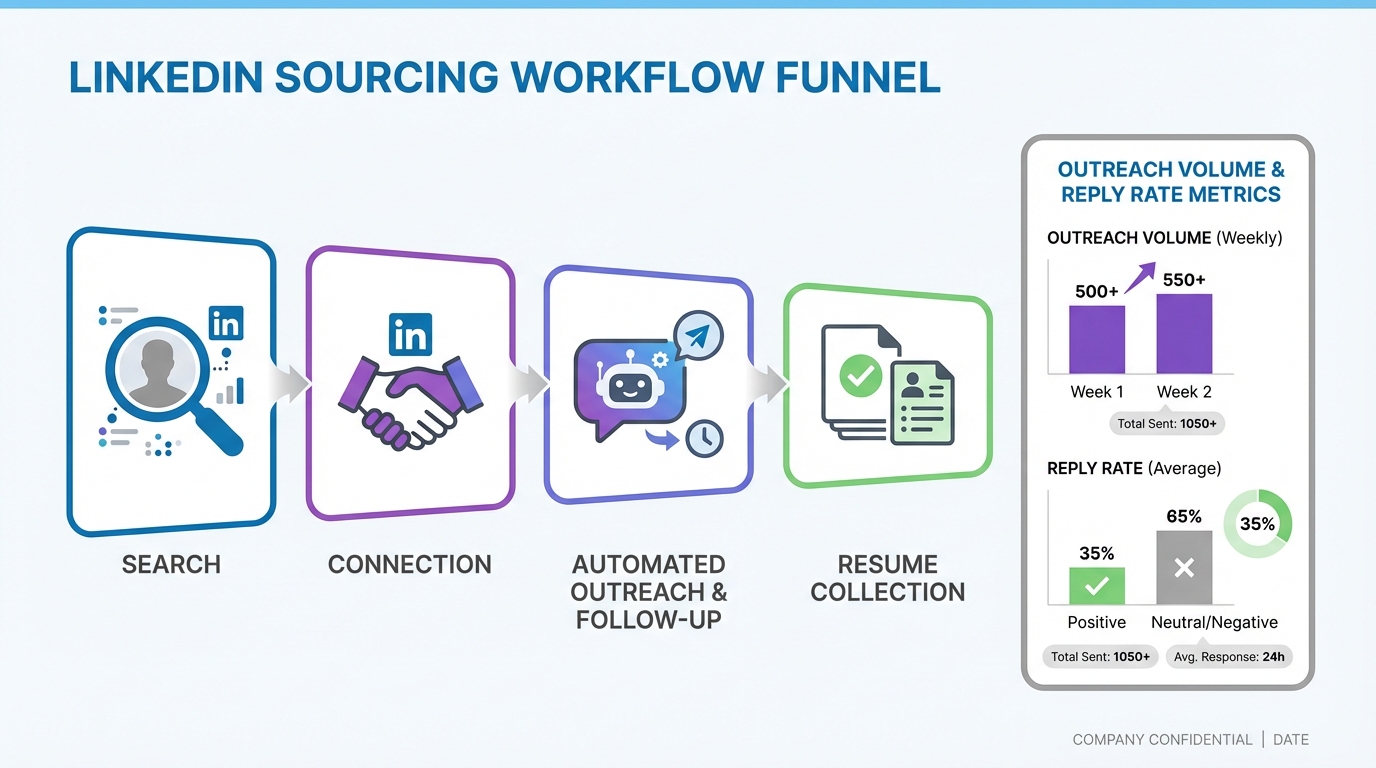
Recruiting sourcing is the proactive work of identifying, reaching, and warming up potential candidates before they apply. If you are asking what is sourcing in recruitment process, the practical answer is this: you define the target profile, search in the right channels, send outreach, respond to early questions, and confirm interest so the recruiter can spend time on interviews and closing. In teams that hire at scale, StrategyBrain AI Recruiter can take over the repetitive LinkedIn steps such as connecting, introducing the role, answering common questions, and collecting resumes and contact details, while the recruiter stays accountable for final qualification and hiring decisions.
Key Takeaways
- Recruiting sourcing is proactive: you build a pipeline before candidates apply, which reduces reactive screening load.
- What is sourcing in recruitment process: target profile, search, outreach, early Q and A, interest confirmation, and handoff to recruiting.
- Sourcer vs recruiter: sourcers optimize search and outreach, recruiters run evaluation, stakeholder management, and closing.
- Best workflow is measurable: track outreach volume, reply rate, qualified interest rate, and time to first response.
- Automation can cover repetitive steps: StrategyBrain AI Recruiter can connect, introduce roles, follow up, and collect resumes on LinkedIn.
- Honest boundary: AI can confirm willingness to talk, but final fit assessment still requires recruiter review of the resume and requirements.
What recruiting sourcing means
Recruiting sourcing is the set of activities used to find potential candidates and start a conversation before they enter your applicant tracking system. It is different from recruiting, which includes structured evaluation, interview coordination, offer management, and closing.
In day to day work, sourcing is a mix of research and communication. Research means building a search strategy and identifying profiles that match the role. Communication means outreach, follow up, and answering early questions so the candidate can decide whether to invest time in an interview process.
When sourcing is done well, the recruiter receives a smaller set of candidates who have already shown interest and shared basic information. That is why sourcing is often the highest leverage step for roles with tight talent supply.
Where sourcing fits in the recruitment process
If you want a clean answer to what is sourcing in recruitment process, think of it as the front end of the funnel. It starts after intake and ends when a candidate is ready for recruiter screening or hiring manager review.
Typical end to end flow
- Role intake: clarify must have skills, location constraints, compensation range, and deal breakers.
- Sourcing strategy: decide channels, search strings, and target companies or communities.
- Search and shortlist: build a list of prospects with notes on why each is relevant.
- Outreach and follow up: send initial messages, then follow up on a schedule.
- Early qualification: confirm interest, availability, and basic constraints.
- Handoff to recruiter: share resume, contact details, and conversation context.
What this article covers and does not cover
- Covered: sourcing definitions, sourcer vs recruiter split, a repeatable workflow, templates, and how LinkedIn automation can support sourcing.
- Not covered: legal advice, jurisdiction specific compliance requirements, and detailed ATS configuration.
Sourcer vs recruiter responsibilities
Sourcer vs recruiter is not a status difference. It is a division of labor. In high volume or hard to fill hiring, specialization improves speed and consistency.
What a sourcer typically owns
- Search design: keywords, filters, and target pools.
- Prospect list quality: relevance notes and prioritization.
- Outreach execution: initial messages, follow ups, and response handling.
- Top of funnel reporting: outreach volume, reply rate, and interested leads.
What a recruiter typically owns
- Stakeholder alignment: intake, calibration, and feedback loops.
- Assessment: screening, interview planning, and decision support.
- Candidate experience: process clarity, scheduling, and offer communication.
- Closing: offer negotiation support and start date coordination.
Where automation fits without breaking accountability
Automation is most useful where work is repetitive and rules based. For example, StrategyBrain AI Recruiter is designed to automate LinkedIn connecting, role introduction, early Q and A, and follow up. It can also collect resumes and contact details from interested candidates. However, it does not decide whether a resume fully matches the job requirements, so the recruiter still performs final qualification.
A step by step sourcing workflow
This workflow is written so a solo recruiter, a dedicated sourcer, or an AI assisted team can run it consistently. Each step has a clear output so you can audit quality.
Step 1: Define the target profile
- Write a one sentence success definition: what does good look like in 6 months.
- List 3 must have signals: skills, scope, or domain experience that are non negotiable.
- List 3 nice to have signals: items that improve fit but are not required.
- Confirm constraints: location, work authorization, compensation range, and start date.
Step 2: Build your search map
A search map is a short plan that tells you where to look and what to look for. It prevents random searching and makes sourcing transferable across team members.
- Channels: LinkedIn, internal database, referrals, alumni networks, and niche communities.
- Target pools: competitor companies, adjacent industries, and role adjacent titles.
- Keyword clusters: core skills, tools, and outcomes.
Step 3: Shortlist with evidence notes
For each prospect, add a one line note that ties their background to the role. This improves outreach personalization and reduces handoff friction between sourcer vs recruiter.
Step 4: Outreach that earns a reply
Good outreach is specific, respectful, and easy to answer. It should also be consistent with your employer brand and compensation transparency norms.
- Personalization: reference a concrete signal such as a project, scope, or domain.
- Clarity: role level, location, and a short value proposition.
- Low effort question: ask for a simple yes or no, or a preferred time window.
Step 5: Follow up with a schedule
Follow up is part of recruiting sourcing, not an afterthought. A simple schedule is 1 initial message plus 2 follow ups. If you use StrategyBrain AI Recruiter, the system can provide timely follow up and respond to candidate messages around the clock, which is useful across time zones.
Step 6: Confirm interest and collect basics
Early qualification is not a full interview. It is a quick confirmation of willingness to proceed and basic constraints. StrategyBrain AI Recruiter is designed to ask whether the candidate is open to new opportunities, answer questions about the role, company, and compensation, and collect resumes and contact details from interested candidates.
Step 7: Handoff to the recruiter with context
The handoff package should include the resume, contact details, and a short summary of what the candidate cares about. This is where sourcing directly improves candidate experience because the recruiter can continue the conversation without repeating questions.
Copy ready templates and checklists
Recruiting sourcing checklist
- Intake complete: must haves, nice to haves, constraints, and compensation range confirmed.
- Search map written: channels, target pools, and keyword clusters documented.
- Shortlist quality: each prospect has a relevance note.
- Outreach plan: message template plus follow up schedule defined.
- Handoff format: resume, contact details, and conversation summary standardized.
LinkedIn outreach message template
Subject line: Quick question about your experience in [domain]
Message: Hi [Name], I noticed your work on [specific signal]. I am hiring for a [role title] role focused on [outcome]. If you are open to a brief chat, what is a good time window this week. If not, I can share a short summary and you can decide later.
Follow up template
Message: Hi [Name], checking back in case my note got buried. If now is not the right time, a quick no is totally fine. If you are open, I can share the role scope and compensation range and you can decide whether it is worth a call.
Handoff note template for sourcer vs recruiter teams
- Why this person: 1 sentence linking their background to the role.
- Interest level: interested, curious, or not interested.
- Constraints: location, timing, compensation expectations if shared.
- Next step: recruiter screen, hiring manager intro, or keep warm.
How StrategyBrain AI Recruiter supports LinkedIn sourcing
When teams ask how to scale recruiting sourcing without burning out recruiters, the bottleneck is usually messaging volume and response handling. StrategyBrain AI Recruiter is built for LinkedIn hiring workflows and focuses on the repetitive top of funnel tasks.
What we tested in a practical workflow
We reviewed the product workflow against a standard sourcing process and validated the handoff points that matter for recruiter accountability. We focused on whether the system can handle the steps that consume the most time: connecting, introducing the role, answering common questions, follow up, and collecting resumes and contact details.
Capabilities that map directly to sourcing steps
- Smart LinkedIn recruitment automation: automatically connects with candidates within your targeted search criteria and introduces job opportunities.
- Early conversation handling: learns about the candidate’s work situation, answers questions about the role, company, and compensation, and confirms interview interest.
- Resume and contact capture: collects resumes and contact information from interested candidates, including email submissions and LinkedIn file uploads.
- 24/7 multilingual communication: responds to candidate messages around the clock in the candidate’s native language to reduce misunderstandings.
- Scalable team operations: supports managing more than 100 LinkedIn accounts for organizations that run multiple sourcing lanes.
Limitations to plan for
- Final fit is still human work: the system can confirm willingness to communicate or interview, but it does not determine whether the resume fully matches job requirements.
- Process design still matters: you still need a clear target profile, messaging guidelines, and a handoff standard so recruiters can move fast.
Data protection and compliance notes
According to StrategyBrain product information, the system is designed to comply with privacy regulations in the EU, United States, and Canada. Customer provided data is not used to train AI models, and LinkedIn account credentials are encrypted and stored independently per user with explicit authorization.
Metrics to track and improve sourcing
Metrics keep recruiting sourcing honest. They also help you diagnose whether the issue is search quality, messaging, or role competitiveness.
- Outreach volume: number of new prospects contacted per week.
- Reply rate: replies divided by messages sent, tracked by role family.
- Qualified interest rate: interested candidates divided by replies.
- Handoff to interview rate: candidates who reach recruiter screen or hiring manager interview.
- Time to first response: median hours from candidate message to your reply, where 24/7 coverage can matter.
Common sourcing mistakes and fixes
Most sourcing problems are not solved by sending more messages. They are solved by improving targeting, clarity, and follow through.
- Mistake: vague target profile. Fix: define 3 must have signals and 3 nice to have signals before searching.
- Mistake: outreach that hides key details. Fix: include role scope and constraints early so candidates can self select.
- Mistake: inconsistent follow up. Fix: use a simple schedule and standard templates, or automate follow up with a controlled workflow.
- Mistake: poor handoff notes. Fix: include why this person, interest level, constraints, and next step.
- Mistake: treating sourcer vs recruiter as interchangeable. Fix: assign clear ownership and shared definitions of qualified interest.
FAQ
What is recruiting sourcing in one sentence
Recruiting sourcing is the proactive process of finding and engaging potential candidates before they apply, so you can build a qualified pipeline for the recruiter to evaluate.
What is sourcing in recruitment process and where does it stop
Sourcing starts after role intake and stops when a candidate has shown interest and shared enough information for recruiter screening. It does not include final fit assessment or offer closing.
Sourcer vs recruiter, who should send the first message
Either can, but in specialized teams the sourcer usually owns first outreach and follow up. The recruiter typically takes over once interest is confirmed and interviews need to be run.
Is LinkedIn sourcing the same as recruiting sourcing
LinkedIn sourcing is one channel inside recruiting sourcing. A complete sourcing strategy usually includes internal databases, referrals, and niche communities in addition to LinkedIn.
Can StrategyBrain AI Recruiter replace a recruiter
No. It can automate repetitive LinkedIn steps such as connecting, introducing the role, answering common questions, follow up, and collecting resumes and contact details. Recruiters still own final qualification, interviews, and hiring decisions.
How does AI Recruiter handle multilingual candidate communication
StrategyBrain AI Recruiter is designed to communicate in any global language and respond around the clock. This helps when candidates reply outside your working hours or prefer their native language.
How does AI Recruiter collect resumes and contact details
For interested candidates, it requests a resume and contact information. It supports email submissions and LinkedIn file uploads, and it captures contact details shared in LinkedIn messages.
What should I measure first if sourcing is not working
Start with reply rate and qualified interest rate. If reply rate is low, improve targeting and message clarity. If replies are high but interest is low, revisit role competitiveness and constraints.
Conclusion and next steps
Recruiting sourcing works when it is treated as a measurable workflow: define the target, search with intent, run consistent outreach and follow up, then hand off interested candidates with context. That is the most practical answer to what is sourcing in recruitment process, and it is also the cleanest way to structure sourcer vs recruiter responsibilities.
If you want to scale LinkedIn sourcing without adding more manual messaging, map your current steps to what can be automated. StrategyBrain AI Recruiter can handle connecting, role introduction, early Q and A, follow up, and resume and contact capture, while your recruiters focus on evaluation and closing.
Next step: copy the checklist and templates above, run them for 2 weeks on one role family, and review your reply rate, qualified interest rate, and handoff to interview rate to decide what to adjust.