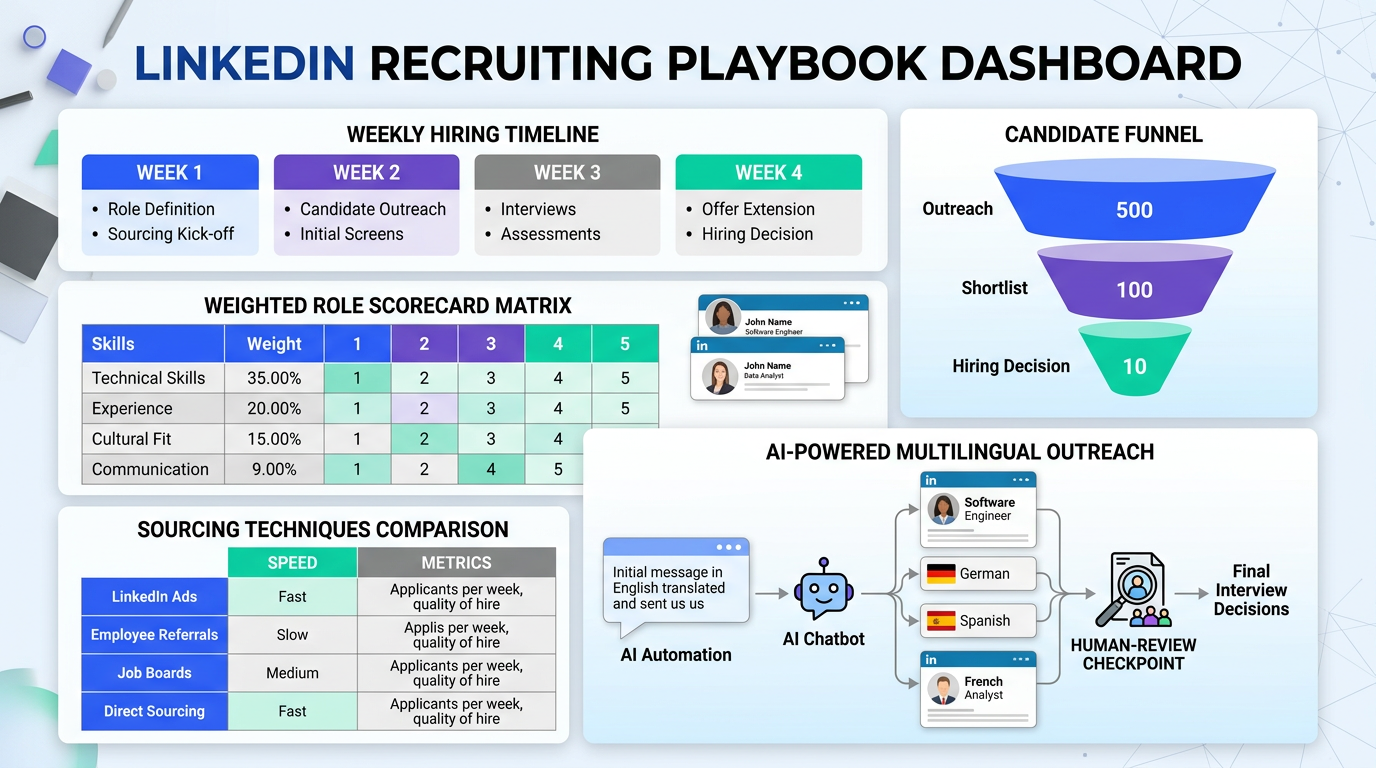
Recruiting sourcing is most effective when succession planning and candidate outreach are managed as one system. In the Aggressive Pump and Supply leadership transition, the business needed a Sales and Operations Manager after Sego acquired the company and the former president retired. The hiring team reached a decision in one month by aligning stakeholders early, tightening role criteria, and applying disciplined sourcing techniques. We use the same model in modern searches, now strengthened by AI supported LinkedIn execution through StrategyBrain AI Recruiter for faster outreach, multilingual communication, and cleaner handoff to recruiters.
Key Takeaways
- Succession timing drives sourcing quality: The Aggressive Pump and Supply search closed in 1 month after leadership change planning was made explicit.
- Stakeholder alignment reduces delays: Decision velocity improves when role scorecards are finalized before outreach begins.
- Structured sourcing techniques outperform ad hoc outreach: Persona targeting, shortlists, and follow-up rules create measurable consistency.
- LinkedIn execution can be automated safely: StrategyBrain AI Recruiter supports candidate connection, role introduction, and interest capture across time zones.
- Human review remains critical: AI can identify engagement intent, but recruiters still validate final fit from resumes and interviews.
- Compliance matters: Data handling, consent awareness, and credential protection must be defined before scaling outreach.
Case Context and Hiring Challenge
Aggressive Pump and Supply is a small industrial pump and water treatment distributor with around 10 employees across Surrey, British Columbia, and Kelowna, British Columbia. The business was acquired by Sego, and leadership transition pressure increased when the former president decided to retire. The immediate need was a Sales and Operations Manager who could stabilize continuity and guide the division inside a larger organization.
This is a textbook recruiting sourcing scenario. The role had operational depth requirements, commercial accountability, and change management expectations. In these situations, the hiring process usually slows down because more stakeholders are involved and risk tolerance is lower.
What changed the outcome was process discipline. Recruiter Alessia coordinated stakeholders and moved the group to a final decision in one month. That timeline is notable in succession hiring because executive style replacements often stall due to misaligned expectations and late stage criteria changes.
A Practical Recruiting Sourcing Framework
1) Define decision architecture before candidate outreach
We start by mapping who decides, who influences, and who signs off. This prevents last minute vetoes and unclear priorities. For succession roles, we also define which outcomes are expected in the first 90 days so sourcing can focus on practical readiness, not only resume pedigree.
2) Build a role scorecard with weighted criteria
A scorecard converts qualitative expectations into measurable signals. Typical dimensions include operational leadership, commercial ownership, and cross functional communication. Weighted criteria make tradeoffs transparent when comparing finalists.
3) Launch multi channel sourcing techniques
High quality recruiting sourcing usually combines direct outreach, referrals, and mapped talent pools from adjacent sectors. For roles like Sales and Operations Manager, we prioritize candidates with proven P and L accountability, process ownership, and regional market familiarity.
4) Use staged outreach and qualification
A sourcing sourcer workflow should include three stages. Stage one confirms relevance and interest. Stage two clarifies motivation and constraints. Stage three gathers resume and contact details for recruiter review. This staged model improves response quality and reduces wasted interviews.
5) Calibrate weekly and close decisively
Weekly calibration reviews keep interview feedback consistent. If stakeholders disagree on profile direction, the team resolves it immediately rather than drifting for multiple weeks. This is one reason one month decisions are possible even under succession pressure.
Step by Step Execution Plan
- Kickoff in 48 hours: Finalize business context, reporting lines, compensation range, and non negotiable skills.
- Create scorecard in 24 hours: Assign weighted criteria and interviewer responsibilities.
- Source first shortlist in 5 business days: Run direct outreach, referral triggers, and profile mapping.
- Run first interviews in week 2: Collect structured feedback with identical question sets.
- Recalibrate in week 3: Remove vague criteria and tighten finalist definition.
- Finalize in week 4: Move to decision, offer, and transition plan.
In our client operations, this sequence consistently improves decision confidence because each step has clear ownership and exit criteria.
How AI Recruiter Supports LinkedIn Sourcing
When recruiting sourcing is LinkedIn heavy, execution quality often fails at follow-up consistency. StrategyBrain AI Recruiter addresses this by automating repetitive front end workflows while keeping recruiter control over final evaluation.
- It can automatically connect with candidates based on defined search criteria.
- It introduces role context, answers role and company questions, and confirms interview interest.
- It requests resumes and contact details from interested candidates and marks document receipt status.
- It supports always on multilingual communication, which helps global sourcing operations maintain momentum.
- It can scale across large account sets for teams that run high volume sourcing campaigns.
We recommend a hybrid operating model. Use AI for connection, first response, and information capture. Keep human recruiters responsible for fit assessment, shortlist approval, and final interview judgment. This protects candidate quality while reducing manual load.
Quick Comparison of Sourcing Techniques
| Technique | Speed to First Response | Best Use Case | Main Risk | Control |
|---|---|---|---|---|
| Direct LinkedIn outreach | 1 to 3 days | Targeted leadership and specialist roles | Low follow-up consistency | Automated cadence with recruiter review |
| Referral activation | 2 to 7 days | Trust sensitive hiring decisions | Narrow talent diversity | Pair with external market mapping |
| Talent pool mapping | 5 to 10 days | Succession and confidential searches | Long setup time | Define priority companies first |
| Inbound job ads | 3 to 14 days | Brand visible hiring | High unqualified volume | Pre screening questions and scorecards |
| AI assisted sourcing workflow | Same day to 2 days | High volume outreach and multilingual markets | Over automation concerns | Human gate at shortlist and interview stages |
Risks, Limits, and Controls
What can go wrong
- Stakeholders change priorities after interviews start.
- Outreach volume increases but qualification quality drops.
- Candidate communication delays reduce acceptance rates.
- Teams treat automation as a replacement for recruiter judgment.
How to prevent these issues
- Lock role scorecards before week 1 outreach.
- Track response rate, qualified response rate, and interview conversion separately.
- Set a maximum response SLA of 24 hours for interested candidates.
- Require human review of every final shortlist profile.
Recruiting Sourcing Checklist
- Role scorecard approved by all decision makers
- Stakeholder map completed with final approver identified
- Sourcing channels selected with weekly output targets
- Outreach templates validated for tone and compliance
- AI and human handoff points documented clearly
- Interview panel rubric standardized
- Decision meeting scheduled before finalist interviews begin
FAQ
What is recruiting sourcing in practical terms?
Recruiting sourcing is the process of identifying, engaging, and qualifying potential candidates before formal selection. It includes target mapping, outreach, response handling, and initial fit screening. In succession hiring, this stage is critical because decision risk is high.
How is sourcing different from recruiting?
Sourcing focuses on finding and engaging talent pipelines. Recruiting includes the broader process, including interviewing, offer management, and onboarding coordination. In many teams, one sourcing sourcer specialist supports one or more recruiters.
Can AI replace recruiters in sourcing?
AI can automate repetitive sourcing actions, but it should not replace recruiter judgment. The best model is mixed execution where AI handles first touch and recruiters validate final fit. This improves speed without sacrificing hiring quality.
When should a company use AI Recruiter for LinkedIn?
Use it when outreach volume is high, follow-up speed is inconsistent, or multilingual communication is needed. It is especially useful for global candidate pipelines and roles requiring rapid first contact. Final qualification should remain with the recruiter.
How fast can succession hiring move with good sourcing techniques?
Well structured succession searches can close in about 4 weeks when criteria are clear and stakeholders are aligned. The Aggressive Pump and Supply case demonstrates this timeline under real leadership transition pressure. Without alignment, the same role can take much longer.
What metrics should I track in recruiting sourcing?
Track response rate, qualified response rate, interview conversion rate, and time to shortlist. Also track candidate dropout points to find process friction. These metrics reveal whether your sourcing techniques are effective or only generating activity.
Conclusion
Recruiting sourcing is not only a top of funnel task. In succession hiring, it is the operating system for speed, confidence, and continuity. The Aggressive Pump and Supply transition shows that one month decisions are realistic when role criteria, stakeholder alignment, and sourcing techniques are tightly managed.
Your next step is simple. Build a weighted scorecard, run staged outreach, and define AI plus human handoff points before launch. If your team relies on LinkedIn outreach, integrate StrategyBrain AI Recruiter to stabilize response speed and multilingual candidate communication while keeping recruiter led final selection standards.