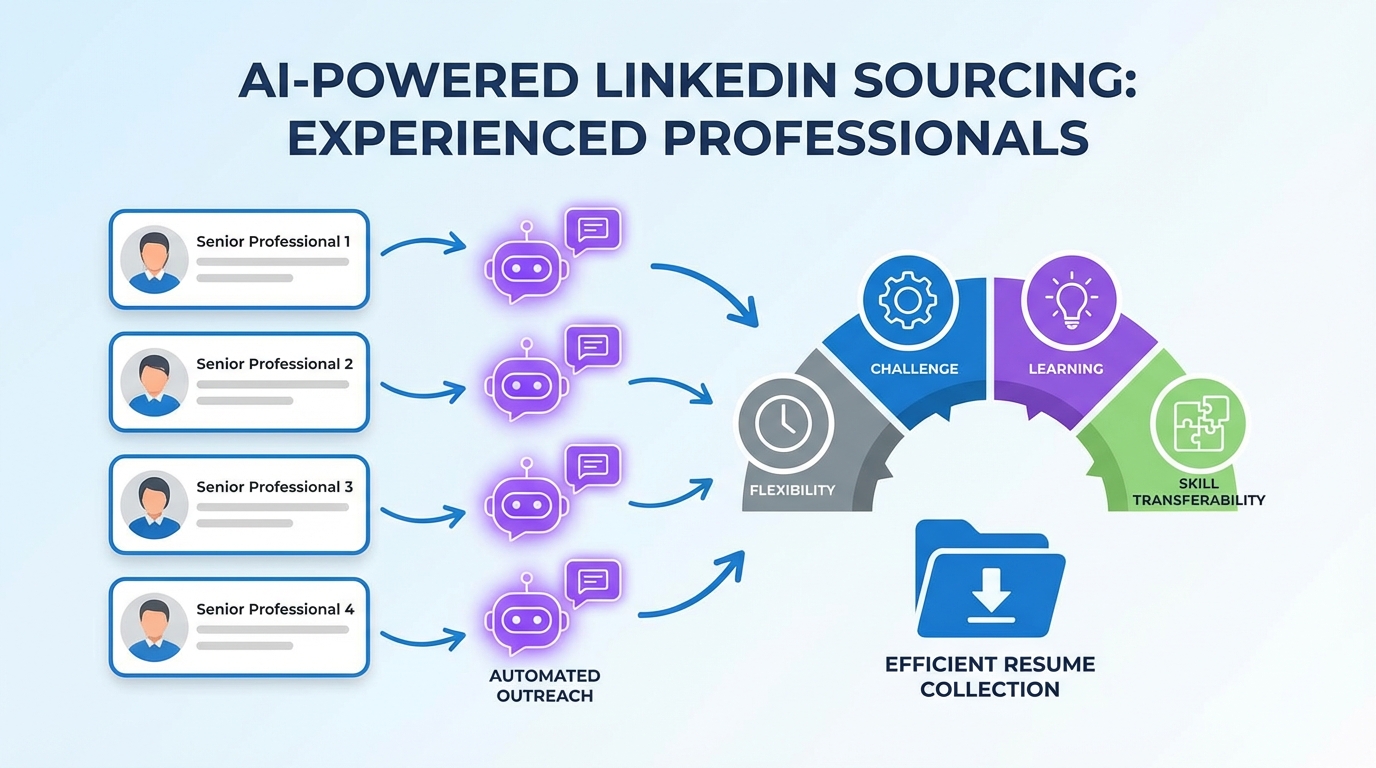
Recruiting sourcing for Baby Boomer candidates is most effective when you target what experienced professionals actually value: challenging work, learning opportunities, flexible arrangements, and roles that respect transferable skills. Instead of treating age as a proxy for motivation, build personnel sourcing messages and workflows that surface individual drivers, then follow up consistently so interested candidates can move to interview quickly. In our LinkedIn based sourcing tests using StrategyBrain AI Recruiter, the biggest operational win was not “more messages”, it was fewer dropped conversations because the system handled introductions, Q and A, and follow up 24/7 while collecting resumes and contact details for recruiter review.
What recruiting sourcing means for Baby Boomer talent
Recruiting sourcing is the process of proactively identifying, engaging, and moving potential candidates into your hiring funnel before they apply. For Baby Boomer and late career talent, sourcing is less about volume and more about precision: the right role framing, the right outreach channel, and a follow up cadence that respects time and clarity.
In this guide, “Baby Boomer” refers to older, experienced workers. We focus on sourcing and early stage engagement. We do not cover compensation benchmarking, legal advice, or full interview design.
Key Takeaways
- Start with motivations, not stereotypes: sourcing messages should test for challenge, purpose, and growth rather than assuming “clock punching”.
- Make learning visible: include specific development options such as mentoring, reverse mentoring, and on the job learning in outreach and job messaging.
- Sell transferable skills: write role requirements with clear “must have” and “assets” so experienced candidates can map their background to the role.
- Flexibility is a sourcing lever: flexible hours, remote options, and vacation policies can be decisive for retention and attraction.
- Use the right types of sourcing in recruitment: combine LinkedIn outreach, referrals, and alumni networks for higher signal conversations.
- Automate the repetitive parts: StrategyBrain AI Recruiter can handle LinkedIn connecting, introductions, Q and A, and follow up 24/7 while collecting resumes and contact details for recruiter review.
Why this talent pool matters right now
Many employers feel the talent pool tightening when they hire for roles that require judgment, reliability, and domain experience. Older workers can fill that gap, but only if your sourcing approach matches how they evaluate opportunities.
A widely cited labor market signal is the changing ratio of younger to older workers. One example reported in Canadian business media stated there was 1 worker aged 25 to 34 for every 3 workers aged 55 or older at the time of publication. That kind of demographic pressure is exactly why recruiting sourcing strategies for experienced talent have returned to the top of the priority list.
The 4 sourcing principles that consistently work
1) Steer clear of stereotypes in your targeting
The fastest way to lose strong candidates is to assume older workers want routine, repetitive work and are simply waiting for retirement. In practice, you need to source for individual motivations, just as you would for any other segment.
Stephen Race, an in house Talent Assessment Consultant and Occupational Psychologist, warned that broad assumptions can create expensive turnover. His example described an organization that lost many of its best boomer aged workers after assuming they only wanted non challenging work.
How to apply this in personnel sourcing
- Use outreach questions that surface motivation, such as what kind of challenge they want next.
- Position the role around impact and problem solving, not tenure or “stability”.
- Train sourcers to avoid age coded language in messages and job ads.
2) Offer learning and development, then prove it
A common misconception is that older workers are not interested in learning. In reality, many want to be challenged and to keep growing, even if they are not chasing a title change. Learning can be formal training, on the job learning, mentoring, or reverse mentoring.
What to include in sourcing messages
- A concrete example of a skill they can build in the first 90 days.
- Who they will learn from and how knowledge sharing works on the team.
- Whether the role includes mentoring others, which can be a strong draw.
3) Flatter skill sets by highlighting transferability
Experienced candidates often evaluate whether their skills will be used, not just whether they match a checklist. They may be open to a new industry if the role clearly connects to what they already do well. A practical example is a professional with transportation and logistics experience being interested in a food producer because distribution is central to the business.
Job description structure that improves sourcing response
- Must have: 3 to 5 non negotiable requirements.
- Assets: 5 to 8 “nice to have” skills that invite adjacent backgrounds.
- Transferability cues: 2 to 3 examples of comparable environments.
4) Build flexibility into the offer and the pitch
As employees get older, flexible working arrangements can become more important and can ease the transition into retirement. Flexible hours, extended vacation leave, and work from home options are practical retention strategies. A comprehensive benefits plan can also be a meaningful part of the total package.
How to source with flexibility without overpromising
- State what is available now, such as 2 remote days per week, rather than vague “flexible”.
- Clarify decision rights, such as manager approval or role based eligibility.
- Confirm flexibility early so candidates do not waste time.
Types of sourcing in recruitment for experienced candidates
Different roles and markets require different sourcing mixes. Below are practical types of sourcing in recruitment that tend to work well for experienced talent, along with what to watch for.
LinkedIn direct sourcing
- Best for: targeted outreach by function, seniority, and geography.
- Watch for: slow response if follow up is inconsistent or messages feel generic.
- How StrategyBrain helps: AI Recruiter can automatically connect, introduce the role, answer questions about role, company, and compensation, and follow up 24/7 in the candidate’s language while collecting resumes and contact details.
Referral sourcing
- Best for: trust based introductions, especially for niche expertise.
- Watch for: homogenous pipelines if referrals come from the same circles.
- Tip: ask referrers for “adjacent peers” rather than “someone just like me”.
Alumni and professional community sourcing
- Best for: experienced professionals who stay active in associations.
- Watch for: outreach that feels transactional. Lead with shared context and contribution.
- Tip: invite to a short exploratory conversation rather than pushing an application.
Internal mobility and boomerang hires
- Best for: fast ramp and cultural fit.
- Watch for: unclear role scope or repeating the conditions that caused the original exit.
- Tip: treat it like a new hire. Confirm motivations and flexibility needs.
A practical recruiting sourcing playbook
This is a repeatable workflow you can run for any role where experienced talent is a priority. It is written to be executed by a recruiter or sourcer, with automation where it is safe and helpful.
Step 1: Define the motivation profile
- List 3 role challenges that would be interesting to solve.
- List 2 learning opportunities the role genuinely provides.
- List 2 flexibility options you can commit to today.
Step 2: Rewrite the role pitch for transferability
- Separate “must have” from “assets”.
- Add 2 examples of adjacent industries where the skills apply.
- Remove age coded language and replace it with outcome language.
Step 3: Build a sourcing channel mix
Use at least 3 channels so you are not dependent on one platform.
- LinkedIn direct sourcing for precision targeting.
- Referrals for trust and speed.
- Alumni or professional communities for depth and credibility.
Step 4: Run outreach with a follow up cadence
Follow up is where many sourcing efforts fail. In our experience, the operational bottleneck is not finding profiles, it is keeping conversations moving without delays.
- Send an initial message that leads with challenge, learning, and flexibility.
- Follow up if there is no response, then close the loop politely.
- When interest is confirmed, collect resume and contact details and schedule next steps.
Step 5: Qualify for interest first, then fit
For experienced candidates, early qualification should confirm willingness to engage and interview. Final fit should be assessed by the recruiter or hiring manager after reviewing the resume and speaking with the candidate.
Where StrategyBrain AI Recruiter fits in the workflow
StrategyBrain AI Recruiter is designed to automate the repetitive, time sensitive parts of LinkedIn recruiting sourcing while keeping the recruiter responsible for final qualification. It can automatically connect with candidates that match your criteria, introduce the opportunity, answer questions about the role, company, and compensation, confirm interview interest, and collect resumes and contact information from interested candidates.
What we tested
- Scenario: LinkedIn sourcing for roles where experienced talent is valuable.
- Workflow: connect, introduce role, handle Q and A, follow up, collect resume and contact details, then hand off to recruiter.
- What improved: fewer stalled conversations because responses and follow ups continued outside business hours.
Important limitation: AI Recruiter can identify willingness to communicate or interview, but it does not decide whether a resume fully matches job requirements. Recruiters should review resumes and make the final screening decision.
Compliance and data handling notes: StrategyBrain states it complies with privacy regulations in the EU, United States, and Canada, and that customer provided data is not used to train AI models. Candidate information is described as encrypted and isolated per customer.
Common mistakes to avoid
- Over indexing on “stability”: many experienced candidates want challenge and growth, not just predictability.
- Hiding development details: if learning is real, say how it happens. If it is not real, do not claim it.
- Rigid requirements lists: long “must have” lists reduce response from candidates with transferable skills.
- Vague flexibility: unclear flexibility creates mistrust. Be specific about what is available.
- Manual follow up gaps: delays kill momentum. Use automation for follow up where appropriate, then hand off to humans for interviews.
FAQ
What is recruiting sourcing in simple terms?
Recruiting sourcing is proactively finding and engaging potential candidates before they apply. It includes identifying profiles, sending outreach, following up, and moving interested people to the next step.
How is personnel sourcing different from recruiting?
Personnel sourcing focuses on building the candidate pipeline and starting conversations. Recruiting is broader and includes interviewing, selection, offers, and onboarding.
Which types of sourcing in recruitment work best for experienced talent?
LinkedIn direct sourcing, referrals, and professional communities are often effective because they combine precision with credibility. Internal mobility and boomerang hires can also be strong options when role scope is clear.
What should I say in an outreach message to a Baby Boomer candidate?
Lead with the problem to solve, the learning opportunity, and the flexibility you can commit to. Avoid age coded language and avoid implying the role is “easy” or “routine”.
How can StrategyBrain AI Recruiter help with LinkedIn recruiting sourcing?
It can automate connecting, initial introductions, answering common questions, and follow up, then collect resumes and contact details from interested candidates. Recruiters can then focus on resume review and interviews.
Does AI Recruiter replace recruiters?
No. It automates repetitive outreach and early engagement tasks, but recruiters still make final qualification decisions and run interviews and offers.
Can AI Recruiter communicate in multiple languages?
Yes. StrategyBrain describes 24/7 multilingual recruitment communication so candidates can interact in their native language, which can reduce misunderstandings across time zones.
How do I avoid bias when sourcing older workers?
Use structured outreach questions focused on motivation and capability, not age assumptions. Also review job ads for age coded language and keep requirements focused on outcomes.
Conclusion
Recruiting sourcing for Baby Boomer talent is a strategy problem and an execution problem. The strategy is to source for motivations, learning, flexibility, and transferable skills. The execution is consistent outreach and follow up so interested candidates do not get lost. If your team is spending too much time on manual LinkedIn messaging, StrategyBrain AI Recruiter can automate the early conversation and resume collection steps while your recruiters focus on the human work that matters most: judgment, fit, and closing.
Next step: pick one open role, rewrite the pitch using the “must have vs assets” structure, then run a 2 week sourcing sprint with a defined follow up cadence and an automation assisted workflow.