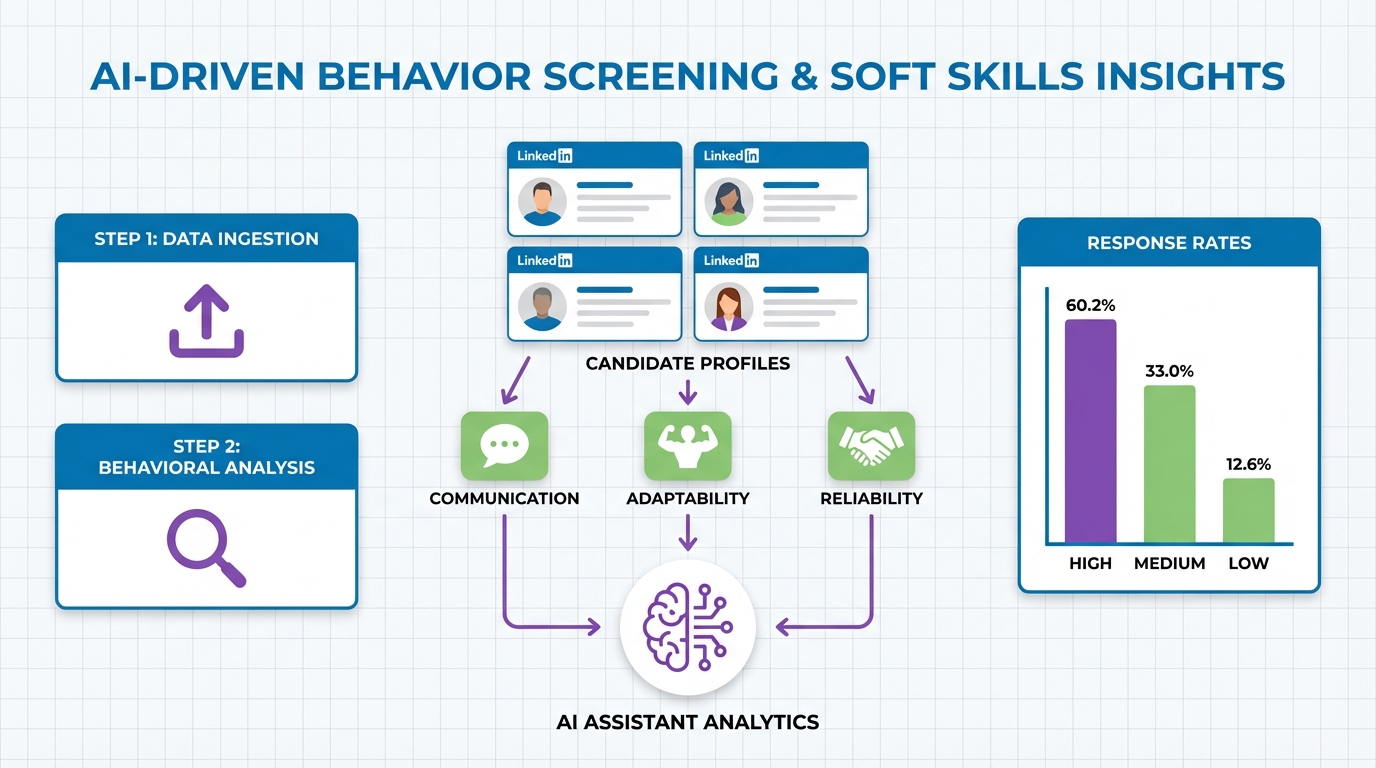
Recruiting sourcing works best when you define the soft skills your role truly needs, then source and screen for evidence of those behaviors using structured outreach, behavioral questions, and consistent evaluation. In our day to day recruiting work, we see teams lose time when they treat soft skills as a vague preference instead of a measurable requirement. The fix is straightforward. Put the soft skills into the job description, then use repeatable ways of sourcing candidates and a screening script that forces real examples. If you use LinkedIn heavily, StrategyBrain AI Recruiter can automate the first touch, answer candidate questions about role, company, and compensation, and collect résumés and contact details so recruiters can focus on final qualification.
Key Takeaways
- Soft skills are a measurable sourcing target: name them in the job description and screen for evidence, not impressions.
- Use multiple ways of sourcing candidates: combine LinkedIn outreach, referrals, and talent communities to reduce single channel bias.
- Screen with behavioral questions: ask for specific past situations that demonstrate communication, adaptability, and reliability.
- Automate the repetitive LinkedIn layer: StrategyBrain AI Recruiter can handle connecting, initial messaging, Q and A, and follow up.
- Keep human judgment for final fit: AI Recruiter can confirm interest and collect résumés, but recruiters still validate job match.
- Operationalize consistency: use a scorecard and a short checklist so every candidate is evaluated the same way.
Table of Contents
What the soft skills gap means for recruiting sourcing
When people talk about a skills gap, they often mean technical skills. Yet a survey of 500 U.S. senior executives reported that soft skills were the biggest gap for 44 percent of respondents, while 22 percent cited technical skills, 14 percent cited leadership, and 12 percent cited computer skills. This matters for sourcing human resources because sourcing is not only about finding profiles. It is about predicting on the job performance from limited signals.
For temporary and contract hiring, soft skills can matter even more because ramp time is short and the work environment changes quickly. In our experience, adaptability, reliability, strong work ethic, and communication are the traits that prevent churn in the first 30 days.
Step 1: Define soft skills as sourcing criteria
Soft skills are behaviors. Treat them like requirements you can observe. Start by translating each soft skill into a concrete signal you can source for and a question you can screen with.
Example translation table
- Communication: can explain decisions clearly in writing and in conversation.
- Critical thinking: can describe tradeoffs and how they chose an approach.
- Collaboration: can describe how they handled conflict or alignment.
- Adaptability: can describe a change in priorities and what they did next.
- Reliability: can describe how they manage deadlines and follow through.
Scope boundary: this article focuses on sourcing and early stage screening. It does not cover full competency modeling, psychometrics, or reference check design.
Step 2: Put soft skills into the job description
If you want to improve recruiting sourcing outcomes, the job description must ask for the soft skills explicitly. Otherwise, your sourcing funnel will optimize for keywords and titles only.
What to add to the job description
- Soft skills list: 3 to 5 soft skills that are truly required for the role.
- Behavioral proof prompt: a line that asks candidates to share an example in their application or initial message.
- Context: why the soft skills matter in this environment, such as client facing work or shifting priorities.
We also recommend aligning hiring managers on what good looks like before sourcing begins. That prevents interview feedback from drifting into subjective preferences.
Step 3: Ways of sourcing candidates that surface soft skills
There is no single best channel for soft skills. The best approach is to use multiple ways of sourcing candidates so you can triangulate signals and reduce channel bias.
Channel mix that works well for soft skills
- LinkedIn outreach: good for fast volume and quick written communication signals.
- Employee referrals: often stronger soft skill signal because the referrer stakes reputation.
- Alumni and talent communities: better context on collaboration and work style over time.
- Contractor pools: useful for reliability and adaptability when you have performance history.
Practical sourcing tip
When you source on LinkedIn, pay attention to how candidates respond, not only whether they respond. Clarity, tone, and follow through are early indicators of communication and reliability.
Step 4: Screen and interview for proof using behavioral questions
Behavioral interview questions ask candidates to describe a real past situation. This is one of the most reliable ways to evaluate soft skills early because it forces specifics. During screening, you are looking for a situation, an action, and an outcome.
Behavioral questions you can reuse
- Communication: Tell me about a time you had to explain a complex topic to a non expert. What did you say and what happened next.
- Adaptability: Tell me about a time priorities changed quickly. What did you do in the first 24 hours.
- Collaboration: Tell me about a disagreement with a teammate. How did you resolve it.
- Reliability: Tell me about a deadline you were at risk of missing. How did you handle it.
What to listen for
- Specificity: names of stakeholders, constraints, and decisions.
- Ownership: what they did, not what the team did.
- Reflection: what they would do differently next time.
Step 5: Combine LinkedIn recruiting with StrategyBrain AI Recruiter
LinkedIn is often the highest volume channel in recruiting sourcing, which also makes it the most repetitive. StrategyBrain AI Recruiter is designed to automate the initial LinkedIn workflow so recruiters can spend time on final qualification and hiring manager alignment.
What we use AI Recruiter for in the sourcing layer
- Automated connecting: it connects with candidates that match your search criteria.
- Role introduction: it introduces the opportunity and checks whether the candidate is open to new roles.
- Candidate Q and A: it answers questions about the role, company, and compensation using the information you provide.
- Follow up: it responds 24 hours a day and continues follow up so conversations do not stall.
- Résumé and contact capture: it collects résumés and contact details from interested candidates.
Important limitation: AI Recruiter can confirm willingness to proceed and gather information, but it does not decide whether the résumé matches the job requirements. A recruiter still reviews the résumé and makes the final qualification decision.
Why this helps with soft skills
Soft skills show up in conversation quality. When outreach and follow up are consistent, you get cleaner signals. You can also evaluate written communication earlier because candidates are prompted to explain their situation and ask questions. If you hire globally, AI Recruiter supports multilingual communication so candidates can respond in their native language, which reduces misunderstandings during early screening.
Templates: scorecard and outreach checklist
Copyable soft skills scorecard
| Soft skill | Evidence to look for | Screening question | Rating scale |
|---|---|---|---|
| Communication | Clear, structured explanation with outcome | Explain a complex topic to a non expert | 1 to 5 |
| Adaptability | Fast reprioritization and stakeholder alignment | Priorities changed quickly, what did you do | 1 to 5 |
| Collaboration | Conflict resolution and shared decision making | Disagreement with teammate, how resolved | 1 to 5 |
| Reliability | Follow through, proactive risk management | Deadline risk, how handled | 1 to 5 |
Recruiting sourcing checklist for soft skills
- Confirm 3 to 5 soft skills that are required for the role.
- Add those soft skills to the job description with a proof prompt.
- Choose at least 3 ways of sourcing candidates, including LinkedIn and one non LinkedIn channel.
- Use a consistent screening script with behavioral questions.
- Record evidence in a scorecard, not in free form notes.
- Automate repetitive LinkedIn outreach and follow up where appropriate using StrategyBrain AI Recruiter.
Quick Comparison
| Approach | Speed impact | Best for | Soft skills signal quality |
|---|---|---|---|
| Job description soft skills rewrite | Medium | Improving applicant quality | Medium |
| Behavioral screening script | Medium | Consistent early evaluation | High |
| LinkedIn outreach with AI Recruiter automation | High | Scaling conversations and follow up | Medium to High |
| Referrals and talent communities | Low to Medium | Higher trust pipelines | High |
FAQ
What is recruiting sourcing in plain terms
Recruiting sourcing is the process of finding and engaging potential candidates before they apply, then moving the right people into screening. It includes channel selection, outreach, follow up, and early qualification.
What are the best ways of sourcing candidates for soft skills
The best mix usually includes LinkedIn outreach, referrals, and a talent community or alumni network. Using multiple channels improves signal quality because you can compare how candidates communicate across contexts.
How do I screen soft skills without making it subjective
Use behavioral questions and a scorecard. Require a specific past example, document the evidence, and rate on a consistent 1 to 5 scale for every candidate.
Can StrategyBrain AI Recruiter replace recruiters in sourcing human resources
No. StrategyBrain AI Recruiter automates the repetitive LinkedIn layer such as connecting, initial messaging, answering common questions, follow up, and collecting résumés and contact details. Recruiters still do final qualification and hiring decisions.
How does AI Recruiter help with global hiring
It supports 24 hour messaging and multilingual communication so candidates can interact in their native language. This reduces delays across time zones and lowers the risk of misunderstandings in early conversations.
What should I change first if my sourcing pipeline is slow
Start with two changes. Add soft skills explicitly to the job description, then standardize the first screen with behavioral questions. After that, automate LinkedIn outreach and follow up if volume is the bottleneck.
Is candidate data used to train AI models in AI Recruiter
According to StrategyBrain AI Recruiter product information, customer provided data is not used to train AI models. Data is used to personalize communication for the customer’s AI instance and is protected with encryption and isolation controls.
Conclusion
The soft skills gap is not solved by hoping you will spot good communication in a final interview. It is solved by designing recruiting sourcing to surface soft skills early. Define the behaviors, put them into the job description, use multiple ways of sourcing candidates, and screen with behavioral questions and a scorecard. If LinkedIn outreach is your main volume driver, StrategyBrain AI Recruiter can automate connecting, messaging, follow up, and résumé collection so your team can spend time on the human work that matters. Next step: copy the scorecard above, update one job description today, and run your next 10 screens using the same behavioral script.