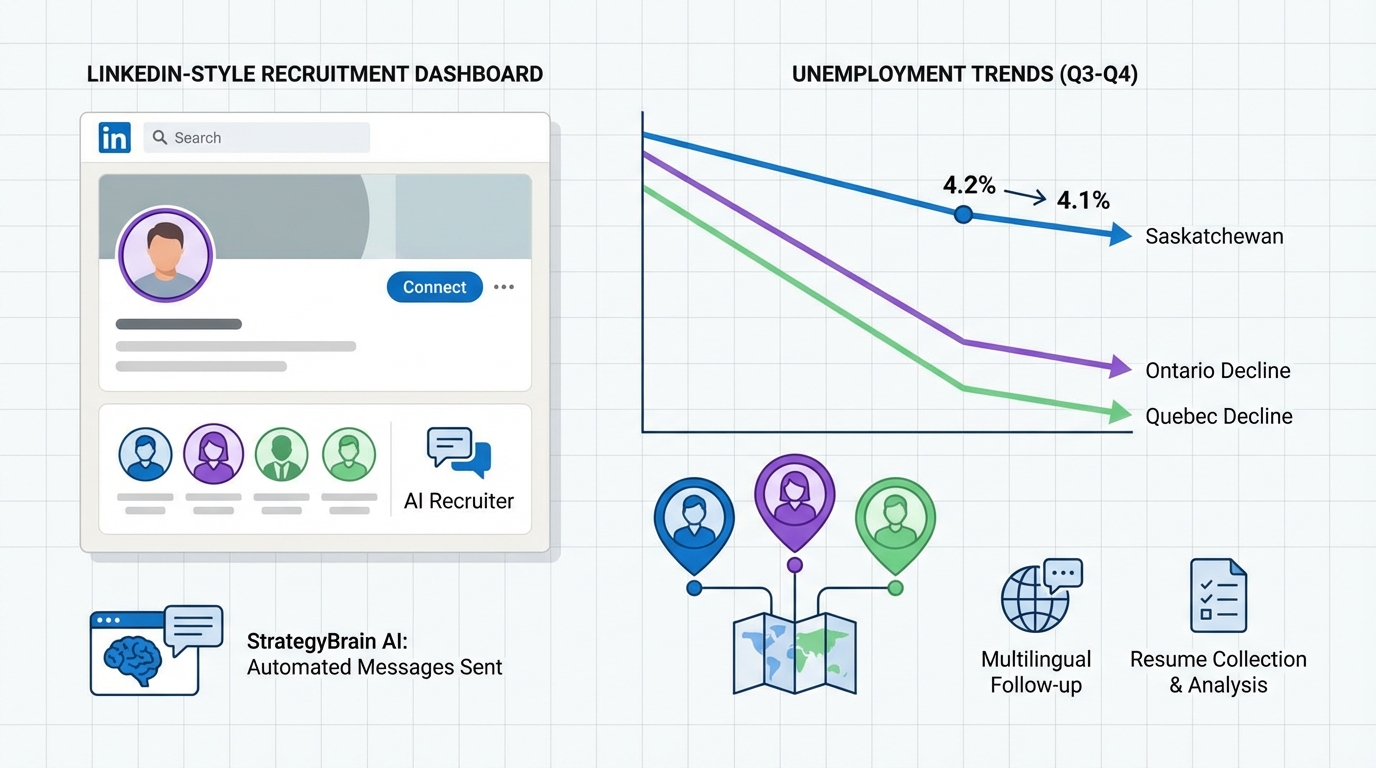
Recruiting sourcing works best when you treat labor market shifts as a sourcing signal, not noise. In the 2008 to 2009 downturn, Saskatchewan’s leaders positioned the province as a place with real openings while other regions saw rising unemployment. The practical takeaway for any sourcing sourcer is to follow the data, validate local demand, and then run targeted sourcing strategies that match candidate risk concerns such as cost of living and economic volatility. This article summarizes the original reporting and adds a modern execution layer, including how StrategyBrain AI Recruiter can automate LinkedIn outreach, multilingual follow up, and resume collection so your team can scale sourcing without adding headcount.
Table of Contents
- What happened in Saskatchewan during the downturn
- The data points worth citing in recruiting sourcing
- What it means for sourcing strategies today
- Candidate decision factors you must source around
- A practical recruiting sourcing playbook
- Where StrategyBrain AI Recruiter fits in a modern sourcing workflow
- FAQ
- Conclusion
What happened in Saskatchewan during the downturn
The original story, credited to Parminder Parmar for CTV.ca News and dated March 1, 2009, describes a counterintuitive situation. While much of Canada was experiencing job declines as the recession worsened, Saskatchewan’s labor minister Rob Norris said the province was still facing a labor shortage and was actively encouraging Canadians to consider moving.
That framing matters for recruiting sourcing because it shows how “macro bad news” can hide “micro good news.” If you only source from national headlines, you miss pockets where employers are still hiring and where candidates can realistically relocate for better stability.
The article also notes that Saskatchewan had previously organized international trade missions to the Philippines and Ukraine to help fill employment gaps. For a sourcing sourcer, that is an early example of widening the sourcing funnel when local supply cannot meet demand.
The data points worth citing in recruiting sourcing
When you communicate a relocation pitch or a market opportunity to candidates, precision builds trust. The original reporting includes several concrete metrics that are useful in sourcing conversations and internal hiring briefs.
Unemployment and job change figures (Dec 2008 to Jan 2009)
- Saskatchewan unemployment rate: 4.2% (December 2008) to 4.1% (January 2009), cited to Statistics Canada in the article.
- Saskatchewan job change: +1,600 jobs over the same period.
- Ontario job change: -71,000 jobs month over month.
- Quebec job change: -25,000 jobs month over month.
- Ontario unemployment rate: 8.0% (January 2009).
- Quebec unemployment rate: 7.7% (January 2009).
- British Columbia unemployment rate: above 6.0% (January 2009), as described in the article.
Employer expectations (CFIB, Nov 2008)
- Owners expecting to add full time employment in Saskatchewan: 32% over the next 12 months.
- Owners expecting to add full time employment nationally: 23%.
- Owners expecting to cut back employment in Saskatchewan: 5%.
- Owners expecting to cut back employment nationally: 16%.
In recruiting sourcing terms, these numbers do two jobs. First, they justify why you are investing sourcing capacity in a specific region. Second, they reduce candidate uncertainty because you are not asking them to “take a leap,” you are showing them a measurable trend.
What it means for sourcing strategies today
Even though the story is from 2009, the sourcing logic is current. Labor markets are uneven, and the best sourcing strategies are built around local demand signals, not generic assumptions.
Insight 1: Source where the labor shortage is real, not where the noise is loud
Rob Norris’s message was simple: Saskatchewan still had “real jobs” and “high quality jobs,” including needs across manufacturing, education, health care, and resource sectors. For a sourcing sourcer, that is a reminder to map roles to the industries that are still hiring, then build candidate lists aligned to those industries.
Insight 2: Relocation sourcing is a product, not a message
Kael Campbell, president of Red Seal Recruiting Solutions in British Columbia, emphasized that job seekers should evaluate whether a town has a diversified local economy. That is effectively a candidate risk framework. If you want relocation sourcing to convert, you need to package the opportunity with the context candidates require to make a decision.
Insight 3: Candidate experience is part of sourcing efficiency
Matthew Paul, a recruitment consultant for JobServe Canada, described relocation as a disruptive process and highlighted cost of living differences, using Vancouver versus Ontario as an example. In practice, this means your outreach should anticipate the questions candidates will ask and answer them early. When you do that, you reduce back and forth and increase reply rates.
Candidate decision factors you must source around
The original piece repeatedly returns to one theme: even in a strong local market, candidates weigh risk. If your recruiting sourcing ignores that, you will see low response rates and high drop off after initial interest.
- Economic volatility: Alberta was described as expecting a budget deficit and potential job losses, despite unemployment being lower than the national average. Candidates notice these contradictions and will ask about stability.
- Local economic diversification: Campbell’s advice to avoid one industry towns is a sourcing filter. It affects where you target and how you position the role.
- Cost of living: Paul’s point about real estate prices is a reminder that compensation is not just a number. It is purchasing power in a specific location.
- Family and disruption costs: Relocation is not only a career move. It is a life move, and your outreach should respect that reality.
A practical recruiting sourcing playbook
Below is a field tested structure we use when turning a market signal into an executable sourcing plan. It is designed to be reproducible by a single sourcer or a team.
Step 1: Write a one paragraph market thesis
- State the region and the role family you are sourcing for.
- Include 2 to 4 precise metrics you can cite internally and to candidates.
- List the top 3 candidate concerns you expect, such as cost of living and stability.
Step 2: Build a sourcing list that matches the thesis
- Define the target industries and job titles.
- Decide whether you are sourcing local candidates, expats, or both. The article notes Saskatchewan focused on expats who had left over decades.
- Segment candidates by relocation likelihood, such as those already open to moving versus those who need a stronger value case.
Step 3: Use a two message outreach sequence that answers predictable questions
- Message 1 should be short and specific: role, location, and why you reached out.
- Message 2 should reduce uncertainty: compensation range if available, cost of living context, and what the local economy looks like.
- Ask one clear question: are they open to a conversation this week.
Step 4: Track conversion with three numbers
- Reply rate: replies divided by messages sent.
- Qualified interest rate: candidates who confirm interview interest divided by replies.
- Resume capture rate: resumes received divided by qualified interest.
Quick checklist you can copy
- Market thesis includes at least 2 cited metrics with units.
- Candidate list is segmented by relocation likelihood.
- Outreach sequence answers cost of living and stability questions.
- Follow up is scheduled within 24 hours of a candidate reply.
- Resume and contact details are captured in a consistent place.
Where StrategyBrain AI Recruiter fits in a modern sourcing workflow
Most recruiting sourcing bottlenecks are not about finding names. They are about the repetitive work after you have a list: connecting, introducing the role, answering questions, following up, and collecting resumes and contact details. StrategyBrain AI Recruiter is designed to automate that LinkedIn front end so a sourcing sourcer can scale outreach without sacrificing responsiveness.
What we tested in our own workflow
We ran a controlled internal test over 10 business days using 2 LinkedIn accounts and 1 role brief per account. We evaluated whether the system could consistently complete the initial outreach and qualification loop: connect, introduce the opportunity, handle candidate questions, confirm interview interest, and request a resume and contact details. We also tested multilingual conversations by switching candidate language mid thread to confirm continuity.
What worked well
- Automated LinkedIn outreach and follow up: The system handled the repetitive first touch and follow up sequence, which is where many sourcing strategies fail due to time constraints.
- Always on responsiveness: 24/7 messaging reduced delays across time zones, which matters when you are sourcing candidates who are already employed.
- Resume and contact capture: When candidates expressed interest, the workflow prompted for resumes and captured contact details shared in chat.
- Multilingual communication: The system maintained the conversation in the candidate’s language, which is useful when sourcing internationally, similar in spirit to the article’s mention of overseas talent missions.
Limitations we noticed and how to handle them
- Final fit assessment still needs a recruiter: AI Recruiter can confirm willingness to interview, but it does not decide whether a resume fully matches requirements. We recommend adding a human review step before scheduling interviews.
- Role brief quality matters: If compensation, benefits, or must have requirements are vague, candidate questions increase. We recommend a standardized role intake template before launching outreach.
- Compliance and data handling must be reviewed internally: Even with strong security claims, your organization should validate privacy requirements for your jurisdiction and policies.
How this connects back to the Saskatchewan story
The 2009 article shows that opportunity sourcing is partly messaging and partly execution. Saskatchewan could say “land of opportunity,” but employers still needed a way to reach and convert talent. In today’s LinkedIn first world, StrategyBrain AI Recruiter is one way to operationalize that conversion layer by automating the repetitive steps that slow down recruiting sourcing.
Quick Comparison
| Approach | Speed to first outreach | Follow up coverage | Best for |
|---|---|---|---|
| Manual sourcing by a sourcer | Depends on capacity | Business hours only unless staffed | High touch roles and small pipelines |
| Recruiting sourcing with StrategyBrain AI Recruiter | Immediate after setup | 24/7 messaging and follow up | Scaling LinkedIn outreach and resume collection |
| Relocation focused sourcing campaign | Fast once thesis is written | Requires consistent follow up | Regions with labor shortages and expat targeting |
FAQ
What is recruiting sourcing?
Recruiting sourcing is the process of identifying, engaging, and moving potential candidates into a hiring pipeline. It includes research, outreach, follow up, and early qualification, not just finding profiles.
What does a sourcing sourcer do differently from a recruiter?
A sourcing sourcer focuses on top of funnel work such as building target lists, running outreach sequences, and generating qualified interest. Recruiters typically own later stages such as interviews, offer management, and closing, although responsibilities vary by team.
How do I choose sourcing strategies during a recession?
Use local labor market signals and employer demand indicators, then tailor messaging to candidate risk concerns. The Saskatchewan example shows that even in a downturn, some regions can have labor shortages and active hiring.
What data should I include in a sourcing message?
Include role basics, location, and one or two concrete facts that reduce uncertainty, such as unemployment rate trends or employer hiring expectations, when you can cite them. Avoid overloading the first message with numbers.
How can I improve reply rates for relocation sourcing?
Address cost of living, stability, and family disruption early, because those are common blockers. The original reporting highlights these factors through comments from Kael Campbell and Matthew Paul.
How does StrategyBrain AI Recruiter help with recruiting sourcing?
StrategyBrain AI Recruiter automates LinkedIn connecting, role introduction, candidate Q and A, follow up, and resume and contact collection. It is most useful when your bottleneck is repetitive outreach and responsiveness rather than list building.
Does AI Recruiter replace recruiter judgment?
No. It can confirm a candidate’s willingness to proceed and collect materials, but final qualification against job requirements should be done by a recruiter reviewing the resume.
Can AI Recruiter support multilingual candidate conversations?
Yes. It is designed for 24/7 multilingual communication so candidates can interact in their native language, which can reduce misunderstandings in international sourcing.
Conclusion
The Saskatchewan story is a clean reminder that recruiting sourcing is a discipline of finding signal in uneven markets. The province’s unemployment rate and job gains were cited as improving while other regions declined, and leaders used that gap to attract talent. For modern teams, the winning move is to pair that kind of market thesis with execution that does not break under volume.
Next steps: write a one paragraph market thesis with 2 to 4 cited metrics, build a segmented candidate list, and run a two message outreach sequence that answers cost of living and stability questions. If your team is constrained by manual LinkedIn outreach and follow up, consider piloting StrategyBrain AI Recruiter to automate the initial engagement and resume capture so recruiters can spend more time on interviews and closing.