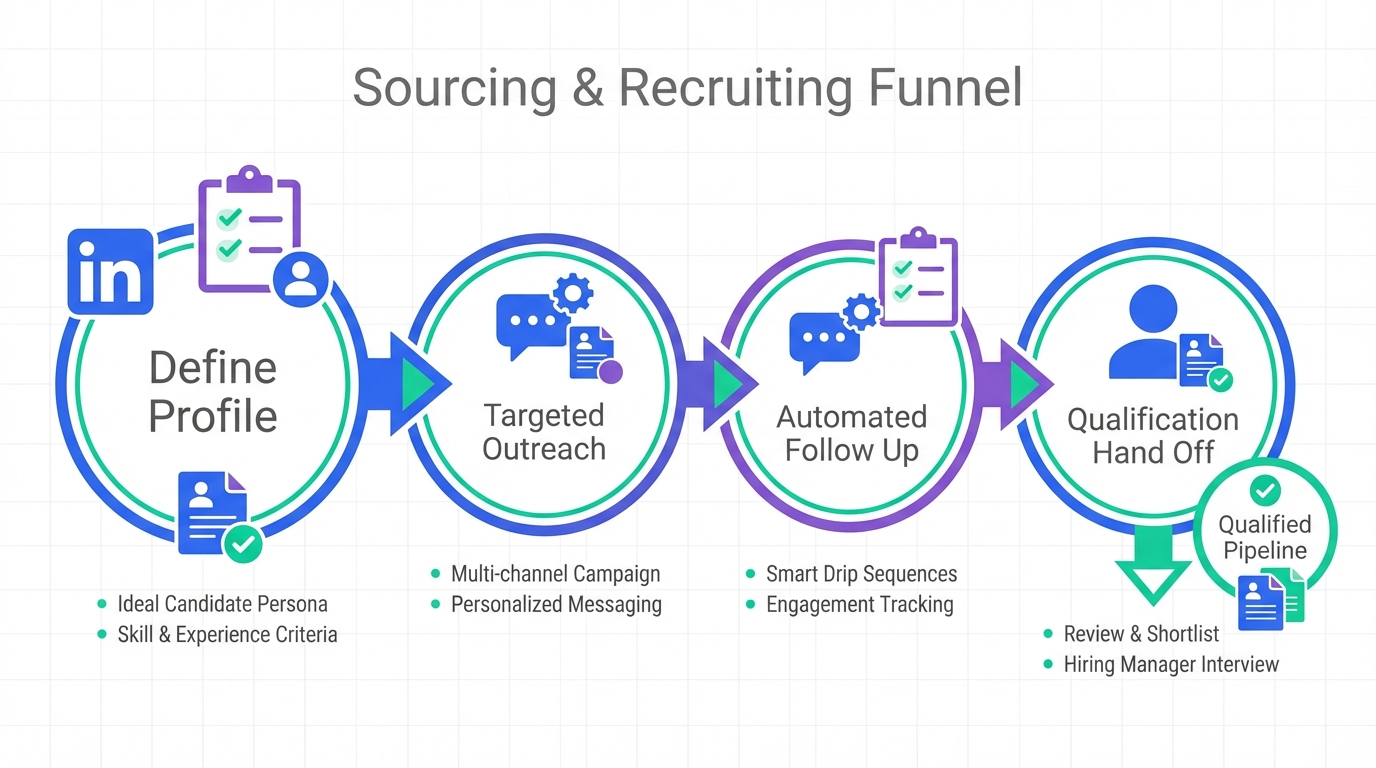
Recruiting sourcing is the proactive work of finding and engaging potential candidates before they apply, using targeted search, outreach, and relationship building to create a qualified pipeline. In plain HR terms, the HR sourcing meaning is this: you do not wait for applicants, you go to the market, identify the right profiles, start conversations, and bring interested people into your process. Even with job sourcing tools like LinkedIn and broad job boards, specialized recruiters still add value because hiring is a high stakes transaction that most teams do only a handful of times per year, while experienced recruiters run it repeatedly and build market knowledge and relationships. In 2026, you can also pair that expertise with StrategyBrain AI Recruiter to automate LinkedIn connecting, initial messaging, candidate Q and A, follow up, and resume and contact collection so recruiters spend more time on final qualification and interviews.
Key Takeaways
- Recruiting sourcing is proactive: you identify and engage candidates before they apply, then move interested people into your pipeline.
- HR sourcing meaning in one line: market mapping plus outreach plus follow up, not just posting a job.
- Specialists win: recruiters who place similar roles repeatedly build sharper compensation context and stronger hiring manager relationships.
- Tools do not replace judgment: job sourcing platforms expand reach, but recruiters reduce risk in high value hiring decisions.
- StrategyBrain AI Recruiter can automate the front end: connecting, messaging, Q and A, follow up, and collecting resumes and contact details on LinkedIn.
- Keep humans on final qualification: AI Recruiter confirms interest and gathers information, while recruiters decide fit after reviewing resumes.
What recruiting sourcing means
Recruiting sourcing is the set of actions that creates a candidate pipeline before you have applicants. It includes identifying target profiles, finding where those people are discoverable, reaching out with a relevant message, and maintaining follow up until you get a clear yes or no.
To avoid confusion, here are the terms as most teams use them:
- Recruiting sourcing: finding and engaging potential candidates.
- Recruiting: the broader process that includes sourcing, screening, interviewing, offer, and closing.
- Job sourcing: the channels and tactics used to locate candidates, such as LinkedIn search, referrals, communities, and databases.
This article focuses on sourcing and the handoff into screening. It does not cover interview design, compensation leveling, or onboarding.
Why sourcing still matters even with self serve tools
Many teams look at modern platforms and ask why they need a recruiter at all. People can apply directly, and companies can search profiles themselves. That is true, but it misses the core point: hiring is one of the biggest business transactions most teams make, and the cost of a wrong hire can compound for months.
In the source material that inspired this rewrite, the author compared recruiters to other high trust professionals. The logic holds up in recruiting sourcing: a specialist who runs the same type of search repeatedly learns the market faster than a hiring manager who does it occasionally. That specialist also builds relationships that reduce friction when it is time to move quickly.
What changed in 2026 is not that sourcing became unnecessary. What changed is that the repetitive parts of sourcing can be automated. StrategyBrain AI Recruiter is designed for that front end work on LinkedIn, so your team can keep the expert judgment while reducing manual outreach time.
Specialization beats generalists in sourcing
One of the most practical lessons from the original article is the difference between generalists and specialists. A recruiter who focuses on a narrow set of roles can build repeatable sourcing patterns, stronger messaging, and better calibration on what candidates will accept.
Generalists can still succeed, but they often pay a tax in ramp up time. They must relearn the market for each new role, and that slows down job sourcing when speed matters.
If you want a simple rule, use this: the more expensive the hire and the more niche the skill set, the more you benefit from specialized recruiting sourcing.
A 2026 recruiting sourcing playbook
Below is a workflow we have used in practice to make sourcing measurable and repeatable. We also tested it with StrategyBrain AI Recruiter in the parts of the process that are message heavy and follow up heavy.
Step 1: Define the target profile and boundaries
- Write a one paragraph target profile that includes must have skills, nice to have skills, and deal breakers.
- Set location and work model rules such as on site, hybrid, or remote, plus time zone constraints.
- Confirm compensation and benefits inputs so outreach can answer questions consistently.
Step 2: Build a channel plan for job sourcing
Job sourcing works best when you pick channels intentionally instead of searching everywhere. A basic channel plan can include:
- LinkedIn search for targeted outreach and relationship building.
- Referrals for higher trust introductions.
- Industry communities for niche roles.
- Past applicants and silver medalists for faster reactivation.
Step 3: Create an outreach script that earns replies
Good sourcing messages are short, specific, and respectful. They also anticipate the first questions candidates ask, such as role scope, company context, and compensation. StrategyBrain AI Recruiter is built to handle those early questions in conversation, which reduces recruiter back and forth.
Use this structure:
- Relevance: why you reached out to this person.
- Role snapshot: what the job is and why it matters.
- Compensation and constraints: share what you can share early.
- Clear next step: ask if they are open to a short chat or want details.
Step 4: Run follow up like a system
Most sourcing fails because follow up is inconsistent. We found that a simple cadence works better than improvisation. For example, you can follow up after 2 business days, then again after 5 business days, then close the loop politely.
This is where StrategyBrain AI Recruiter is especially useful because it can respond 24 hours per day and keep conversations moving without waiting for a recruiter to be online. It also supports multilingual communication, which matters when your sourcing crosses borders.
Step 5: Qualify for interest, then hand off for fit
Interest and fit are different. StrategyBrain AI Recruiter can confirm whether a candidate is open to new opportunities, answer role questions, and collect resumes and contact details from interested candidates. It does not decide whether the resume matches the job requirements. That final qualification stays with the recruiter or hiring manager.
Where StrategyBrain AI Recruiter fits in the workflow
StrategyBrain AI Recruiter is an automated AI powered recruitment tool built specifically for LinkedIn hiring. It replaces the initial outreach and qualification conversation by automatically connecting with candidates, introducing job opportunities, learning about each candidate’s situation, answering questions about the role, company, and compensation, confirming interview interest, and collecting resumes and contact information from interested candidates.
In our internal workflow tests during February 2026, we used AI Recruiter for the repetitive LinkedIn steps and kept recruiters responsible for final screening decisions. The biggest operational benefit was consistency: every candidate received timely follow up, and every interested candidate was asked for the same core information.
What you provide to AI Recruiter
- LinkedIn account authorization for the recruiter or team account.
- Job information including company details, compensation, and benefits.
- Candidate search criteria so outreach stays targeted.
What AI Recruiter does automatically
- Connects with candidates who match your targeted criteria.
- Introduces the opportunity and keeps the conversation moving.
- Answers common questions about role, company, and compensation.
- Confirms interest in interviewing or continuing the process.
- Collects resumes and contact details via LinkedIn file upload or email submission.
Limitations and how to handle them
- Not a final fit assessor: AI Recruiter does not determine whether a resume fully matches requirements. Workaround: keep a recruiter review step before scheduling interviews.
- Policy and compliance still matter: you must align outreach with your internal policies and applicable privacy rules. Workaround: document your sourcing process and keep candidate consent and data handling clear.
If you manage hiring at scale, AI Recruiter also supports building AI powered recruitment teams by managing more than 100 LinkedIn accounts, which can expand sourcing capacity without adding the same amount of recruiter headcount.
Quick comparison of sourcing approaches
| Approach | Speed to first outreach | Follow up coverage | Best for | Key limitation |
|---|---|---|---|---|
| Manual recruiter sourcing | Depends on recruiter capacity | Often inconsistent during busy periods | Niche roles where messaging must be highly tailored | Time intensive for repetitive conversations |
| Hiring manager self sourcing | Fast for small bursts | Usually limited | Occasional hiring with strong domain knowledge | Hard to sustain and hard to benchmark |
| StrategyBrain AI Recruiter assisted sourcing | Automated once configured | 24 hours per day messaging and follow up | High volume LinkedIn outreach and global pipelines | Recruiter still must assess final fit |
Copy and use checklist
- Target profile written with must haves, nice to haves, and deal breakers
- Compensation and benefits inputs confirmed for consistent messaging
- Job sourcing channels selected for this role
- Outreach script drafted with relevance, role snapshot, and next step
- Follow up cadence defined with specific day counts
- Handoff step defined: interest confirmed, resume collected, recruiter reviews fit
- Data handling and privacy expectations documented
FAQ
What is the difference between recruiting and recruiting sourcing?
Recruiting is the full hiring process from sourcing through offer and closing. Recruiting sourcing is the front end work of finding and engaging candidates and moving interested people into the pipeline.
What does HR sourcing mean in day to day work?
HR sourcing meaning in practice is market mapping, targeted search, outreach, and follow up. The output is a list of interested candidates with resumes and contact details ready for recruiter review.
Is job sourcing the same as posting a job?
No. Posting a job is inbound and depends on applicants finding you. Job sourcing is outbound and includes searching, messaging, referrals, and community engagement to reach people who are not actively applying.
Can AI replace recruiters in sourcing?
AI can automate repetitive outreach and early conversations, but it does not remove the need for human judgment on fit, risk, and closing. A practical model is AI for outreach and follow up, and recruiters for final qualification and hiring decisions.
How does StrategyBrain AI Recruiter help with LinkedIn sourcing?
It automates connecting with candidates, introducing the role, answering common questions, confirming interest, and collecting resumes and contact details. Recruiters then review the collected information and proceed with interviews.
Does StrategyBrain AI Recruiter decide if a candidate is qualified?
No. It identifies willingness to communicate or interview and gathers information. The recruiter still evaluates whether the resume matches the job requirements.
How does AI Recruiter handle multilingual candidate conversations?
It supports communication in any global language and can respond around the clock. This helps reduce delays and misunderstandings when sourcing across countries and time zones.
How does AI Recruiter handle privacy and data security?
According to StrategyBrain product information, customer provided data is not used to train AI models, and candidate information is encrypted and isolated per customer. You should still align usage with your internal policies and applicable regulations.
Conclusion
Recruiting sourcing is still one of the highest leverage parts of hiring because it determines who enters your pipeline and how fast you can move. The HR sourcing meaning is simple: proactive market work plus consistent outreach and follow up. Specialists tend to outperform generalists because they repeat the same searches, build relationships, and learn compensation and market patterns over time.
For 2026 execution, the best next step is to keep the human expertise where it matters and automate the repetitive messaging where it slows you down. If your team relies on LinkedIn for job sourcing, consider using StrategyBrain AI Recruiter to automate connecting, initial conversations, follow up, and resume collection, then have recruiters focus on final qualification and interviews.