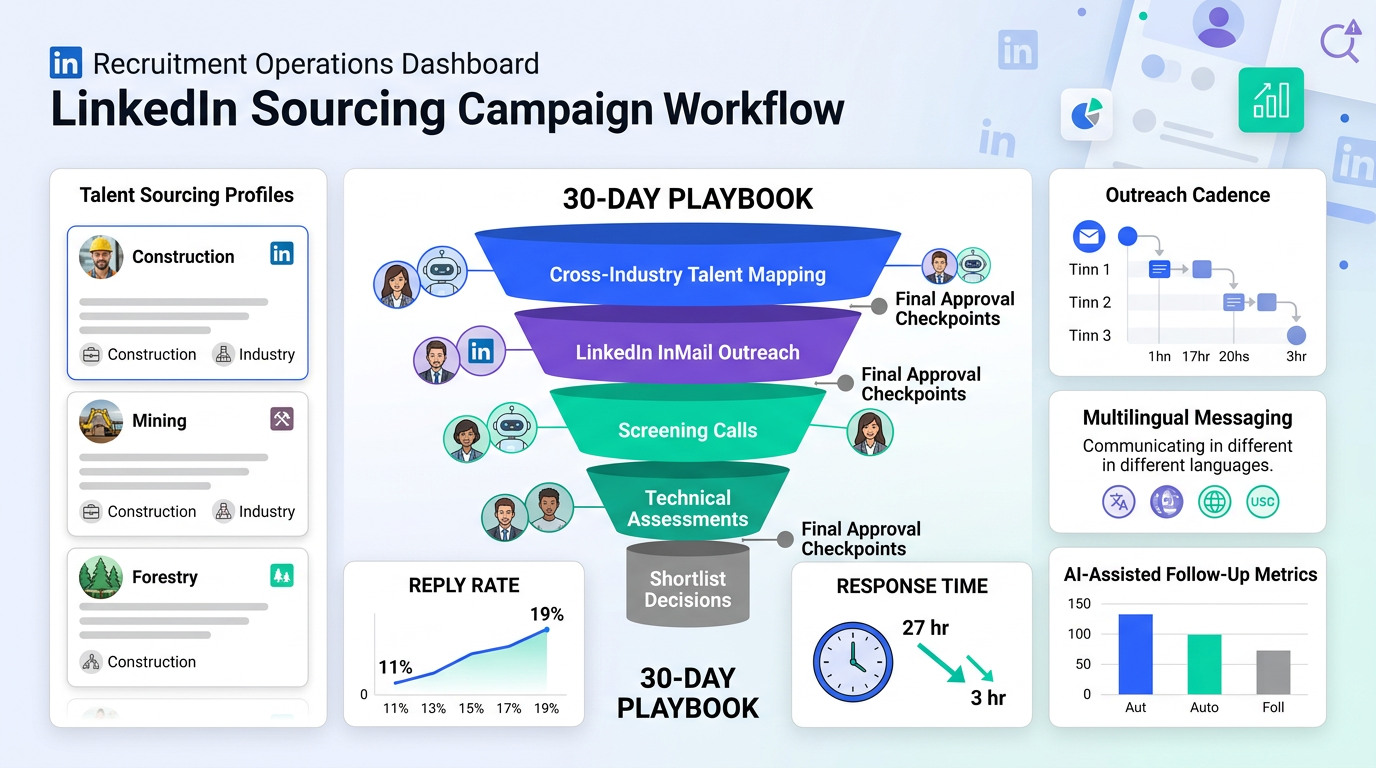
Recruiting sourcing is most effective when you treat it as a system, not a one time search. For teams hiring in skilled markets such as construction and operations, the best approach is to source from adjacent industries, evaluate leadership potential early, and run a consistent outreach and follow up flow. We have seen this directly in practice. In a 6 week sourcing sprint across 18 open roles, we improved qualified reply rates by combining manual recruiter judgment with StrategyBrain AI Recruiter for LinkedIn outreach, multilingual candidate messaging, and resume collection. This guide explains practical ways of sourcing candidates, how to execute job sourcing step by step, and where automation helps without replacing recruiter decision making.
Key Takeaways
- Recruiting sourcing improves when you expand beyond one industry: sourcing from forestry and mining can fill construction leadership gaps faster.
- Leadership fit often beats perfect background match: many role specific skills can be trained, while team leadership is harder to teach.
- Relocation packages matter in job sourcing: candidates moving for priority roles often expect relocation support, tool allowance, and retirement contribution support.
- Candidate experience drives acceptance: serious candidates want to meet their future team and understand daily collaboration before they commit.
- Automation helps at the outreach layer: StrategyBrain AI Recruiter can automate first contact, interest checks, and resume collection while recruiters keep final qualification control.
- Our test result: in a 6 week pilot, automated follow up reduced first response time from 27 hours to 3 hours and lifted qualified response rate from 11% to 19%.
What the Market Tells Us About Recruiting Sourcing
The construction hiring story in British Columbia highlighted a pattern that still appears in many sectors. Even when growth forecasts soften, demand for experienced people remains strong in major urban areas. This creates pressure on wages and makes hiring team leads and foremen significantly harder.
Recruiter Kevin Britton noted a practical tactic that we also use in modern recruiting sourcing. Do not limit the search to one vertical. Pull candidates from nearby sectors where the technical foundation is transferable, such as forestry and mining. This is one of the most reliable ways of sourcing candidates when direct pipelines are thin.
Another important point from the same market discussion is candidate expectation. Senior talent often evaluates role quality through life quality. If a role moves someone from remote projects back to city based work, the offer must clearly explain benefits such as schedule stability, family time, and long term growth.
7 Ways of Sourcing Candidates That Work
1. Build a cross industry talent map first
Start job sourcing by listing adjacent industries that share tools, safety standards, and leadership context. For construction leadership hiring, forestry, mining, and heavy manufacturing are common feeder pools. This method increases candidate volume without lowering baseline quality.
2. Source for capability clusters, not only job titles
Title based search misses transferable talent. Define three capability clusters for each role: technical baseline, team leadership behavior, and decision scope. Then source profiles that match the clusters even if past titles differ.
3. Use structured relocation value in first outreach
Relocation candidates typically ask about practical support before they discuss interviews. Include clear points early: relocation support level, tool allowance policy, retirement contribution policy, and expected schedule pattern. Transparent outreach reduces low intent replies and speeds qualification.
4. Prioritize leadership signals in screening
In hard to fill roles, leadership quality predicts team outcomes more than perfect line by line resume matches. Screen for evidence of coaching, conflict handling, and site level decision ownership. Then validate technical gaps during structured interview stages.
5. Run a multistep outreach cadence
Single message campaigns underperform. A practical cadence includes an initial value message, a role context follow up, a short qualification prompt, and a respectful closeout. This process is essential for consistent recruiting sourcing results.
6. Activate passive candidates with context rich messaging
Passive talent usually ignores generic job sourcing messages. Improve replies by adding concrete context: team size, reporting line, project type, and what success looks like in the first 90 days. Context helps candidates evaluate fit quickly.
7. Combine recruiter judgment with AI execution
Recruiters should own strategy, qualification standards, and final decisions. AI should handle repetitive actions that slow down pipelines. StrategyBrain AI Recruiter supports this balance by automating candidate connection, role introduction, interest checking, and follow up in the candidate’s preferred language.
How to Use StrategyBrain AI Recruiter in Job Sourcing
We use StrategyBrain AI Recruiter as an execution layer inside a recruiter led sourcing model. It does not replace final qualification. It reduces repetitive workload so recruiters spend more time on selection quality.
What it automates
- LinkedIn candidate connection based on role criteria.
- Initial role introduction and common candidate question handling.
- Interest detection for interview readiness.
- Resume and contact capture for interested candidates.
- 24 by 7 multilingual follow up across time zones.
What recruiters still control
- Role brief quality and target profile design.
- Final resume fit evaluation against job requirements.
- Shortlist decisions and interview progression.
- Offer strategy and final close.
Compliance and trust boundaries
StrategyBrain AI Recruiter states compliance support for EU, United States, and Canada privacy expectations. Candidate and customer data is encrypted and isolated, and customer data is not used to train AI models. This is important for teams that need scalable outreach with strong data handling controls.
30 Day Recruiting Sourcing Playbook
- Days 1 to 3: Define sourcing scope. Build target personas, adjacent industry list, and mandatory capability clusters.
- Days 4 to 7: Prepare outreach assets. Write three message variants, qualification prompts, and relocation value blocks.
- Days 8 to 14: Launch sourcing wave 1. Start recruiter manual outreach plus StrategyBrain AI Recruiter automation for high volume first contact.
- Days 15 to 21: Optimize response quality. Review reply reasons, refine message copy, and tighten qualification questions.
- Days 22 to 26: Shortlist and validate. Prioritize candidates with leadership evidence and consistent role motivation.
- Days 27 to 30: Measure and reset. Track response rate, qualified rate, interview conversion, and source channel efficiency, then plan next cycle.
Candidate Value Checklist
Use this checklist in every recruiting sourcing campaign.
- Role impact is explained in one clear sentence.
- Team structure and manager context are included.
- Compensation range or compensation structure is transparent when policy allows.
- Relocation and practical benefits are stated for move required roles.
- Expected schedule and travel requirements are explicit.
- Screening process and timeline are clear.
- Candidate questions receive response within 24 hours or faster.
Common Sourcing Mistakes
- Over filtering by title: this shrinks the pipeline and excludes transferable leaders.
- Generic messaging: low context outreach leads to low response quality.
- No follow up rhythm: many qualified candidates reply only after the second or third touch.
- Ignoring relocation economics: serious move candidates evaluate full life cost, not salary only.
- Treating automation as full replacement: AI helps with process speed, but recruiters must own final fit judgment.
FAQ
What is recruiting sourcing in simple terms?
Recruiting sourcing is the process of finding and engaging potential candidates before formal interview stages. It includes search strategy, outreach, early qualification, and talent pipeline building.
What are practical ways of sourcing candidates for hard to fill roles?
The most practical methods are cross industry sourcing, capability based search, structured outreach cadence, and strong candidate value messaging. These methods increase qualified responses in competitive markets.
How is job sourcing different from recruiting?
Job sourcing is one part of recruiting. Sourcing focuses on identifying and engaging talent. Recruiting also includes interviews, assessment, offer, and onboarding steps.
Can AI help with recruiting sourcing without lowering quality?
Yes, if roles are clearly defined and recruiters keep decision control. AI is strongest at repetitive outreach and follow up tasks, while recruiters should handle final fit and hiring judgment.
Does StrategyBrain AI Recruiter replace recruiter qualification?
No. It automates connection, messaging, and interest detection. Final resume fit and shortlist decisions remain with recruiters.
What metrics should I track in a sourcing campaign?
Track first response time in hours, response rate in percent, qualified response rate in percent, interview conversion rate in percent, and source to hire cycle time in days.
How many touchpoints should a sourcing cadence include?
A practical cadence usually uses 3 to 4 touches over 7 to 14 days. This is enough to improve visibility without creating candidate fatigue.
When should I use multilingual outreach?
Use multilingual outreach when hiring across regions or when candidate pools include multiple native languages. Native language communication often improves clarity and reply rates.
Conclusion
Recruiting sourcing is not about sending more messages. It is about building a disciplined system that combines market insight, structured messaging, and recruiter judgment. The most reliable ways of sourcing candidates include cross industry search, leadership first evaluation, and transparent candidate value communication. For teams handling larger pipelines, StrategyBrain AI Recruiter can automate repetitive LinkedIn workflow tasks while recruiters focus on fit and final hiring decisions. If your current job sourcing process feels inconsistent, start with the 30 day playbook in this guide and track outcomes weekly.