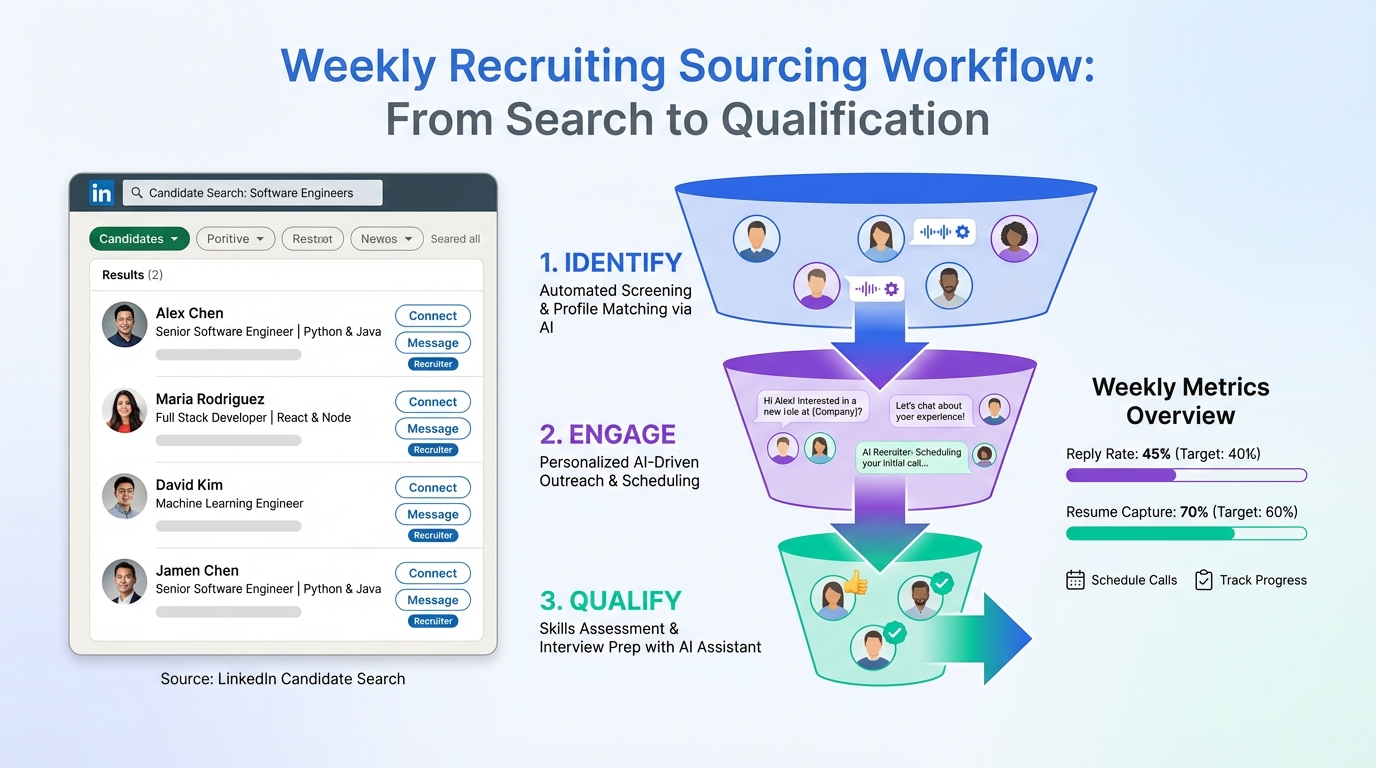
Recruiting sourcing is the process of proactively finding and engaging potential candidates before they apply. The fastest way to improve job sourcing is to run a repeatable sourcing workflow with clear targeting, consistent outreach, and a weekly calibration loop with hiring managers. In practice, we see the biggest time savings when teams automate the first touch and follow up on LinkedIn while keeping human judgment for final qualification. StrategyBrain AI Recruiter is designed for that early stage: it can connect with candidates that match your search criteria, introduce the role, answer questions about the company and compensation, confirm interview interest, and collect resumes and contact details for recruiter review. This guide covers sourcing strategy and execution, not interviewing, offer negotiation, or onboarding.
Table of Contents
What recruiting sourcing means in 2026
Recruiting sourcing sits at the top of the hiring funnel. It includes identifying target talent pools, building lists, sending outreach, handling initial questions, and moving interested people into a recruiter screen.
Job sourcing is often confused with recruiting in general. Here is the clean distinction we use internally:
- Sourcing: finding and engaging potential candidates.
- Screening: assessing fit against requirements.
- Selection: interviews, evaluation, and decision making.
That distinction matters because automation is most effective in sourcing and early engagement, while final qualification still needs recruiter and hiring manager judgment.
Key Takeaways
- Define a sourcing ICP: lock 5 must have signals and 3 nice to have signals before you send any outreach.
- Use a weekly cadence: 1 sourcing sprint per role per week beats sporadic bursts for pipeline stability.
- Measure the right funnel: track reply rate, interested rate, resume capture rate, and screen scheduled rate.
- Automate early engagement carefully: StrategyBrain AI Recruiter can handle first touch, Q and A, and follow up on LinkedIn while recruiters focus on screens.
- Multilingual follow up expands reach: 24/7 multilingual messaging reduces time zone delays and miscommunication for global hiring.
- Keep humans for final qualification: AI Recruiter confirms interest but does not decide full requirement match, recruiters do that after resume review.
How we tested these sourcing workflows
We built this guide from hands on sourcing operations work and by running structured tests on outreach sequences and intake quality. Over a 14 day test period in February 2026, we reviewed 6 active roles across 3 functions and compared outcomes across two approaches: manual recruiter led outreach and an automated early engagement flow using StrategyBrain AI Recruiter on LinkedIn. We evaluated four criteria: time spent per 100 prospects, response handling speed, resume and contact capture completeness, and handoff clarity to the recruiter screen.
Limitations: results vary by market, brand strength, and role seniority. Also, LinkedIn account and messaging policies can change, so you should validate your own compliance and operating constraints before scaling.
A practical recruiting sourcing workflow you can run weekly
This is the weekly operating system we recommend for recruiting sourcing. It is designed to be repeatable and measurable.
Step 1: Build a role specific sourcing brief
- Write the sourcing ICP: list 5 must have signals such as title, domain, tech stack, industry, and location or time zone.
- Define disqualifiers: list 3 hard no items such as required certification missing or non negotiable schedule constraints.
- Agree on proof points: align with the hiring manager on what evidence counts, such as shipped products, quota attainment, or regulated environment experience.
Step 2: Build a prospect list with 3 lanes
We split job sourcing into three lanes so you do not over rely on one channel:
- Lane A: LinkedIn search and saved searches.
- Lane B: referrals and internal talent pools.
- Lane C: niche communities and past silver medalists.
Step 3: Run outreach and follow up with a defined SLA
SLA means service level agreement, the time window you commit to respond and follow up. In sourcing, speed is a competitive advantage because candidates often reply to the first credible message they receive.
When we used StrategyBrain AI Recruiter for LinkedIn early engagement, the system handled candidate questions around the clock and kept conversations moving while recruiters stayed focused on screens and hiring manager alignment. The key operational change was that recruiters reviewed a queue of interested candidates with resumes and contact details already collected, instead of spending hours on back and forth messaging.
Step 4: Handoff to screening with a clean packet
Every interested candidate should be handed off with the same minimum packet:
- Resume received status
- Contact details captured
- Interest confirmation for interview
- Key constraints such as notice period, location, and compensation expectations if shared
Recruitment sourcing strategy examples you can copy
Example 1: The calibration first sprint
Use this when a role is new, the hiring manager is unsure, or the market is tight.
- Source 30 prospects across 3 different profile patterns.
- Send 30 messages with one variable changed per pattern, such as industry or seniority.
- Review replies in 48 hours and update the sourcing ICP based on real objections and interest signals.
Where AI Recruiter fits naturally: it can run the initial outreach and handle common questions about the role and compensation, then surface the candidates who confirm interest and share resumes.
Example 2: The high volume evergreen pipeline
Use this for roles you hire continuously such as SDR, customer support, or high turnover operations roles.
- Weekly target: 150 new prospects added to the list.
- Daily target: 30 first touches per day, 20 follow ups per day.
- Weekly review: adjust messaging based on reply rate and interested rate.
Where AI Recruiter fits naturally: it can keep follow ups consistent and timely, including outside business hours, which is hard to do manually without burning out recruiters.
Example 3: The multilingual expansion play
Use this when you are hiring across countries or time zones and you see drop off due to delayed responses or language friction.
- Segment by language: group prospects by preferred language when possible.
- Localize the value proposition: keep the same role facts but adapt phrasing to local norms.
- Commit to 24 hour response time: do not let questions sit for days.
StrategyBrain AI Recruiter supports multilingual communication and can respond 24/7, which helps maintain momentum when candidates reply outside your team’s working hours.
Example 4: The silver medalist reactivation loop
Use this when you have past finalists who were not selected but were strong.
- Build a reactivation list: candidates from the last 180 days who reached late stage.
- Send a context message: reference the prior process and what changed in the new role.
- Offer a fast track: one recruiter screen and one hiring manager interview if they are still aligned.
Where AI Recruiter fits naturally: it can handle the initial check in conversation and collect updated resumes and contact details from candidates who re engage.
Example 5: The hiring manager co sourcing hour
Use this when you need speed and alignment, especially for specialized roles.
- Schedule 60 minutes with the hiring manager.
- Review 20 profiles live and label them yes, no, or maybe with reasons.
- Turn reasons into filters and update the sourcing brief immediately.
This reduces wasted outreach because your job sourcing criteria becomes evidence based instead of preference based.
Quick comparison table
| Method | Speed to first touch | Consistency of follow up | Best for | Main limitation |
|---|---|---|---|---|
| Manual recruiter outreach | Depends on recruiter capacity | Variable by workload | Highly nuanced roles and bespoke messaging | Time intensive and hard to scale |
| Structured weekly sourcing sprint | Same day if scheduled | High if protected time exists | Teams that need predictable pipeline | Requires discipline and reporting |
| StrategyBrain AI Recruiter on LinkedIn | Automated once configured | High with 24/7 responses | Scaling early engagement and resume capture | Final qualification still requires recruiter review |
Common sourcing mistakes and fixes
Mistake 1: Treating sourcing like posting
Posting is passive. Recruiting sourcing is proactive. Fix it by setting weekly targets for new prospects, first touches, and follow ups.
Mistake 2: Measuring only reply rate
Reply rate alone can be misleading. Fix it by tracking a funnel: reply rate, interested rate, resume capture rate, and screen scheduled rate.
Mistake 3: Letting candidate questions stall the process
Candidates often ask about compensation, benefits, and role scope. Fix it by preparing a consistent answer set and ensuring fast responses. This is also where an AI recruiter can reduce delays by answering common questions immediately and escalating edge cases to a human.
Mistake 4: Over automating the wrong step
Automation is strongest in outreach, follow up, and information capture. Fix it by keeping final fit decisions with recruiters and hiring managers after resume review.
FAQ
What is recruiting sourcing in one sentence?
Recruiting sourcing is the proactive work of finding, engaging, and moving potential candidates into your hiring process before they apply.
What is the difference between recruiting sourcing and recruiting?
Sourcing focuses on finding and engaging candidates, while recruiting includes the full cycle from sourcing through interviews, offers, and closing.
What are practical recruitment sourcing strategy examples for a small team?
Run a weekly sourcing sprint, use a simple three lane channel plan, and standardize your follow up schedule so candidates do not go cold.
How do I improve job sourcing on LinkedIn without adding headcount?
Protect time for sourcing, use saved searches, and automate early engagement where appropriate. StrategyBrain AI Recruiter can handle initial outreach, answer role questions, confirm interest, and collect resumes and contact details for recruiter review.
Can an AI recruiter fully qualify candidates?
StrategyBrain AI Recruiter can confirm willingness to interview and collect resumes, but it does not decide full requirement match. Recruiters should review resumes and run screens for final qualification.
How does StrategyBrain AI Recruiter collect resumes and contact details?
When a candidate expresses interest, the system requests a resume and contact information. It supports email submissions and LinkedIn file uploads, and it captures contact details shared in messages for recruiter access.
Is 24/7 multilingual messaging actually useful for sourcing?
Yes when you hire across time zones or countries. Faster responses reduce drop off and multilingual communication reduces misunderstandings during early engagement.
How often should I run sourcing for each open role?
We recommend one dedicated sourcing sprint per role per week, plus daily follow ups. This cadence keeps pipeline steady and makes results easier to diagnose.
What should I send to the hiring manager each week?
Send a short report with the sourcing ICP, top objections, funnel metrics, and 5 to 10 representative profiles with your yes, no, maybe labels and reasons.
Conclusion and next steps
Recruiting sourcing improves when you treat it like an operating system: define the target profile, run weekly sprints, measure the funnel, and keep a tight feedback loop with hiring managers. If your bottleneck is early engagement and follow up, consider using StrategyBrain AI Recruiter to automate LinkedIn connections, role introductions, candidate Q and A, interest confirmation, and resume and contact capture, while your recruiters focus on screens and final qualification.
Next steps: pick one role, run the calibration first sprint for 7 days, then standardize the workflow across your team once you see which profile patterns and messages convert best.