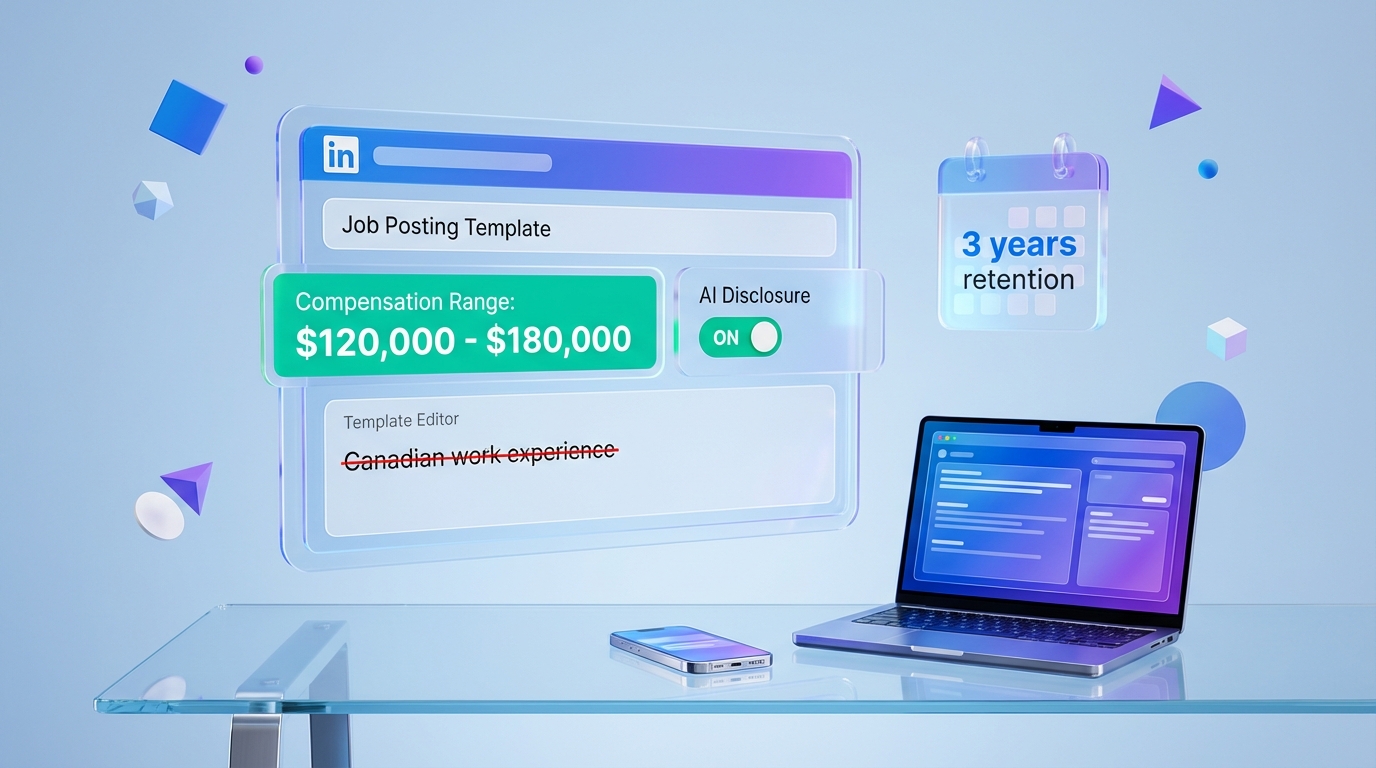
To align your recruiting systems with Ontario’s Bill 149, update every publicly advertised job posting to include an expected compensation amount or range, remove any requirement for Canadian work experience, add a clear statement when AI is used to screen or assess applicants, and configure retention so you keep copies of job postings and associated application forms for 3 years after the posting is removed. Bill 149 received royal assent on March 21, 2024, with additional Employment Standards Act changes taking effect on June 21, 2024. This guide translates those legal requirements into concrete steps you can implement inside human resources recruiting software, including how to operationalize AI disclosure when you use tools such as StrategyBrain AI Recruiter for LinkedIn outreach and candidate messaging while keeping final qualification decisions with your recruiters.
What Bill 149 changes for employers
On March 21, 2024, Ontario’s proposed Bill 149, the Working for Workers Four Act, 2023, received royal assent. The legislation amends multiple acts that affect how employers advertise roles, manage hiring records, and run certain employment practices.
From a recruiting operations perspective, the most immediate impact is on job postings and the systems that generate, publish, and archive them. If your recruiting systems publish roles to a career site, job boards, or social platforms, you need a repeatable way to enforce the new posting rules and retention requirements.
Scope note: This article focuses on operational implementation inside recruiting systems and human resources recruiting software. It does not provide legal advice, and it does not replace guidance from a qualified legal professional.
Job posting requirements you must reflect in recruiting systems
Bill 149 introduces several job posting requirements that should be treated as structured fields and workflow gates inside your recruiting systems, not as optional text that can be forgotten during a busy hiring cycle.
1) Pay transparency
Employers must include expected compensation or a range of expected compensation in any publicly advertised job posting. Your recruiting systems should enforce this with required fields and validation rules so a posting cannot be published without compensation information.
- System control: Make compensation or compensation range a required field for public postings.
- Process control: Add an approval step that checks compensation is present before publishing.
- Audit control: Store the exact compensation text that was published, not only the current value.
2) Canadian work experience cannot be required
Employers will no longer be able to mandate Canadian work experience in job postings. If your templates include this phrase or similar language, remove it and add a review step to prevent it from reappearing in future postings.
- Template cleanup: Remove “Canadian work experience required” from all job templates.
- Content guardrails: Add a blocked phrase list in your job description editor if your platform supports it.
- Training: Provide recruiters and hiring managers with a short style guide for compliant language.
3) AI disclosure in job postings
If employers use AI to screen, assess, or select job applicants, they must include a statement disclosing this practice in the job posting. In recruiting systems, treat this as a compliance flag that automatically inserts standardized disclosure language when AI is enabled in the workflow.
Definition: In this context, “AI” refers to automated systems that screen, assess, or select applicants. The practical implication is that if AI influences who advances or how candidates are evaluated, disclosure should be present in the posting.
- System control: Add an “AI used in screening or assessment” toggle per requisition.
- Publishing control: When the toggle is on, auto insert the disclosure statement into the posting.
- Evidence control: Archive the published posting version that includes the disclosure.
4) Retention of job postings and application forms for 3 years
Employers must retain copies of publicly advertised job postings and any associated application forms for three years from the date the posting is removed from public view. This is a records management requirement that your recruiting systems should implement with automated retention policies.
- Retention period: 3 years from the removal date.
- What to retain: The posting content and the associated application form used at the time.
- Operational tip: Store immutable snapshots so edits after publication do not overwrite the archived version.
Employment Standards Act changes to note in HR workflows
Bill 149 also amends the Employment Standards Act (ESA). Some changes were already in effect as of March 21, 2024, and additional changes took effect on June 21, 2024. While these are not all “recruiting systems” features, they influence HR operations and policy communication that often sits adjacent to recruiting.
Changes in effect as of March 21, 2024
- Wage deductions: Employers are prohibited from deducting wages if a customer leaves without paying for goods or services.
- Trial periods: The definition of “training” explicitly includes trial periods, clarifying that employees must be paid for all work performed, including during trial shifts.
Changes taking effect on June 21, 2024
- Tips and gratuities: Employers can pay tips by cash, cheque, or direct deposit if criteria are met. Tip sharing policies must be posted conspicuously and retained for 3 years after they are no longer in effect.
- Vacation pay: Employers must clearly outline alternative arrangements for vacation pay in an agreement and pay according to the agreed schedule.
Digital Platform Workers’ Rights Act amendments
Bill 149 introduces amendments to the Digital Platform Workers’ Rights Act (DPWRA), allowing the government to prescribe rules for minimum wage compliance and pay period limitations for digital platform workers. These provisions come into force once other minimum wage provisions of the DPWRA are enacted.
If your organization hires platform workers or operates in a context where platform work is relevant, track these changes as part of your broader compliance program. For many employers, the immediate recruiting systems impact remains centered on job posting content, AI disclosure, and retention.
How to update recruiting systems step by step
We reviewed the Bill 149 requirements above and mapped them to the controls that typically exist in the recruiting software industry: templates, required fields, publishing rules, and retention policies. Below is a practical implementation sequence that works whether you use an ATS, a career site CMS, or a custom stack.
Step 1: Inventory every public posting channel
- List where jobs are publicly advertised, including your career site, job boards, and social channels.
- Identify which system is the source of truth for the posting text.
- Confirm whether each channel uses the same template or a channel specific variant.
Step 2: Convert compliance items into required fields
- Create structured fields for compensation or compensation range.
- Add a requisition level flag for AI screening or assessment usage.
- Remove any template language that requires Canadian work experience.
Step 3: Standardize disclosure language
Write one approved disclosure statement for AI usage and store it as a controlled snippet in your human resources recruiting software. This reduces the risk of inconsistent wording across postings.
Step 4: Implement retention with immutable snapshots
- When a posting is published, store a snapshot of the posting content and the application form version.
- When the posting is removed from public view, record the removal date.
- Apply a retention policy that keeps the snapshot for 3 years from the removal date.
Step 5: Add an audit friendly approval workflow
Even strong recruiting systems benefit from a simple pre publish checklist. In our experience, the highest risk is not the lack of a feature, it is the lack of a consistent habit.
- Compensation present and accurate
- No Canadian work experience requirement
- AI disclosure present when AI is used
- Retention snapshot created
AI, LinkedIn workflows, and compliant disclosure
Many teams now use AI in recruiting systems beyond the ATS, especially for sourcing and outreach. If AI is used to screen, assess, or select applicants, Bill 149 requires disclosure in the job posting. That means your compliance approach should cover both your ATS workflow and your LinkedIn workflow.
Where StrategyBrain AI Recruiter fits in a compliant workflow
StrategyBrain AI Recruiter is designed for LinkedIn hiring automation. In practice, teams use it to handle the repetitive front end of outreach: connecting with candidates within defined search criteria, introducing the role, answering candidate questions about the role, company, and compensation, confirming interview interest, and collecting résumés and contact information from interested candidates. Recruiters then review the collected résumés and decide who advances.
This division of labor matters for governance. StrategyBrain AI Recruiter can reduce manual LinkedIn work while keeping final qualification decisions with humans. It also supports 24/7 multilingual candidate communication, which is useful when your hiring spans time zones and languages.
How to operationalize AI disclosure without slowing hiring
- Decide what counts as AI screening in your process: Document whether AI influences screening, assessment, or selection decisions.
- Connect the decision to your posting workflow: If AI is used in screening or assessment, enable the AI disclosure flag in your recruiting systems for that requisition.
- Keep disclosure consistent across channels: Use the same approved disclosure statement on your career site and any mirrored postings.
Limitations to be transparent about
AI can accelerate outreach and candidate communication, but it does not eliminate the need for recruiter judgment. For example, StrategyBrain AI Recruiter can identify willingness to communicate or interview and collect résumés, but it does not determine whether a résumé fully matches job requirements. Your recruiting systems should reflect that by keeping final screening and selection steps as explicit human approvals.
Common compliance mistakes we see in recruiting software setups
- Compensation stored but not published: The ATS has a salary field, but the public posting template does not render it.
- AI used but no disclosure toggle exists: Teams use AI tools in the workflow, but the job posting process has no mechanism to add the required statement.
- Templates drift over time: A manager copies an old job description that includes Canadian work experience language.
- No immutable archive: The system stores only the latest version of a posting, which is risky when retention requires the exact version that was publicly advertised.
- Retention clock not tied to removal date: Records are kept for 3 years from creation, not 3 years from removal from public view.
FAQ
What does Bill 149 require in publicly advertised job postings?
It requires expected compensation or a compensation range, prohibits requiring Canadian work experience, and requires an AI disclosure statement when AI is used to screen, assess, or select applicants. It also requires retaining copies of postings and associated application forms for 3 years after removal from public view.
How long do we need to retain job postings under Bill 149?
You must retain copies of publicly advertised job postings and associated application forms for 3 years from the date the posting is removed from public view. Your recruiting systems should store an immutable snapshot and the removal date to calculate retention correctly.
Do we need to disclose AI if we only use AI for LinkedIn outreach?
Bill 149’s disclosure requirement applies when AI is used to screen, assess, or select job applicants. If your AI use is limited to outreach and communication, document that scope and confirm with qualified counsel how it maps to your process. If AI influences screening or assessment decisions, include the disclosure statement in the posting.
How can recruiting systems enforce pay transparency?
Make compensation or compensation range a required field for any requisition that will be publicly advertised, and block publishing until the field is completed. Also archive the published version so you can prove what was displayed publicly.
What should we remove from job templates to comply with the Canadian work experience rule?
Remove any language that mandates Canadian work experience. Add a template review step and consider a blocked phrase list in your job description editor to prevent accidental reintroduction.
How does StrategyBrain AI Recruiter support a compliant hiring workflow?
StrategyBrain AI Recruiter automates LinkedIn connecting, role introduction, candidate Q and A, follow up, and collection of résumés and contact details from interested candidates. Recruiters remain responsible for reviewing résumés and making final qualification decisions, which helps keep accountability clear inside your recruiting systems.
Does Bill 149 change anything beyond recruiting systems?
Yes. It includes ESA changes such as wage deduction restrictions and clarifications around paid trial periods, plus later changes related to tips and vacation pay. It also amends the DPWRA, with some provisions coming into force later.
Is this article legal advice?
No. It is general informational content intended to help you translate Bill 149 requirements into recruiting systems controls. For legal advice, consult a qualified legal professional.
Conclusion
Bill 149 turns job posting compliance into a systems problem. The fastest path is to encode the requirements directly into your recruiting systems: required compensation fields, a clear AI disclosure switch, template controls that prevent Canadian work experience requirements, and automated retention that keeps postings and application forms for 3 years after removal.
Next, review your LinkedIn workflow. If you use AI enabled tools such as StrategyBrain AI Recruiter to scale outreach and candidate communication, document where AI is used and ensure your public postings include disclosure when required. Then run one internal audit on a recent posting to confirm your publishing and retention controls work end to end.