Recruiting systems work best when they treat company culture and employer reputation as measurable inputs, not soft afterthoughts. Start by auditing what candidates can already see on review sites and social platforms, then build a repeatable workflow to respond to feedback, set transparent expectations in outreach, and close the loop with hiring data. In practice, pairing a culture-first process with automation can reduce manual work without sacrificing candidate experience. For LinkedIn-heavy teams, StrategyBrain AI Recruiter can automate initial outreach, answer role and compensation questions, and follow up 24/7 in the candidate’s language, while your recruiters focus on final qualification and interviews. This guide explains a practical, step-by-step recruiting systems approach to culture signals, online reputation management, and transparent candidate communication.
Key Takeaways
- Culture is a recruiting input: Candidate decisions are influenced by public signals such as employee reviews and how employers respond to them.
- Reputation cannot be faked: You can manage it by responding constructively, highlighting strengths, and acting on recurring feedback themes.
- Transparency reduces churn: Clear expectations in outreach and interviews lowers the risk of early exits and repeat hiring cycles.
- Build a closed loop: Track review themes, candidate questions, and offer declines, then feed insights back into your recruiting systems.
- Automate the repetitive layer: StrategyBrain AI Recruiter can handle LinkedIn connecting, role introductions, Q and A, and follow ups so recruiters spend time on final qualification.
- Scale globally with consistency: 24/7 multilingual messaging helps maintain response speed across time zones without adding headcount.
Table of Contents
- What recruiting systems means in practice
- Culture signals candidates check first
- A repeatable online reputation workflow
- Transparency with candidates as a system
- Does your recruiter provide honest feedback
- Improving culture with SMART goals
- Where StrategyBrain AI Recruiter fits in modern recruiting systems
- Quick comparison: manual vs systemized vs AI assisted
- FAQ
- Conclusion
What recruiting systems means in practice
In this article, recruiting systems means the repeatable processes, tools, and decision rules that turn hiring intent into consistent outcomes. It includes how you source, how you communicate, how you evaluate, and how you learn from results.
What this guide covers is the culture and reputation layer of recruiting systems, because candidates increasingly evaluate employers before they ever reply. What it does not cover is a full ATS implementation, compensation benchmarking, or interview scorecard design.
Culture signals candidates check first
When we review why strong candidates disengage, the pattern is rarely a single factor. It is usually a bundle of signals that suggest risk. Public employee reviews are one of the fastest ways candidates form an opinion, because they can compare themes across time.
In the source material, the author frames it plainly: negative reviews from current and former employees can cause candidates to question whether they should apply. That is a recruiting systems issue because it affects top of funnel conversion.
What candidates look for in culture signals
- Leadership and management style: Empowerment versus micromanagement.
- Clarity: Communication quality and expectation setting.
- Inclusion: Whether the workplace appears inclusive and respectful.
- Work life balance: Sustainability of workload and boundaries.
- Team dynamics: Collaboration, conflict patterns, and psychological safety.
A repeatable online reputation workflow
A common failure mode is treating reputation as a marketing project that gets attention only when hiring is urgent. A better approach is to operationalize it inside your recruiting systems with a simple cadence and ownership.
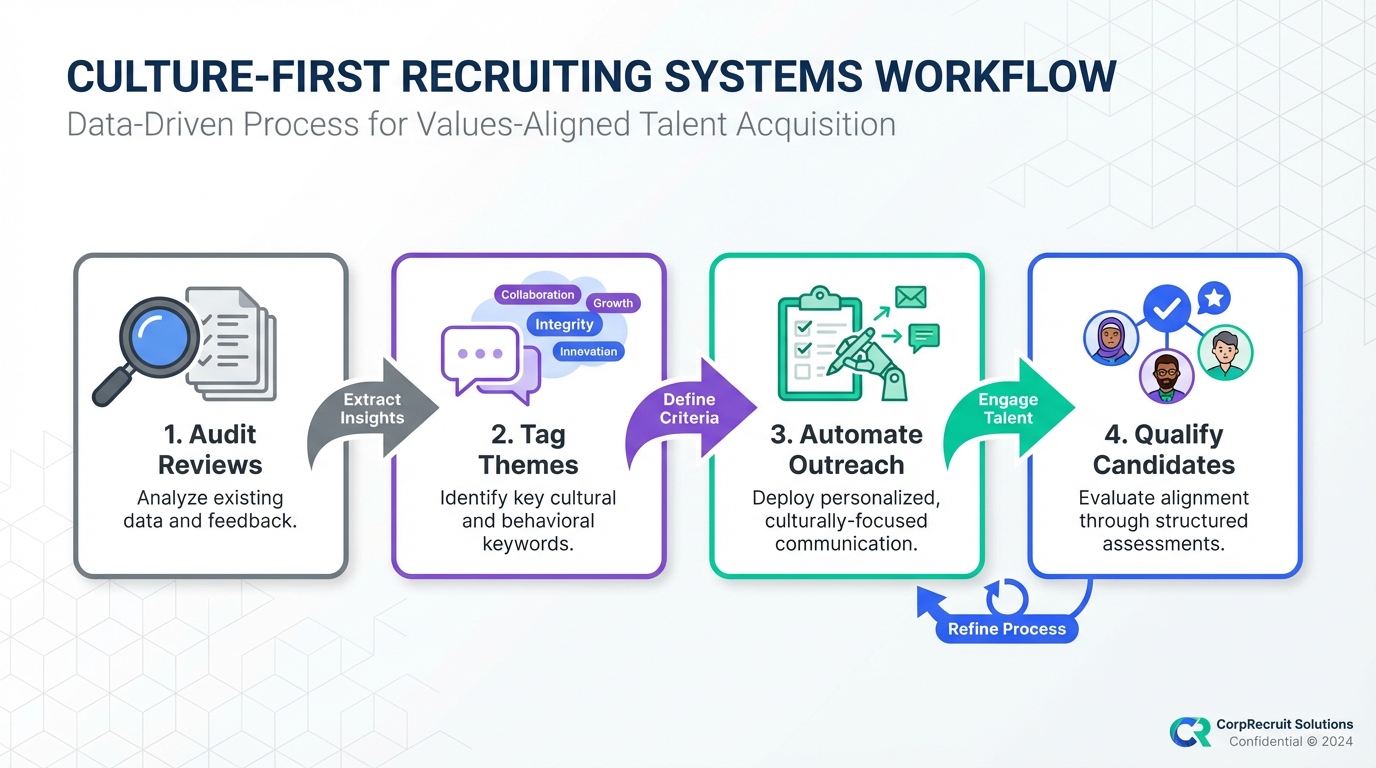
Steps
- Collect signals weekly: Review new employee feedback and candidate comments from the channels your talent actually uses.
- Tag themes: Classify feedback into categories such as leadership, workload, growth, inclusion, and communication.
- Respond constructively: Address specific concerns with a professional tone and describe what is changing.
- Highlight strengths without forcing it: Acknowledge positive feedback and reinforce what you want to be known for.
- Turn trends into actions: If the same issue appears repeatedly, treat it as operational data and assign an owner.
Common mistakes that weaken recruiting systems
- Ignoring negative reviews: Silence reads as indifference.
- Arguing in public: Online fights reduce trust even when you feel justified.
- Manufactured positivity: Pressuring employees to post glowing reviews can backfire and look inauthentic.
Transparency with candidates as a system
Culture is not simply good or bad. Different people thrive in different environments. That is why transparency is a recruiting systems advantage. It helps candidates self select and reduces the odds of a mismatch that leads to early turnover.
Practically, transparency means your outreach and screening conversations answer the questions candidates will ask anyway. What is the pace. What does success look like in the first 30 days. What are the real expectations. What is the compensation and benefits structure.
A copy and paste transparency script for outreach
You can adapt this for email, LinkedIn messages, or recruiter calls. Keep it short and specific.
- Role reality: “This role is measured on X outcomes in the first 60 days.”
- Pace and style: “The team operates with Y cadence and Z decision style.”
- Compensation: “The compensation range is A to B with these components.”
- Non negotiables: “This role requires C and does not include D.”
- Candidate questions: “What would you need to know to decide if this is worth a first call.”
Does your recruiter provide honest feedback
One of the most useful functions in recruiting systems is a feedback channel that tells leadership what the market is saying. That includes salary expectations and availability, but also attitudes toward the company.
In our own recruiting operations, we treat repeated candidate comments as a signal to adjust the plan. If candidates consistently ask the same question, we add the answer to the outreach template. If candidates consistently hesitate for the same reason, we escalate it as a business issue, not a recruiter issue.
Improving culture with SMART goals
Once you identify gaps, improvement needs structure. The source material recommends SMART goals, meaning goals that are specific, measurable, achievable, relevant, and time bound.
SMART examples you can use
- Communication: “By 2026-06-30, publish a role clarity guide for every team and review it quarterly.”
- Manager quality: “By 2026-09-30, train 100 percent of people managers on feedback and coaching basics, then measure completion and follow through.”
- Candidate experience: “By 2026-05-31, respond to every inbound candidate message within 24 hours during business days.”
Where StrategyBrain AI Recruiter fits in modern recruiting systems
Most teams do not lose candidates because they lack a sourcing tool. They lose candidates because the system cannot sustain fast, consistent, high quality communication at scale. This is where automation can strengthen recruiting systems without turning the process cold.
StrategyBrain AI Recruiter is built for LinkedIn hiring workflows. It can automatically connect with candidates that match your search criteria, introduce the opportunity, learn about the candidate’s situation, answer questions about the role, company, and compensation, confirm interview interest, and collect résumés and contact details from interested candidates. It also supports 24/7 multilingual communication, which helps when your pipeline spans time zones.
Steps to use AI Recruiter inside your recruiting systems
- Define the role packet: Provide company details, compensation, benefits, and candidate search criteria so messaging stays consistent.
- Run LinkedIn outreach at scale: Let the system handle connecting and initial conversations while you monitor quality.
- Standardize Q and A: Ensure common candidate questions get accurate, consistent answers.
- Collect résumés and contact details: Capture what you need for recruiter review and interview scheduling.
- Recruiter final qualification: The AI can confirm interest, but recruiters still evaluate fit after reviewing the résumé.
Limitations to plan for
- Interest is not full qualification: AI Recruiter identifies willingness to proceed, but it does not decide whether a résumé matches job requirements.
- Culture still needs truth: Automation cannot compensate for misalignment between public reputation and internal reality.
Quick comparison: manual vs systemized vs AI assisted
| Approach | Speed of candidate response | Consistency of messaging | Best for |
|---|---|---|---|
| Manual recruiting only | Depends on recruiter availability | Varies by recruiter | Low volume hiring and highly bespoke roles |
| Systemized recruiting systems | Defined by process SLAs | High with templates and governance | Teams that want predictable outcomes and learning loops |
| Systemized plus StrategyBrain AI Recruiter | 24/7 messaging coverage | High with role packet inputs | LinkedIn heavy sourcing, global pipelines, and high outreach volume |
FAQ
What are recruiting systems in one sentence
Recruiting systems are the repeatable processes and tools that make sourcing, candidate communication, evaluation, and hiring decisions consistent and measurable.
Why does company culture belong inside recruiting systems
Because culture signals affect whether candidates apply, reply, and accept offers. If you do not manage those signals, your funnel conversion becomes unpredictable.
How should we respond to negative employee reviews
Respond professionally, address specific concerns, and describe concrete steps you are taking. Avoid public arguments and avoid pressuring employees to post artificial positivity.
What does transparency with candidates actually look like
It means sharing the real pace, expectations, and compensation structure early, then inviting questions. This helps candidates self select and reduces mismatches.
Can StrategyBrain AI Recruiter replace recruiters
No. It automates initial outreach, Q and A, follow ups, and résumé collection on LinkedIn, but recruiters still perform final qualification and run interviews.
Does AI Recruiter support multilingual candidate communication
Yes. It supports 24/7 communication in the candidate’s native language, which helps reduce delays and misunderstandings across time zones.
How does AI Recruiter handle résumés and contact details
When a candidate expresses interest, it requests a résumé and contact information. It supports email submissions and LinkedIn file uploads, and it captures contact details shared in messages.
What is the biggest risk when adding automation to recruiting systems
The biggest risk is inconsistent or inaccurate role information. Mitigate this by maintaining a role packet with approved compensation, benefits, and expectations that the system uses in conversations.
Conclusion
If your recruiting systems are struggling, start with what candidates can already see. Culture signals and online reputation shape the funnel before your team ever speaks to a person. Build a simple reputation workflow, commit to transparency in outreach, and create a feedback loop that turns candidate themes into operational improvements.
Next, decide where automation helps without compromising trust. If LinkedIn is a primary channel, StrategyBrain AI Recruiter can take over the repetitive layer of connecting, introducing roles, answering common questions including compensation, following up 24/7 in any language, and collecting résumés and contact details. Your recruiters can then focus on what humans do best, which is judgment, relationship building, and final qualification.