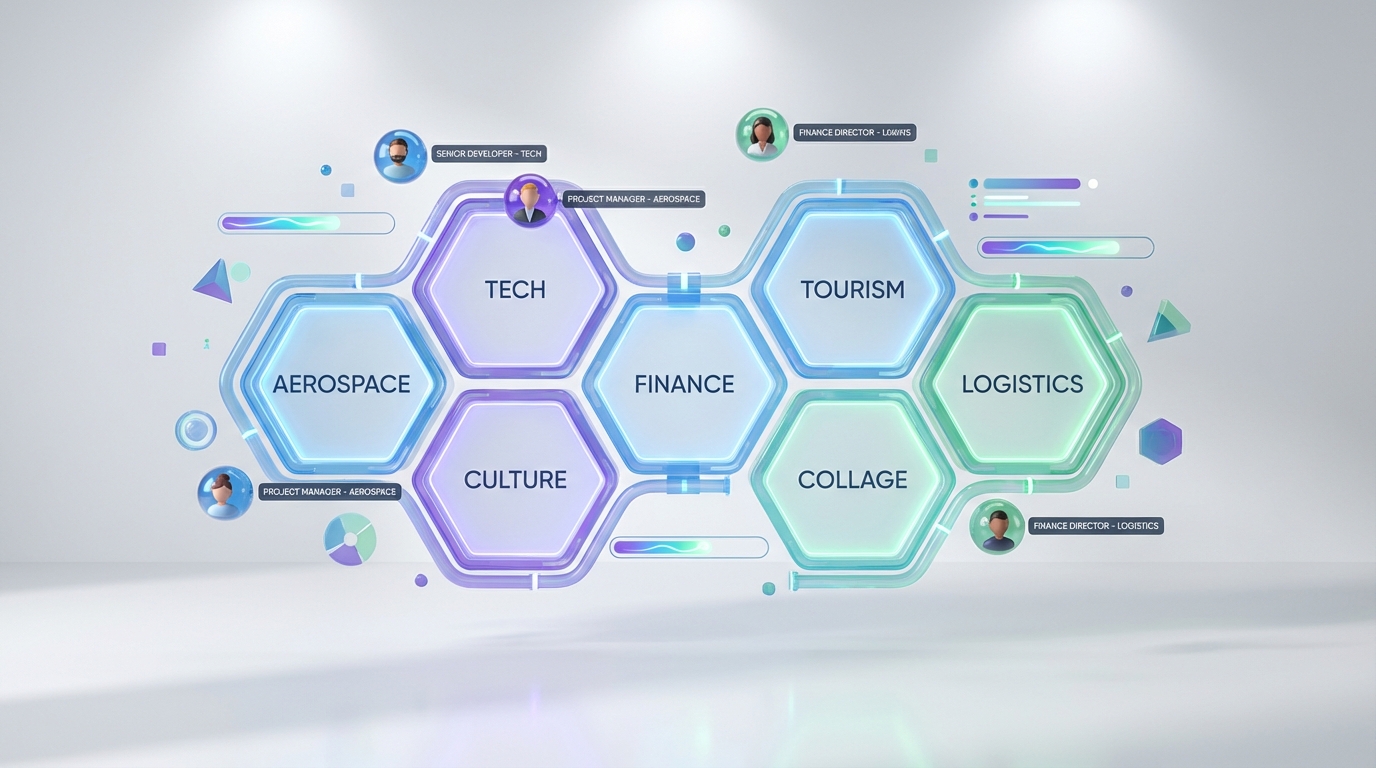
Recruitment agency software helps you turn a broad local talent market into a searchable, reusable pipeline by standardizing candidate data, automating outreach, and tracking conversations across roles. In practice, the fastest way to strengthen your talent pool is to combine a recruitment CRM workflow with clear segmentation by industry and seniority, then run consistent LinkedIn outreach and follow up. In this guide, we use Montréal as a concrete example of a diverse economy and show how agencies can map talent pools across aerospace, tech, finance, culture, tourism, and logistics. We also explain where StrategyBrain AI Recruiter fits when you need LinkedIn automation that connects, introduces roles, answers candidate questions, and collects résumés and contact details while your team focuses on interviews and final qualification.
Key Takeaways
- Start with segmentation: Build talent pools by industry and role family first, then add seniority and language tags for faster shortlists.
- Montréal is a useful model: The city’s economy spans aerospace, tech, finance, culture, tourism, and logistics, which is ideal for cross industry recruiting pipelines.
- Use automation where it is repetitive: StrategyBrain AI Recruiter can automate LinkedIn connecting, initial messaging, Q and A, follow up, and résumé collection.
- Contract staffing software needs extra controls: Track availability dates, compliance documents, rate cards, and redeployment history, not only interview stages.
- Keep humans for final fit: AI can qualify interest and collect information, but recruiters should still validate skills match and culture fit.
- Trust and compliance are part of the stack: Use encryption, access controls, and privacy safe processes, especially when handling candidate contact details.
Table of Contents
- Why Montréal is a practical talent pool case study
- What recruitment agency software should do for talent pools
- Industry mapping: turning local economics into sourcing strategy
- Method 1: Build a segmented talent pool inside your recruitment CRM
- Method 2: Use LinkedIn automation with StrategyBrain AI Recruiter
- Method 3: Configure contract staffing software workflows
- Quick Comparison
- FAQ
- Conclusion
Why Montréal is a practical talent pool case study
When agencies evaluate recruitment agency software, the conversation often stays abstract. Montréal makes it tangible because the city supports multiple high demand sectors at the same time. That diversity forces a better operating model: you cannot rely on one candidate stream, one message template, or one qualification script.
In the source material we reviewed, Montréal is described as Canada’s university capital with a broad talent base that supports a wide range of industries. The article highlights aerospace, technology, finance, arts and culture, tourism, and logistics as major contributors to the local economy. For recruiters, that mix is a reminder that a strong talent pool is not one list. It is a set of structured pools that can be searched, refreshed, and redeployed.
What recruitment agency software should do for talent pools
Recruitment agency software is the system of record and the system of action for a staffing firm. A strong platform does two jobs at once. It stores candidate data in a consistent structure, and it makes it easy to run repeatable workflows across sourcing, outreach, screening, and redeployment.
Here is the practical definition we use internally. A talent pool is a tagged set of candidates with known skills, location constraints, language preferences, and engagement history. Candidate relationship management is the discipline of keeping that pool warm through consistent, relevant communication and accurate status tracking.
Minimum capabilities to look for
- Candidate data model: Skills, role family, seniority, location, work authorization, language, and availability fields.
- Search and segmentation: Saved searches, dynamic lists, and consistent tagging rules.
- Outreach tracking: Message history, response status, and follow up scheduling.
- Pipeline visibility: Stage tracking for each requisition plus a global view across clients.
- Compliance and security: Access controls and audit trails for sensitive candidate data.
Industry mapping: turning local economics into sourcing strategy
One of the most underused features in recruitment CRM setups is industry mapping. Instead of building one generic database, you build pools that mirror the local economy. Montréal is a good example because the source article provides specific sector signals and numbers that can be translated into recruiting operations.
Aerospace: high skill, long relationship cycles
The source article states that 75% of Canadian aerospace research and development takes place in Greater Montréal. It also names major employers such as Bombardier, CAE, and Pratt and Whitney Canada. For agencies, this implies a talent pool strategy that emphasizes long term relationship management, niche skill tagging, and careful outreach cadence.
Tech: fast moving pipelines and high volume outreach
The source article cites CBRE via BetaKit and reports that Montréal added 51,500 tech jobs between 2017 and 2022. It also notes a large STEM workforce and mentions AI, gaming, biotech, and cleantech activity. In software terms, this is where automation and fast follow up matter because candidate response windows are short.
Finance and fintech: bilingual communication and compliance
The source article notes that Québec has 226 fintech companies and that 77% are headquartered in Montréal. Finance hiring tends to require structured screening notes, consistent documentation, and careful handling of personal data. Your recruitment agency software should support permissioning and auditability, not only speed.
Culture, tourism, and logistics: seasonal demand and redeployment
The source article describes Montréal as the world’s fourth largest Francophone city and references the city’s festival reputation. It also notes that tourism returned to pre pandemic levels by mid summer 2023, and it highlights the Port of Montréal and the Pierre Elliott Trudeau International Airport as logistics anchors. These sectors often create contract and seasonal demand, which is where contract staffing software features become central, especially availability tracking and redeployment history.
Method 1: Build a segmented talent pool inside your recruitment CRM
This method is the foundation. We have implemented versions of it in agency workflows where the database existed, but the pool was not usable because tags were inconsistent and engagement history was scattered.
Steps
- Define 6 to 10 pool categories: Use your market reality, for example aerospace engineering, software engineering, fintech operations, bilingual customer support, logistics coordinators, and seasonal hospitality.
- Standardize tags: Create a controlled vocabulary for skills, seniority, language, and availability. Avoid free text where possible.
- Set engagement statuses: Use a small set such as new, contacted, replied, interested, not now, and do not contact.
- Build saved searches: Each pool should have a saved search that can be refreshed weekly.
- Schedule pool maintenance: Assign a weekly cadence for data cleanup and follow up tasks.
Features
- Reusable shortlists that do not depend on one recruiter’s memory.
- Faster time to submit because search filters are already validated.
- Better reporting on which pools produce placements and which pools need new sourcing.
Limitations
- Tagging discipline is hard without training and periodic audits.
- Data decay is real because availability and interest change quickly.
Best For
- Agencies that recruit across multiple industries in one city or region.
- Teams that want predictable delivery for repeat clients.
Method 2: Use LinkedIn automation with StrategyBrain AI Recruiter
Once your pools are defined, the next bottleneck is outreach volume and follow up consistency. This is where StrategyBrain AI Recruiter fits naturally into recruitment agency software operations because it handles the repetitive front end of LinkedIn recruiting while preserving recruiter time for interviews and final qualification.
Based on the product information provided, StrategyBrain AI Recruiter is designed for LinkedIn hiring workflows. It can automatically connect with candidates that match your search criteria, introduce the opportunity, learn about the candidate’s situation, answer questions about the role, company, and compensation, confirm interview interest, and collect résumés and contact information from interested candidates. It also supports 24/7 multilingual communication and can be managed across more than 100 LinkedIn accounts for scalable hiring teams.
Steps
- Prepare a role brief: Provide company details, compensation, benefits, and candidate search criteria so the AI can answer common questions accurately.
- Define outreach boundaries: Decide which pools are eligible for automated outreach and which require manual handling, such as executive search.
- Run connect and message workflows: Let the AI handle initial contact and follow up while you monitor response quality.
- Review collected résumés and contacts: Use recruiter judgment for skills match and shortlist decisions.
- Feed outcomes back into your CRM: Update engagement status and notes so the pool stays current.
Features
- Always on follow up that reduces drop off when candidates reply outside business hours.
- Multilingual messaging that supports global hiring and bilingual markets.
- Scalable account management for agencies running multiple desks or brands.
Limitations
- Interest is not full qualification: The product information states the AI identifies willingness to communicate or interview, but it does not determine full résumé match to requirements.
- Process design still matters: Automation amplifies your messaging quality, good or bad, so role briefs and templates must be accurate.
Best For
- High volume sourcing where response speed and follow up consistency drive outcomes.
- Teams hiring across time zones or languages.
Method 3: Configure contract staffing software workflows
Contract staffing software is often discussed as a separate category, but in practice it is a set of workflow requirements layered onto recruitment agency software. If you recruit for tourism, events, logistics, or seasonal operations, contract workflows are not optional.
Steps
- Add availability and redeployment fields: Track start date, end date, shift preferences, and redeployment history.
- Track compliance documents: Store document status and expiry dates, such as right to work and role specific certifications.
- Standardize rate and margin inputs: Ensure each assignment includes pay rate, bill rate, and approval status.
- Build a redeployment playbook: Trigger outreach to recently completed contractors first, then expand to new sourcing.
Features
- Faster fill rates for repeatable roles because redeployment becomes a default motion.
- Lower risk because document expiry is visible and auditable.
- Clearer client communication because assignment details are standardized.
Limitations
- More data entry unless you automate capture and enforce required fields.
- More edge cases such as extensions, early terminations, and shift changes.
Best For
- Agencies that place contractors, temps, or seasonal staff.
- Teams that need redeployment to protect margins.
Quick Comparison
| Method | Speed Impact | Cost Impact | Best For |
|---|---|---|---|
| Segmented talent pools in recruitment CRM | Medium | Low | Multi industry recruiting and repeatable shortlists |
| LinkedIn automation with StrategyBrain AI Recruiter | High | Medium | High volume outreach, fast follow up, multilingual engagement |
| Contract staffing software workflow configuration | Medium | Low to Medium | Temps, contractors, seasonal hiring, redeployment |
FAQ
What is recruitment agency software in practical terms?
Recruitment agency software is the system that stores candidate and client data and runs workflows for sourcing, outreach, screening, submissions, and placements. For talent pools, the most important functions are segmentation, search, and engagement tracking.
How is contract staffing software different from standard recruitment CRM?
Contract staffing software emphasizes assignment management. It needs availability dates, compliance document tracking, rate and margin fields, and redeployment history. A standard recruitment CRM can support this if it is configured with the right data model and processes.
How does StrategyBrain AI Recruiter fit into a recruitment agency software stack?
StrategyBrain AI Recruiter supports the front end of LinkedIn recruiting by automating connecting, initial messaging, follow up, answering candidate questions, and collecting résumés and contact details. Recruiters then review the collected information and run interviews and final qualification.
Does AI Recruiter replace recruiters?
No. Based on the provided product information, AI Recruiter identifies willingness to communicate or interview, but it does not determine whether a résumé fully matches job requirements. Recruiters remain responsible for final screening decisions and client advisory work.
How do I keep talent pools from going stale?
Use a weekly maintenance cadence, enforce consistent engagement statuses, and run periodic re confirmation outreach. Automation helps, but the key is updating availability and interest signals as soon as you learn them.
What should agencies in the UK consider when searching for the best recruitment software UK options?
Focus on data protection, auditability, and workflow fit for your placement model. If you do contract staffing, prioritize assignment and compliance tracking. If LinkedIn is a primary channel, evaluate how well your process supports consistent outreach and follow up.
Is multilingual outreach actually useful in Montréal style markets?
Yes. The source material emphasizes Montréal’s Francophone identity and bilingual workforce. Multilingual communication can reduce misunderstandings and improve response rates when candidates prefer to communicate in their native language.
Conclusion
A strong talent pool is not an accident. Recruitment agency software makes it repeatable by enforcing structure, searchability, and consistent engagement history. Montréal’s multi industry economy is a useful reminder that agencies need segmented pools that match real market demand, from aerospace and tech to finance, tourism, and logistics.
Next steps are straightforward. First, standardize your pool taxonomy and tags inside your recruitment CRM. Second, add LinkedIn automation where it saves the most time, and StrategyBrain AI Recruiter is a practical option for connecting, messaging, follow up, and résumé collection while recruiters focus on interviews. Third, if you place contractors, configure contract staffing software workflows so availability, compliance, and redeployment are first class data, not afterthoughts.