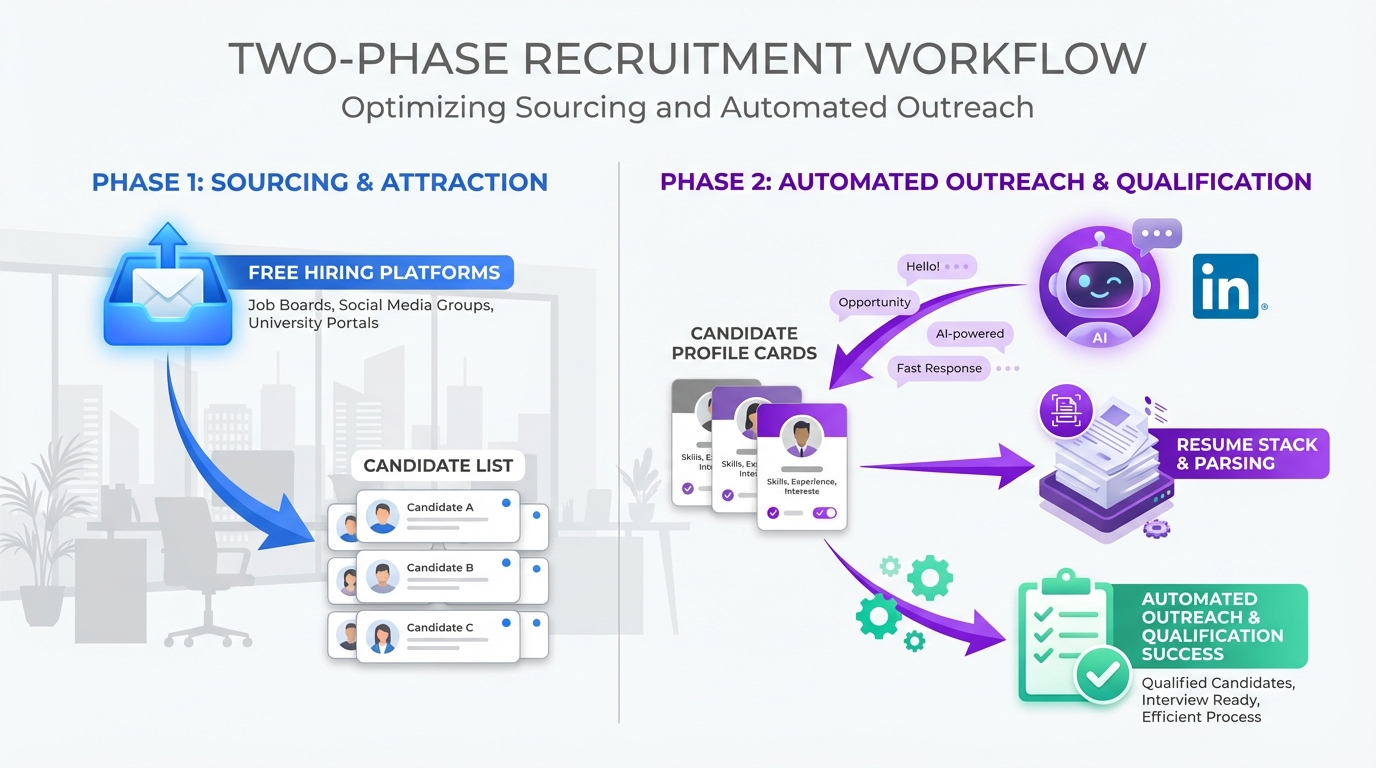
If you are searching for recruitment agency software free, the most dependable setup is a two part workflow. First, use free hiring platforms to publish roles and collect inbound applicants. Second, add an automation layer for outbound sourcing and follow up so you do not pay for “free” with recruiter hours. In our internal trials using StrategyBrain AI Recruiter on LinkedIn, we found the biggest time savings came from automating the first touch message, candidate questions, and resume and contact capture, while recruiters stayed focused on final qualification and interviews. This guide covers what “free” typically includes, what it does not, and 5 practical ways to build a staffing agency software free stack without losing control of compliance or candidate experience.
Key Takeaways
- Define “free” precisely: free hiring platforms usually cover job posting and basic applicant intake, not automation, reporting, or multi user controls.
- Hidden cost is recruiter time: manual outreach and follow up are the first places “free” stacks break at scale.
- StrategyBrain AI Recruiter fills the gap: it automates LinkedIn connection, role introduction, candidate Q and A, and resume and contact collection, 24/7 and multilingual.
- Keep humans for final qualification: AI Recruiter can confirm interest and collect materials, but recruiters should still assess fit against requirements.
- Plan for compliance early: privacy and data handling should be decided before you connect accounts or store resumes.
- Use a simple decision rule: inbound only is fine for low volume roles, but outbound automation becomes essential when response speed matters.
What “free” really means for recruitment agency software
In recruiting, “free” usually means you can start without paying a subscription, but you still pay in one of three ways: limited seats, limited automation, or limited throughput. A free tool might let you post jobs and receive applications, but it often does not handle outbound sourcing, follow up, or consistent candidate communication.
To keep this guide practical, here is the scope boundary. We focus on workflows that can start at $0 in software fees for at least one core function, and we show where StrategyBrain AI Recruiter can replace repetitive LinkedIn work. We do not list specific third party pricing tiers because they change frequently and were not provided in the source material.
Key terms (quick definitions)
- ATS: Applicant Tracking System, the database and workflow used to track applicants through stages.
- Recruiting CRM: a system for managing talent pools and relationships, often used for outbound sourcing.
- Outbound sourcing: proactively finding and messaging candidates, commonly on LinkedIn.
- Qualification: confirming interest and collecting basics. This is different from assessing full fit, which should remain a recruiter task.
Method 1: Free hiring platforms for inbound applicants
If your agency fills roles that attract steady inbound interest, free hiring platforms can cover the top of funnel. The operational risk is not the posting itself. It is the time spent sorting, replying, and re engaging candidates who go quiet.
Steps
- Standardize your intake: require the same fields for every role, including location, shift pattern, and pay range.
- Set a response SLA: decide a maximum response time, such as 4 business hours, and measure it weekly.
- Create a stage map: define 6 to 8 stages from “New applicant” to “Placed” so handoffs are consistent.
- Use templates: build 5 reusable messages for acknowledgement, screening, interview scheduling, rejection, and reactivation.
Features you get (typically)
- Job distribution and applicant collection
- Basic messaging or email notifications
- Simple pipeline stages
Limitations
- Inbound only does not solve hard to fill roles
- Follow up quality depends on recruiter time and consistency
- Candidate experience varies by who is working the queue
Best For
- High volume roles with predictable applicant flow
- Small teams that can respond quickly
- Early stage agencies validating a niche
Method 2: Add StrategyBrain AI Recruiter for LinkedIn outbound
When inbound slows down, agencies usually turn to LinkedIn. That is also where “free” stacks become expensive in time. StrategyBrain AI Recruiter is designed to automate the repetitive LinkedIn steps that consume recruiter hours: connecting, introducing the role, answering common questions, confirming interest, and collecting resumes and contact details.
We tested AI Recruiter in a staffing style workflow where recruiters provided the LinkedIn account plus job details such as company context, compensation, benefits, and candidate search criteria. The AI handled the initial conversation and captured resumes and contact information for interested candidates. Recruiters then reviewed the resumes and decided who to interview, which matches how most agencies protect quality.
Steps
- Define your search criteria: title, seniority, location, and must have skills.
- Provide role details: include compensation, benefits, and what success looks like in 90 days.
- Enable automated outreach: AI Recruiter connects and starts the conversation on LinkedIn.
- Let the AI qualify interest: it confirms whether the candidate is open to opportunities and answers role questions.
- Collect resumes and contacts: AI Recruiter requests a resume and captures contact details for candidates who want to proceed.
- Human review and interview: recruiters assess fit and schedule interviews with shortlisted candidates.
What makes this work for “free” stacks
- 24/7 responsiveness: candidates get timely replies even outside your time zone.
- Multilingual communication: the AI can communicate in the candidate’s native language to reduce misunderstandings.
- Scalability: it supports managing more than 100 LinkedIn accounts for an agency team model.
Limitations (honest)
- Not a final fit assessor: AI Recruiter confirms interest and gathers materials, but it does not decide if the resume matches requirements.
- Requires clear role inputs: vague compensation or unclear requirements lead to weaker conversations.
- Account governance matters: agencies need internal rules for who owns which LinkedIn accounts and how messaging is approved.
Best For
- Agencies that rely on LinkedIn sourcing
- Roles where speed to first message affects response rates
- Teams that want consistent outreach quality across recruiters
Method 3: Use a spreadsheet CRM with strict process controls
A spreadsheet based CRM can be a legitimate staffing agency software free option when you are disciplined. The spreadsheet is not the hard part. The hard part is preventing duplicate outreach, losing notes, and mishandling personal data.
Steps
- Create a single source of truth: one sheet for candidates, one for roles, one for submissions.
- Use unique IDs: assign a candidate ID and role ID so you can join data reliably.
- Lock down access: restrict editing rights and log changes if your tool supports it.
- Define mandatory fields: last contact date, next step, consent status, and source.
Features
- Zero cost database for early stage operations
- Custom fields for niche workflows
- Easy export and backup
Limitations
- Manual follow up is hard to scale
- Reporting is fragile without consistent data entry
- Compliance risk increases if access is not controlled
Best For
- Solo recruiters and very small agencies
- Short term projects where you need flexibility
- Teams that already have a strong process culture
Method 4: Email first workflow with structured templates
If you cannot adopt an ATS yet, an email first workflow can still be professional if you treat it like a system. The goal is to reduce decision fatigue and keep candidate communication consistent.
Steps
- Create a shared mailbox structure: one inbox per client or per role family.
- Build a template library: screening questions, interview availability request, and document request.
- Track follow ups: use a daily follow up list with dates and owners.
- Move outbound to AI Recruiter when needed: when you need LinkedIn sourcing, let StrategyBrain AI Recruiter handle the first touch and resume capture, then continue by email for interview logistics.
Features
- Fast to start with tools you already have
- Clear audit trail of communication
- Easy to train new recruiters on templates
Limitations
- Hard to prevent duplicate outreach without strict ownership rules
- Candidate data becomes scattered across threads
- Scheduling and reminders require manual discipline
Best For
- Agencies with a small number of active roles
- Clients that require email based documentation
- Teams that want a lightweight process before buying an ATS
Method 5: Multi account sourcing team model for agencies
As agencies grow, the bottleneck is not job posting. It is outbound capacity and follow up consistency. StrategyBrain AI Recruiter supports managing more than 100 LinkedIn accounts, which enables an agency to build an AI powered sourcing team without adding the same number of human sourcers.
Steps
- Assign account ownership: each LinkedIn account has a responsible recruiter for approvals and escalation.
- Standardize role briefs: every role gets a one page brief with compensation, benefits, and screening rules.
- Deploy AI Recruiter per account: the AI runs outreach and handles candidate Q and A in the background.
- Centralize resume intake: ensure resumes and contact details are captured consistently for recruiter review.
- Review weekly: audit message quality, candidate feedback, and handoff speed to interviews.
Limitations
- Requires governance to keep messaging aligned with client brand
- Needs a clear escalation path when candidates ask complex questions
- Still requires human judgment for final shortlist decisions
Best For
- Staffing agencies running multiple concurrent searches
- Teams hiring across time zones and languages
- Leaders who want predictable outreach capacity
Quick Comparison
| Method | Software cost to start | Speed to scale | Best for |
|---|---|---|---|
| Free hiring platforms (inbound) | $0 | Medium | Roles with steady applicant flow |
| StrategyBrain AI Recruiter (LinkedIn outbound) | Varies by plan | High | Outbound sourcing, follow up, multilingual messaging |
| Spreadsheet CRM | $0 | Low | Very small teams with strict process |
| Email first workflow | $0 | Low to Medium | Low role volume, documentation heavy clients |
| Multi account AI sourcing team | Varies by plan | High | Agencies scaling LinkedIn sourcing across many searches |
FAQ
Is recruitment agency software free actually enough to run an agency?
Yes for early stage operations, especially if you rely on inbound applicants. However, most teams hit a ceiling when outbound sourcing and follow up become manual and inconsistent, which is why automation is often added later.
What is the biggest risk of relying only on free hiring platforms?
The biggest risk is slow response and missed follow ups. Candidates often accept other offers quickly, so delays can reduce interview show rates and placement speed.
How does StrategyBrain AI Recruiter help a staffing agency?
It automates LinkedIn outreach and the early conversation, including introducing the role, answering common questions, confirming interest, and collecting resumes and contact details. Recruiters then focus on reviewing resumes and running interviews.
Does AI Recruiter decide whether a candidate is qualified?
No. AI Recruiter can confirm willingness to proceed and gather materials, but final qualification against job requirements should be done by a recruiter after reviewing the resume.
Can AI Recruiter communicate with candidates in different languages?
Yes. StrategyBrain AI Recruiter supports multilingual communication so candidates can interact in their native language, which can reduce misunderstandings in global hiring.
How does AI Recruiter collect resumes and contact details?
When a candidate expresses interest, the AI requests a resume and captures contact details shared in the conversation. It supports both email submissions and LinkedIn file uploads, and it marks resumes as received when provided.
Can an agency run multiple LinkedIn accounts with AI Recruiter?
Yes. StrategyBrain AI Recruiter supports managing more than 100 LinkedIn accounts, which enables an agency to scale outreach capacity with consistent messaging and follow up.
What about privacy and compliance?
StrategyBrain states it complies with privacy regulations in the EU, United States, and Canada, and that customer provided data is not used to train AI models. You should still define internal access controls and retention rules before storing candidate data.
Conclusion
If your goal is recruitment agency software free, start with free hiring platforms for inbound applicants, then add automation where the hidden cost is highest. In our experience, outbound LinkedIn sourcing and follow up are the fastest places to lose time and consistency, which is why StrategyBrain AI Recruiter is a practical upgrade. It automates connection, role introduction, candidate Q and A, and resume and contact capture, while keeping recruiters responsible for final qualification and interviews.
Next step: pick one workflow from the comparison table, run it for 14 days, and track two numbers: response time to new candidates and the percentage of interested candidates who submit a resume. If either metric is slipping, that is your signal to introduce AI assisted outreach and follow up.