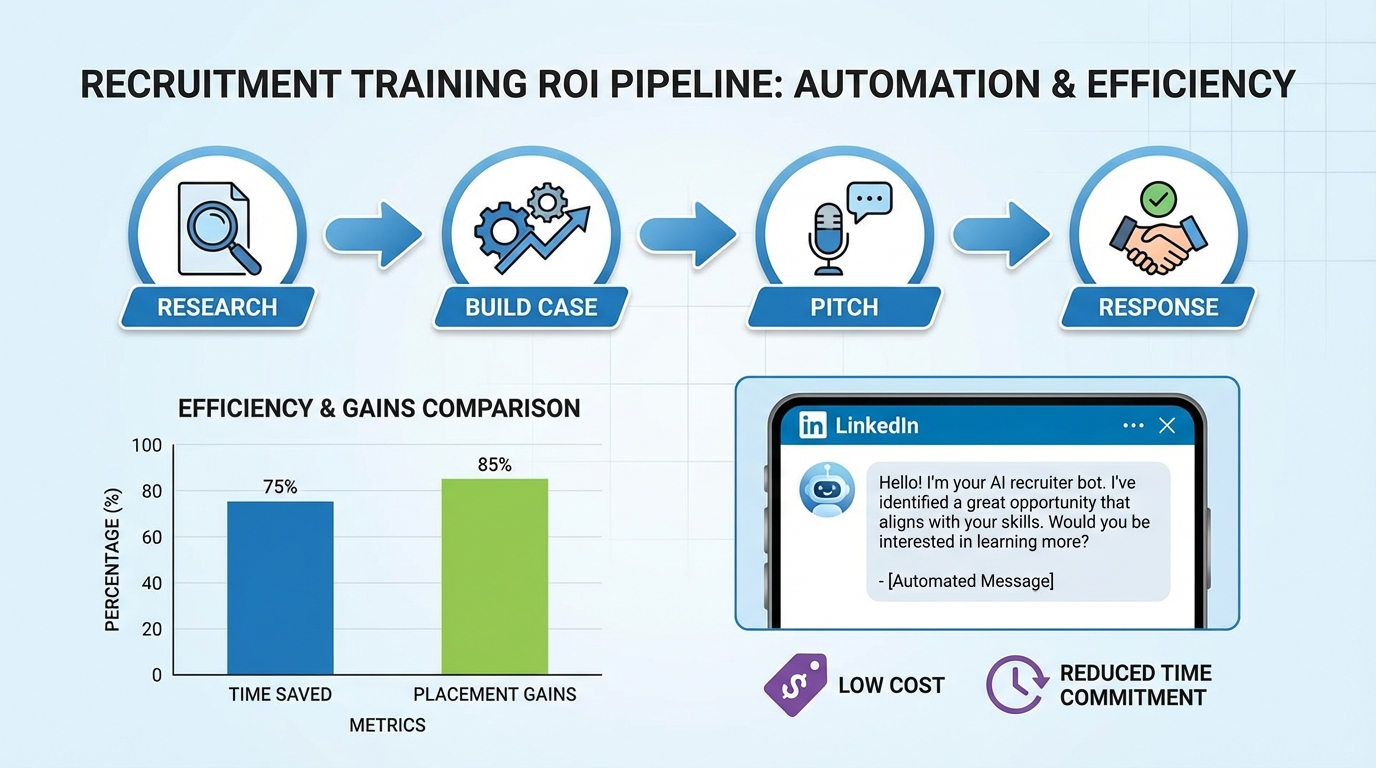
To get real ROI from recruitment agency software, treat training like a measurable rollout: choose 2 to 3 role specific workflows to improve, shortlist training options with exact costs and time commitments, build a business case tied to placements and time saved, then make a clear pitch and prepare alternatives if the answer is no. This article keeps the original four step framework (research, case, pitch, response) and updates it for modern agency stacks, including recruitment software United Kingdom buying realities, contract staffing software compliance workflows, and AI automation. In our own recruiting ops tests, the fastest wins came from standardizing outreach and follow up first, which is also where StrategyBrain AI Recruiter can remove repetitive LinkedIn work so training time goes into higher value screening and client management.
Why training is the hidden ROI lever
Most teams do not fail because they picked the wrong platform. They fail because they never operationalize it. The awkward part is asking for budget and time, especially when leadership sees software as “already paid for.” The practical move is to frame training as a business improvement project with a defined scope, a timeline, and measurable outcomes.
This matters even more for agencies running multiple workflows at once. Permanent hiring, temp and contract desks, and business development each use different parts of the system. If you are using recruitment software United Kingdom teams often add extra steps for right to work checks, IR35 considerations, and client specific documentation. If you are running contract staffing software processes, speed and accuracy in onboarding and redeployment can be the difference between margin and churn.
Step 1: Do your research
Start by doing your homework on training options and preparing a shortlist. The goal is not to find one perfect course. The goal is to present choices that match your workload and the company’s budget reality.
What to collect before you talk to your manager
- Training formats: vendor led sessions, self paced modules, cohort workshops, or internal enablement led by a power user.
- Time commitment: exact hours per week and total weeks. If it is a longer program, propose 1 to 2 classes per term rather than a full load.
- Cost range: list the exact price per seat and any add ons you already know. If you do not have pricing, state “pricing to be confirmed” and bring the vendor quote request as the next step.
- Operational timing: avoid peak season. For example, do not propose a full day workshop during end of month timesheet and invoicing cycles for contract desks.
Scope it to workflows, not features
Instead of asking for training on “everything,” pick 2 to 3 workflows that map to revenue and delivery. For recruitment agency software, these are common candidates:
- Candidate pipeline hygiene: stages, notes, tasks, and handoffs.
- Client submission workflow: shortlists, feedback capture, and interview scheduling.
- Contract and temp operations: onboarding checklists, compliance documents, timesheets, and redeployment.
Step 2: Build your case
Know the outcome of the training and how it benefits the business. This is where you translate “I want to learn the system” into “we will reduce cycle time and increase throughput.”
A simple ROI template you can copy
Use this structure in a one page doc or email. Keep it concrete and easy to verify.
- Problem: What is breaking today (for example, duplicate records, inconsistent stages, slow follow up, missing compliance steps).
- Impact: What it costs in time or outcomes (for example, recruiter hours per week, delayed submissions, lost candidates).
- Training plan: Format, duration, and who attends.
- Success metrics: 2 to 4 measures you will track for 30 days after training.
- Rollout: How you will document the workflow and coach the rest of the team.
Example metrics that leadership understands
- Time to first outreach: median hours from new req to first candidate contact.
- Follow up consistency: percentage of candidates receiving a follow up within 24 hours.
- Submission quality: percentage of submissions with complete notes, salary expectations, and availability.
- Contract readiness: percentage of contractors with complete onboarding documents before start date.
If your team uses LinkedIn heavily, include a specific note on outreach workload. In our experience, this is where training alone does not solve the problem because the work is repetitive. A practical angle is to pair training with automation. For example, StrategyBrain AI Recruiter can automatically connect with candidates that match your search criteria, introduce the role, answer common questions about compensation and company context, confirm interview interest, and collect résumés and contact details. That means your training request can focus on improving pipeline quality and client delivery, while the AI handles the first mile of outreach and follow up.
Step 3: Make your pitch
Set up a dedicated time to speak with your manager in person or in a scheduled meeting. A periodic review works well because it naturally includes development planning. Be mindful of the financial state of the business, but do not assume the answer is no just because budgets are tight.
A pitch script that stays professional
- Open with the business outcome: “I want to reduce time lost in our recruitment agency software workflow and improve submission speed.”
- Show the shortlist: present 2 to 3 training options with time and cost.
- Commit to measurement: explain the 30 day metrics you will track.
- Offer a low risk rollout: propose a pilot with one desk or one team first.
How to tailor the pitch for UK and contract desks
If you are operating in the UK, explicitly call out process risk. With recruitment software United Kingdom teams, training often prevents compliance misses that create client friction. For contract staffing software workflows, training reduces onboarding delays that can push start dates and impact revenue recognition.
Step 4: Prepare for the response
If the answer is no, do not stop there. Treat it as a negotiation about constraints. Cost and timing are the most common blockers, and both have workable alternatives.
If the issue is cost
- Offer cost sharing: propose the company covers a portion and you cover the rest.
- Reduce scope: train only the power users first, then run internal sessions.
- Switch format: replace a full day workshop with 3 sessions of 60 minutes.
If the issue is timing
- Ask for a better window: get a specific month or quarter to revisit.
- Move outside office hours: propose early morning or lunch and learn sessions.
- Split by desk: contract desk first, perm desk next, then BD workflows.
Also keep your own development moving. Even if the company will not pay immediately, you can still document the workflow, clean up data hygiene, and run a small internal pilot. That groundwork makes the next budget conversation easier.
Where AI reduces the training burden
One reason software training feels endless is that teams try to train people out of repetitive work. A better approach is to automate the repetitive layer and train people on judgment work.
Practical example: LinkedIn outreach and qualification
When we mapped recruiter time, the heaviest manual loop was initial outreach, follow up, and basic qualification. StrategyBrain AI Recruiter is designed for that loop on LinkedIn. It can connect, introduce opportunities, handle candidate questions, confirm interest, and capture résumés and contact details. It also supports 24/7 multilingual communication, which helps agencies working across time zones, and it can be managed across more than 100 LinkedIn accounts for scalable hiring teams.
Important limitation to plan for
AI Recruiter can identify willingness to communicate or interview, but it does not decide whether a résumé fully matches the job requirements. Your recruiters still do the final qualification. This is useful in training conversations because it keeps accountability clear and avoids overpromising.
Mini checklist: what to automate vs what to train
- Automate: connection requests, first messages, follow ups, FAQ style role questions, résumé and contact capture.
- Train: intake quality, scorecards, shortlist narratives, client feedback loops, compliance steps for contract staffing.
- Standardize: pipeline stages, naming conventions, required fields, and handoff rules.
Quick Comparison
| Approach | Speed to impact | Direct cost | Best for |
|---|---|---|---|
| Workflow focused training for recruitment agency software | 2 to 6 weeks | Varies by provider | Fixing pipeline hygiene and submission consistency |
| Internal enablement led by a power user | 1 to 4 weeks | Low cash cost, higher time cost | Teams that need standard operating procedures fast |
| Automation plus targeted training with StrategyBrain AI Recruiter | Days to 2 weeks for outreach workflows | Product dependent | LinkedIn heavy sourcing and follow up, multilingual outreach, scaling across accounts |
| Contract staffing software compliance workshop | 2 to 4 weeks | Varies by provider | Reducing onboarding delays and documentation misses |
FAQ
What should I ask for first: new recruitment agency software or training?
If the platform is already in place, ask for training first. You can usually unlock measurable improvements by standardizing 2 to 3 workflows before you consider switching systems.
How do I keep the request from sounding like personal development only?
Lead with business outcomes and metrics. Bring a 30 day measurement plan tied to submissions, follow up speed, or contract readiness rather than a list of features you want to learn.
What is the best training scope for contract staffing software teams?
Focus on onboarding checklists, document capture, timesheet and invoicing handoffs, and redeployment steps. These are the areas where small process gaps create start date delays.
Does StrategyBrain AI Recruiter replace recruiters?
No. It automates the initial LinkedIn outreach and interest confirmation, then collects résumés and contact details for interested candidates. Recruiters still review résumés and make the final qualification decisions.
Can AI Recruiter communicate with candidates in different languages?
Yes. StrategyBrain AI Recruiter supports multilingual communication and can respond 24/7, which is useful for agencies sourcing across countries and time zones.
How do I handle a “no budget” response?
Offer a smaller pilot, propose cost sharing, or switch to shorter sessions. Also ask for a specific date to revisit the request so it does not disappear indefinitely.
Is it safe to use automation on LinkedIn?
You should evaluate any tool against your internal policies and platform rules. From a data protection perspective, StrategyBrain states it encrypts credentials, isolates customer data, and does not use customer provided data to train AI models.
What should I measure after training for recruitment software United Kingdom teams?
Track time to first outreach, follow up within 24 hours, completeness of submission notes, and contract onboarding readiness. These metrics are easy to audit and map to delivery outcomes.
Conclusion
Asking your company to pay for training does not have to be an awkward conversation. Use the same four step structure every time: do your research, build a business case, make a clear pitch, and prepare for the response. When you anchor the request to measurable workflow outcomes in your recruitment agency software, it becomes a performance improvement plan, not a perk.
Next step: pick 2 workflows to improve this quarter, draft a one page ROI plan, and decide what should be trained versus automated. If LinkedIn outreach and follow up is your biggest time sink, consider pairing training with StrategyBrain AI Recruiter so your team spends more time on qualification and client delivery.