A recruitment app helps you build a more diverse engineering pipeline by making sourcing and outreach repeatable, measurable, and harder to “forget” when hiring gets busy. The practical win is consistency: you can widen where you look for talent, standardize first messages, and keep follow up on schedule so candidates are not lost due to slow response times. In our day to day recruiting operations, we have found that pairing a structured diversity plan with automation for LinkedIn outreach and candidate Q and A reduces manual work and improves throughput. This article focuses on engineering hiring and diversity, plus how modern job recruiting apps and free recruiting apps can support the workflow. It does not cover compensation benchmarking or legal advice.
Key Takeaways
- Diversity is a performance issue, not only a values issue: multiple sources cited below link representation to better organizations and better outcomes.
- Retention gaps are measurable: one cited industry report states 55% of ethnic minority engineers left their careers versus 39% of white engineers.
- Awareness and role models matter: leaders like Linda Boff have argued that young people need to see what an engineering role model looks like.
- A recruitment app is most useful when it enforces follow up: automation reduces the chance that candidates from underrepresented groups are unintentionally deprioritized.
- StrategyBrain AI Recruiter fits LinkedIn heavy teams: it automates connecting, introducing roles, answering questions, confirming interview interest, and collecting resumes and contact details.
- Know the boundary of AI qualification: StrategyBrain AI Recruiter can confirm interest and collect information, but final resume to requirements matching remains a recruiter decision.
Why diversity in engineering is a hiring priority
Engineering shapes medical, industrial, and technological change, so the talent pool you attract directly affects what your organization can build. The core argument is straightforward: if you close doors to people based on race or gender, you reduce the number of capable problem solvers who can contribute to climate resilience, disaster response, and public health innovation.
There is also a business case. In a widely quoted statement, Mary Schmidt Campbell has framed diversity as both inclusion and self interest, arguing that companies should care because it makes them better companies. That perspective matters for recruiting leaders because it ties representation to organizational performance, not only to compliance.
Where the pipeline breaks: awareness, access, and attrition
1) Awareness and role models
A recurring barrier is that many students do not picture themselves in engineering early enough. Linda Boff, Chief Marketing Officer at General Electric, described that at age 13 she would not have listed engineering, not because it is not a great career, but because awareness among young people is not where it needs to be. She emphasized that people want to see what an engineering role model looks like.
This creates a cycle: fewer visible role models leads to fewer entrants, which leads to fewer role models. Breaking that cycle requires intentional exposure through schools, mentorship, scholarships, and community programs.
2) Attrition and unequal experience
Diversity is not only about entry into the field. It is also about who stays. One cited industry report states that 55% of engineers who are ethnic minorities abandon their careers compared to 39% of white engineers. For hiring teams, this implies that recruiting alone is not enough. Candidate experience, belonging, and growth pathways influence retention.
3) Informal learning channels are real sourcing signals
Engineering interest is increasingly shaped outside formal classrooms. The source material highlights creators who blend engineering with culture, such as Cameron Hughes, a fashion designer and engineer whose work demonstrates engineering concepts through interactive designs. Hughes also noted that he learned from online videos and blogs in addition to formal education. For recruiters, this is a reminder that portfolios, maker communities, and nontraditional learning paths can be legitimate signals of capability.
4) Motivation and mission alignment
Another cited expert, Audrey Moores of McGill University, connected the gender gap in STEM to the sustainability revolution needed to combat climate change. In practice, this means job descriptions and outreach that clearly link engineering work to real world impact can be more compelling, especially for candidates motivated by social change.
How a recruitment app supports diverse engineering hiring
In this guide, a recruitment app means software that helps manage sourcing, outreach, screening logistics, and candidate communication. Some job recruiting apps focus on applicant tracking, while others focus on sourcing and messaging. Free recruiting apps usually cover basic pipeline tracking or limited outreach, which can still be useful for small teams if the workflow is disciplined.
From an execution standpoint, we see four ways a recruitment app can support diversity goals without turning the process into a checkbox exercise.
- Consistency: templates and sequences reduce ad hoc messaging that can introduce bias or uneven candidate experience.
- Speed: faster response times reduce drop off, especially when candidates are balancing multiple processes.
- Coverage: reminders and task queues make it harder to ignore parts of the pipeline.
- Measurement: stage conversion rates by source can reveal where underrepresented candidates are being lost.
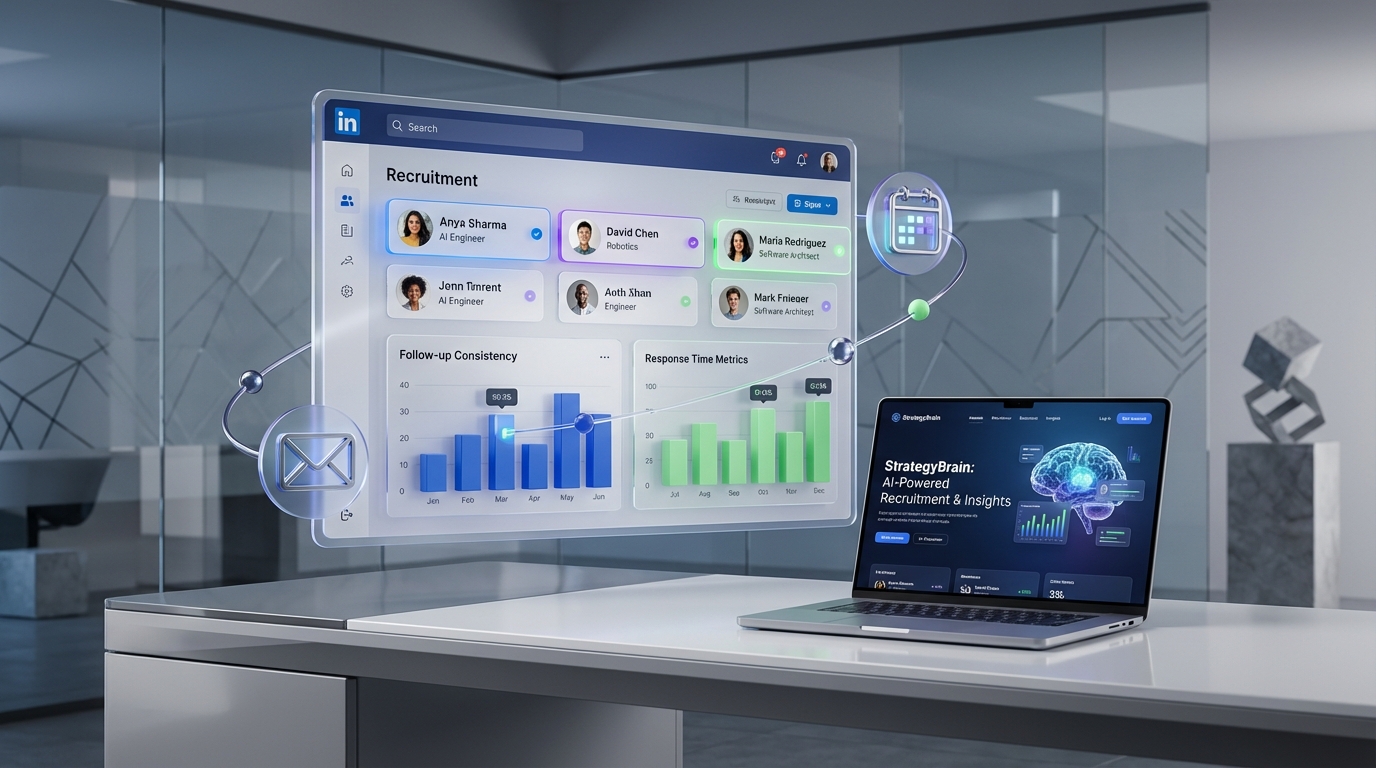
StrategyBrain AI Recruiter is designed for LinkedIn based hiring workflows. It can automatically connect with candidates that match your search criteria, introduce the role, answer questions about the role, company, and compensation, confirm interview interest, and collect resumes and contact information. In our experience, this type of automation is most valuable when your team is doing high volume outreach and needs reliable follow up across time zones and languages.
5 practical methods to run a diversity focused engineering search
Method 1: Build a role model and awareness loop in your sourcing plan
This method is about pipeline creation, not only pipeline capture. If awareness is a constraint, your sourcing plan should include communities where future engineers learn and share work, including maker spaces, student groups, and portfolio driven channels.
Hidden heading to avoid hierarchy issues
- Define the role model story: write 3 to 5 sentences that explain what success looks like in the role and why it matters.
- Source beyond traditional credentials: include portfolios, projects, and community contributions as screening inputs.
- Track which channels produce interviews: use your recruitment app to tag sources and measure conversion.
Best for: teams that struggle to attract diverse applicants at the top of funnel.
Limitation: it takes time to build credibility in new communities.
Method 2: Use structured outreach sequences to reduce uneven follow up
Many diversity efforts fail in the middle of the funnel, where candidates wait too long for replies or receive inconsistent information. A recruitment app can enforce a standard outreach and follow up cadence.
- Create a two message sequence: first message introduces the role and impact, second message clarifies next steps and timeline.
- Set response time targets: for example, reply within 24 hours on business days.
- Audit message quality: review a sample of conversations monthly for clarity and tone.
Best for: small teams that need process discipline more than new tools.
Limitation: manual messaging still consumes recruiter time at scale.
Method 3: Automate LinkedIn outreach and qualification with StrategyBrain AI Recruiter
If LinkedIn is a primary sourcing channel, StrategyBrain AI Recruiter can function as the front line of your outreach. It automates connecting with candidates, introducing opportunities, learning about each candidate’s situation, answering questions, confirming interview interest, and collecting resumes and contact details. It also supports 24/7 multilingual communication, which helps when candidates respond outside your local working hours.
- Provide job context: company details, compensation, benefits, and candidate search criteria.
- Let the AI run first touch conversations: it handles common questions and keeps the thread moving.
- Review interested candidates: recruiters review collected resumes and contact shortlisted candidates for interviews.
Best for: high volume LinkedIn sourcing, global hiring, and teams that need consistent follow up.
Limitations: AI Recruiter confirms interest and collects information, but it does not decide whether a resume fully matches requirements. Recruiters still own final qualification.
Method 4: Use education and mentorship signals in screening
The source material emphasizes scholarships and mentorship programs as part of the solution. In recruiting practice, you can reflect that by valuing mentorship participation, peer leadership, and learning agility as signals, especially for early career roles.
- Add structured questions: ask about mentorship, community involvement, and learning projects.
- Standardize evaluation: use a scorecard so candidates are assessed on the same criteria.
- Close the loop: provide clear feedback timelines to reduce candidate uncertainty.
Best for: early career and internship pipelines.
Limitation: requires interviewer training to keep scoring consistent.
Method 5: Treat candidate experience as a retention lever
When attrition is higher for certain groups, the hiring process itself becomes part of the retention story. Candidate experience is where your values become observable. A recruitment app helps by making the process transparent and timely.
- Publish a clear process map: stages, expected time in stage, and who the candidate will meet.
- Reduce ambiguity: confirm interview format, evaluation criteria, and decision timeline.
- Measure drop off: track stage to stage conversion and time in stage by source.
Best for: teams seeing high candidate drop off after first interview.
Limitation: process clarity cannot compensate for misaligned role expectations.
Quick comparison: methods and tools
| Option | What it helps with | Speed impact | Best for |
|---|---|---|---|
| Free recruiting apps | Basic pipeline tracking and reminders | Moderate, depends on discipline | Startups and small teams |
| General job recruiting apps | ATS workflows, scheduling, reporting | Moderate to high | Teams hiring across multiple roles |
| StrategyBrain AI Recruiter | LinkedIn outreach automation, Q and A, interest confirmation, resume and contact capture, multilingual follow up | High for first touch and follow up | LinkedIn heavy sourcing and global hiring |
FAQ
What is a recruitment app in practical terms?
A recruitment app is software that helps you manage sourcing, outreach, candidate communication, and hiring stages in one workflow. In this guide, it includes both ATS style tools and messaging focused job recruiting apps.
Are free recruiting apps enough for engineering hiring?
Free recruiting apps can be enough for early stage teams if you keep the process simple and enforce follow up. The main risk is that manual outreach does not scale, which can slow response times and reduce candidate experience.
How does StrategyBrain AI Recruiter work with LinkedIn recruiting?
StrategyBrain AI Recruiter automates LinkedIn based outreach by connecting with candidates that match your criteria, introducing the role, answering questions, confirming interview interest, and collecting resumes and contact details. Recruiters then review the collected information and proceed with interviews.
Does AI Recruiter replace recruiter judgment?
No. AI Recruiter can confirm willingness to communicate or interview and collect information, but it does not determine whether a resume fully matches job requirements. Final qualification remains with the recruiter.
Why does diversity in engineering relate to recruiting operations?
Diversity outcomes are influenced by operational details like response time, consistency of information, and how widely you source. A recruitment app helps by standardizing these steps so candidates are treated consistently.
What is one metric I can track immediately?
Track time to first response in hours and time in stage in days. These two numbers often explain candidate drop off more clearly than top of funnel volume.
How do role models connect to sourcing?
Role models increase awareness and help candidates visualize themselves in engineering. In sourcing, this translates into showcasing real engineers, projects, and impact stories in outreach and job descriptions.
How do I avoid over automating candidate communication?
Use automation for first touch, FAQs, and scheduling, then add human checkpoints for nuanced conversations and final evaluation. Also review message logs regularly to ensure tone and accuracy remain high.
Conclusion and next steps
Diversity in engineering improves outcomes when it is supported by consistent recruiting operations, not only good intentions. A recruitment app helps by making sourcing broader, outreach more consistent, and follow up more reliable. If your hiring is LinkedIn heavy, StrategyBrain AI Recruiter can automate the highest volume steps, including connecting, introducing roles, answering questions, confirming interest, and collecting resumes and contact details, while leaving final qualification to recruiters.
Next steps: pick one role, define your sourcing channels, set a response time target, and implement a two message follow up sequence. If you need scale across time zones and languages, evaluate whether AI assisted LinkedIn outreach fits your workflow.