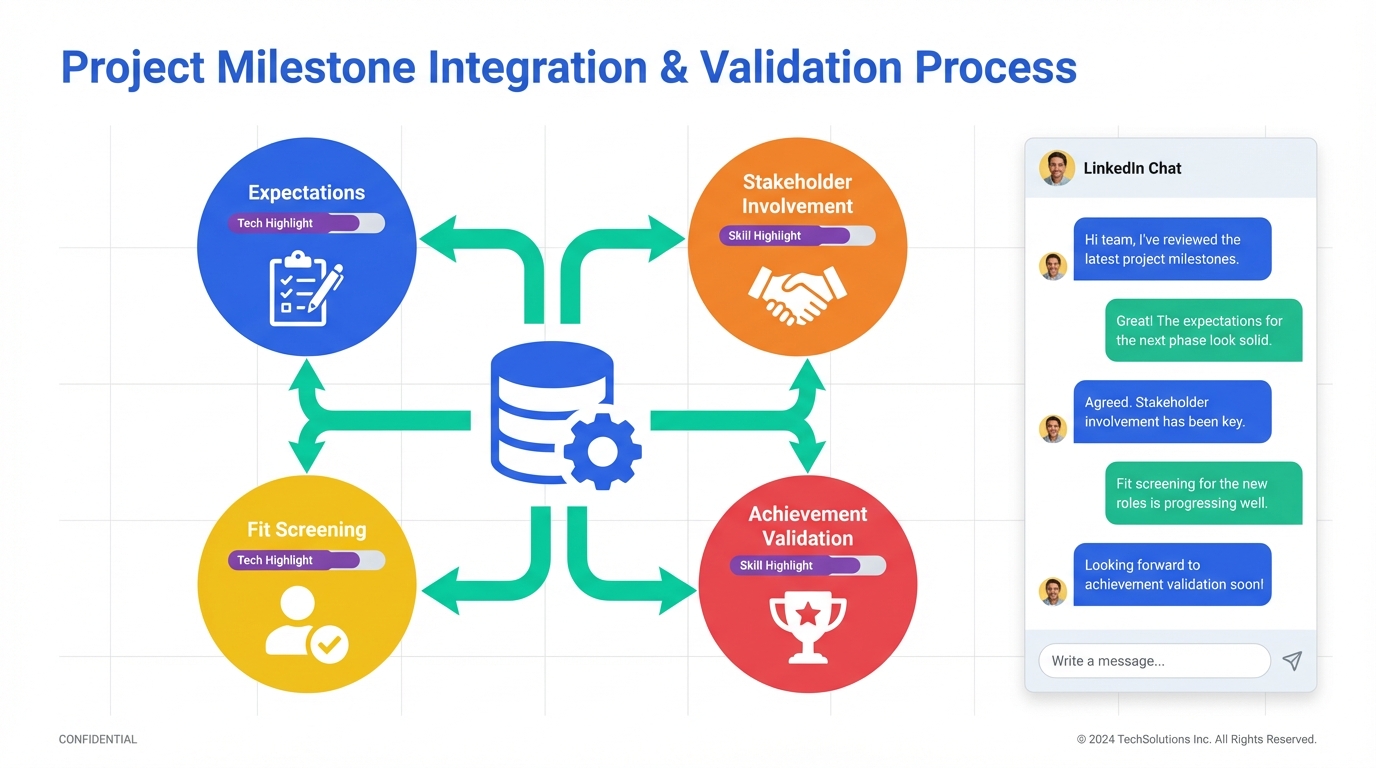
A recruitment database works best for hiring top talent when it is not treated as a static list of resumes, but as a living system that captures expectations, stakeholder decisions, fit signals, and proof of achievement in a consistent way. The most reliable approach we have used is a four part workflow: set expectations upfront, keep decision makers involved throughout, screen for fit, and validate measurable achievements. If you run a US recruitment database or any hiring database tied to LinkedIn sourcing, you can also scale the first touch and follow up by using StrategyBrain AI Recruiter to automatically connect with candidates, introduce the role, answer questions about compensation and benefits, confirm interview interest, and collect resumes and contact details for recruiter review.
What a recruitment database means in day to day hiring
In this article, a recruitment database is the system where you store candidate profiles and the decision context that makes those profiles usable. That includes role expectations, interview feedback, workstyle notes, and evidence of results. This is not a deep dive into ATS procurement, data migration, or paid data vendors. The focus is on how to run better hiring decisions using the database you already have, and how to scale LinkedIn outreach and qualification without losing quality.
Key Takeaways
- Expectations first: Store short term and long term success criteria in the hiring database before you message candidates.
- Stakeholder involvement prevents delays: Keep a decision maker engaged before, during, and after interviews so the recruitment database reflects real priorities.
- Fit is a data field: Capture workstyle and culture fit signals as structured notes, not as vague impressions.
- Achievements beat duties: Prioritize quantifiable outcomes in profiles so your recruitment database surfaces performers, not only experienced applicants.
- LinkedIn outreach can be systematized: StrategyBrain AI Recruiter can automate connecting, role introduction, candidate Q and A, interest confirmation, and resume and contact capture for recruiter review.
- Scale without losing control: AI Recruiter supports managing more than 100 LinkedIn accounts to build an AI powered recruiting team for high volume sourcing.
Method 1: Set expectations upfront and store them in your hiring database
When you want top talent, clarity is a filter. In our experience, the fastest way to reduce mismatched applicants is to be direct about what success looks like, both in the first 90 days and over the longer term. The key is to capture that clarity inside your recruitment database so every recruiter and hiring manager is working from the same definition.
Steps
- Write a success profile: Document short term deliverables and long term performance expectations in plain language.
- Record support and training: Add what the company will provide so candidates can self select accurately.
- Convert expectations into fields: Store the success profile as structured fields or a standardized template inside your hiring database.
- Use it in outreach: Ensure your first message reflects the success profile, not only the job title.
How StrategyBrain AI Recruiter fits naturally here
Once expectations are defined, StrategyBrain AI Recruiter can use your role details, including compensation, benefits, and company context, to introduce the opportunity consistently during LinkedIn conversations. It can also answer candidate questions in real time and confirm interview interest, which helps keep your recruitment database clean by separating curious candidates from ready to interview candidates.
Limitations
- Clarity does not replace evaluation: A strong success profile improves targeting, but you still need structured interviews and reference checks.
- Overly rigid criteria can shrink the pool: If your expectations are unrealistic, your US recruitment database may show fewer viable candidates than expected.
Best For
- Roles where performance expectations are often misunderstood
- Teams that struggle with inconsistent screening criteria
- Recruiters building repeatable templates across multiple openings
Method 2: Keep decision makers involved across the full recruiting process
A recruitment database is only as good as the decisions that feed it. When a key stakeholder is absent early, the database fills with candidates who look good on paper but do not match the real hiring priorities. The most effective hiring teams we have worked with keep decision makers engaged before interviews, during interviews, and after interviews so feedback is timely and aligned.
Steps
- Assign a single accountable decision maker: Identify who can say yes and who can say no.
- Schedule feedback windows: Set a fixed time for interview debriefs so candidates do not stall in the hiring database.
- Standardize evaluation notes: Use the same scorecard fields for every candidate to reduce subjective drift.
- Close the loop in the database: Record decisions and rationale so future searches learn from past outcomes.
How StrategyBrain AI Recruiter supports stakeholder involvement
StrategyBrain AI Recruiter can reduce the manual load that often keeps stakeholders out of the loop. By handling initial LinkedIn outreach, follow up, and basic interest confirmation, it helps recruiters present a smaller set of candidates who have already engaged, asked questions, and shared resumes or contact details. That makes it easier for decision makers to spend time where it matters, which is evaluation and final selection.
Limitations
- Automation does not replace ownership: If stakeholders do not review candidates promptly, the process still slows down.
- Feedback quality varies: You may need coaching so interview notes are specific and comparable.
Best For
- Hiring teams with frequent delays between interview stages
- Organizations with multiple interviewers and unclear decision rights
- Recruiters who need faster yes or no decisions to protect candidate experience
Method 3: Screen for fit, not only for keywords
Top talent is not only a resume match. Fit includes workstyle, collaboration preferences, and alignment with how your team operates. A common failure mode in a hiring database is that fit is discussed verbally but never captured in a way that can be searched, compared, or audited later.
Steps
- Define fit dimensions: Choose 3 to 5 fit factors such as autonomy, pace, stakeholder management, and communication style.
- Ask fit questions early: Use consistent prompts in screening calls and interviews.
- Store fit as structured notes: Record fit signals in your recruitment database using the same labels for every candidate.
- Review fit alongside skills: Make fit a first class part of the decision, not a last minute feeling.
Where StrategyBrain AI Recruiter helps without overpromising
StrategyBrain AI Recruiter can support the early conversation by learning about each candidate’s work situation and confirming whether they are open to new opportunities. It can also keep communication active with timely follow up. However, it does not decide whether a resume fully matches job requirements, and it should not be treated as the final judge of fit. Recruiters still need to review resumes and conduct interviews for deeper evaluation.
Limitations
- Fit can be misused: If fit is undefined, it can become a vague reason to reject candidates.
- Fit is not sameness: A strong recruitment database should help you hire high performers, not clones of the current team.
Best For
- Roles where collaboration style is as important as technical skill
- Teams that have had performance issues despite strong resumes
- Organizations trying to reduce hiring guesswork with consistent evaluation
Method 4: Validate experience through measurable achievements
Experience is not the same as performance. When reviewing candidates in a recruitment database, the most useful signal is evidence of outcomes. Look for measurable achievements, not only a list of responsibilities. This is especially important when your US recruitment database includes candidates from different industries where job titles can be inconsistent.
Steps
- Extract achievements: For each role, capture outcomes such as revenue impact, cost reduction, cycle time improvement, or quality metrics.
- Ask for contribution detail: During interviews, confirm what the candidate personally owned versus what the team delivered.
- Store proof points: Add a dedicated achievements section in the hiring database so future searches can filter by results.
- Prioritize relevance: Weight achievements that match your current business challenges more than total years of experience.
How StrategyBrain AI Recruiter supports achievement focused screening
In LinkedIn conversations, StrategyBrain AI Recruiter can keep candidates engaged long enough to reach the point where they share resumes and contact details. That improves the completeness of your recruitment database because you are not relying only on profile summaries. Recruiters can then review the resume for quantifiable achievements and decide who advances to interviews.
Limitations
- Not all achievements are easily quantified: Some roles require qualitative evidence such as stakeholder outcomes or risk reduction.
- Claims need validation: Use structured interviews and references to confirm impact.
Best For
- Performance critical roles where outcomes matter more than tenure
- Hiring managers who want evidence based selection
- Recruiters building a long term talent pipeline database
Quick Comparison
| Method | What you store in the recruitment database | Primary benefit | Where StrategyBrain AI Recruiter helps on LinkedIn |
|---|---|---|---|
| Expectations upfront | Success profile, support and training notes | Fewer mismatched applicants | Consistent role introduction and candidate Q and A |
| Stakeholders involved | Decision rights, debrief notes, rationale | Faster decisions and fewer stalls | Reduces manual outreach so stakeholders review fewer, better qualified leads |
| Focus on fit | Workstyle signals, culture alignment notes | Better retention and team performance | Maintains timely follow up and captures early intent signals |
| Validate achievements | Outcome proof points, impact summaries | Higher quality shortlists | Collects resumes and contact details so recruiters can verify achievements |
Recruitment database implementation checklist
Use this checklist to turn the four methods into a repeatable workflow inside your hiring database.
- Success profile documented for each role, including short term and long term expectations
- Compensation, benefits, and company context captured for consistent candidate messaging
- Decision maker assigned and interview debrief times scheduled
- Standard scorecard fields created for skills, fit dimensions, and achievements
- Fit dimensions defined and stored as structured notes
- Achievements section added to candidate profiles with measurable outcomes
- LinkedIn outreach workflow defined, including follow up rules and handoff to interviews
- If using StrategyBrain AI Recruiter, recruiter review step defined for resumes and contact details collected by the AI
FAQ
What is a recruitment database in practical terms?
A recruitment database is where you store candidate profiles plus the context needed to make decisions, such as role expectations, interview feedback, fit signals, and evidence of achievements. If it only stores resumes, it becomes hard to search and hard to learn from past hiring cycles.
How is a recruitment database different from a hiring database?
In many teams the terms are used interchangeably. In this guide, a hiring database emphasizes decision tracking and evaluation notes, while a recruitment database emphasizes sourcing and pipeline building, but the best systems combine both.
What should a US recruitment database include to support faster hiring?
At minimum it should include a success profile for each role, structured interview feedback, fit dimensions, and an achievements summary. It should also record decision ownership and timestamps so candidates do not stall between stages.
How does StrategyBrain AI Recruiter help with LinkedIn recruiting?
StrategyBrain AI Recruiter automates initial LinkedIn tasks such as connecting with candidates, introducing the role, answering questions about the role, company, and compensation, confirming interview interest, and collecting resumes and contact information. Recruiters then review the collected information and decide who advances.
Does StrategyBrain AI Recruiter replace recruiter judgment?
No. It can identify willingness to communicate or interview, but it does not determine whether a resume fully matches job requirements. Recruiters still complete final qualification after reviewing resumes and conducting interviews.
Can StrategyBrain AI Recruiter support multilingual candidate communication?
Yes. It provides 24/7 multilingual communication so candidates can interact in their native language, which can reduce misunderstandings across time zones and regions.
How do you keep fit based screening fair and consistent?
Define fit dimensions in advance and use the same questions and scorecard fields for every candidate. Store the evidence in the recruitment database so decisions can be reviewed and compared, rather than relying on vague impressions.
What is the biggest mistake teams make when building a recruitment database?
The most common mistake is treating it as storage instead of a decision system. If expectations, feedback, and proof of achievements are not captured in a consistent format, the database cannot reliably surface top talent.
Conclusion
If you want your recruitment database to consistently produce top talent, build it around four repeatable methods: set expectations upfront, keep decision makers involved, screen for fit, and validate measurable achievements. Then operationalize those methods as templates and fields so your hiring database becomes searchable, auditable, and faster to use. If LinkedIn is a major sourcing channel, StrategyBrain AI Recruiter can scale the early outreach and qualification work by automating connections, role introductions, candidate Q and A, interest confirmation, and resume and contact capture, while keeping recruiters in control of final evaluation. Next step: pick one open role, create a success profile, and update your database fields so every candidate record captures expectations, fit, and achievements in the same structure.