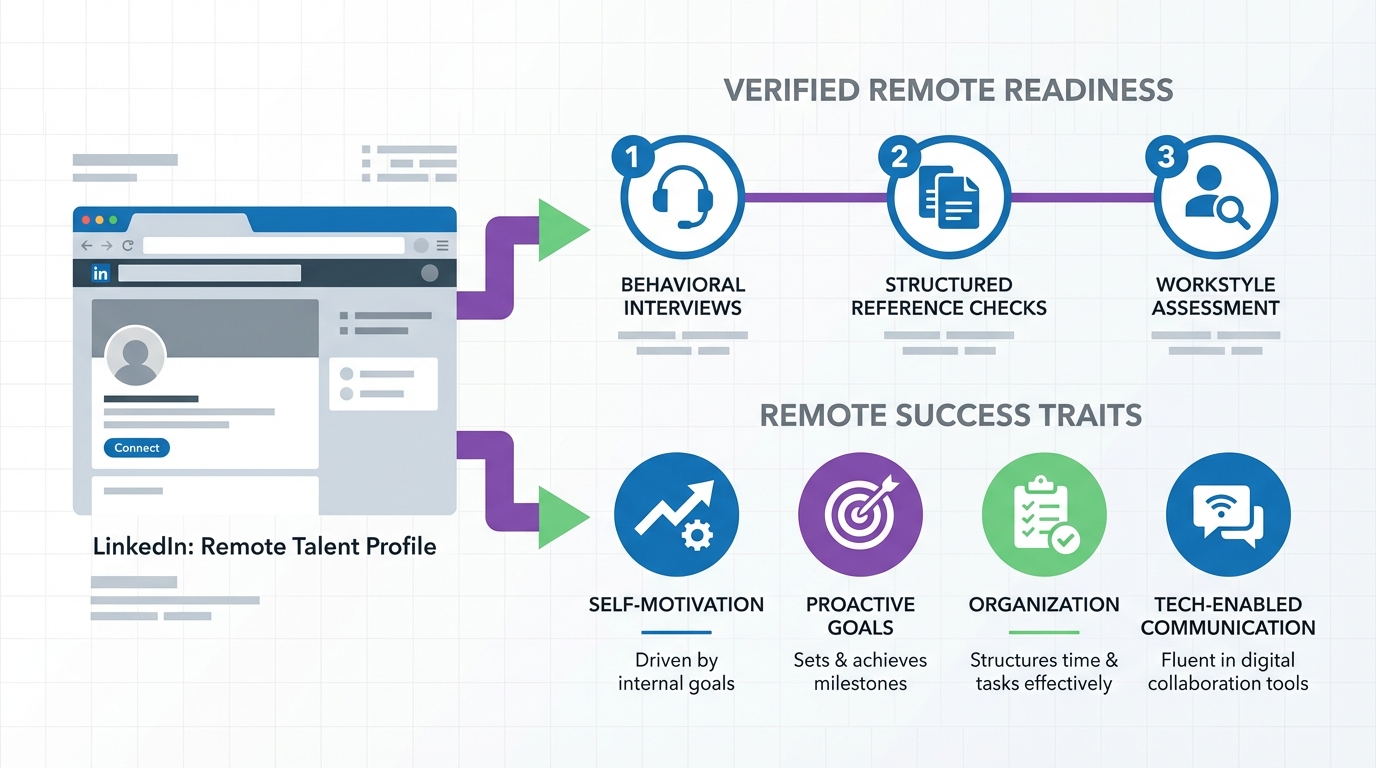
To hire strong remote employees with recruitment management software, define the role outcomes first, then screen for four traits that predict remote success: self motivation, proactive goal setting, organization, and tech enabled communication. Next, verify those traits using three evidence based steps: behavioral interview questions, structured reference checks, and a validated personality and workstyle assessment focused on task orientation and social orientation. In our recruiting workflows, we also use StrategyBrain AI Recruiter to automate LinkedIn outreach and early conversations so candidates can demonstrate communication habits and responsiveness in real time, while recruiters stay focused on final qualification and interviews.
Key Takeaways
- Remote success traits: Self motivating, proactive, organized, and comfortable communicating through technology.
- Verification matters: Traits should be proven with examples, not assumed from a resume.
- 3 step validation: Behavioral interviews, reference checks, and personality or workstyle assessments.
- Assessment focus: Task orientation and social orientation are especially predictive for remote roles.
- Operationalize in systems: Use recruitment management software and human resources talent management software to standardize scorecards, notes, and decision logs.
- LinkedIn execution: StrategyBrain AI Recruiter can automate initial LinkedIn connecting, role introduction, Q and A, and resume collection to reduce manual work.
What to look for in a remote worker
Remote work can be a win for both employers and candidates, but it is not a fit for everyone. When we are hiring for remote sales, support, or other roles where day to day supervision is limited, we consistently prioritize four traits because they show up in performance and retention.
1) Self motivating and committed to business goals
Remote employees need to move work forward without constant prompting. In practice, this looks like consistent follow through, clear ownership, and an ability to prioritize tasks that support team outcomes.
2) Proactive in setting goals and projects
Strong remote workers do not wait for perfect instructions. They propose next steps, clarify expectations early, and create momentum even when requirements evolve.
3) Organized and task driven
Organization is the difference between remote flexibility and remote chaos. Candidates who naturally plan, document, and manage their workload tend to require fewer check ins and deliver more predictable results.
4) Comfortable communicating through technology
Remote work is communication heavy. Candidates should be able to write clearly, use collaboration tools, and keep stakeholders informed without being chased.
How to verify remote worker traits during hiring
The hard part is not listing traits. The hard part is proving a candidate actually demonstrates them. We use a three part verification approach that can be standardized inside recruitment management software and across top talent management software stacks.
Step 1: Behavioral interview questions
- Ask for a specific past example that matches the trait you are testing.
- Probe for context, actions, and results so you can separate storytelling from evidence.
- Score the answer on a rubric and store the scorecard in your recruitment management software for auditability.
What we listen for is not confidence. We listen for concrete actions, constraints, and measurable outcomes such as response times, throughput, or stakeholder impact.
Step 2: Reference checks
- Use structured questions aligned to the same four traits so references are comparable.
- Request examples of how the candidate worked without supervision and how they communicated issues.
- Document the call in your human resources talent management software so the hiring team can review the same facts.
Reference checks are most useful when they confirm patterns you already saw in interviews and work samples. They are less useful when they are treated as a formality.
Step 3: Personality and workstyle assessments
Personality influences on the job behavior, which many teams describe as workstyle. For remote roles, a workstyle assessment can preview how someone will behave when no one is watching, including whether they stay on task or get distracted.
Using personality and workstyle testing for remote roles
In the source workflow we reviewed, a Workstyle and Performance Profile style assessment measured six dimensions, with two areas emphasized for remote hiring. The exact instrument you use may differ, but the logic is consistent: focus on the dimensions that map to remote execution and remote communication.
Task orientation: spontaneous vs regimented
For remote roles, we generally prefer candidates who lean more regimented because they are methodical, organized, and less likely to drift away from priorities. Candidates who lean more spontaneous can still succeed, but they often need more frequent follow ups and clearer checkpoints.
Social orientation: reserved vs outgoing
Remote work reduces casual social interaction. Extremely outgoing candidates can struggle if the role has long stretches of solo work with limited calls. One practical exception is a role with frequent phone or video conversations, such as sales, where that interaction can substitute for office social contact. At the same time, candidates should not be so reserved that they avoid necessary communication, because healthy remote manager employee relationships depend on clear updates.
Limitations and how we handle them
- Assessments are not a hiring decision by themselves: We treat them as one data point alongside interviews and references.
- Role context matters: A profile that fails in one remote role can succeed in another with different communication demands.
- Candidate experience matters: We explain why we use assessments and how results are interpreted to keep the process fair.
How to operationalize this in recruitment management software
Most teams buy recruitment management software for workflow control, but the real value comes from standardization. Below is the structure we implement so remote hiring decisions are consistent across recruiters and hiring managers.
A practical setup checklist
- Create a remote success scorecard with the four traits and a 1 to 5 rating scale.
- Attach a behavioral interview guide so every interviewer tests the same competencies.
- Use structured reference templates and require at least 2 references for finalists.
- Store assessment results in the candidate record with an interpretation note and role context.
- Require a decision log that summarizes evidence for and against, not just a yes or no.
What this looks like in day to day recruiting
When the workflow is built into your recruitment management software, you reduce bias and rework. Hiring managers see the same evidence, recruiters can compare candidates consistently, and you can improve the process over time by reviewing which signals predicted performance.
Where StrategyBrain AI Recruiter fits in LinkedIn recruiting
Remote hiring often starts on LinkedIn, especially for sales and support roles. In our experience, the bottleneck is not finding profiles. The bottleneck is the repetitive outreach and follow up required to confirm interest, answer questions, and collect resumes. This is where StrategyBrain AI Recruiter fits naturally into a modern recruitment management software workflow.
What we use it for
- Automated connecting and introductions: It connects with candidates who match your search criteria and introduces the opportunity.
- Always on candidate messaging: It responds 24 hours a day and can communicate in the candidate’s native language to reduce misunderstandings.
- Early qualification signals: It confirms interview interest and collects resumes and contact details from interested candidates.
- Scale with multiple accounts: It supports managing more than 100 LinkedIn accounts for teams that need high volume outreach.
How it supports the remote worker traits in this guide
Because the early conversation happens in writing and often across time zones, you can observe responsiveness and clarity, which are practical indicators of tech enabled communication. You also see whether candidates can proactively ask relevant questions about role scope, compensation, and expectations. Recruiters still make the final qualification decision after reviewing resumes, but the manual workload is reduced substantially.
Important boundary
StrategyBrain AI Recruiter can identify willingness to communicate or interview, but it does not decide whether a resume fully matches job requirements. We keep that final evaluation with the recruiter and hiring manager.
Quick comparison: verification methods
| Method | What it verifies best | What can go wrong | How to strengthen it |
|---|---|---|---|
| Behavioral interview | Real examples of self direction and organization | Polished storytelling without evidence | Probe for constraints, actions, and outcomes, then score with a rubric |
| Reference checks | Consistency of behavior over time | Vague praise and limited detail | Use structured questions and ask for specific incidents |
| Workstyle assessment | Default tendencies under low supervision | Over interpreting results | Use as one data point and interpret in role context |
| LinkedIn outreach automation with StrategyBrain AI Recruiter | Responsiveness and communication habits during early engagement | Assuming interest equals fit | Use it to collect resumes and interest, then apply your scorecard and interviews |
FAQ
What traits make someone successful in remote work?
The most reliable traits are self motivation, proactive goal setting, strong organization, and clear communication through technology. These traits reduce the need for constant supervision and prevent work from stalling.
How do you verify a candidate is a self starter?
Use behavioral interview questions that require specific examples, then confirm patterns through structured reference checks. A workstyle assessment can add another signal, but it should not be the only deciding factor.
Are personality and workstyle assessments worth it for remote hiring?
Yes, when used responsibly. They can reveal default tendencies such as task orientation and social orientation, which are especially relevant when someone works without in person structure.
What should I look for in task orientation for remote roles?
Candidates who lean more regimented tend to be methodical and organized, which supports remote execution. Candidates who lean more spontaneous can still succeed, but they often need clearer checkpoints and follow ups.
How does recruitment management software improve remote hiring?
It standardizes scorecards, interview guides, reference templates, and decision logs so every candidate is evaluated consistently. This reduces bias, improves collaboration, and makes hiring decisions easier to audit.
How does StrategyBrain AI Recruiter help with LinkedIn recruiting?
It automates connecting, role introductions, candidate Q and A, follow up messaging, and resume and contact collection. This reduces repetitive manual work and helps recruiters focus on final qualification and interviews.
Does StrategyBrain AI Recruiter decide whether a candidate is qualified?
No. It confirms willingness to communicate or interview and collects resumes and contact details from interested candidates. Recruiters still review resumes and make the final fit decision.
Can StrategyBrain AI Recruiter communicate with candidates in different languages?
Yes. It supports multilingual communication so candidates can interact in their native language, which can reduce misunderstandings and improve response quality across time zones.
Conclusion
Hiring remote employees is easier when you separate what you want from what you can prove. Start with the four traits that predict remote success, then verify them with behavioral interviews, reference checks, and a workstyle assessment focused on task and social orientation. Finally, operationalize the process inside recruitment management software so every hire is evaluated the same way. If LinkedIn outreach is your bottleneck, StrategyBrain AI Recruiter can automate early engagement and resume collection so your team spends more time on final qualification and interviews.
Next step: Build a remote success scorecard in your system, then run your next shortlist through the three step verification workflow before you extend an offer.