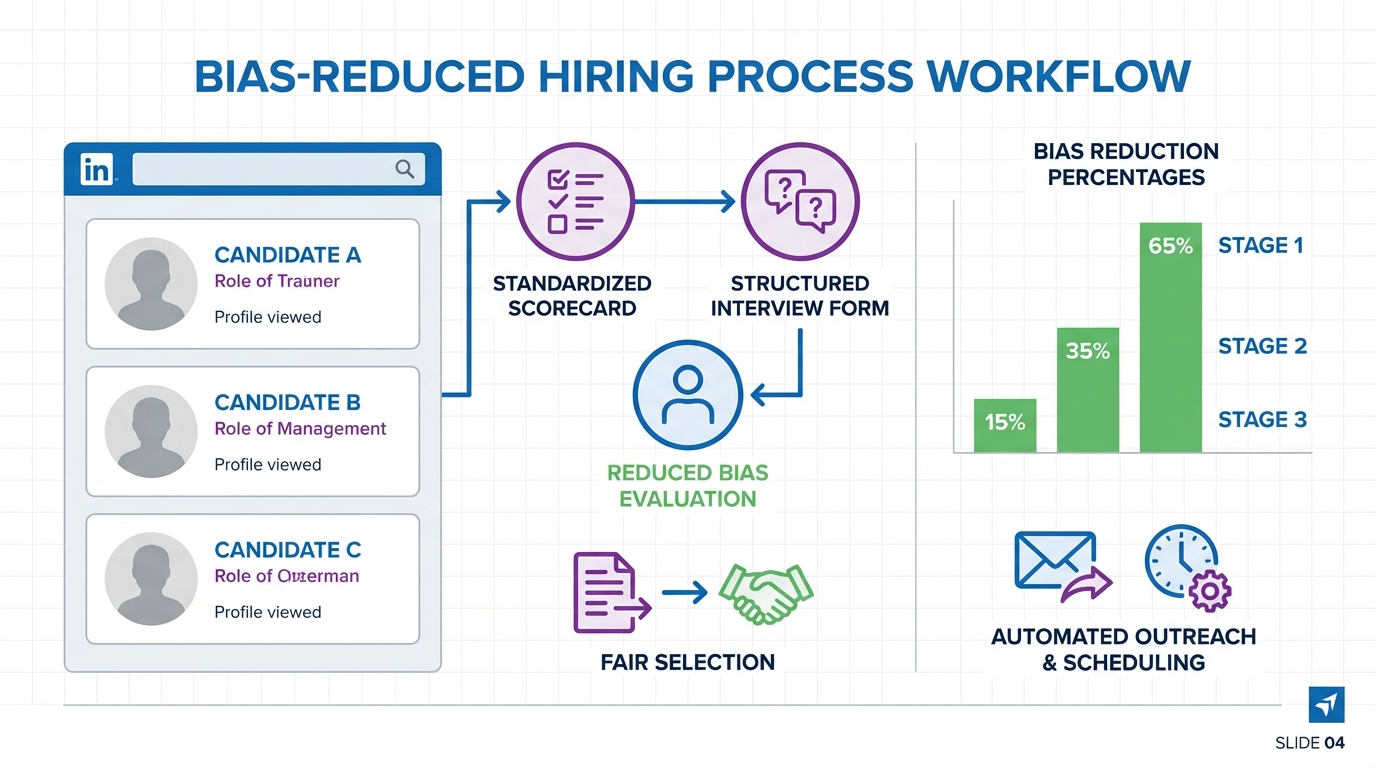
Recruitment management software can reduce age bias by standardizing screening criteria, documenting decisions, and automating consistent candidate communication. The most practical way to do this is to define job related evaluation rubrics, require structured notes for every stage, and use automation for outreach and follow up so candidates are treated consistently. In our day to day recruiting workflows, we see fewer subjective rejections when teams use a single scorecard and when early conversations are handled in a repeatable way. This guide explains ageism in the workplace, the stereotypes that drive it, and a step by step process you can implement using recruitment management software and HR talent management software. It also shows where StrategyBrain AI Recruiter fits when LinkedIn is a primary sourcing channel.
Key Takeaways
- Ageism definition: Ageism is discrimination based on age, and it can show up in sourcing, screening, and interview decisions.
- Canada workforce context: Canada’s median age was 41.7 years in 2021 (Source: Statistics Canada).
- Skilled trades context: The average age of a journeyperson in Ontario was reported as 57 years (Source: CBC News).
- Process beats intention: Standardized rubrics and structured interviews reduce bias more reliably than one time training alone.
- Automation can help fairness: Consistent outreach and follow up reduces “who got attention” variability across recruiters and time zones.
- Where StrategyBrain AI Recruiter helps: It automates LinkedIn connecting, role introduction, Q&A, interest confirmation, and résumé and contact capture, while recruiters keep final qualification decisions.
Table of Contents
- What ageism in the workplace means for hiring
- Why ageism shows up in recruiting
- How recruitment management software reduces age bias
- Implementation plan: 5 methods you can apply
- Quick comparison: bias controls by method
- FAQ
- Conclusion and next steps
What ageism in the workplace means for hiring
Ageism is discrimination based on age. In recruiting, it often appears as assumptions about competence, cost, or adaptability that are not tied to the actual job requirements. The risk is highest when hiring decisions rely on unstructured impressions instead of documented, job relevant evidence.
Ageism is becoming more visible as workforces age. For example, Canada’s median age in 2021 was 41.7 years, and in some skilled trades contexts the workforce skews older. These demographics make it even more important that hiring systems are designed to evaluate capability rather than stereotypes.
Why ageism shows up in recruiting
In the source material, several common stereotypes are called out. These stereotypes can influence sourcing messages, screening decisions, and interview feedback, especially when teams do not use consistent criteria.
Stereotype 1: “Older workers are less competent”
This belief can show up as lower interview scores without clear evidence, or as fewer interview invitations for experienced candidates. The source material notes that this stereotype can be reinforced when older workers are treated as less capable, creating a self fulfilling dynamic.
Stereotype 2: “Older workers cost more”
Hiring teams sometimes assume higher benefit usage, wage expectations, or training costs. The practical issue is that these assumptions can lead to early rejection before the candidate’s actual fit is evaluated against the role’s requirements.
Stereotype 3: “Older workers are less adaptable to change”
The source material highlights that adaptability is often misjudged, and it references research and reporting that challenge the assumption that younger workers are always more adaptable. In hiring, this stereotype often appears as vague feedback like “not a fit for our pace” without measurable criteria.
How recruitment management software reduces age bias
Recruitment management software is most effective against bias when it forces consistency. That means the system should make it easy to apply the same steps to every candidate and hard to skip documentation. When paired with human resources talent management software or HR talent management software, you can also connect hiring decisions to performance outcomes, which helps teams validate what “good” actually looks like for the role.
Bias controls that matter in real workflows
- Structured scorecards: A rubric with defined competencies and anchored scoring reduces subjective comparisons.
- Stage gates: Requiring specific evidence before moving a candidate forward or rejecting them improves decision quality.
- Audit trails: Time stamped notes and decision reasons make patterns visible for review.
- Consistent outreach: Templates and automated follow up reduce uneven candidate experience.
- Reporting: Funnel metrics by stage can reveal where certain groups are disproportionately screened out.
Implementation plan: 5 methods you can apply
Method 1: Build a job relevant scorecard inside your recruitment management software
Definition: A scorecard is a structured evaluation form that lists competencies and scoring rules for the role.
- Define 5 to 8 competencies that directly map to job outcomes, such as safety compliance, troubleshooting, stakeholder communication, or project planning.
- For each competency, write 2 examples of acceptable evidence, such as certifications, portfolio artifacts, or scenario answers.
- Require a score and a short evidence note for every competency before a candidate can be advanced or rejected.
Limitations: A scorecard only works if hiring managers use it consistently. If the team treats it as a formality, bias can re enter through free text comments.
Best for: Teams that want repeatable decisions across multiple recruiters and hiring managers.
Method 2: Convert interviews into structured interviews with consistent questions
Definition: A structured interview uses the same questions and scoring approach for all candidates for the same role.
- Create 6 to 10 questions tied to the scorecard competencies.
- Add a scoring guide for each question, including what a strong answer must contain.
- Require interviewers to submit scores independently before group discussion.
Limitations: Structured interviews can feel rigid if you do not leave room for clarifying follow ups. Keep follow ups allowed, but score only against the defined criteria.
Best for: Roles where “culture fit” feedback has historically dominated decisions.
Method 3: Standardize outreach and follow up to reduce uneven candidate attention
In practice, candidate experience varies when outreach depends on individual recruiter habits and time zones. Recruitment management software can reduce this variability by using templates, scheduled follow ups, and consistent response expectations.
- Create outreach templates that focus on role requirements and value proposition, not age coded language like “digital native” or “high energy.”
- Set follow up rules, such as a second message after 48 hours and a final check in after 7 days.
- Track response rates by template and role to improve clarity and fairness.
Where StrategyBrain AI Recruiter fits: If LinkedIn is your main sourcing channel, StrategyBrain AI Recruiter can automate connecting with candidates that match your search criteria, introduce the opportunity, answer questions about the role, company, and compensation, confirm interview interest, and collect résumés and contact details. This helps keep early stage communication consistent, including outside business hours and across languages.
Limitations: Automation should not replace final qualification. StrategyBrain AI Recruiter is designed to identify willingness to communicate or interview, while recruiters still decide whether the résumé matches the requirements.
Method 4: Add decision checkpoints and require evidence for rejections
One of the fastest ways bias shows up is in early rejection with vague reasons. A simple control is to require a job related reason tied to the scorecard.
- Define allowed rejection reasons that map to competencies, such as missing certification, insufficient experience with a specific system, or failed scenario response.
- Require a short evidence note for each rejection reason.
- Review a sample of rejections monthly for quality and consistency.
Limitations: This adds friction. The tradeoff is better documentation and more defensible decisions.
Best for: High volume roles where speed pressure increases shortcut decisions.
Method 5: Use HR talent management software to validate hiring signals against performance
Human resources talent management software and HR talent management software can connect hiring inputs to downstream outcomes like retention, safety incidents, performance reviews, and promotion velocity. This helps teams test whether assumptions about age and adaptability are actually predictive.
- Pick 2 outcome metrics relevant to the role, such as 90 day retention and first year performance rating.
- Compare outcomes against interview scores and scorecard competencies.
- Remove interview questions or criteria that do not correlate with outcomes.
Limitations: Outcome data takes time to accumulate and must be interpreted carefully to avoid reinforcing existing bias in performance reviews.
Best for: Organizations that hire at scale and want evidence based hiring criteria.
Quick comparison: bias controls by method
| Method | Primary bias risk reduced | What to configure in software | Best for |
|---|---|---|---|
| Scorecards | Subjective screening | Competencies, anchored scoring, required evidence notes | Consistent evaluation across teams |
| Structured interviews | Unstructured impressions | Standard questions, scoring guides, independent scoring | Reducing “fit” driven decisions |
| Standardized outreach | Uneven candidate attention | Templates, follow up rules, response tracking | High volume sourcing |
| Decision checkpoints | Vague rejections | Allowed rejection reasons, required documentation | Defensible, auditable hiring |
| Talent management linkage | Wrong hiring signals | Outcome metrics, reporting, criteria iteration | Evidence based hiring improvements |
FAQ
What is ageism in the workplace?
Ageism is discrimination based on age. In hiring, it often appears as assumptions about competence, cost, or adaptability that are not tied to the job’s actual requirements.
Can recruitment management software actually reduce bias?
Yes, when it enforces consistent steps like scorecards, structured interviews, and documented rejection reasons. Software does not remove bias automatically, but it can reduce opportunities for inconsistent treatment.
What should I look for in HR talent management software to support fair hiring?
Look for the ability to connect hiring criteria to performance and retention outcomes, plus reporting that lets you review funnel patterns by stage. This helps you validate which signals predict success and which signals introduce noise.
How does StrategyBrain AI Recruiter fit into a recruitment management software stack?
StrategyBrain AI Recruiter automates LinkedIn outreach and early stage conversations, including role introduction, candidate Q&A, interest confirmation, and résumé and contact capture. Recruiters then review the collected information and make the final qualification decision.
Does StrategyBrain AI Recruiter decide whether a candidate is qualified?
No. It identifies willingness to communicate or interview and collects materials, but it does not determine whether the résumé fully matches job requirements. Recruiters keep that decision.
How does multilingual communication affect fairness?
When candidates can communicate in their native language, misunderstandings drop and response quality improves. Always on multilingual messaging also reduces time zone related delays that can disadvantage certain candidate pools.
How do I avoid age coded language in job ads and outreach?
Remove terms that imply age or life stage, and focus on measurable requirements and working conditions. Use templates that emphasize skills, responsibilities, and growth opportunities rather than stereotypes.
What is one simple process change I can make this week?
Require a scorecard with evidence notes for every interview and every rejection. This single change makes decisions more consistent and easier to review.
Conclusion and next steps
Ageism in the workplace is often driven by stereotypes that slip into hiring when decisions are unstructured. Recruitment management software helps when it standardizes evaluation, requires documentation, and makes outreach consistent. If LinkedIn is central to your sourcing, StrategyBrain AI Recruiter can automate connecting, messaging, and early qualification conversations so candidates receive timely, consistent communication, while your team retains control of final selection.
Next steps: (1) implement a scorecard for your top role, (2) convert interviews to a structured format, and (3) standardize outreach and follow up rules. After 30 days, review funnel data and rejection reasons to identify where bias risk is highest and iterate the process.