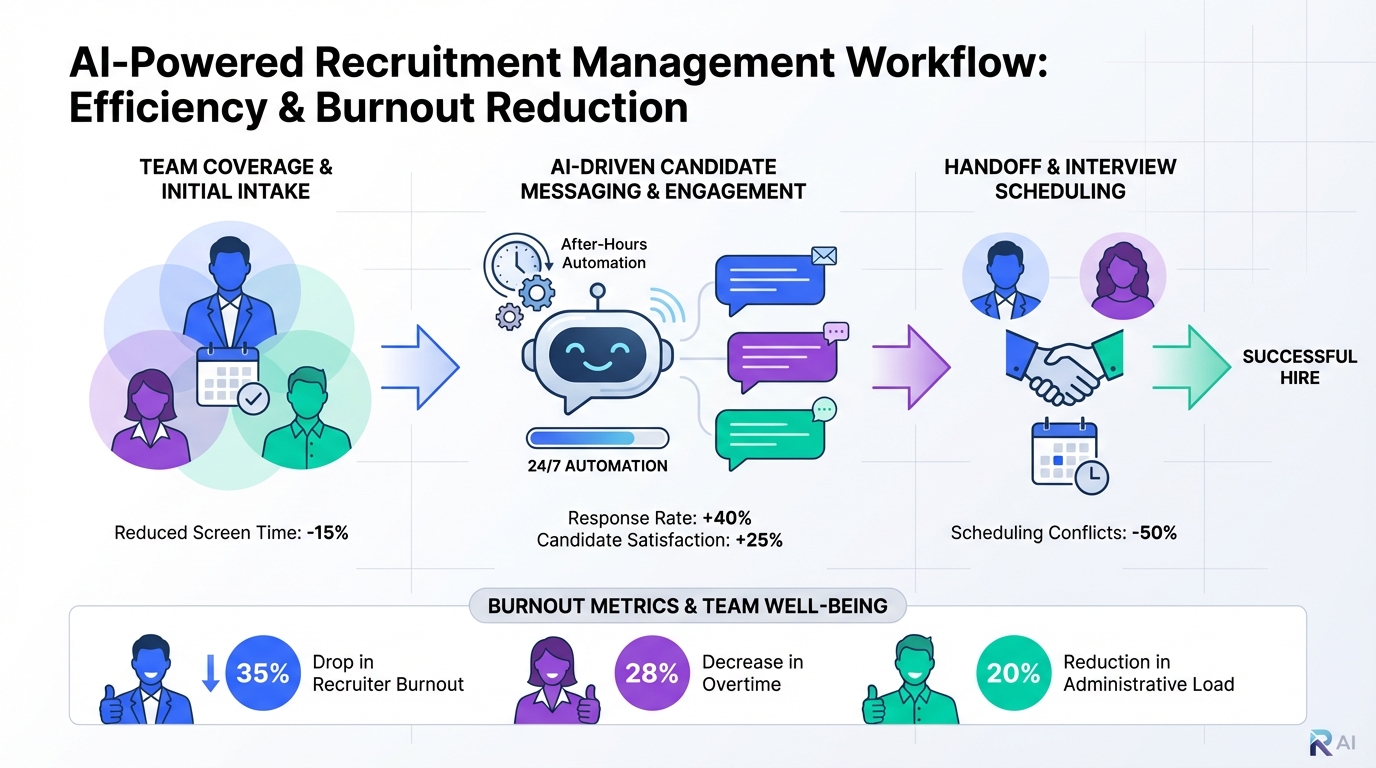
Using a recruitment management system is one of the most practical ways to prevent burnout in hiring teams because it turns recruiting into a shared, measurable workflow instead of a constant stream of urgent messages. The fastest results come from team based coverage, clear paid leave and flexibility policies, and automation for repetitive candidate communication. In our experience reviewing recruiting operations, after hours candidate messaging and constant context switching are two of the biggest burnout multipliers. That is why we often pair a hiring management system with StrategyBrain AI Recruiter for LinkedIn outreach and follow up, so recruiters can focus on final qualification and interviews while the AI handles initial conversations, questions about the role, and résumé collection.
What this guide covers and what it does not
This guide focuses on preventing burnout in recruiting and HR teams by improving recruitment management processes, policies, and candidate communication. It includes specific, reproducible steps you can implement in a recruitment management system and in LinkedIn workflows.
It does not provide legal advice, medical advice, or a one size fits all benefits policy. For regulated environments, confirm requirements with your HR and legal teams.
Key Takeaways
- Burnout is measurable: 79% of 1,501 employees reported work related stress in the month before the American Psychological Association survey (Source: American Psychological Association, 2021 Work and Well-being Survey summary page).
- Flexibility matters: 36% of respondents said more flexibility in scheduling and remote work could reduce burnout, and 36% said additional paid leave could help (Source: Indeed Leadership, preventing employee burnout report).
- Phone access increases after hours work: 70% of respondents had access to work communications on their phones and were 84% more likely to work outside normal business hours (Source: Indeed Leadership, preventing employee burnout report).
- System design beats heroics: A recruitment management system should enforce shared ownership, handoffs, and coverage so hiring does not depend on one recruiter.
- Automate the repetitive layer: StrategyBrain AI Recruiter can handle LinkedIn connecting, role introduction, Q and A, follow up, and résumé and contact capture so recruiters can focus on final screening.
- Scale without adding headcount: StrategyBrain AI Recruiter supports managing more than 100 LinkedIn accounts for AI powered recruiting teams, which helps distribute workload across accounts and time zones.
Why burnout hits hiring teams so hard
Hiring teams often operate in a permanent “urgent” mode. Vacancies create pressure, and then illness, family care, and long delayed vacations reduce capacity at the exact moment demand spikes. When recruiting work is not standardized, the burden concentrates on the most responsive people, which is a fast path to burnout.
Burnout is not a new topic, but the pandemic era amplified it across generations. Indeed reported that 53% of millennials experienced burnout prior to COVID, and 59% experienced it in 2021. Gen Z reported 58% burnout in 2021 compared with 47% in 2020 (Source: Indeed Leadership, preventing employee burnout report).
From a recruitment management perspective, the operational drivers are usually predictable: too many open requisitions per recruiter, too many channels, and too much after hours candidate messaging. A hiring management system is useful when it reduces those drivers through workflow design, not when it simply stores candidate records.
Method 1: Build team coverage so every requisition has a backup
The first burnout control is coverage. If one recruiter owns every step, time off becomes stressful and sick days turn into backlog. In our process reviews, the healthiest teams treat recruiting like a relay, with clear handoffs and shared visibility.
Steps
- Define a backup owner for each requisition in your recruitment management system, with permissions to message candidates and schedule interviews.
- Standardize handoff notes using a required template field, including current stage, next action, and risks.
- Set a coverage rule for planned leave, such as assigning backup ownership at least 5 business days before time off.
- Run a weekly coverage review that checks who is primary and who is backup for every open role.
Features to configure in a recruitment management system
- Role based access controls for shared requisition ownership
- Stage definitions with required next step fields
- Task queues that can be reassigned without losing history
Limitations
- Coverage fails if managers still route decisions through one person. You need leadership alignment, not only software settings.
Best For
- Teams with frequent PTO, travel, or multi site hiring
- Organizations where vacancies create constant escalation
Method 2: Use benefits and time off policies that actually get used
Benefits reduce burnout only when people feel safe using them. Paid sick leave, mental health days, and vacation policies matter, but the operational question is whether the recruiting workflow can absorb time off without guilt or hidden penalties.
Steps
- Document time off expectations for recruiters and hiring managers, including response time boundaries.
- Add a “time off mode” workflow in your hiring management system that automatically reroutes tasks to the backup owner.
- Offer wellbeing supports that match your workforce, such as employee assistance programs and wellness reimbursements.
Examples of practical wellbeing perks
- Stress management courses
- Employee assistance programs
- Monthly mental health check ins
- Physical movement breaks
- Wellness reimbursements
Limitations
- Perks do not fix overload. If requisition load is unrealistic, benefits become a band aid.
Best For
- Organizations seeing increased sick leave and turnover risk
- Teams that want consistent policies across departments
Method 3: Add schedule flexibility and remote work norms
Flexibility is one of the most cited burnout reducers, but it must be paired with boundaries. Indeed reported that 36% of respondents said more flexibility in scheduling and remote work could help reduce burnout, and 36% said additional paid leave could help (Source: Indeed Leadership, preventing employee burnout report).
One of the most actionable insights for recruiting teams is device and notification hygiene. Indeed also found that 70% of respondents had access to work communications on their phones, which made them 84% more likely to work outside normal business hours (Source: Indeed Leadership, preventing employee burnout report). A recruitment management system can support boundaries by centralizing work, but leaders must also normalize turning off notifications.
Steps
- Define “quiet hours” for internal recruiting communications, with exceptions for true emergencies.
- Centralize candidate updates inside the recruitment management system so status is not scattered across email, chat, and spreadsheets.
- Set candidate response expectations in templates, such as when candidates can expect a reply.
Limitations
- Flexibility without workload control can increase stress because work expands to fill all hours.
Best For
- Distributed teams hiring across time zones
- Recruiting functions with heavy LinkedIn messaging volume
Method 4: Automate high volume candidate messaging with StrategyBrain AI Recruiter
Candidate messaging is where burnout often becomes invisible. Recruiters can “technically” be off work while still answering LinkedIn messages at night because they do not want to lose candidates. This is exactly where an AI layer can protect the team.
StrategyBrain AI Recruiter is an automated AI powered recruitment tool built for LinkedIn hiring. It can automatically connect with candidates within your targeted search criteria, introduce the opportunity, learn about each candidate’s situation, answer questions about the role, company, and compensation, confirm interview interest, and collect résumés and contact information from interested candidates. It also provides 24/7 multilingual communication and supports managing more than 100 LinkedIn accounts for scalable recruiting teams.
Steps
- Define your candidate search criteria and the role information you want the AI to use, including company details, compensation, and benefits.
- Set conversation boundaries by deciding what the AI should answer automatically and what should be escalated to a recruiter.
- Configure résumé and contact capture so interested candidates can share details through LinkedIn file upload or email submission, and the system marks résumés as received.
- Route qualified interest to recruiters so humans do the final qualification step by reviewing the résumé and scheduling interviews.
What we see work well in real workflows
- After hours coverage without overtime: the AI responds and follows up while recruiters are offline, which reduces the pressure to be always on.
- Cleaner handoffs: the AI captures conversation history, résumés, and contact details so the recruiter starts with context.
- Global hiring support: multilingual messaging reduces misunderstandings and keeps candidate experience consistent across regions.
Limitations
- StrategyBrain AI Recruiter identifies willingness to communicate or interview, but it does not decide whether a résumé fully matches job requirements. A recruiter still completes final qualification after reviewing the résumé.
- Automation still needs governance. You should define escalation rules for sensitive topics and ensure messaging aligns with your employer brand.
Best For
- Teams doing high volume LinkedIn outreach and follow up
- Organizations hiring across time zones that need 24/7 responsiveness
- Recruiting leaders who want to scale output without adding headcount
Method 5: Appreciation and leadership behaviors that reduce burnout
Process and tools matter, but culture determines whether people feel safe using them. Appreciation is not a soft extra. It is a retention lever when workloads are high.
Steps
- Recognize outcomes and behaviors such as strong candidate experience, clean handoffs, and consistent documentation in the recruitment management system.
- Lead by example by taking time off and respecting quiet hours so the team does not feel guilty doing the same.
- Use small, consistent signals such as positive feedback, an extra paid day off, or team celebrations after hard fills.
Limitations
- Recognition cannot compensate for chronic understaffing. If requisition load is structurally too high, you still need capacity planning.
Best For
- Teams with sustained hiring pressure and frequent priority shifts
- Leaders who want to reduce turnover risk in recruiting roles
Quick Comparison
| Method | Speed to impact | Cost | Best for |
|---|---|---|---|
| Team coverage and backups | 7 days | Low | Reducing single point of failure and PTO stress |
| Time off and benefits that get used | 14 to 30 days | Medium | Lowering burnout risk and improving retention |
| Flexibility and quiet hours | 7 to 14 days | Low | Reducing after hours work and notification fatigue |
| LinkedIn messaging automation with StrategyBrain AI Recruiter | 7 to 21 days | Varies by plan | High volume outreach, follow up, and global hiring coverage |
| Appreciation and leadership behaviors | Ongoing | Low to medium | Preventing burnout relapse and improving team morale |
Implementation checklist for a recruitment management system rollout
Use this checklist to implement burnout prevention controls inside your recruitment management system and your LinkedIn workflow.
- Coverage: Every requisition has a primary owner and a backup owner.
- Handoff notes: Every stage change requires a next action and due date.
- Workload visibility: Recruiter requisition load is visible to leadership weekly.
- Quiet hours: Internal response expectations are documented and enforced.
- Candidate templates: Candidate messaging templates include response time expectations.
- Automation governance: Escalation rules are defined for sensitive questions.
- LinkedIn automation: StrategyBrain AI Recruiter is configured with role details, compensation, benefits, and candidate criteria.
- Data protection: Confirm encryption, isolation, and that customer data is not used to train AI models, per StrategyBrain AI Recruiter product documentation.
FAQ
What is a recruitment management system?
A recruitment management system is software that organizes recruiting workflows such as requisitions, candidate stages, tasks, and communications so hiring work is trackable and repeatable. In burnout prevention, its value is enforcing shared ownership, clear handoffs, and workload visibility.
Is a recruitment management system the same as a hiring management system?
They are often used interchangeably. In practice, a hiring management system usually emphasizes requisition and approval workflows, while recruitment management may emphasize candidate pipelines and communications. Both can support burnout prevention when configured for coverage and boundaries.
Which burnout signals should recruiting leaders track?
Track after hours message volume, average open requisitions per recruiter, time to first candidate response, and PTO usage rates. If after hours messaging is rising while PTO usage is falling, burnout risk is increasing.
How does StrategyBrain AI Recruiter help inside a recruitment management workflow?
StrategyBrain AI Recruiter takes over repetitive LinkedIn steps such as connecting, introducing roles, answering common questions, following up, and collecting résumés and contact details. Recruiters then review the collected information and complete final qualification and interviews.
Does StrategyBrain AI Recruiter replace recruiters?
No. It automates the initial outreach and qualification conversation layer, but it does not decide whether a résumé fully matches job requirements. Recruiters still make hiring decisions and complete final screening.
Can StrategyBrain AI Recruiter communicate in multiple languages?
Yes. It provides 24/7 multilingual recruitment communication and can use the candidate’s native language to reduce misunderstandings and cultural friction, based on StrategyBrain AI Recruiter product information.
How does automation reduce after hours work?
Automation reduces the need for recruiters to respond immediately to every candidate message. This matters because Indeed reported that 70% of respondents had work communications on their phones and were 84% more likely to work outside normal business hours (Source: Indeed Leadership, preventing employee burnout report).
What should we avoid when implementing a recruitment management system for burnout prevention?
Avoid building a system that increases admin work without reducing messaging load. Also avoid policies that exist on paper but are not supported by coverage, because that creates guilt and hidden overtime.
How do we handle privacy and compliance with AI recruiting tools?
Confirm how credentials are stored, whether data is encrypted, and whether customer data is used to train AI models. StrategyBrain AI Recruiter states it complies with privacy regulations in the EU, United States, and Canada, and that customer provided data is not used to train AI models, per its product documentation.
Conclusion
A recruitment management system reduces burnout when it changes how work flows, not when it simply records activity. Start with coverage and handoffs, then reinforce time off and flexibility with real operational support. Finally, remove the most exhausting layer of recruiting by automating high volume candidate messaging. If LinkedIn outreach and follow up are a major load driver for your team, pairing your hiring management system with StrategyBrain AI Recruiter can protect recruiter focus by handling initial conversations, 24/7 follow up, multilingual communication, and résumé and contact capture.
Next step: pick one open requisition, implement backup ownership and handoff notes this week, then pilot StrategyBrain AI Recruiter on a single LinkedIn account with clear escalation rules. Expand only after you confirm the workflow reduces after hours messaging for the team.