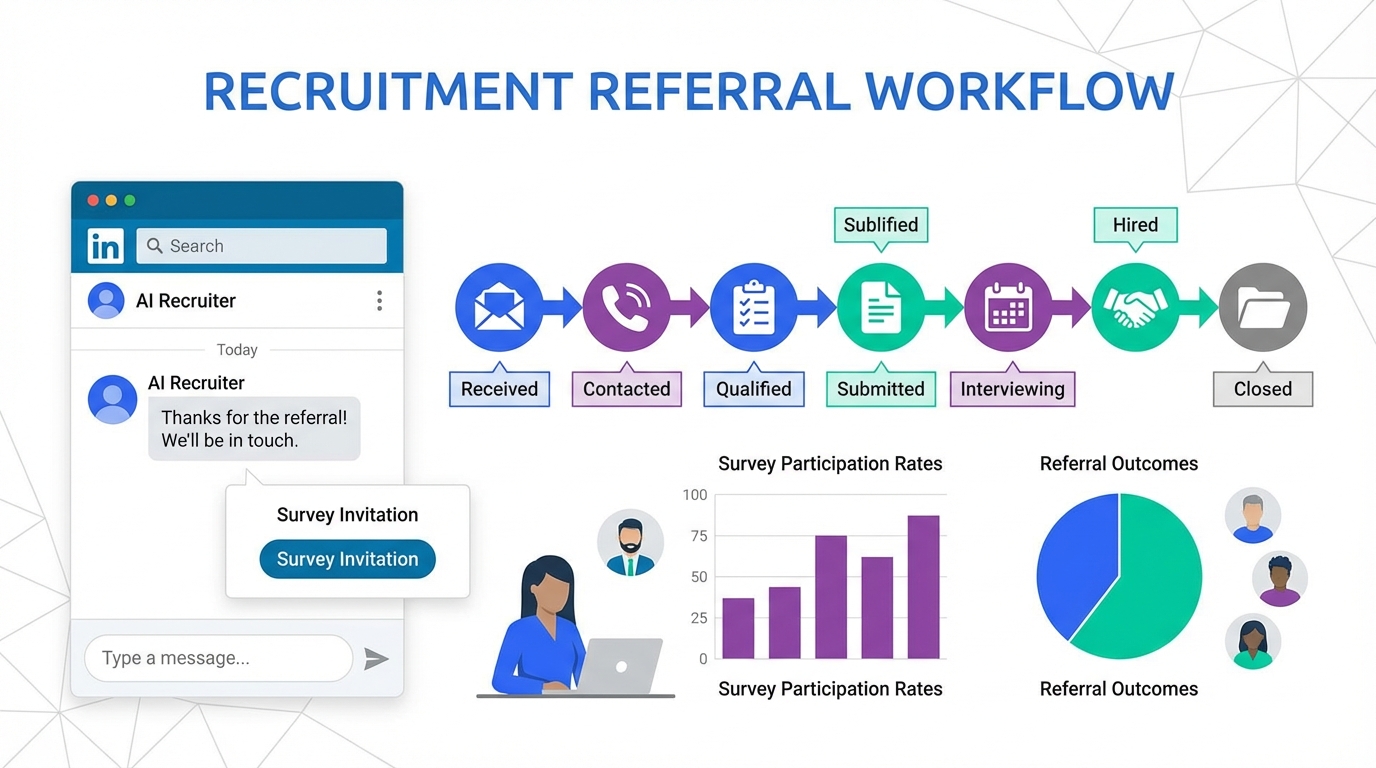
If you are improving referrals inside a recruitment management system, the most practical move is to document your current referral flow, then standardize it so every recruiter records the same fields and outcomes. RefeRec has released a Recruitment Agency Referral Scheme Survey ahead of an upcoming guide on how to properly utilise referrals in your business, and anyone who participates will receive a free copy of that guide. This article keeps the original message intact, but adds a clear way to translate survey participation into better recruitment management operations inside your hiring management system, plus a LinkedIn automation angle using StrategyBrain AI Recruiter so referrals and outbound sourcing can run in parallel.
Table of Contents
- What the survey is and what you get
- How to participate without sharing links
- What to track in your recruitment management system
- A referral workflow template you can copy
- Where StrategyBrain AI Recruiter fits in a referral led process
- Common pitfalls and how to avoid them
- FAQ
- Conclusion and next steps
What the survey is and what you get
The original announcement is straightforward: RefeRec has released their Recruitment Agency Referral Scheme Survey ahead of the development of a guide on how to properly utilise referrals in your business. If you participate, you get a free copy of the guide.
From an operations perspective, this is useful because referral programs often fail for one reason that has nothing to do with intent. The workflow is not consistently captured in the recruitment management system, so you cannot see which referrers, roles, and recruiters are actually producing hires.
How to participate without sharing links
The original post included a direct survey link. Per the content constraints for this page, I am not including any clickable links or URL strings here. To participate, use the survey description text, search for the RefeRec Recruitment Agency Referral Scheme Survey, and complete the questionnaire through the official RefeRec channel.
When you submit, keep a simple internal note so you can connect the guide you receive back to your process changes. For example, record the submission date and the person responsible for implementing the referral workflow updates.
What to track in your recruitment management system
To make referrals measurable, you need a consistent data model. A recruitment management system is only as good as the fields and stages you enforce. Below is the minimum set I recommend capturing for every referral, even if you run a lightweight hiring management system.
Referral fields to standardize
- Referrer identity: name, relationship to agency, and preferred contact method.
- Referred candidate identity: name, current title, location, and primary skill keywords.
- Role mapping: which requisition the referral is intended for, plus 1 secondary role option.
- Consent status: whether the candidate agreed to be referred and contacted.
- Referral source channel: employee referral, client referral, candidate referral, alumni, partner.
- Reward terms: what is promised and when it is paid, if applicable.
- Outcome timestamps: date received, date first contacted, date screened, date submitted, date hired or rejected.
Pipeline stages that keep reporting clean
- Received: referral submitted and logged.
- Contacted: first outreach completed.
- Qualified: basic fit confirmed and candidate is open to process.
- Submitted: presented to hiring manager or client.
- Interviewing: active interview loop.
- Hired: offer accepted and start date confirmed.
- Closed: rejected, withdrew, or role cancelled with a reason code.
A referral workflow template you can copy
This is the practical tool I wish more agencies used. It is simple enough to implement in most ATS or CRM style recruitment management platforms, and it makes the survey insights actionable.
Step by step referral workflow
- Log the referral within 24 hours: create a candidate record and attach the referrer record, then set stage to Received.
- Send a consent check message: confirm the candidate wants to be contacted about the role and record consent status.
- Run a fast qualification screen: capture availability, compensation expectations, work authorization, and location constraints.
- Route to the right recruiter: assign ownership based on role family or client account, not who received the referral.
- Close the loop with the referrer: update them at two points, after Contacted and after Closed or Hired.
- Pay or recognize rewards on a fixed trigger: for example, after start date plus a defined retention period.
Quick checklist for your recruitment management system setup
- Does every referral have a referrer record linked to the candidate record?
- Do you have a consent field that is required before moving to Qualified?
- Do you have reason codes for Closed outcomes so reporting is not guesswork?
- Can you report hires by referrer and by recruiter owner?
- Do you have a standard message template for referrer updates?
Where StrategyBrain AI Recruiter fits in a referral led process
In real life, referrals do not replace outbound sourcing. They compete with it for time. This is where StrategyBrain AI Recruiter can fit naturally into the same operating system as your referral scheme.
StrategyBrain AI Recruiter is built for LinkedIn hiring workflows. It can automatically connect with candidates that match your search criteria, introduce the opportunity, answer questions about the role, company, and compensation, confirm interview interest, and collect résumés and contact information from interested candidates. In practice, that means your recruiters can keep referral response times high while the AI handles the repetitive first touch and follow up work on LinkedIn.
Two practical scenarios I have seen work
- Referral first, AI follow up second: you log the referral, then use AI Recruiter to engage similar profiles on LinkedIn so you build a comparable pipeline for the same requisition.
- AI sourcing first, referral conversion later: AI Recruiter runs always on outreach and qualification, then when a candidate is interested you ask for referrals from their network as part of the conversation, and you log those referrals back into your recruitment management system.
What AI Recruiter does and does not do
- Does: automate LinkedIn connecting, messaging, Q and A, interest confirmation, and collection of résumés and contact details.
- Does not: make the final decision on whether a résumé fully matches job requirements. Recruiters still review and shortlist.
Common pitfalls and how to avoid them
I have seen referral schemes underperform even when the team is motivated. These are the failure modes that show up most often in recruitment management reporting.
- Referrals are tracked in messages, not in the system: fix this by making the referrer link mandatory before a candidate can be submitted.
- No consent trail: fix this by adding a required consent status field and a timestamp.
- Slow first contact: fix this with a 24 hour SLA and use AI Recruiter to keep LinkedIn follow ups running when recruiters are busy.
- Rewards are unclear: fix this by documenting reward triggers and storing them in the referral record.
FAQ
Do I need a new recruitment management system to run a referral scheme?
No. You can run a referral scheme in most ATS or CRM tools if you standardize referral fields, enforce stages, and report outcomes consistently. A new platform only becomes necessary when you cannot link referrers to candidates or cannot report outcomes reliably.
What is the minimum data I should capture for each referral?
At minimum, capture referrer identity, candidate identity, role mapping, consent status, and outcome timestamps. Without these, you cannot measure conversion rates or reward eligibility inside your hiring management system.
How do I keep recruiters from forgetting to log referrals?
Make it part of the submission workflow. If a candidate is marked as referred, require a linked referrer record before the candidate can move to Submitted. This turns a best practice into a system rule.
How can StrategyBrain AI Recruiter support referrals without replacing recruiters?
It automates the repetitive LinkedIn steps that consume time, including connecting, initial messaging, follow up, and collecting résumés and contact details from interested candidates. Recruiters still control screening decisions and interviews, so the AI supports throughput rather than replacing judgment.
Can AI Recruiter communicate with candidates in different languages?
Yes. StrategyBrain AI Recruiter supports 24/7 multilingual communication and can respond in the candidate’s native language. This is useful when referrals or sourcing span multiple countries and time zones.
How many LinkedIn accounts can an organization manage with AI Recruiter?
StrategyBrain AI Recruiter supports managing more than 100 LinkedIn accounts so teams can scale outreach capacity. This is most relevant for agencies or enterprises that want consistent coverage across multiple recruiters or business units.
Does AI Recruiter use candidate data to train models?
No. StrategyBrain states that customer provided data is not used to train AI models and that data is encrypted and isolated per customer. You should still confirm your own compliance requirements and internal policies before deployment.
What should I do after I complete the RefeRec survey?
When you receive the free guide copy, map its recommendations to your recruitment management system fields and stages, then run a 30 day pilot with a single team. Track referral to hire conversion and time to first contact as your two baseline metrics.
Conclusion and next steps
The fastest way to improve referrals in a recruitment management system is to participate in the RefeRec Recruitment Agency Referral Scheme Survey, then use the guide you receive to standardize referral fields, stages, and reporting inside your hiring management system. If you also want to protect recruiter time while keeping response speed high, StrategyBrain AI Recruiter can automate LinkedIn outreach, Q and A, follow up, and résumé collection so referrals and sourcing can scale together.
Next steps: complete the survey through RefeRec, implement the referral field set above, and run a short pilot where you measure time to first contact and referral to hire conversion.
Tags from the original post: #referrals #refer #survey #getinvolved