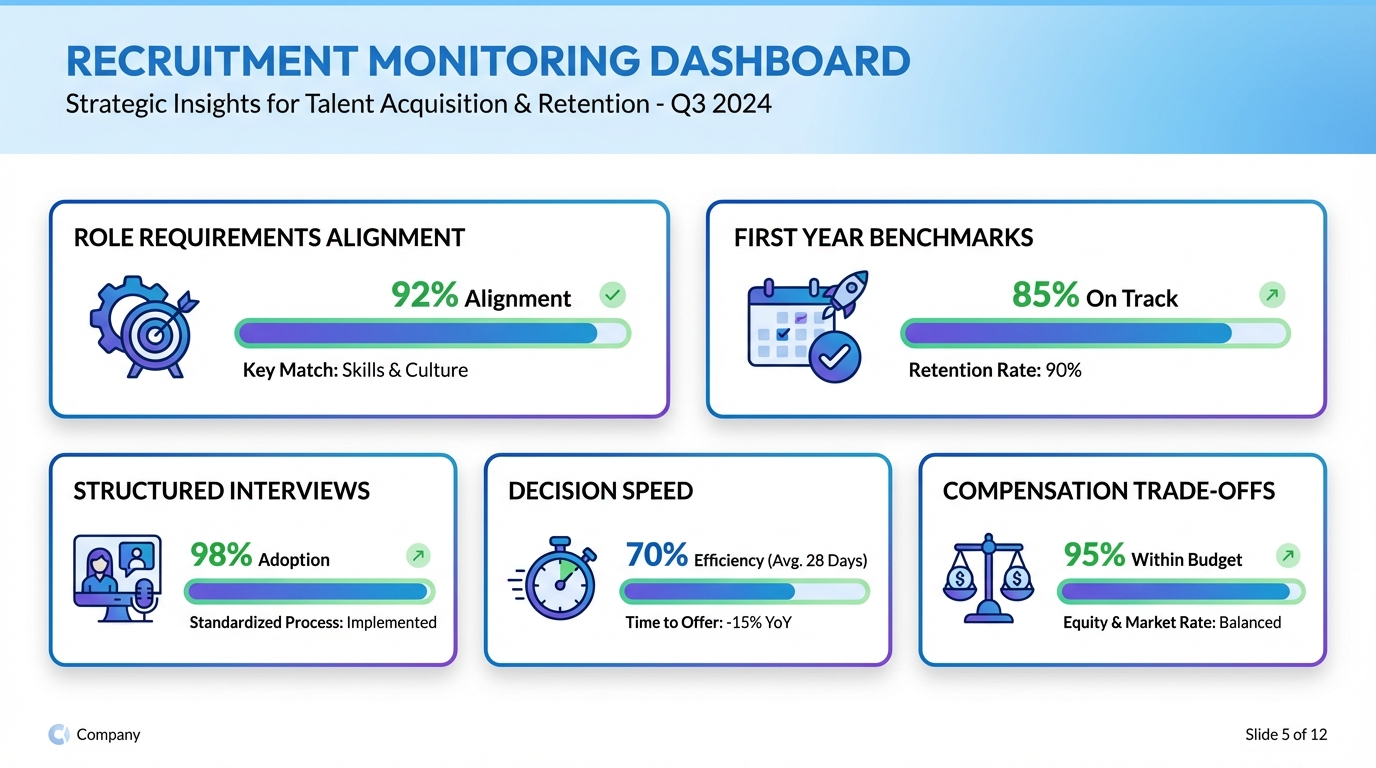
Recruitment monitoring is the practice of tracking your hiring process with consistent metrics, scorecards, and decision timelines so you can improve quality of hire, reduce time to fill, and avoid losing strong candidates. The fastest way to make it work is to monitor five points: role requirements, first year benchmarks, structured interviews, decision speed, and compensation trade-offs. In our recruiting operations work, we have found that teams get the biggest lift when monitoring is tied to specific HR hiring metrics and key recruitment metrics, not just opinions. This guide turns a classic five tip hiring approach into a measurable system and shows where StrategyBrain AI Recruiter can automate LinkedIn outreach, candidate Q and A, follow up, and résumé collection so your monitoring data stays complete.
Key Takeaways
- Start with alignment: Monitor stakeholder agreement on must have requirements before sourcing begins to prevent rework later.
- Define measurable first year outcomes: Track 12 month milestones so candidates and interviewers share the same success definition.
- Standardize evaluation: Use a scorecard so interview feedback becomes comparable data, not disconnected opinions.
- Speed is a metric: Monitor time between stages and decision latency to reduce candidate drop off and offer declines.
- Compensation trade-offs must be explicit: Monitor where you will pay, where you will flex, and where you will settle.
- Automate early funnel activity: StrategyBrain AI Recruiter can run LinkedIn outreach, follow up, and résumé capture so monitoring reflects real activity, not manual gaps.
What recruitment monitoring covers and what it does not
Recruitment monitoring is not the same as recruiting analytics. Analytics is the reporting layer. Monitoring is the operational discipline that ensures the process is consistent enough to measure and improve. In practice, monitoring means you define what good looks like, you instrument the workflow, and you review the numbers on a fixed cadence.
This article focuses on monitoring the hiring workflow for a role, including role definition, interviews, decision speed, and compensation alignment. It does not cover employer branding campaigns, paid job advertising optimization, or background check vendor selection.
Core HR hiring metrics to track
- Time to fill (days): Days from requisition open to accepted offer.
- Time in stage (days): Days spent in each stage, such as screening, interview loop, offer.
- Candidate response rate (percent): Replies divided by outreach messages sent.
- Interview to offer ratio (number): Interviews completed divided by offers extended.
- Offer acceptance rate (percent): Accepted offers divided by offers extended.
Key recruitment metrics that indicate quality
- First year milestone attainment (percent): Percent of defined 12 month milestones achieved.
- Hiring manager satisfaction (score): A consistent post hire rating scale, such as 1 to 5.
- New hire ramp time (days): Days to reach defined productivity threshold.
Method 1: Monitor role requirements alignment
One of the most common reasons hiring drags is that the team is recruiting for an outdated version of the job. Monitoring starts before you post anything. You need a measurable signal that stakeholders agree on what matters and what does not.
Steps
- Run a stakeholder intake: Collect requirements from the hiring manager and 2 to 5 stakeholders who will work with the hire.
- Convert requirements into a scorecard: Define 5 to 8 competencies with clear pass signals.
- Lock the must haves: Mark each competency as must have or nice to have before sourcing begins.
- Set a change control rule: Any change after sourcing starts requires a documented reason and a reset of expectations.
What to monitor
- Requirements churn (count): Number of changes to must have criteria after sourcing begins.
- Rework rate (percent): Candidates re screened due to changed requirements divided by total screened.
Where StrategyBrain AI Recruiter fits naturally
When your requirements are clear, StrategyBrain AI Recruiter can use them to automate LinkedIn outreach to candidates who match your targeted search criteria, then introduce the role and answer questions about the company, compensation, and benefits. That creates consistent early funnel conversations, which makes recruitment monitoring easier because the same information is collected in the same way across candidates.
Limitations
Monitoring alignment does not eliminate disagreement. It surfaces it early. If stakeholders cannot agree, the metric will show churn, but leadership still needs to resolve the conflict.
Method 2: Monitor first year benchmarks
Hiring gets easier to evaluate when you define what success looks like in the first 12 months. This is both a candidate clarity tool and a monitoring tool. It also reduces late stage surprises because expectations are explicit.
Steps
- Define 3 to 6 first year deliverables: Use outcomes, not activities.
- Assign time windows: For example, by day 30, day 90, and month 12.
- Map each deliverable to interview questions: Ensure the interview loop tests for the ability to deliver those outcomes.
- Review benchmarks with candidates: Confirm understanding during the process.
What to monitor
- Benchmark clarity score (1 to 5): Hiring manager rating of how clear the benchmarks are before interviews start.
- Benchmark coverage (percent): Interview questions mapped to benchmarks divided by total benchmarks.
- First year milestone attainment (percent): Milestones achieved divided by milestones defined.
Best for
- Roles where success is measurable, such as finance, accounting, analytics, and operations.
- Teams that want to connect recruiting to performance management.
Limitations
Benchmarks can become unrealistic if they are not updated when the business changes. Review them at least every 90 days for active hiring.
Method 3: Monitor structured interviews with a scorecard
Unstructured interviews produce unstructured data. If you want recruitment monitoring that is defensible, you need consistent questions and a consistent evaluation method. A scorecard is the simplest way to do this.
Define key terms
- Scorecard: A standardized rubric that rates candidates against the same competencies using the same scale.
- Structured interview: An interview where questions are planned in advance and mapped to competencies.
Steps
- Create a competency list: 5 to 8 competencies tied to the role requirements.
- Write 2 questions per competency: Use behavioral prompts and work sample prompts.
- Set a rating scale: For example, 1 to 5 with written anchors for 1, 3, and 5.
- Require written evidence: Each rating must include a short justification.
- Calibrate interviewers: Run a 30 minute calibration session before the loop starts.
What to monitor
- Scorecard completion rate (percent): Completed scorecards divided by interviews completed.
- Interviewer variance (points): Standard deviation of ratings across interviewers for the same candidate.
- Decision confidence (1 to 5): Hiring manager rating after debrief.
Where StrategyBrain AI Recruiter helps without changing your interview style
StrategyBrain AI Recruiter does not replace your final qualification step. It can, however, standardize the early stage by automatically introducing the opportunity, learning about the candidate’s work situation, confirming interview interest, and collecting résumés and contact information from interested candidates. That reduces manual variability in the top of funnel and improves the reliability of your monitoring data for response rate, time in stage, and drop off.
Limitations
A scorecard only works if leaders enforce it. If interviewers skip it, your monitoring will show completion gaps, but you still need accountability.
Method 4: Monitor decision speed and candidate closure
Slow decisions are measurable, and they are expensive. Candidates interpret silence as disinterest. Monitoring decision speed means you track time between stages and you set service level expectations for feedback and next steps.
Steps
- Compress the interview plan: Aim for 1 to 2 on site or virtual visits for strong candidates when feasible.
- Set feedback SLAs: For example, interviewer feedback due within 24 hours.
- Schedule debriefs in advance: Put debrief time on calendars before interviews start.
- Provide closure: Communicate next steps or a no decision quickly and respectfully.
What to monitor
- Decision latency (hours): Hours from final interview end to decision made.
- Candidate closure time (hours): Hours from decision to candidate notification.
- Drop off rate (percent): Candidates who withdraw divided by candidates in process.
How StrategyBrain AI Recruiter supports monitoring on LinkedIn
When early stage messaging is manual, follow up timing varies by recruiter workload and time zone. StrategyBrain AI Recruiter provides 24 by 7 multilingual candidate communication and timely follow up, which helps you monitor response rate and time in stage with fewer gaps. It also keeps conversations moving when recruiters are offline, which can reduce avoidable drop off in the outreach and screening stages.
Limitations
Automation does not fix late stage indecision. If stakeholders delay approvals, monitoring will still show bottlenecks at offer and final decision points.
Method 5: Monitor compensation realism and trade-offs
Many hiring processes fail because the team wants premium outcomes but budgets for a discount. Recruitment monitoring should include a clear view of compensation expectations and which requirements you are willing to relax.
Steps
- Define the compensation range internally: Confirm approval before sourcing.
- List non negotiables: Identify the requirements you will not compromise on.
- List flex areas: Identify 2 to 4 requirements you can relax to widen the pool.
- Track candidate expectations early: Capture compensation expectations during initial conversations.
What to monitor
- Compensation mismatch rate (percent): Candidates outside range divided by candidates screened.
- Offer decline reasons (count): Categorized reasons, such as compensation, scope, location, timing.
Best for
- Hard to fill roles where the market moves quickly.
- Teams that repeatedly lose finalists at the offer stage.
Limitations
Monitoring compensation does not replace market benchmarking. It ensures you see the mismatch early enough to adjust the role, the budget, or the expectations.
Quick Comparison
| Monitoring focus | What you instrument | Primary metric | Where AI Recruiter can help |
|---|---|---|---|
| Role requirements alignment | Stakeholder intake and scorecard | Requirements churn (count) | Consistent LinkedIn outreach based on defined criteria |
| First year benchmarks | 12 month deliverables and interview mapping | Milestone attainment (percent) | Early conversations can confirm interest and collect résumé for review |
| Structured interviews | Standard questions and rating anchors | Scorecard completion rate (percent) | Standardizes top of funnel so interview loop starts with cleaner inputs |
| Decision speed | Stage timestamps and SLAs | Decision latency (hours) | 24 by 7 follow up reduces early stage delays and drop off |
| Compensation realism | Range, trade-offs, expectation capture | Mismatch rate (percent) | Automated Q and A can surface compensation questions earlier |
Implementation checklist
Use this checklist to set up recruitment monitoring in 1 week. Keep it simple. You can add sophistication after you have consistent data.
- Day 1: Confirm role requirements with stakeholders and publish the scorecard.
- Day 2: Define 3 to 6 first year benchmarks and map them to interview questions.
- Day 3: Set stage definitions and timestamps, then define feedback SLAs.
- Day 4: Create a dashboard with the metrics you will review weekly.
- Day 5: If you recruit on LinkedIn, configure StrategyBrain AI Recruiter to automate outreach, candidate Q and A, follow up, and résumé collection so monitoring reflects real activity.
Unique framework we use in practice: the 5C monitoring loop
To keep monitoring actionable, we use a simple loop that ties directly to the five methods above.
- Clarity: Requirements are current and agreed.
- Commitments: First year benchmarks are defined.
- Consistency: Interviews use the same scorecard.
- Cadence: Decisions and follow ups happen on time.
- Compensation: Budget and trade-offs match the market reality you are seeing.
FAQ
What is recruitment monitoring in plain language?
Recruitment monitoring means you track the hiring process as it happens using defined stages, timestamps, and scorecards. The goal is to spot bottlenecks and quality issues early, not after a hire fails.
Which HR hiring metrics should I start with?
Start with time to fill in days, time in stage in days, candidate response rate in percent, offer acceptance rate in percent, and scorecard completion rate in percent. These metrics are easy to capture and immediately actionable.
How do I monitor quality without waiting a full year?
Use leading indicators such as work sample performance, scorecard evidence quality, and hiring manager confidence ratings on a 1 to 5 scale. Then validate later with first year milestone attainment.
How does StrategyBrain AI Recruiter support recruitment monitoring?
StrategyBrain AI Recruiter automates LinkedIn outreach and early conversations, including follow up, candidate questions, and résumé and contact capture. That creates consistent top of funnel activity and cleaner timestamps, which improves the reliability of key recruitment metrics like response rate and time in stage.
Does AI Recruiter decide if a candidate is qualified?
No. AI Recruiter can confirm willingness to communicate or interview and collect résumés and contact details, but final qualification against job requirements remains a recruiter and hiring manager decision.
What if my interviewers refuse to use a scorecard?
Make scorecard completion a required step before debrief. Monitor completion rate in percent and follow up with coaching or process enforcement when it drops.
How many metrics are too many?
If you cannot review the metrics weekly and take action, you have too many. For most teams, 5 to 8 metrics is the practical limit for recruitment monitoring.
Is recruitment monitoring compatible with privacy and compliance requirements?
It can be, as long as you define what data you collect, why you collect it, and how it is secured. StrategyBrain AI Recruiter states that customer provided data is not used to train AI models and that data is encrypted and isolated per customer, which supports common compliance expectations.
Conclusion
Recruitment monitoring works when you monitor the right five points: role requirements, first year benchmarks, structured interviews, decision speed, and compensation trade-offs. If you implement those with a small set of HR hiring metrics and key recruitment metrics, you get a hiring process that is easier to manage and easier to improve.
Next steps: pick one open role, build the scorecard and 12 month benchmarks, then track time in stage and decision latency for 2 weeks. If LinkedIn is a major sourcing channel for you, consider using StrategyBrain AI Recruiter to automate outreach, follow up, and résumé collection so your monitoring data stays consistent and your team can focus on final evaluation and closing.