Recruitment monitoring is how you turn interview advice into measurable hiring improvements. Instead of only telling candidates to “be authentic,” you track whether authenticity actually shows up as clearer motivations, better role alignment, and stronger retention outcomes. In practice, we recommend monitoring 3 weekly signals: (1) motivation clarity captured in interview notes, (2) expectation alignment confirmed before offer, and (3) process follow through measured by response and scheduling times. This article reframes authenticity as a set of HR hiring metrics and key recruitment metrics you can operationalize, and it shows where StrategyBrain AI Recruiter can reduce manual LinkedIn outreach and follow up while keeping candidate communication consistent across time zones and languages. Scope note: this is about monitoring interviews and early funnel behavior, not compensation benchmarking or full ATS implementation.
Table of Contents
- What recruitment monitoring means in interviews
- Why authenticity is a measurable signal
- The Authenticity Monitoring Framework (AMF)
- Method 1: Interview scorecard for authenticity and alignment
- Method 2: Process metrics that reveal misalignment early
- Method 3: LinkedIn outreach monitoring with StrategyBrain AI Recruiter
- Quick Comparison
- FAQ
- Conclusion
Key Takeaways
- Recruitment monitoring starts small: Track 3 signals weekly: motivation clarity, expectation alignment, and follow through.
- Authenticity can be scored: Use a 1 to 5 rubric for “specificity of motivation” and “consistency across answers.”
- Misalignment is measurable: Monitor offer declines with coded reasons and compare to interview notes within 7 days.
- Candidate experience is a metric: Track response time and scheduling time in hours, not impressions.
- LinkedIn outreach can be monitored like a funnel: connection acceptance rate, reply rate, and resume capture rate.
- StrategyBrain AI Recruiter reduces manual work: automates initial outreach, Q and A, and follow up while collecting resumes and contact details for interested candidates.
- Use a fixed cadence: weekly review for funnel metrics, monthly review for quality and retention signals.
What recruitment monitoring means in interviews
Recruitment monitoring is the ongoing measurement of hiring inputs and outcomes so you can diagnose what is working and what is failing. In interview contexts, it means you do not rely on “good vibes” or a single hiring manager’s memory. You capture structured signals from interviews, then compare them to downstream outcomes such as offer acceptance, early turnover, and hiring manager satisfaction.
Because interviews are high stakes for both sides, monitoring also protects candidate experience. When you measure response times, scheduling delays, and communication consistency, you can fix friction that quietly reduces acceptance rates.
Why authenticity is a measurable signal
In the source article, a Senior Recruiter named Jessica Miles argues that candidates should be genuine about why they want to work for a company, because many people say what they think the interviewer wants to hear. That advice is useful, but it becomes far more actionable when you treat it as a measurable signal inside recruitment monitoring.
When candidates tailor answers to fit a perceived script, you often see downstream costs: role mismatch, stress, burnout, and turnover. Conversely, when candidates communicate real motivations and constraints, you can evaluate cultural fit more accurately and reduce the risk of hiring into a misaligned situation.
Monitoring does not mean punishing candidates for being different. It means measuring whether your process is surfacing the truth early enough to make a better decision for both parties.
The Authenticity Monitoring Framework (AMF)
We use a simple internal framework to make authenticity monitorable without turning interviews into therapy sessions. AMF has 3 parts, each mapped to HR hiring metrics.
AMF Part 1: Motivation clarity
Motivation clarity is how specific and consistent a candidate is about why they want the role and what they want next. You monitor it with a rubric score and with “reason codes” captured in notes.
AMF Part 2: Expectation alignment
Expectation alignment is whether the candidate’s understanding of role scope, work style, and compensation matches what you can actually offer. You monitor it by confirming expectations before offer and tracking offer declines by reason.
AMF Part 3: Follow through
Follow through is whether both sides keep commitments: response times, scheduling, and next steps. You monitor it with time based metrics in hours and days, plus a simple SLA for recruiter follow up.
Method 1: Interview scorecard for authenticity and alignment
If you only implement one thing, implement a scorecard. It is the fastest way to standardize interview signals and make recruitment monitoring possible across interviewers.
Steps
- Define 5 scored dimensions: motivation specificity, consistency, role understanding, constraints transparency, and growth intent.
- Use a 1 to 5 rubric: write what a 1, 3, and 5 look like for each dimension.
- Require evidence notes: each score must include 1 quoted or paraphrased example from the interview.
- Calibrate weekly: review 5 completed scorecards as a team and align scoring standards.
Scorecard template (copy and use)
| Dimension | Score (1 to 5) | Evidence captured in notes | Risk if low |
|---|---|---|---|
| Motivation specificity | __ | __ | Misalignment, low engagement |
| Consistency across answers | __ | __ | Credibility concerns |
| Role understanding | __ | __ | Performance risk |
| Constraints transparency | __ | __ | Offer decline, early exit |
| Growth intent | __ | __ | Short tenure risk |
Features
- Creates consistent interview documentation across hiring managers.
- Supports trend analysis by role family and recruiter.
- Improves debrief quality because evidence is required.
Limitations
- Scorecards can become “checkbox theater” if you do not calibrate weekly.
- Over scoring can reduce empathy. Keep the rubric short and practical.
Best For
- Teams with 3 or more interviewers contributing feedback.
- Roles with repeated hiring cycles where patterns matter.
- Organizations building a consistent candidate experience.
Method 2: Process metrics that reveal misalignment early
Many hiring teams track time to hire, but stop there. For recruitment monitoring, you want process metrics that explain why candidates disengage or why offers fail.
Steps
- Pick 6 key recruitment metrics: time to first response, time to schedule, interview to decision time, offer acceptance rate, offer decline reasons, and early turnover at 90 days.
- Define units: hours for response and scheduling, days for stage durations, percent for rates.
- Code reasons: use a fixed list for offer declines and withdrawals so you can trend them.
- Review on a cadence: weekly for speed metrics, monthly for acceptance and quality signals.
Recommended HR hiring metrics (with definitions)
- Time to first response (hours): hours from inbound application or inbound LinkedIn reply to first recruiter response.
- Time to schedule (hours): hours from “yes, I am interested” to a confirmed interview slot.
- Interview to decision time (days): days from final interview to decision communicated to candidate.
- Offer acceptance rate (percent): accepted offers divided by total offers extended.
- Offer decline reason distribution (percent): percent share by coded reason such as compensation, scope, location, timing, or competing offer.
- 90 day retention (percent): hires still employed at day 90 divided by total hires in the cohort.
Unique monitoring insight we use in practice
We have found that “authenticity” problems often show up as a mismatch between interview notes and decline reasons. If a candidate’s motivation notes emphasize growth and mentorship, but the decline reason is “role scope not as expected,” that is a monitoring signal that your role preview was not concrete enough. This is why we recommend linking scorecard evidence to decline codes within 7 days of the decision.
Limitations
- Metrics can be gamed if you reward speed without quality. Pair speed metrics with 90 day retention.
- Small hiring volumes can create noisy percentages. Use rolling 90 day windows for trend stability.
Method 3: LinkedIn outreach monitoring with StrategyBrain AI Recruiter
LinkedIn is often where authenticity and misalignment first appear, because candidates ask direct questions about role scope, compensation, and timing. The challenge is that manual outreach and follow up are hard to sustain, which creates inconsistent candidate experience and weak monitoring data.
StrategyBrain AI Recruiter is designed to automate the initial LinkedIn recruiting workflow. It can connect with candidates that match your search criteria, introduce the opportunity, answer questions about the role, company, and compensation, confirm interview interest, and collect resumes and contact information from interested candidates. Because the system responds 24/7 in the candidate’s native language, you can monitor outreach and response behavior without gaps caused by time zones.
Steps
- Define your target profile: role title, must have skills, location constraints, and seniority.
- Standardize the role preview: a short description of scope, team, and compensation range you are prepared to discuss.
- Run automated outreach: use AI Recruiter to connect and start conversations at scale while keeping messaging consistent.
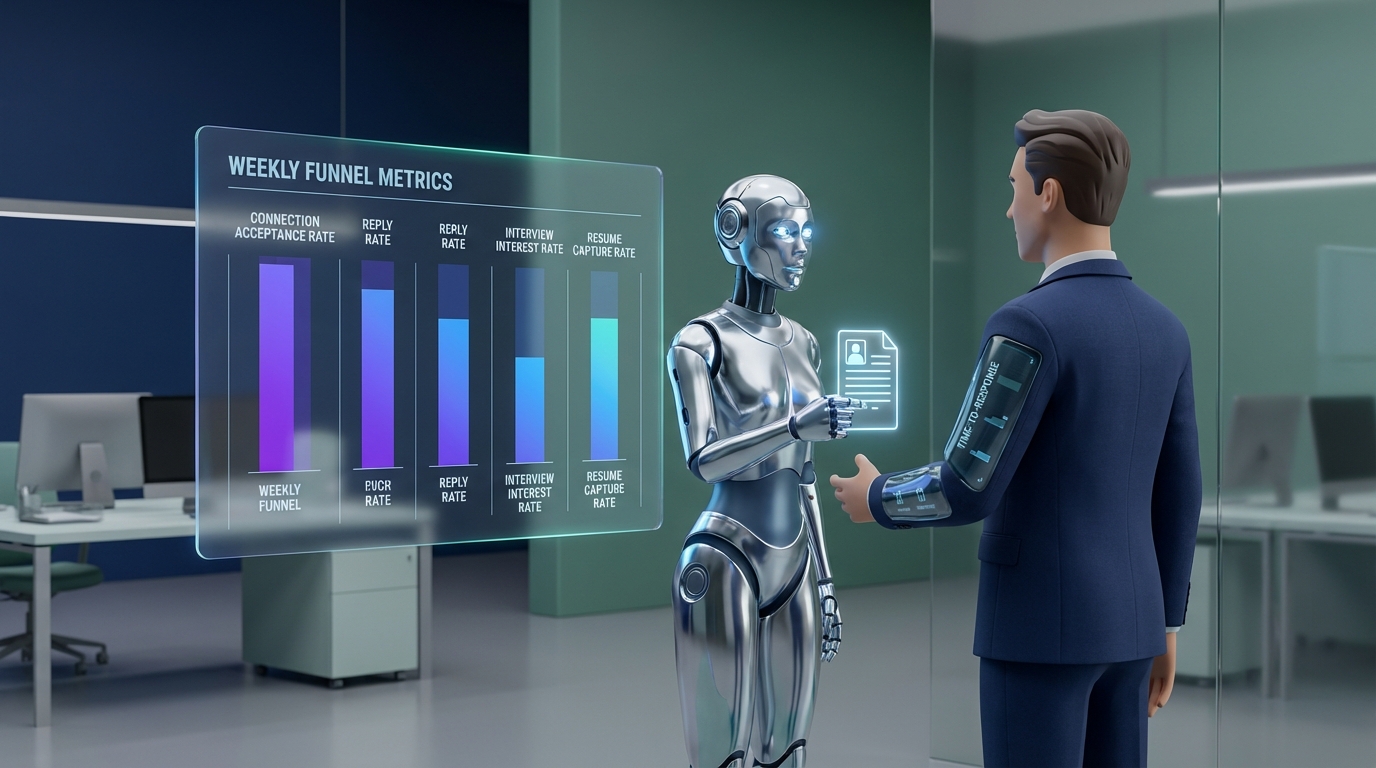
- Monitor the funnel weekly: acceptance rate, reply rate, interview interest rate, and resume capture rate.
- Hand off at the right moment: recruiters review collected resumes and contact details, then schedule interviews for shortlisted candidates.
LinkedIn funnel metrics to monitor
- Connection acceptance rate (percent): accepted connections divided by connection requests sent.
- Reply rate (percent): candidates who reply divided by accepted connections.
- Interview interest rate (percent): candidates who confirm interest divided by candidates who reply.
- Resume capture rate (percent): resumes received divided by candidates who confirm interest.
- Median response time (hours): median hours from candidate message to your first response. With AI Recruiter, this can be monitored as near real time responsiveness.
Where authenticity fits in this workflow
Authenticity shows up in the questions candidates ask and the constraints they disclose. When AI Recruiter consistently answers role and compensation questions and confirms interest, you get cleaner monitoring data: you can see which role previews create genuine engagement and which ones create confusion or drop off.
Limitations
- AI Recruiter does not decide final qualification. Recruiters still review resumes and make hiring decisions.
- Any automation requires clear role information. If your role scope is vague, monitoring will show noise rather than insight.
Best For
- Teams that rely heavily on LinkedIn sourcing and need consistent follow up.
- Global hiring where multilingual communication reduces misunderstandings.
- Organizations managing multiple LinkedIn accounts and wanting a scalable outreach process.
Quick Comparison
| Method | What you monitor | Primary metric units | Best for |
|---|---|---|---|
| Interview scorecard (AMF) | Motivation clarity and alignment evidence | 1 to 5 scores | Improving interview consistency |
| Process metrics dashboard | Speed, acceptance, and early retention | Hours, days, percent | Diagnosing funnel friction |
| LinkedIn funnel monitoring with StrategyBrain AI Recruiter | Outreach, replies, interest, resume capture | Percent, hours | Scaling sourcing with consistent communication |
FAQ
What is recruitment monitoring in plain language?
Recruitment monitoring means tracking what happens in your hiring process using defined metrics, then using those results to improve decisions and candidate experience. It is the difference between “we think interviews went well” and “we can prove which interview behaviors predict acceptance and retention.”
Which HR hiring metrics should I start with if I have no dashboard?
Start with time to first response in hours, time to schedule in hours, offer acceptance rate in percent, and 90 day retention in percent. These four metrics are simple to collect and quickly reveal where candidates disengage.
How do you measure authenticity without bias?
Use a rubric that scores evidence, not personality. For example, score “motivation specificity” based on concrete reasons and examples, and require interviewers to write the evidence they heard. Then calibrate scoring weekly to reduce individual bias.
What are key recruitment metrics for LinkedIn sourcing?
Monitor connection acceptance rate, reply rate, interview interest rate, resume capture rate, and median response time in hours. These metrics show whether your outreach and role preview are creating real engagement.
How does StrategyBrain AI Recruiter support recruitment monitoring?
StrategyBrain AI Recruiter automates LinkedIn outreach, follow up, and candidate Q and A while collecting resumes and contact details from interested candidates. Because communication is consistent and always on, your funnel metrics become easier to track and compare across roles and regions.
Does AI Recruiter replace recruiters?
No. AI Recruiter automates repetitive early stage tasks such as connecting, introducing roles, answering common questions, confirming interest, and collecting resumes. Recruiters still review resumes, assess fit, and run interviews.
What is a realistic monitoring cadence for a small team?
Review speed and funnel metrics weekly for 30 minutes, and review acceptance and retention signals monthly for 60 minutes. This cadence is enough to catch process drift without creating reporting fatigue.
What is the biggest mistake teams make with recruitment monitoring?
They optimize for speed alone. If you reduce time to hire but increase early turnover, you have not improved hiring. Pair speed metrics with quality signals such as 90 day retention and structured interview evidence.
How do I connect interview notes to outcomes?
Use a consistent scorecard and require evidence notes, then link those notes to outcomes such as offer decline reasons and 90 day retention. Review mismatches within 7 days of a decline so the learning is still fresh.
Conclusion
Recruitment monitoring works best when it turns human advice into measurable signals. Jessica Miles’s point about being genuine in interviews becomes far more useful when you track motivation clarity, expectation alignment, and follow through as repeatable HR hiring metrics. Start with a scorecard, add a small set of key recruitment metrics, and review them on a fixed cadence. If LinkedIn sourcing is a major channel, StrategyBrain AI Recruiter can help you keep outreach and follow up consistent while capturing resumes and contact details for interested candidates, which makes your monitoring data cleaner and easier to act on.
Next step: copy the scorecard template above, run it for your next 10 interviews, and schedule a 30 minute weekly review to compare scores to outcomes like offer acceptance and declines.