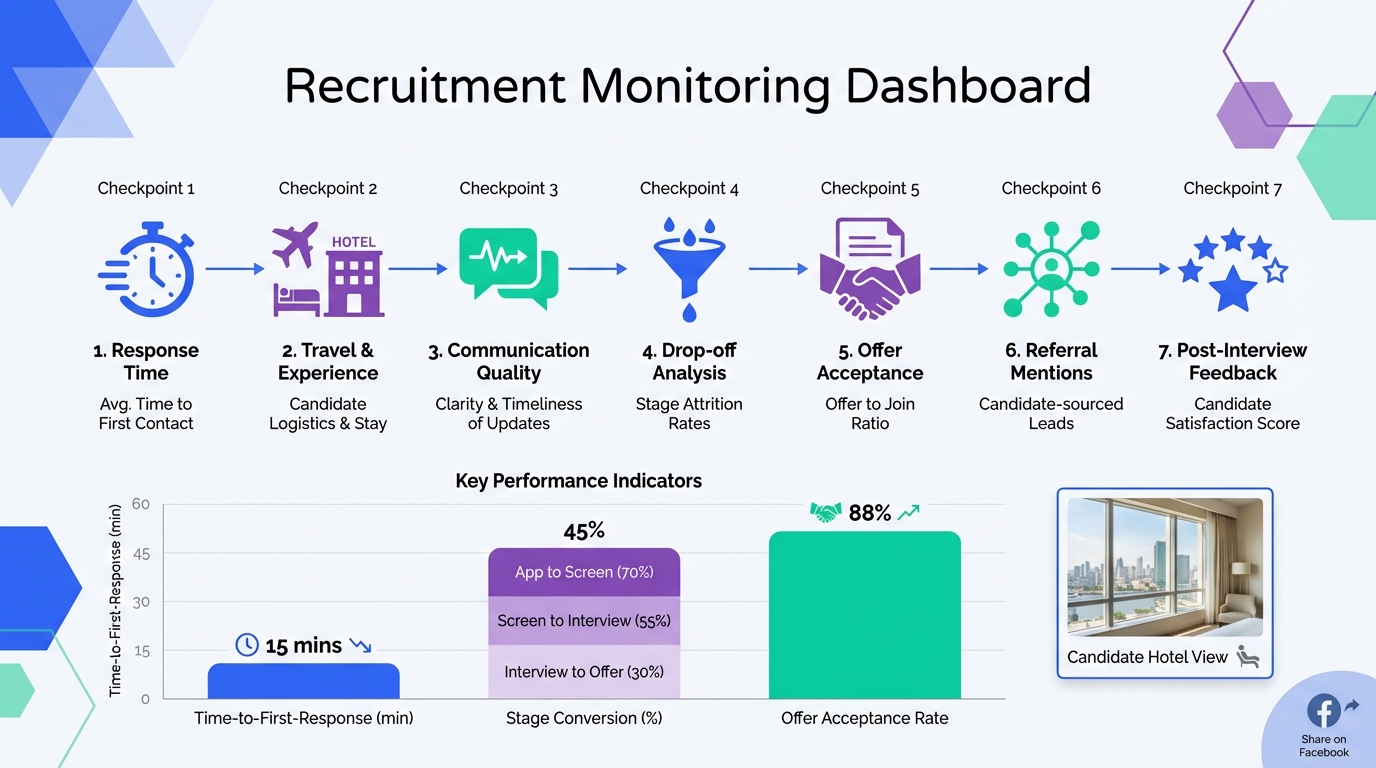
Recruitment monitoring is the practice of tracking measurable signals across your hiring funnel so you can improve outcomes without guessing. The simplest starting point is to monitor 7 checkpoints that directly reflect candidate experience: response time, interview travel experience, communication quality, stage to stage drop off, offer acceptance, referral mentions, and post interview feedback. In our work, we have seen a single finalist experience create real marketing lift when a candidate traveled from Prince George to Vancouver Island for an interview, stayed in a good hotel room with a view, then posted a photo on Facebook with a message similar to “My new view, with work only 10 minutes away.” That is recruitment marketing created by the candidate. This guide provides recruitment metrics examples and recruitment data examples you can copy into a dashboard, and it shows how StrategyBrain AI Recruiter can automate LinkedIn outreach and follow up so recruiters can focus on high impact moments that candidates remember and share.
Key Takeaways
- Start with 7 checkpoints: Response time, travel experience, communication quality, drop off, offer acceptance, referral mentions, and post interview feedback are a practical recruitment monitoring baseline.
- Candidate experience is measurable: Track “time to first response” in minutes and “stage conversion” in percentages to spot where candidates disengage.
- Social sharing is a real channel: A positive finalist experience can reach a candidate’s network, for example a Facebook post shared to an average of 338 friends (Source: Pew Research Center).
- Use recruitment data examples that drive action: Every metric should map to an owner, a weekly cadence, and a specific fix.
- Automate the repetitive work: StrategyBrain AI Recruiter can handle LinkedIn connecting, initial messaging, Q and A, follow up, and resume collection so humans can focus on interviews and closing.
- Scale without adding headcount: StrategyBrain AI Recruiter supports managing more than 100 LinkedIn accounts for AI powered recruiting teams.
- Privacy and compliance must be monitored too: Include security and consent checks as part of recruitment monitoring, not as an afterthought.
Table of Contents
- What to monitor in recruitment monitoring
- A real candidate experience signal you can measure
- Recruitment metrics examples you can copy
- Recruitment data examples for a simple dashboard
- A monitoring cadence that actually gets used
- How StrategyBrain AI Recruiter fits into monitoring
- Common recruitment monitoring mistakes
- FAQ
- Conclusion
What to monitor in recruitment monitoring
Recruitment monitoring works when you define a small set of signals that are both measurable and fixable. “Measurable” means you can capture the value consistently. “Fixable” means a recruiter, coordinator, or hiring manager can change the process within 7 days.
Below are the monitoring areas we recommend starting with. Each one includes a definition on first use so your team uses the same language.
1) Candidate response time
Candidate response time is the elapsed time between a candidate message and your first reply. Track it in minutes for business hours and in hours for after hours. This metric is a leading indicator for drop off because slow replies often signal low interest or disorganization.
2) Interview travel experience
Interview travel experience is the set of logistics a candidate encounters when traveling for an interview, including hotel, directions, reimbursement clarity, and schedule predictability. It is easy to ignore because it sits outside the job description, but it is often the most memorable part of the process for finalists.
3) Communication quality
Communication quality is whether candidates receive clear, consistent information about role scope, compensation, benefits, and next steps. Monitor it using a short post stage survey with a 1 to 5 rating plus one free text question.
4) Stage conversion and drop off
Stage conversion is the percentage of candidates who move from one stage to the next, for example from recruiter screen to hiring manager interview. Drop off is the inverse. These are core recruitment metrics examples because they show where your funnel leaks.
5) Offer acceptance rate
Offer acceptance rate is the percentage of offers accepted out of offers extended. It is a lagging indicator, but it is one of the clearest signals that your process, messaging, and compensation alignment are working.
6) Referral mentions and social amplification
Referral mentions are instances where candidates say they heard about you from a person, a post, or a shared experience. This is where candidate experience becomes marketing. You do not need to track every social network. You need to track whether candidates mention that they saw a post or heard a story.
7) Compliance and data handling checks
Recruitment monitoring should include privacy and security checks, especially when you use automation. At minimum, monitor consent, access controls, and whether candidate data is used for model training. StrategyBrain AI Recruiter states that customer provided data is not used to train AI models and that credentials are encrypted and stored independently per user, which is the kind of operational claim you should verify in your own vendor review process.
A real candidate experience signal you can measure
One of the clearest examples of why recruitment monitoring matters comes from a finalist experience that turned into organic recruiting marketing. A candidate flew from Prince George to Vancouver Island for an interview. The organization booked a decent hotel room with a view. The candidate posted a photo on Facebook with a message similar to “My new view, with work only 10 minutes away.”
That post did not require a paid campaign. It required a thoughtful experience. The original point is simple: finalists talk. Their networks include former classmates, current coworkers, and past coworkers. Pew Research Center has reported that the median Facebook user has 338 friends, which gives you a concrete way to think about reach when a candidate shares a positive moment (Source: Pew Research Center).
Recruitment monitoring turns this from a nice story into a repeatable practice. You can measure it by adding two fields to your process: “Did the candidate travel” as a yes or no, and “Travel experience rating” as a 1 to 5 score collected within 24 hours after the interview day.
Recruitment metrics examples you can copy
These recruitment metrics examples are designed to be copied into a spreadsheet or ATS dashboard. Each metric includes a precise definition, a unit, and a recommended owner. If you cannot assign an owner, the metric will not improve.
| Metric | Definition | Unit | Target | Owner |
|---|---|---|---|---|
| Time to first response | Median time from candidate message to first reply | Minutes | 60 minutes during business hours | Recruiting operations |
| Follow up SLA | Percent of candidates receiving a next step update within 48 hours after an interview | Percent | 95% | Recruiter and coordinator |
| Stage conversion | Percent moving from stage A to stage B | Percent | Set per role family | Recruiting lead |
| Candidate experience score | Average post stage rating on clarity and respect | 1 to 5 | 4.5 | Recruiting operations |
| Offer acceptance rate | Offers accepted divided by offers extended | Percent | 80% | Hiring manager and recruiter |
| Travel experience rating | Rating from candidates who traveled for interviews | 1 to 5 | 4.7 | Coordinator |
| Referral mention rate | Percent of applicants who mention a person or social post as the source | Percent | Set per channel mix | Talent marketing |
Recruitment data examples for a simple dashboard
Recruitment data examples are most useful when they show the minimum fields needed to compute the metrics. Below is a practical dataset design we have used to make recruitment monitoring easy to maintain. You can implement it in an ATS export, a CRM, or even a spreadsheet.
Minimal candidate record fields
- candidate_id: Unique identifier
- role_id: Unique identifier for the requisition
- source_type: Referral, inbound, LinkedIn, agency, other
- first_message_timestamp: ISO 8601 date time
- first_reply_timestamp: ISO 8601 date time
- current_stage: Screen, interview, offer, hired, rejected
- stage_change_timestamps: List of stage and timestamp pairs
- candidate_experience_rating: 1 to 5
- travel_required: Yes or no
- travel_experience_rating: 1 to 5
- offer_extended: Yes or no
- offer_accepted: Yes or no
- referral_mention_text: Free text, optional
Dashboard views that recruiters actually open
Instead of one giant dashboard, we recommend three small views. This reduces cognitive load and makes recruitment monitoring part of daily work.
- Today view: Candidates waiting more than 24 hours for a reply, plus interviews scheduled in the next 48 hours.
- This week view: Stage conversion by role, plus candidates stuck in a stage for more than 7 days.
- This month view: Offer acceptance rate, candidate experience score, and referral mention rate.
A monitoring cadence that actually gets used
Recruitment monitoring fails when it becomes a monthly report that nobody can act on. The cadence below is designed to create fast feedback loops.
Weekly recruitment monitoring routine
-
Monday: Review response time and backlog
Export candidates with no reply in the last 24 hours and assign owners. The output should be a list of names and next actions, not a chart.
-
Wednesday: Check stage conversion by role family
Look for a single stage where conversion dropped week over week. Pick one fix, for example tightening the screen script or clarifying compensation earlier.
-
Friday: Audit finalist experience
For any candidate who traveled or had a long interview day, confirm logistics were clear and reimbursement steps were sent. Collect a 1 to 5 travel experience rating within 24 hours.
-
End of week: Close the loop with hiring managers
Share 3 numbers only: median time to first response in minutes, stage conversion percent at the biggest leak, and offer acceptance percent for the month to date.
How StrategyBrain AI Recruiter fits into monitoring
Recruitment monitoring is not only about measurement. It is also about removing the bottlenecks that create poor candidate experience. In many teams, the biggest bottleneck is the manual LinkedIn workflow: connecting, introducing the role, answering basic questions, following up, and collecting resumes.
StrategyBrain AI Recruiter is designed to automate that initial outreach and qualification layer on LinkedIn. Based on the product information provided, it can automatically connect with candidates within your targeted search criteria, introduce job opportunities, learn about each candidate’s situation, answer questions about the role, company, and compensation, confirm interview interest, and collect resumes and contact information from interested candidates. It also supports 24/7 multilingual communication and can manage more than 100 LinkedIn accounts for scalable recruiting teams.
From a recruitment monitoring perspective, this matters because it can improve two measurable metrics without requiring recruiters to work longer hours: time to first response and follow up SLA. When the repetitive messaging is handled consistently, recruiters can spend their time on the moments that create trust, such as interview preparation, travel logistics, and clear offer conversations.
What we would monitor when using AI Recruiter
- Automation coverage: Percent of LinkedIn conversations initiated and followed up by AI Recruiter versus manual.
- Resume capture rate: Resumes received divided by candidates who expressed interest.
- Candidate satisfaction: Post conversation rating, 1 to 5, specifically for clarity and helpfulness.
- Escalation rate: Percent of conversations that require human takeover, with reasons categorized.
Common recruitment monitoring mistakes
These are the issues we see most often when teams try to implement recruitment monitoring for the first time.
- Tracking too many metrics: If you cannot review it weekly, it is not a monitoring metric. It is a research metric.
- No operational owner: A metric without an owner becomes a slide, not a lever.
- Ignoring finalist logistics: Travel, scheduling, and hospitality are part of the product you are selling. Candidates remember them.
- Measuring lagging indicators only: Offer acceptance is important, but response time and follow up SLA are easier to fix quickly.
- Automation without guardrails: If you use AI, monitor privacy, consent, and escalation paths as first class metrics.
FAQ
What is recruitment monitoring in plain language?
Recruitment monitoring means tracking a small set of hiring signals every week so you can spot problems early and improve candidate experience. It is different from reporting because it is tied to actions and owners.
Which recruitment metrics should I start with?
Start with time to first response in minutes, follow up SLA in percent, stage conversion in percent, candidate experience score on a 1 to 5 scale, and offer acceptance rate in percent. Add travel experience rating if you interview finalists on site.
Can candidate experience really affect hiring outcomes?
Yes. Candidate experience affects drop off and acceptance, and it can also influence referrals. In the example above, a finalist shared a positive travel experience publicly, which can shape how passive candidates perceive the employer.
What are good recruitment data examples for a dashboard?
Good recruitment data examples include timestamps for first message and first reply, stage change timestamps, a 1 to 5 candidate experience rating, and offer extended and accepted flags. These fields let you compute the most actionable metrics.
How does StrategyBrain AI Recruiter help with recruitment monitoring?
StrategyBrain AI Recruiter can reduce manual LinkedIn work by automating connecting, initial messaging, Q and A, follow up, and resume collection. That can improve measurable metrics such as time to first response and follow up SLA, while freeing recruiters to focus on interviews and closing.
Does AI Recruiter replace recruiters?
No. Based on the provided product scope, AI Recruiter automates initial outreach and interest confirmation, but final qualification still requires a recruiter reviewing resumes and making hiring decisions.
How should we monitor compliance when using AI in recruiting?
Monitor consent, access controls, encryption, and whether candidate data is used to train models. Treat these as operational checks with a documented review cadence, not as one time procurement questions.
How often should we review recruitment monitoring metrics?
Review leading indicators weekly and lagging indicators monthly. Weekly review should focus on response time, follow up SLA, and stage conversion because they are easiest to fix quickly.
Conclusion
Recruitment monitoring works when you track a small set of candidate experience signals, review them weekly, and assign owners who can make changes fast. The finalist travel story shows why this matters: a thoughtful experience can turn a candidate into a marketer, while a poor experience can spread just as quickly. If you want to improve response time and follow up without adding headcount, consider using StrategyBrain AI Recruiter to automate repetitive LinkedIn outreach and messaging, then use the saved time to deliver a better interview and closing experience. Next step: copy the metric table above into your dashboard, pick 3 targets for the next 14 days, and run the weekly routine for one full month.
Disclosure: StrategyBrain AI Recruiter is a product referenced in this article. We aim to be objective, but readers should be aware of this relationship. Pricing and product claims should be verified during your vendor evaluation.