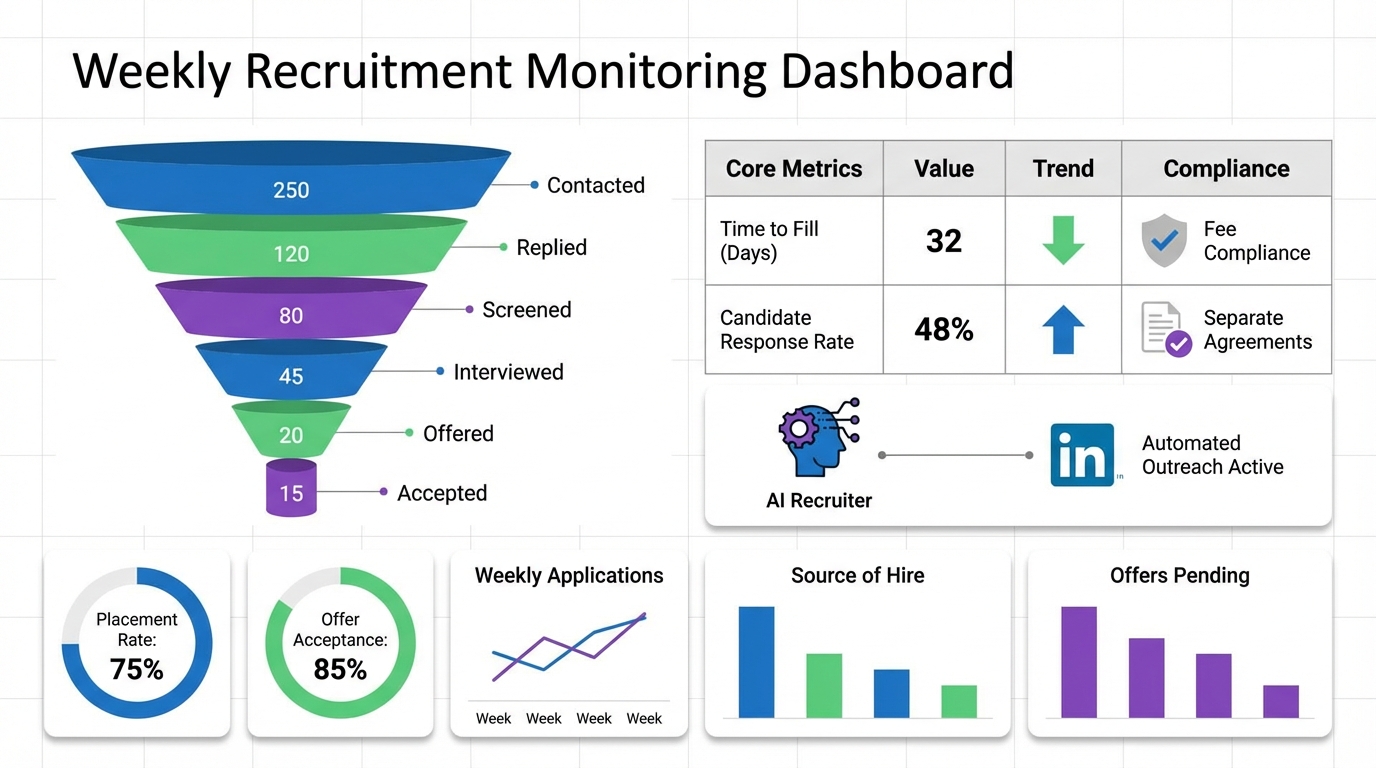
Recruitment monitoring is the day to day discipline of tracking hiring activity, compliance, and outcomes using recruitment metrics such as time to fill, source of hire, and candidate response rate. In Canada, effective recruitment monitoring also includes fee compliance, because recruitment agencies can charge employers for services delivered, but they generally cannot demand or collect a fee from a person they are helping to find work. This guide explains what is chargeable and what is prohibited, how to separate employment agency work from immigration representation, and how to set up a monitoring scorecard you can run weekly. Where LinkedIn outreach is part of your funnel, StrategyBrain AI Recruiter can automate connecting, role introduction, Q and A, follow up, and résumé and contact capture so your monitoring data stays consistent across time zones and languages.
Table of Contents
- What recruitment monitoring means in practice
- What recruitment agencies do in Canada
- Agency fees in Canada: chargeable vs prohibited
- Recruitment agencies vs immigration representatives
- A practical recruitment monitoring framework
- Monitoring LinkedIn outreach with StrategyBrain AI Recruiter
- Quick comparison: monitoring focus by hiring channel
- FAQ
- Conclusion
Key Takeaways
- Recruitment monitoring combines compliance checks and recruitment metrics so you can spot issues early and improve hiring outcomes.
- Canada fee rule baseline: agencies can charge employers for delivered services, but cannot demand or collect a fee from someone they are helping to find work.
- Candidate paid services can be chargeable only when they are not directly related to recruitment and are covered by a separate written agreement that quotes the fee.
- Immigration representatives and employment agencies are not the same role, so your monitoring should track which party is responsible for which step.
- Hiring metrics examples that work weekly: time to fill in days, response rate in percent, and résumé capture rate in percent.
- StrategyBrain AI Recruiter can automate LinkedIn outreach and follow up, collect résumés and contact details, and support multilingual messaging for consistent monitoring.
What recruitment monitoring means in practice
When I audit a hiring process, I treat recruitment monitoring as two parallel tracks. The first track is compliance, which answers whether the process is lawful and aligned with policy. The second track is performance, which answers whether the process is producing qualified candidates at a sustainable cost and speed.
In practical terms, recruitment monitoring is a weekly routine. You review a small set of recruitment metrics, compare them to targets, and then decide what to change in sourcing, outreach, screening, or agency management.
Definitions used in this guide
- Recruitment metrics: measurable indicators of hiring activity and outcomes, such as time to fill in days or candidate response rate in percent.
- Time to fill: the number of calendar days from requisition approval to accepted offer.
- Source of hire: the channel that produced the accepted candidate, such as agency, referral, or LinkedIn outreach.
What recruitment agencies do in Canada
Recruitment agencies can play different roles depending on the country, so it helps to be explicit in your monitoring plan. In Canada, the source material describes three common purposes for employment and recruitment agencies.
- Assist employers with recruiting employees for open jobs.
- Match job seekers to employer positions.
- Test or evaluate job related skills on behalf of companies.
From a recruitment monitoring perspective, each purpose implies different metrics. For example, skills testing should be monitored with pass rates and turnaround time, while matching should be monitored with shortlist quality and interview to offer conversion.
Agency fees in Canada: chargeable vs prohibited
Fee compliance is not a side note. It is a core part of recruitment monitoring because it affects candidate trust, employer risk, and the integrity of your hiring funnel.
Chargeable fees
- Recruitment agencies in Canada are allowed to charge employers for services delivered.
- Recruiters can charge job seekers for certain services when those services are not directly related to recruitment, such as resume preparation or job skills training, and a separate written agreement exists that quotes the fee.
- The fee must not be charged as a condition to help the individual find work.
Prohibited fees
- A recruitment agency cannot demand or collect a fee from someone it is helping to find work.
- An agency is prohibited from demanding or holding a deposit or bond from the employee, even if there is a promise to refund the fee.
- The recruiting agency cannot direct the employer to recover the costs of agency services from the employee.
How to monitor fee compliance without slowing hiring
I recommend a simple control that takes less than 10 minutes per week per agency. Ask for a written statement of what is billed to the employer, and confirm that candidates are not being charged for placement. If the agency offers candidate paid services like resume writing, confirm there is a separate written agreement and that it is not tied to placement support.
Recruitment agencies vs immigration representatives
The source material highlights a common confusion. An immigration representative is hired by a foreign employee to conduct business on their behalf with bodies such as the Refugee Board, the Canada Border Services Agency, or Citizenship and Immigration Canada. An employment agency cannot negotiate with those bodies on behalf of a worker.
At the same time, immigration representatives have no authority to assist a person to secure work in Canada. For recruitment monitoring, this matters because you should track which party is responsible for which deliverable. If you mix responsibilities, you can end up measuring the wrong outcomes and missing compliance gaps.
A practical recruitment monitoring framework
This section is designed to be copy and paste ready. It is a monitoring framework you can run for agency hiring, direct hiring, and LinkedIn sourcing.
Step by step: set up a weekly monitoring scorecard
- Define your funnel stages
Use consistent stages across channels, such as contacted, replied, screened, interviewed, offered, accepted. Consistency is what makes recruitment metrics comparable.
- Pick 7 core recruitment metrics
Choose metrics you can compute every week. If a metric cannot be updated weekly, it is usually not a monitoring metric.
- Time to fill in days
- Time to first response in hours
- Candidate response rate in percent
- Screen to interview conversion in percent
- Interview to offer conversion in percent
- Offer acceptance rate in percent
- Source of hire as a count per channel
- Add 3 compliance checks
These checks keep you aligned with the Canada fee rules described earlier.
- Candidate fee check: confirm no placement fee is charged to job seekers.
- Separate agreement check: if candidate paid services exist, confirm a separate written agreement that quotes the fee.
- Deposit or bond check: confirm no deposit or bond is demanded or held from employees.
- Set thresholds and actions
Monitoring only works if each metric has a trigger and a response. Example triggers are listed below.
- If response rate drops below your baseline for 2 consecutive weeks, revise outreach messaging and targeting.
- If time to first response increases week over week, add follow up cadence or automation.
- If interview to offer conversion falls, review screening criteria and interviewer calibration.
- Review weekly and document changes
Write down what you changed and when. Without this, you cannot attribute improvements or regressions to specific actions.
Hiring metrics examples: a simple scorecard template
| Metric | Unit | Weekly target | Owner |
|---|---|---|---|
| Time to fill | Days | Set per role family | Recruiting lead |
| Time to first response | Hours | Set per channel | Sourcer |
| Candidate response rate | Percent | Set per channel | Sourcer |
| Screen to interview conversion | Percent | Set per role | Recruiter |
| Interview to offer conversion | Percent | Set per role | Hiring manager |
| Offer acceptance rate | Percent | Set per level | Recruiter |
| Source of hire | Count | Balanced mix | Recruiting ops |
Monitoring LinkedIn outreach with StrategyBrain AI Recruiter
LinkedIn outreach is often where monitoring breaks down, because recruiters cannot consistently follow up across time zones, and manual messaging creates uneven data. In our experience, the fastest way to stabilize recruitment monitoring on LinkedIn is to standardize outreach and follow up so your recruitment metrics reflect the market, not the variability of individual inbox habits.
StrategyBrain AI Recruiter is built for this workflow. It can automatically connect with candidates that match your search criteria, introduce the role, learn about the candidate’s situation, answer questions about the role, company, and compensation, confirm interview interest, and collect résumés and contact information from interested candidates. It also supports 24 by 7 multilingual communication, which helps keep time to first response in hours consistent even when your team is offline.
What to monitor when AI Recruiter runs the first touch
- Connection acceptance rate in percent, by search segment.
- Reply rate in percent, by message sequence.
- Résumé capture rate in percent, defined as résumés received divided by interested candidates.
- Contact detail capture rate in percent, defined as contact details captured divided by interested candidates.
- Follow up latency in hours, defined as time between candidate message and first response.
Known limitation and how to monitor around it
AI Recruiter can identify willingness to communicate or interview, but it does not determine whether a résumé fully matches job requirements. Your monitoring should reflect that division of labor. Track AI stage outcomes such as response and résumé capture, then track recruiter stage outcomes such as shortlist quality and interview conversion after human review.
Quick comparison: monitoring focus by hiring channel
| Channel | Primary monitoring focus | Typical risk to watch | Best weekly metric |
|---|---|---|---|
| Recruitment agency | Fee compliance and shortlist quality | Candidate fee violations and unclear deliverables | Interview to offer conversion percent |
| Direct applicants | Screening speed and candidate experience | Backlog and slow response | Time to first response hours |
| LinkedIn outreach with AI Recruiter | Consistency of outreach, follow up, and capture | Message fatigue and targeting drift | Reply rate percent |
FAQ
What is recruitment monitoring?
Recruitment monitoring is the ongoing tracking of hiring activity, compliance, and outcomes using recruitment metrics. It is typically run weekly so teams can adjust sourcing, outreach, and screening before problems become quarter long delays.
What recruitment metrics should I start with?
If you need a minimal set, start with time to fill in days, time to first response in hours, candidate response rate in percent, and offer acceptance rate in percent. These four metrics usually reveal where the funnel is slowing down.
Can recruitment agencies charge job seekers in Canada?
An agency cannot demand or collect a fee from someone it is helping to find work. The source material also notes that recruiters can charge for certain services that are not directly related to recruitment, such as resume preparation, when there is a separate written agreement that quotes the fee and it is not a condition of helping the person find work.
What fees are prohibited for agencies?
The source material lists three prohibited practices: charging a person being helped to find work, demanding or holding a deposit or bond from the employee even with a refund promise, and directing the employer to recover agency costs from the employee.
How do I monitor an agency relationship without micromanaging?
Use a weekly scorecard with 5 to 7 recruitment metrics and 2 to 3 compliance checks. Ask for clarity on deliverables, confirm fee compliance, and focus on conversion metrics such as interview to offer percent rather than activity counts.
What is the difference between a recruitment agency and an immigration representative?
An immigration representative is hired to conduct business with immigration related bodies on behalf of a foreign employee, while an employment agency cannot negotiate with those bodies on behalf of a worker. The source material also states that immigration representatives have no authority to assist a person to secure work in Canada.
How does StrategyBrain AI Recruiter support recruitment monitoring?
StrategyBrain AI Recruiter standardizes LinkedIn outreach and follow up by automatically connecting, introducing roles, answering questions, and collecting résumés and contact details. This consistency makes recruitment metrics like reply rate percent and follow up latency hours easier to monitor and improve.
Does AI Recruiter replace recruiter screening?
No. AI Recruiter can confirm willingness to communicate or interview, but it does not judge whether a résumé fully matches job requirements. Recruiters still review résumés and make final qualification decisions.
Conclusion
Recruitment monitoring works when it covers both performance and compliance. In Canada, that means you monitor recruitment metrics like time to fill and response rate, and you also monitor agency fee practices so candidates are not charged for placement and prohibited deposits are not used. If LinkedIn outreach is a major source, standardizing first touch and follow up can make your monitoring data far more reliable. A practical next step is to implement the weekly scorecard in this guide, then pilot StrategyBrain AI Recruiter for one role family so you can track reply rate, résumé capture, and follow up latency with consistent execution.