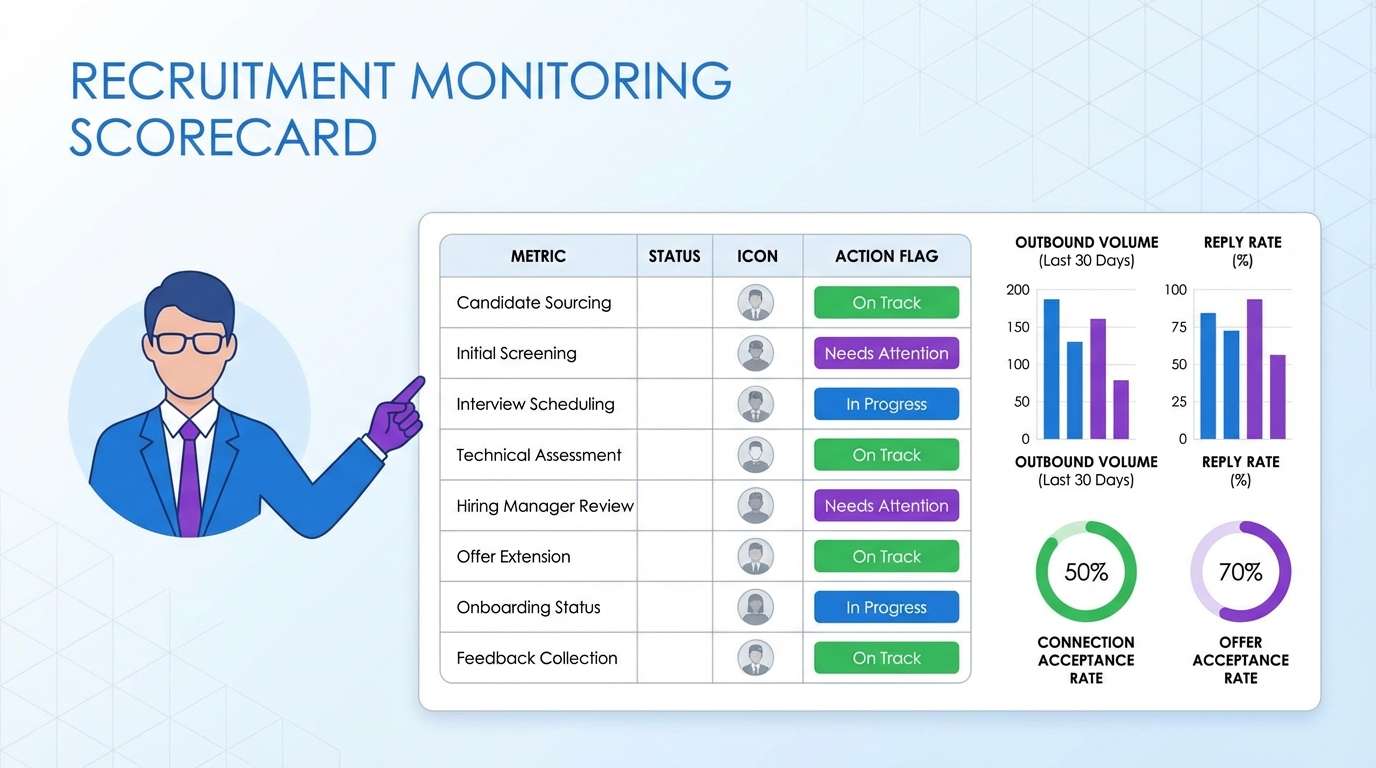
Recruitment monitoring is the practice of tracking hiring activity and outcomes with a consistent set of hiring metrics so you can spot bottlenecks, improve candidate experience, and forecast hiring capacity. The most reliable approach is to define a small scorecard of key recruitment metrics, set weekly review rules, and connect each metric to a decision such as adjusting sourcing, improving outreach, or speeding up interviews. In this guide, we translate a real recruiter advice story into a practical monitoring system, including hiring metrics examples, a ready to copy scorecard, and a workflow that pairs human judgment with StrategyBrain AI Recruiter for LinkedIn outreach, follow up, and résumé collection. Scope note: this article focuses on monitoring and operational control of recruiting, not compensation benchmarking or performance management after hire.
Table of Contents
- What recruitment monitoring means in practice
- The story we used as a monitoring case study
- Key Takeaways
- The recruitment monitoring scorecard (copy and use)
- Weekly monitoring cadence: what to review and what to change
- Where StrategyBrain AI Recruiter fits in the monitoring loop
- Hiring metrics examples with targets and actions
- Common recruitment monitoring failures and fixes
- FAQ
- Conclusion
What recruitment monitoring means in practice
Recruitment monitoring is not a one time report. It is an operating system for hiring. You choose a small set of metrics, define how they are calculated, and review them on a fixed schedule so the team can make decisions quickly.
To keep terms precise, here are the definitions used in this article.
- Metric: a measured value with a unit and a formula, such as days, percent, or count.
- Funnel: the sequence from sourced candidates to contacted, replied, screened, interviewed, offered, and hired.
- Leading indicator: a metric that changes before outcomes change, such as reply rate.
- Lagging indicator: a metric that confirms outcomes, such as offer acceptance rate.
Good recruitment monitoring links every metric to a decision. If a metric moves, the team knows what lever to pull.
The story we used as a monitoring case study
The source material we were given is a recruiter advice post titled “Ask A Recruiter: How to Get Promoted.” It features an employee who has been in a role for 18 months, has strong performance reviews, and wants to understand how to earn a promotion. The advice is attributed to Danielle Bragge, described as a partner and co founder with 25 years in the recruitment industry across South Africa and Canada, and a career development coach who has trained and developed staff for over 20 years.
Although the topic is promotion, the underlying management principles map directly to recruitment monitoring. The post emphasizes behaviors that are observable and repeatable, such as communication quality, avoiding gossip, and consistent effort. In hiring, we monitor the observable behaviors of the recruiting system in the same way, using metrics that reveal whether the process is healthy.
Key Takeaways
- Start with 8 to 12 key recruitment metrics: fewer metrics improves decision speed and reduces reporting noise.
- Use a weekly cadence: review leading indicators every 7 days so you can fix pipeline issues before offers slip.
- Define formulas in writing: recruitment monitoring fails when teams calculate “time to fill” differently across roles.
- Pair metrics with actions: each metric should have a trigger and a next step, not just a number.
- Automate outreach and follow up where it is safe: StrategyBrain AI Recruiter can handle LinkedIn connecting, messaging, and résumé collection so humans focus on final qualification.
- Track candidate experience signals: response time in hours and drop off rates often predict offer declines.
The recruitment monitoring scorecard (copy and use)
This scorecard is designed for weekly review. It includes a formula, unit, and the decision it supports. You can paste it into a spreadsheet or a dashboard tool.
| Metric | Definition and formula | Unit | Why it matters | Action when it drops |
|---|---|---|---|---|
| Outbound volume | Number of first messages sent to new candidates in 7 days | count per 7 days | Controls top of funnel capacity | Increase sourcing time or add automation for outreach |
| Connection acceptance rate | (Connections accepted ÷ connection requests sent) × 100 | percent | Signals targeting and profile credibility | Tighten search criteria and rewrite the connect note |
| Reply rate | (Candidates who reply ÷ candidates contacted) × 100 | percent | Leading indicator for pipeline health | Test message copy and improve role clarity |
| Median first response time | Median hours from candidate message to first recruiter response | hours | Candidate experience and conversion | Use 24/7 coverage or automated responses for FAQs |
| Screen to interview conversion | (Candidates scheduled for interview ÷ candidates screened) × 100 | percent | Quality of screening and role alignment | Adjust screening questions and clarify must haves |
| Interview to offer conversion | (Offers made ÷ candidates interviewed) × 100 | percent | Hiring manager calibration | Run a calibration session and tighten scorecards |
| Offer acceptance rate | (Offers accepted ÷ offers made) × 100 | percent | Compensation fit and candidate experience | Improve expectation setting and speed up approvals |
| Time to fill | Calendar days from requisition open date to accepted offer date | days | Outcome metric for planning | Diagnose the slowest stage using stage time metrics |
Weekly monitoring cadence: what to review and what to change
Recruitment monitoring works when the review is short, consistent, and tied to decisions. We recommend a 30 minute weekly review for each hiring pod, plus a monthly leadership review for capacity planning.
Weekly review agenda (30 minutes)
- Check leading indicators: outbound volume, acceptance rate, reply rate, and median first response time.
- Find the bottleneck stage: identify the stage with the largest week over week drop in conversion.
- Pick 1 experiment: change one variable only, such as message copy, targeting, or interview scheduling.
- Assign owners: one person owns the experiment and one person owns data integrity.
- Document decisions: write what changed and the expected metric movement in 7 days.
Monthly review agenda (45 minutes)
- Capacity: hires per recruiter per month and open requisitions per recruiter.
- Quality signals: interview to offer conversion and offer acceptance rate by role family.
- Process debt: stages with repeated delays, such as feedback turnaround time.
Where StrategyBrain AI Recruiter fits in the monitoring loop
In the promotion advice story, one theme is consistency. In recruiting, consistency often breaks first in outreach and follow up because it is repetitive and time sensitive. This is where StrategyBrain AI Recruiter can support recruitment monitoring without replacing human judgment.
Based on our product documentation, StrategyBrain AI Recruiter is built for LinkedIn hiring automation. It can automatically connect with candidates that match your search criteria, introduce the opportunity, answer common questions about the role and company, confirm interview interest, and collect résumés and contact details from interested candidates. It also supports 24/7 multilingual communication and can be managed across more than 100 LinkedIn accounts for scalable hiring teams.
From a monitoring perspective, this matters because it stabilizes leading indicators. When outreach volume and response time become predictable, your dashboard becomes more actionable. Recruiters can then focus on the final qualification step, which the product explicitly does not automate.
A practical monitoring workflow using AI Recruiter
- Define the role packet: company details, compensation, benefits, and candidate search criteria.
- Run automated outreach: AI Recruiter sends connection requests and initial messages on LinkedIn.
- Monitor early funnel metrics: acceptance rate, reply rate, and median first response time in hours.
- Collect structured outcomes: résumé received status and captured contact details for interested candidates.
- Human review: recruiters review résumés and decide who advances to interviews.
Hiring metrics examples with targets and actions
Teams often ask for hiring metrics examples that include targets. Targets depend on role type, labor market, and employer brand, so we avoid universal benchmarks. Instead, use a baseline and a trigger rule. The baseline is your last 4 weeks. The trigger is a specific change that forces a decision.
Example 1: Reply rate trigger
- Metric: Reply rate (percent)
- Baseline: last 4 weeks average
- Trigger: drops by 10 percentage points week over week
- Decision: rewrite the first message and tighten targeting
- Execution note: AI Recruiter can run A and B message variants while keeping follow up consistent
Example 2: Median first response time trigger
- Metric: Median first response time (hours)
- Trigger: exceeds 12 hours for 7 consecutive days
- Decision: add coverage, templates, or automated responses for common questions
- Execution note: AI Recruiter provides 24/7 multilingual responses, which can reduce delays across time zones
Example 3: Interview to offer conversion trigger
- Metric: Interview to offer conversion (percent)
- Trigger: drops by 15 percentage points compared with the prior month
- Decision: run a hiring manager calibration and tighten interview scorecards
- Execution note: keep outreach stable so you can isolate whether the issue is interview evaluation, not sourcing
Common recruitment monitoring failures and fixes
In our experience building dashboards for recruiting teams, most failures come from unclear definitions and inconsistent follow through. The promotion advice story warns that ego and gossip can derail performance. In recruiting operations, the equivalents are metric vanity and blame.
- Failure: Too many metrics. Fix: cap the weekly scorecard at 12 metrics and review the rest monthly.
- Failure: No formulas. Fix: write formulas next to each metric and lock them for a quarter.
- Failure: Reporting without decisions. Fix: add a required “action if down” column to every metric.
- Failure: Slow candidate responses. Fix: use templates and automation for first response and follow up, then measure response time in hours.
- Failure: Confusing qualification with interest. Fix: separate “candidate is interested” from “candidate is qualified.” AI Recruiter can confirm interest and collect résumés, while recruiters make the final fit decision.
FAQ
What is recruitment monitoring?
Recruitment monitoring is the ongoing tracking of recruiting activity and outcomes using defined metrics, reviewed on a fixed cadence, so teams can identify bottlenecks and take corrective action.
What are the key recruitment metrics to start with?
A practical starter set is outbound volume, connection acceptance rate, reply rate, median first response time in hours, screen to interview conversion, interview to offer conversion, offer acceptance rate, and time to fill in days.
How often should I review recruitment monitoring metrics?
Review leading indicators weekly every 7 days and review outcome metrics monthly. Weekly reviews help you fix pipeline issues before they affect offers and start dates.
How do I choose targets for hiring metrics examples?
Use your last 4 weeks as a baseline and set trigger rules, such as a 10 percentage point drop in reply rate or a median first response time above 12 hours. This avoids unrealistic benchmarks and keeps decisions grounded in your context.
Can StrategyBrain AI Recruiter replace recruiters?
No. StrategyBrain AI Recruiter automates initial outreach, messaging, and interest confirmation on LinkedIn and collects résumés and contact details from interested candidates. Recruiters still perform final qualification by reviewing résumés and running interviews.
How does AI Recruiter help recruitment monitoring specifically?
It can stabilize and scale top of funnel activity by automating connection requests, initial messages, and follow up, and by responding 24/7 in multiple languages. That makes leading indicators like outbound volume and response time more consistent and easier to manage.
Is candidate data used to train AI models in AI Recruiter?
According to the product information provided, customer provided data is not used to train AI models, and candidate information is encrypted and isolated per customer. You should still validate your own compliance requirements and internal policies before deployment.
What is the biggest mistake in recruitment monitoring?
The biggest mistake is tracking numbers without linking them to decisions. If a metric cannot tell you what to change within 7 days, it does not belong on the weekly scorecard.
Conclusion
Recruitment monitoring works when it is simple, consistent, and decision driven. Define a small scorecard of key recruitment metrics, review it every 7 days, and document one change you will make based on what the numbers show. If your biggest bottleneck is inconsistent outreach and slow follow up, StrategyBrain AI Recruiter can help by automating LinkedIn connecting, messaging, and résumé collection while recruiters keep control of final qualification.
Next step: copy the scorecard table into your dashboard, pick 2 leading indicators to improve this week, and run one controlled experiment for 7 days.