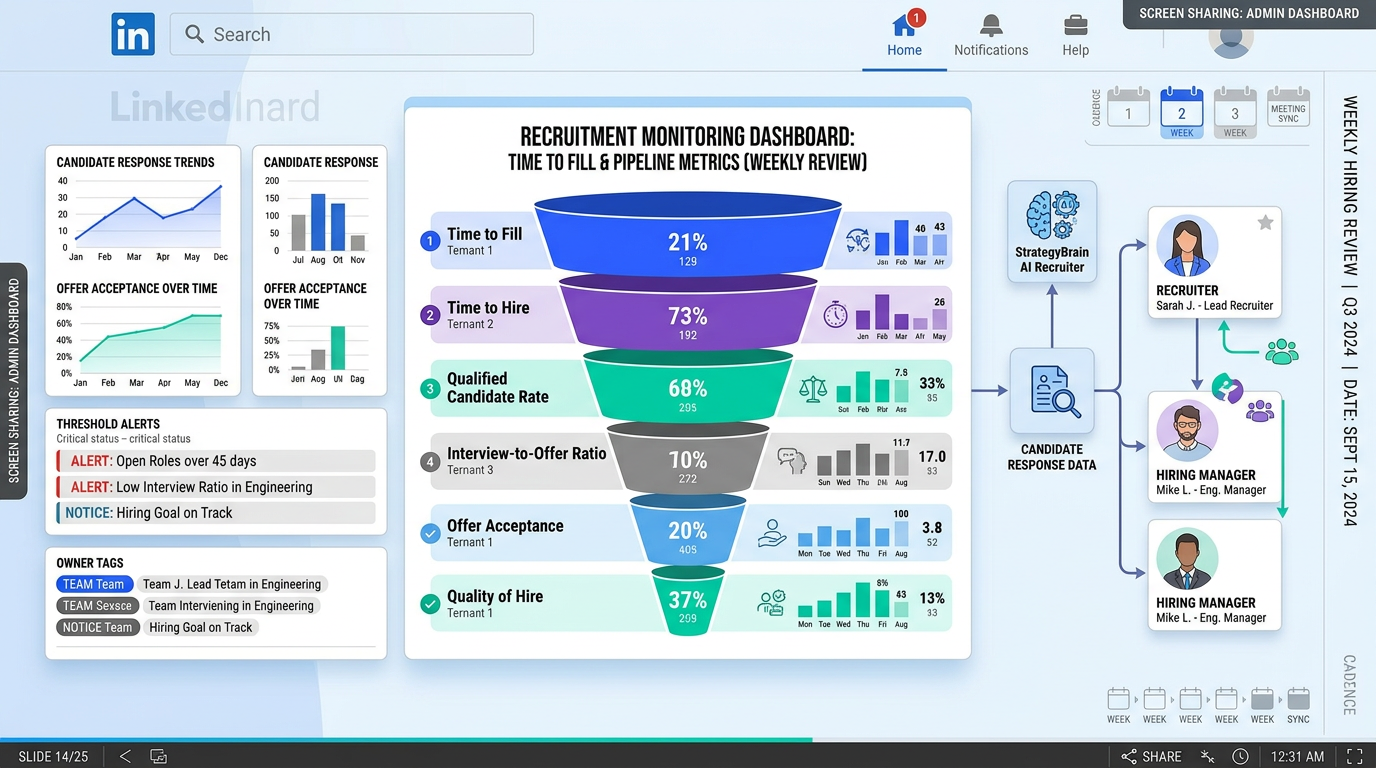
Recruitment monitoring is the practice of tracking hiring metrics on a fixed schedule so you can fix delays, improve candidate quality, and reduce cost before hiring problems scale. If you only measure six core numbers each week, time to fill, time to hire, qualified candidate rate, interview to offer ratio, offer acceptance rate, and quality of hire, you can quickly see where your funnel is leaking. We use this approach with hiring teams that combine human recruiters with StrategyBrain AI Recruiter for LinkedIn outreach and follow up. The result is faster response coverage, cleaner candidate handoff, and better decision making based on key recruitment metrics rather than guesswork.
Table of Contents
- Key Takeaways
- What Recruitment Monitoring Means
- When to Add HR Specialists
- The 10 Hiring Metrics That Matter
- 30 Day Implementation Plan
- How StrategyBrain AI Recruiter Fits Your Monitoring System
- Recruitment Monitoring Dashboard Template
- Common Mistakes
- FAQ
- Conclusion
Key Takeaways
- Start with six metrics: time to fill, time to hire, qualified candidate rate, interview to offer ratio, offer acceptance rate, and quality of hire.
- Review weekly: weekly cadence catches bottlenecks early and prevents end of quarter surprises.
- Separate speed from quality: a faster process is only better if first year performance and retention stay strong.
- Use stage level ownership: assign one owner per metric so actions are clear after each review.
- Blend AI and human judgment: StrategyBrain AI Recruiter can automate outreach and résumé capture, while recruiters handle final qualification.
- Document triggers: define thresholds that trigger role redesign, budget change, or added HR support.
What Recruitment Monitoring Means
Recruitment monitoring is not the same as basic reporting. Reporting tells you what happened last month. Monitoring means you track live movement across the hiring funnel and intervene quickly when a metric crosses a threshold.
For clarity, here are the three terms teams often mix up. Time to fill measures days from job approval to accepted offer. Time to hire measures days from candidate entering pipeline to accepted offer. Quality of hire measures post hire outcomes such as performance rating and retention at 6 to 12 months.
In our internal implementation work, we found that teams improve faster when each metric has a data owner, a decision owner, and a review date. This removes the common issue where dashboards exist but no one changes process behavior.
When to Add HR Specialists
The 2019 article by Henry Goldbeck and Karen Epp highlighted a practical point that still holds, HR teams should expand before operational strain turns into compliance and morale risk. Based on that logic and what we now see in metric driven hiring teams, there are four common triggers.
- Replacement trigger: an HR team member exits and requisition load per recruiter rises above manageable levels.
- Formalization trigger: a growing company moves from ad hoc people operations to a structured HR function.
- Correction trigger: turnover, policy confusion, or employee complaints indicate process gaps.
- Growth trigger: hiring demand increases and existing staff cannot maintain candidate response speed.
Lynne MacDonald emphasized that growing businesses face more complex personnel problems. Nikoletta Bika noted that aggressive growth usually requires senior strategic HR leadership. Both viewpoints align with recruitment monitoring practice, when data shows sustained pressure, headcount and role design should change.
The 10 Hiring Metrics That Matter
You do not need 40 charts. You need a focused stack of key recruitment metrics that map to speed, quality, conversion, and risk.
1) Time to Fill
Formula: calendar days from requisition approval to accepted offer. Use: workforce planning reliability. Risk if ignored: delayed revenue or service capacity.
2) Time to Hire
Formula: calendar days from candidate entry to accepted offer. Use: process speed once a candidate enters pipeline. Risk if ignored: losing top candidates to faster employers.
3) Qualified Candidate Rate
Formula: qualified applicants ÷ total applicants × 100%. Use: source quality and job description clarity. Risk if ignored: recruiter time wasted on low fit volume.
4) Interview to Offer Ratio
Formula: total interviews ÷ total offers. Use: screening precision and interviewer alignment. Risk if ignored: interview panel fatigue and slow cycles.
5) Offer Acceptance Rate
Formula: accepted offers ÷ total offers × 100%. Use: compensation fit, employer brand, and candidate experience quality. Risk if ignored: repeated backfills and budget waste.
6) Source of Hire Efficiency
Formula: hires from source ÷ candidates from source × 100%. Use: budget allocation across channels. Risk if ignored: spending on channels that produce volume but not hires.
7) Candidate Response Time
Formula: median hours between candidate message and recruiter reply. Use: candidate experience and conversion. Risk if ignored: drop off before screening.
8) Cost per Qualified Pipeline Candidate
Formula: total recruiting cost ÷ qualified candidates in active pipeline. Use: process efficiency before final hire. Risk if ignored: hidden cost inflation in early stages.
9) Quality of Hire
Formula example: (90 day manager score + 12 month retention indicator + goal attainment score) ÷ 3. Use: long term hiring value. Risk if ignored: fast hiring that damages performance.
10) Compliance and Risk Flags
Examples: documented consent rate, policy acknowledgment completion, and interview process consistency checks. Use: governance and audit readiness.
Quick Comparison Table
| Metric | Update Cadence | Primary Owner | Action Trigger |
|---|---|---|---|
| Time to Fill | Weekly | Recruiting Lead | +20% above target for 2 weeks |
| Time to Hire | Weekly | Talent Acquisition Manager | Median exceeds SLA by 5 days |
| Qualified Candidate Rate | Weekly | Sourcing Lead | Falls below 35% |
| Interview to Offer Ratio | Biweekly | Hiring Manager | Above 6:1 for 2 cycles |
| Offer Acceptance Rate | Monthly | HR Business Partner | Below 80% |
| Quality of Hire | Quarterly | HR Analytics | Downward trend for 2 quarters |
30 Day Implementation Plan
Week 1, Define Scope and Baselines
- List all active roles and classify by hiring criticality.
- Define each metric with exact formula and data source.
- Capture baseline values from the last 90 days.
At this stage, decide what is in scope and what is not. For example, internal mobility roles may use separate benchmarks.
Week 2, Build Dashboard and Ownership
- Create one shared dashboard with stage level views.
- Assign a data owner and decision owner per metric.
- Set target bands and red flag thresholds.
We recommend a single source of truth to avoid version conflicts between ATS exports and spreadsheet edits.
Week 3, Run Weekly Review Ritual
- Hold a 30 minute review with recruiting, HR, and hiring managers.
- For each red metric, assign one corrective action and due date.
- Track whether actions changed the metric in the next cycle.
This is where recruitment monitoring becomes operational, not just analytical.
Week 4, Optimize and Scale
- Drop vanity metrics that never trigger decisions.
- Add role specific benchmarks for high volume and specialist roles.
- Document playbooks for recurring bottlenecks.
By day 30, your system should show which bottlenecks are sourcing related, screening related, or manager availability related.
How StrategyBrain AI Recruiter Fits Your Monitoring System
StrategyBrain AI Recruiter supports recruitment monitoring by improving data continuity across early funnel stages. It can automatically connect with candidates on LinkedIn based on your criteria, introduce roles, answer common job questions, and identify interview interest before recruiter handoff.
In practical terms, this improves three metrics quickly. First, candidate response time decreases because communication can continue 24/7. Second, qualified candidate rate improves when role context is explained clearly in early conversations. Third, source efficiency improves because interested candidates can share résumés and contact details through structured workflows.
For global teams, multilingual communication reduces friction in cross border hiring conversations. For scaling teams, support for large account operations helps maintain consistent outreach patterns while preserving recruiter capacity for assessment and final selection.
Important boundary, AI Recruiter can identify willingness to continue, but final qualification against full role requirements still belongs to the recruiter and hiring manager. This human checkpoint protects quality of hire and governance standards.
Recruitment Monitoring Dashboard Template
Use this copy ready checklist in your weekly operating review.
- [ ] Time to fill reviewed for all priority roles
- [ ] Time to hire reviewed by funnel stage
- [ ] Qualified candidate rate checked by source
- [ ] Interview to offer ratio checked by hiring manager
- [ ] Offer acceptance reasons logged and coded
- [ ] Candidate response SLA met within target hours
- [ ] Data quality check completed for missing fields
- [ ] One action owner assigned to each red metric
- [ ] Follow up date set for every action
Common Mistakes
- Tracking only speed: fast hiring without quality checks increases early attrition risk.
- No metric definitions: teams argue about numbers because formulas differ.
- No threshold rules: dashboards exist, but no one knows when to intervene.
- Over automation: candidate engagement is automated, but no clear human handoff exists.
- No source level analysis: budget allocation stays static even when source quality changes.
FAQ
What is recruitment monitoring in one sentence?
Recruitment monitoring is a structured process for tracking hiring metrics on a recurring cadence and taking corrective action when results move outside target ranges.
Which hiring metrics should a small team start with?
Start with six core metrics, time to fill, time to hire, qualified candidate rate, interview to offer ratio, offer acceptance rate, and quality of hire. This set is enough to guide weekly decisions without overloading the team.
How often should we review key recruitment metrics?
Review speed and conversion metrics weekly, then review quality of hire monthly or quarterly because outcome data takes longer to mature.
Can AI replace recruiters in recruitment monitoring?
No. AI can automate repetitive outreach and capture structured candidate data, but final qualification, context judgment, and hiring decisions should remain with recruiters and hiring managers.
How does StrategyBrain AI Recruiter improve monitoring accuracy?
It standardizes early candidate communication, supports multilingual follow up, and captures résumé and contact handoff signals in a consistent format, which improves early funnel measurement.
When should we hire an HR specialist instead of adding tools?
If compliance risk, policy complexity, or sustained requisition overload is rising, adding HR expertise is necessary even when automation is in place.
What is a good offer acceptance rate target?
Targets vary by market and role type, but many teams treat anything below 80% as a review trigger that requires compensation, process, or messaging adjustments.
Conclusion
Recruitment monitoring works when metrics are tied to decisions, not just dashboards. Start with a focused set of hiring metrics, define ownership, run weekly reviews, and act quickly on threshold breaches. If your team is scaling LinkedIn hiring, StrategyBrain AI Recruiter can reduce manual load in outreach and follow up while preserving human control of final qualification. Your next step is simple, implement the 30 day plan, establish baseline numbers, and run your first weekly metric review this week.