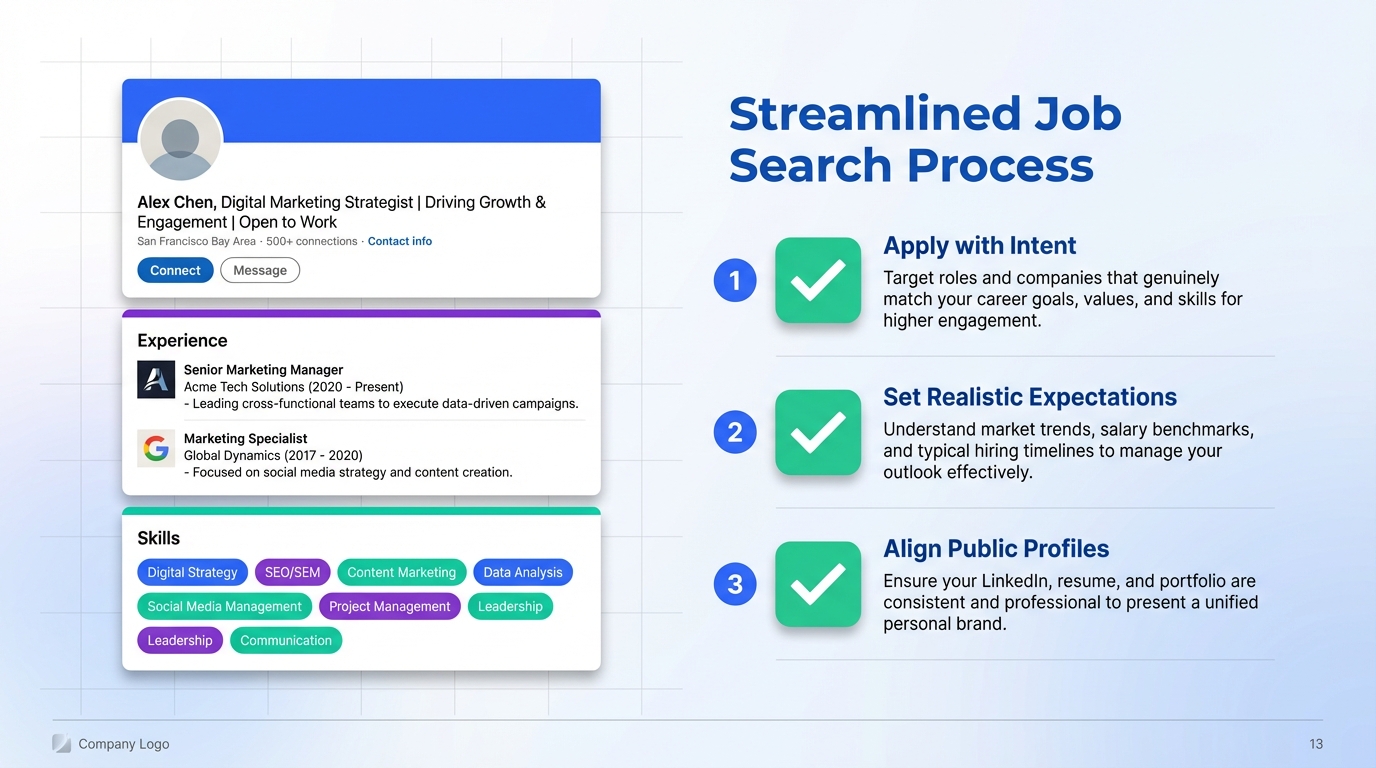
Recruitment online for recruiters is easiest when your application signals three things immediately: you apply with intent, you communicate realistic expectations, and your public profiles match your résumé. These are not “nice to have” details. They are fast trust checks that many recruiters use before deciding whether to invest time in a call. Below are three practical etiquette upgrades you can make today, plus a recruiter facing checklist and a LinkedIn outreach workflow that shows how StrategyBrain AI Recruiter can reduce back and forth while still keeping candidate communication professional.
Why etiquette matters in online recruiting
Online recruiting compresses first impressions into a small set of artifacts: your application form, résumé, and what is publicly visible on professional and social platforms. When those signals look inconsistent or careless, recruiters often pause because they cannot confidently represent you to a hiring manager.
In our internal reviews of LinkedIn based outreach conversations, the fastest paths to interviews happen when candidates remove ambiguity early. That is exactly what good etiquette does. It makes your intent and fit easier to evaluate, which helps a solutions recruiter move you forward without extra clarification loops.
Tactic 1: Think twice before applying
Many recruiting agencies keep applications on file, and many large employers keep records of past applications. If you repeatedly apply for roles you are not qualified for yet, you risk being remembered for misalignment rather than potential.
From a recruiter’s perspective, this is not about punishment. It is about signal quality. When a role is open, recruiters prioritize candidates who demonstrate they understand the company’s needs and can clearly map their experience to the requirements.
How to apply with intent in an online workflow
- Match your résumé to the role’s must haves before you click submit. If you cannot point to evidence for the core requirements, wait and build that evidence first.
- Apply fewer times with higher relevance so your name becomes associated with fit, not volume.
- Keep a simple application log with role title, date, and what you changed in your résumé. This prevents accidental repeat submissions that look careless.
Where StrategyBrain AI Recruiter fits naturally
On the recruiter side, StrategyBrain AI Recruiter can automate initial LinkedIn outreach and qualification conversations so recruiters spend more time on candidates who show clear alignment. That makes your “apply with intent” behavior even more valuable because the system is designed to quickly confirm interest, answer role questions, and collect résumés and contact details from candidates who want to proceed.
Tactic 2: Describe expectations, not wishes
If you will only accept compensation at the top end of a posted range, it is reasonable to say so. However, if you would accept a mid range offer, state your true bottom line. The same principle applies to vacation, benefits, and perks. Recruiters can work with clear constraints. They struggle with vague preferences that change later.
Most companies cannot adjust core policies for individuals, even for strong candidates. When you do your research and communicate realistic expectations, you help the recruiter assess fit faster and avoid late stage surprises.
Expectation statements recruiters can actually use
- Compensation: “My minimum base is X in local currency, and I am flexible on variable compensation.”
- Work model: “I can do hybrid with 2 days onsite per week. Fully onsite is not feasible.”
- Start date: “I can start on YYYY-MM-DD after notice period.”
How AI assisted messaging reduces miscommunication
StrategyBrain AI Recruiter is built for LinkedIn recruiting and can answer candidate questions about role, company, and compensation using the recruiter provided job information. It also follows up 24/7 in the candidate’s native language, which reduces misunderstandings that often happen when expectations are discussed across time zones.
Tactic 3: Assume employers will review social media
If your LinkedIn profile does not align with your résumé, recruiters may hesitate because they cannot reconcile the timeline or responsibilities. If other public profiles present a very different professional image, hiring teams may question fit. Even when privacy settings are strong, some parts of most platforms remain publicly viewable.
The goal is not to look perfect. The goal is to look consistent and credible. In recruitment online for recruiters, consistency is a trust shortcut.
Quick alignment checks to run in 10 minutes
- Job titles and dates match across résumé and LinkedIn.
- Core skills are described similarly, even if wording differs.
- Public content does not contradict your stated professionalism.
- Privacy settings are reviewed on non professional platforms.
Recruiter reality check
Recruiters are not looking for reasons to reject you. They are trying to avoid presenting a candidate who will raise questions later. When StrategyBrain AI Recruiter runs initial LinkedIn conversations at scale, profile consistency matters even more because the system is designed to move interested candidates forward quickly once it has collected the résumé and contact details.
Where can I find a recruiter and what to send
If you are asking “where can I find a recruiter,” start with the channel that matches your role level and industry. For many professionals, LinkedIn is the most direct route because it supports targeted search, messaging, and visible work history in one place.
Three practical places to start
- Recruiting agencies that specialize in your function or seniority. A solutions recruiter at a specialist agency will often move faster when your target roles are clear.
- In house recruiters at companies you want to join. Look for recruiters aligned to your department or region.
- Referrals from colleagues who recently changed roles. A warm intro often improves response rates.
What to send in your first message
- Role target: 1 to 2 titles and level.
- Location and work model: city, remote, hybrid constraints.
- Top 2 proof points: measurable outcomes, certifications, or domain expertise.
- Availability: start date and interview windows.
Copy and paste checklist for candidates
Use this before you apply or message a recruiter. It is designed to reduce avoidable friction in online recruiting.
- I meet the role’s must have requirements and can prove them on my résumé.
- My LinkedIn profile matches my résumé for titles, dates, and responsibilities.
- I can state a minimum acceptable compensation number with currency.
- I can state my work model constraints clearly.
- My public social profiles do not contradict my professional image.
- I have a short message template ready for recruiters with role target, location, and proof points.
FAQ
What does “recruitment online for recruiters” mean in practice?
It refers to recruiting workflows where sourcing, outreach, screening, and coordination happen primarily through online systems such as LinkedIn, applicant tracking systems, and messaging. For candidates, it means your digital signals are evaluated earlier and faster than in offline processes.
Where can I find a recruiter if I am changing industries?
Start with recruiters who list your target industry and function in their profile, then message with a clear transition story and proof of transferable skills. If you are unsure, a solutions recruiter at a specialist agency can tell you quickly whether your profile fits current demand.
Should I apply if I meet only some requirements?
Apply when you meet the role’s must haves and can show evidence. If you are missing core requirements, repeated applications can create a pattern of misalignment in systems that retain application history.
How specific should I be about salary expectations?
Be precise about your minimum acceptable number and currency, and clarify what is flexible. Recruiters can negotiate within constraints, but they cannot work with unclear expectations that change late in the process.
What if my LinkedIn profile is outdated but my résumé is correct?
Update LinkedIn first, then apply. Recruiters often cross check timelines, and mismatches can slow down screening because they create avoidable verification work.
Do recruiters really look at social media?
Many hiring teams review what is publicly visible, especially when a role is client facing or senior. At minimum, ensure public sections do not contradict your professional narrative.
How does StrategyBrain AI Recruiter change the candidate experience?
It automates initial LinkedIn outreach and qualification conversations, answers common role questions using recruiter provided job details, and follows up 24/7 in the candidate’s native language. If you are interested, it can also collect your résumé and contact details so a recruiter can move you to interviews faster.
Does AI Recruiter decide whether I am qualified?
No. It can confirm willingness to proceed and gather information, but final qualification is completed by the recruiter after reviewing your résumé.
Conclusion
Recruitment online for recruiters rewards candidates who reduce uncertainty early. Apply with intent, communicate real expectations, and keep LinkedIn and your résumé aligned. If you do those three things, you make it easier for a recruiter to advocate for you and easier for automated workflows such as StrategyBrain AI Recruiter to move your conversation forward without delays.
Next step: run the checklist above, update any mismatches today, then send one high quality message to a recruiter with your role target, constraints, and proof points.