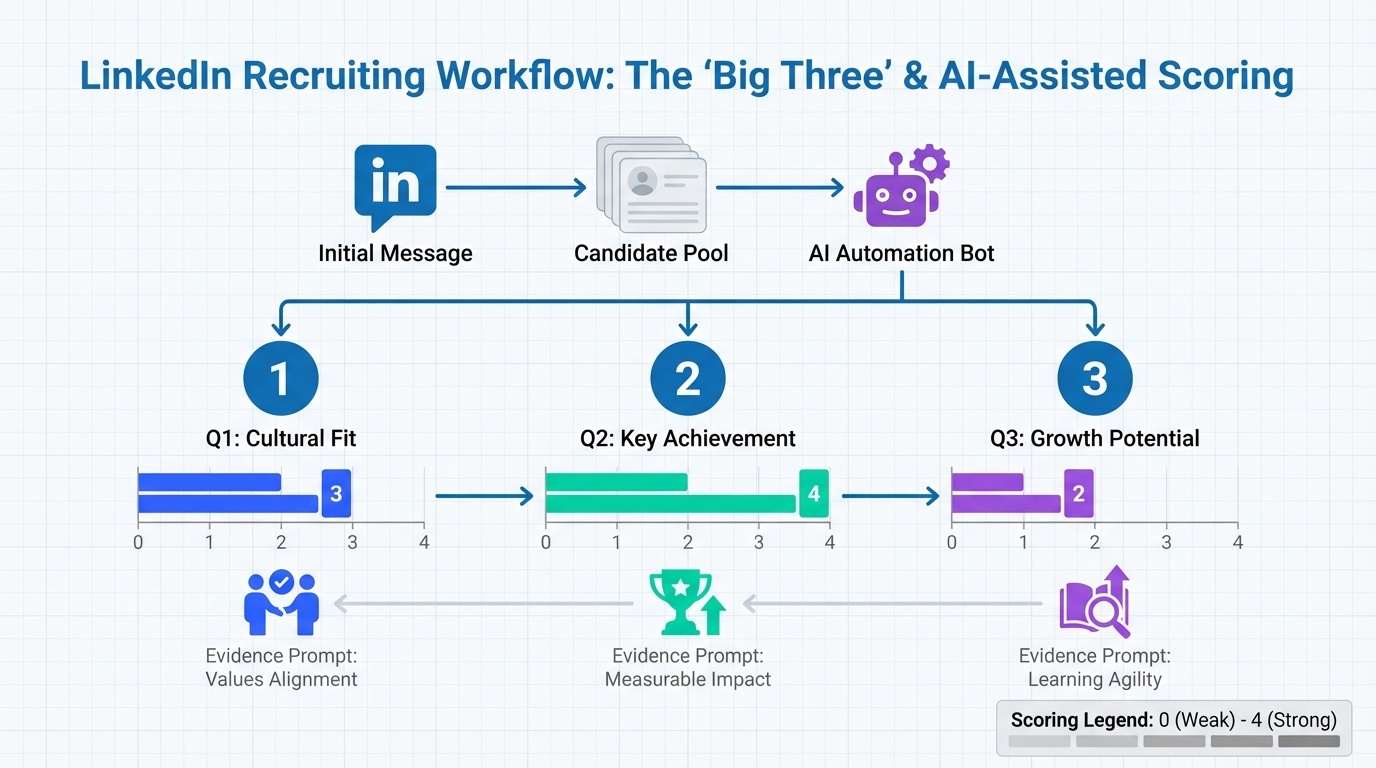
For recruitment online for recruiters, the quickest way to raise interview signal and reduce wasted calls is to standardize how you handle three “common” questions that show up in almost every process: why the candidate wants the role, what their strengths are, and why you should hire them. These questions are often used as warm ups, and on their own they are not strong predictors. However, when you require one role specific example and score answers against job requirements, they become a reliable structure for early stage interviews. This guide gives you a repeatable script, a scoring rubric, and follow up prompts. It also explains where StrategyBrain AI Recruiter fits in a modern workflow by automating LinkedIn outreach and early qualification so recruiters can focus interviews on evidence.
Key Takeaways
- Standardize the “big 3” questions: Use the same prompts and scoring for every candidate to improve fairness and comparability.
- Force evidence: Require 1 concrete example per answer to avoid generic responses and reduce false positives.
- Score with a simple rubric: Use a 0 to 4 scale per question and define what “good” looks like before interviews start.
- Use online recruiting to pre qualify: Let early messaging collect basics so interviews focus on skills, outcomes, and fit.
- StrategyBrain AI Recruiter can handle first touch: It automates LinkedIn connecting, role intro, Q and A, interest confirmation, and résumé collection.
- Be honest about limits: Even structured answers do not replace skills testing, reference checks, or work samples.
Why these questions still matter in online recruiting
In many teams, these questions are treated as “standard,” which is exactly the problem. Candidates rehearse them, and interviewers often score them based on confidence rather than evidence. The fix is not to delete the questions. The fix is to make them measurable.
If you work with recruiters for job seekers or run internal hiring, you already know the reality of online pipelines: candidates come from multiple sources, including job recruiting websites, referrals, and LinkedIn. A consistent interview structure is what lets you compare candidates fairly across channels.
Where StrategyBrain AI Recruiter helps is upstream. It can automate the repetitive LinkedIn steps that usually happen before the interview, including connecting with candidates, introducing the opportunity, answering common questions about the role and compensation, confirming interview interest, and collecting résumés and contact details. That means your interview time can be spent validating skills and outcomes instead of repeating basics.
Question 1: Why are you interested in this position or company
This question is useful when it tests preparation and alignment, not flattery. In online recruiting, it also reveals whether the candidate understands the role beyond the title.
How to ask it (script)
- Ask for one specific reason: “What is one concrete thing about this role or company that you are genuinely interested in?”
- Require a connection: “Which part of your background matches that, and how?”
- Confirm direction: “How does this role fit your next 12 months of career goals?”
What a strong answer includes
- Research signal: Mentions values, product, customers, or recent changes in a way that sounds real, not copied.
- Role match: Connects to a relevant skill or experience that matters for the job.
- Motivation clarity: Explains why now, not just why someday.
Limitations and recruiter notes
Some candidates are excellent but not polished. If the candidate is nervous, use follow ups that pull for evidence rather than style. Also, remember that early stage messaging can shape this answer. If your outreach is vague, you will get vague motivation back.
Question 2: What are your strengths
This question becomes valuable when you constrain it. Otherwise, you get generic traits that do not predict performance.
How to ask it (script)
- Limit to three: “Give me up to 3 strengths that are most relevant to this job.”
- Force proof: “For each one, give a brief example from work, volunteering, or another real responsibility.”
- Make it job linked: “Which strength will matter most in the first 30 days here, and why?”
What to listen for
- Relevance: Strengths map to the job description, not the candidate’s identity story.
- Specificity: Examples include context, action, and outcome.
- Self awareness: The candidate can describe tradeoffs, not just upsides.
Pain points we see in real interviews
- Clichés: “Perfectionist” style answers that avoid real tradeoffs.
- Unscored storytelling: Great narrative with no measurable outcome.
- Mismatch: Strengths that are real but not needed for the role.
Question 3: Why should we hire you
This is the closest thing to a structured “value proposition” question. It works when you anchor it to the employer’s pain points and the candidate’s evidence.
How to ask it (script)
- Set the frame: “Assume we are deciding between you and one other strong candidate.”
- Ask for 2 to 3 proof points: “What are your top 2 or 3 reasons, and what evidence supports each?”
- Test pain point thinking: “What do you think will be hardest about this role, and how would you handle it?”
How to score it (0 to 4 rubric)
| Score | What it sounds like | Recruiter interpretation |
|---|---|---|
| 0 | No clear reasons, mostly generic claims | Low signal, needs deeper probing |
| 1 | Reasons are clear but not tied to the role | Potential mismatch or poor preparation |
| 2 | Some role alignment, limited evidence | Average, verify with work samples |
| 3 | Strong alignment with specific examples and outcomes | High signal, move forward if skills match |
| 4 | Clear value, quantified outcomes, anticipates challenges | Top tier, prioritize for next stage |
Quick Comparison: Unstructured vs structured interviews
| Approach | Speed | Consistency | Best for |
|---|---|---|---|
| Unstructured “chat” interview | Fast to run | Low | Informal culture screens only |
| Structured “big 3” with rubric | Moderate | High | Early stage online screening across multiple sources |
| Structured interview plus work sample | Slower | High | Finalists and high impact roles |
A practical recruitment online workflow for recruiters
Below is a workflow we have used to keep online pipelines moving while protecting interview quality. It is designed for high volume sourcing and works whether candidates come from LinkedIn or job boards.
Step by step
- Define must haves: Write 3 must have skills and 2 must have behaviors for the role.
- Pre qualify with consistent prompts: Ask 3 short questions before scheduling, such as availability, location constraints, and interest level.
- Automate first touch where appropriate: Use StrategyBrain AI Recruiter to connect with candidates on LinkedIn, introduce the role, answer common questions about the company and compensation, confirm interview interest, and collect résumés and contact details.
- Run the “big 3” interview: Use the scripts above and score each answer 0 to 4.
- Decide next step: Move candidates with consistent 3+ scores to skills validation, and send clear closure to others.
Practical checklist you can copy into your ATS notes
- Question 1 scored: Motivation and research aligned to role
- Question 2 scored: Up to 3 strengths, each with one example
- Question 3 scored: 2 to 3 reasons to hire, each with evidence
- Follow ups used: At least 1 probe for specifics per question
- Next step set: Work sample, hiring manager interview, or close out
FAQ
Are these three questions enough to make a hiring decision?
No. They are a structured way to improve early stage screening in recruitment online for recruiters, but they should be paired with skills validation such as work samples, technical screens, or reference checks.
Why do candidates sound similar when answering common interview questions?
Because many candidates rehearse these questions. You get better signal by requiring one concrete example and scoring against job specific criteria instead of confidence.
How do I keep answers concise without cutting candidates off?
Set expectations upfront. Ask for a 60 to 90 second answer, then use one follow up question to pull for details that matter.
What is the “rule of threes” for strengths?
It is a constraint that asks candidates to share a maximum of three strengths. This reduces rambling and makes it easier to compare candidates consistently.
How does StrategyBrain AI Recruiter fit into an online recruiting process?
It automates LinkedIn outreach and early qualification by connecting with candidates, introducing the job, answering questions about the role and compensation, confirming interest, and collecting résumés and contact details. Recruiters then focus interviews on skills and evidence.
Does StrategyBrain AI Recruiter replace the recruiter’s final qualification decision?
No. It can identify willingness to communicate or interview and collect information, but final qualification against job requirements is still done by the recruiter after reviewing the résumé and interview evidence.
How should recruiters handle candidates who are nervous or not polished?
Use evidence based follow ups. Ask what they did, what changed, and what they learned. This reduces bias toward presentation style.
Is it okay to use these questions for all roles?
Yes for early screening, but you should adjust the scoring criteria to match the role. For specialized roles, add a work sample or technical assessment.
Conclusion
Recruitment online for recruiters works best when you combine speed with structure. The three common interview questions can be low value when they are treated as small talk, but they become useful when you require evidence and score answers against the job’s must haves. If you also automate early LinkedIn outreach and qualification with StrategyBrain AI Recruiter, you protect interview time for what matters: skills, outcomes, and fit. Next step: copy the rubric into your interview template, run it for 10 interviews, then refine the scoring definitions with your hiring managers.