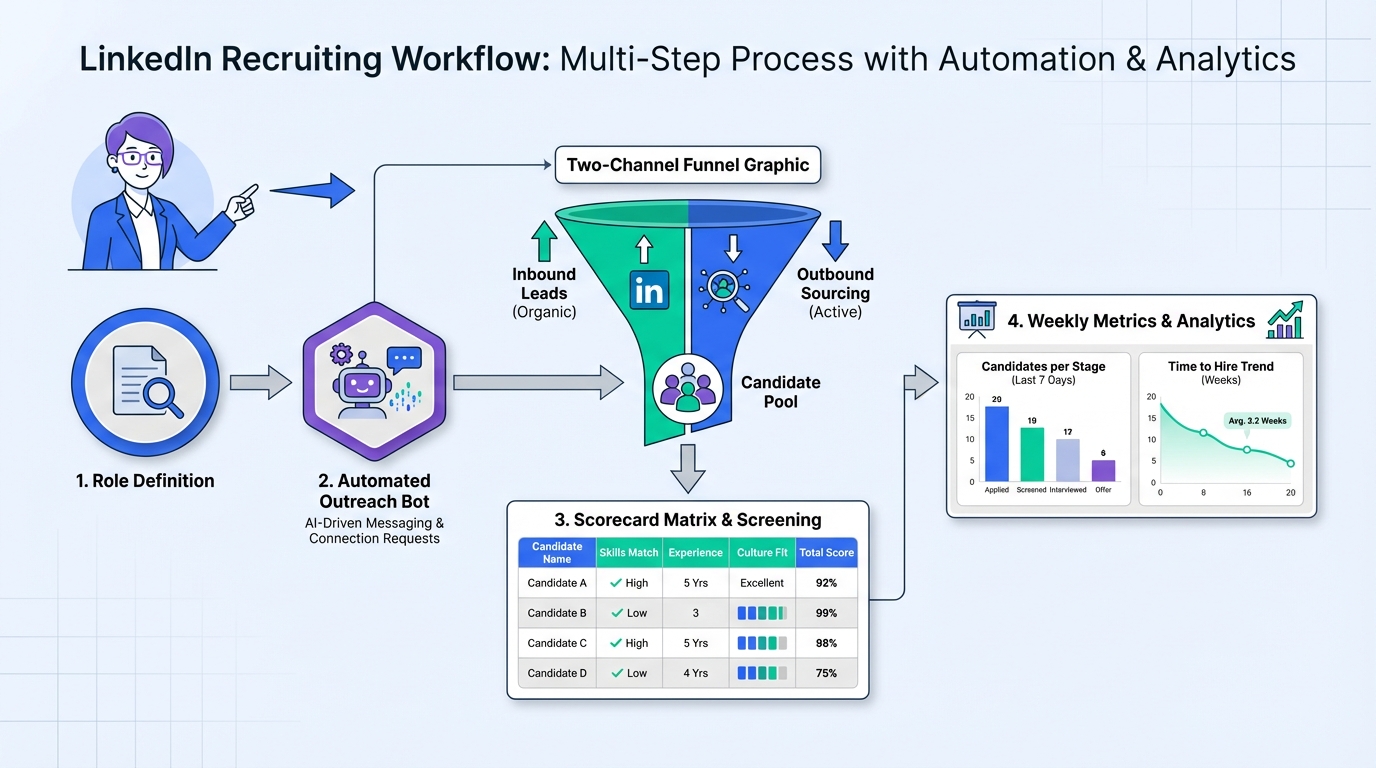
Recruitment online for recruiters works best when you treat sourcing like a repeatable system: define the role and outreach message, build a targeted LinkedIn search, run consistent follow ups, and track responses weekly. In our team’s day to day recruiting operations, the biggest lift comes from automating the repetitive first touch and qualification steps so recruiters can spend time on interviews and closing. This guide gives you 5 practical plays you can run immediately, including how to decide where to hire a recruiter, and how to respond when a hiring manager asks “how do i find a recruiter to work with” for a hard to fill role. Scope: online recruiting workflows and tools, not legal advice or country specific employment law.
Table of Contents
- Key Takeaways
- Play 1: Turn the role into a searchable target
- Play 2: Build a LinkedIn outreach engine with AI Recruiter
- Play 3: Use a two channel funnel for inbound and outbound
- Play 4: Decide where to hire a recruiter using a simple scorecard
- Play 5: Measure what matters weekly
- Quick Comparison
- FAQ
- Conclusion
Key Takeaways
- Fastest way to scale outreach: Automate first touch, Q and A, and follow ups so recruiters focus on interviews and closing.
- LinkedIn is still the core channel: A precise search plus consistent messaging beats “post and pray” for most professional roles.
- AI Recruiter fits the repetitive layer: It can connect, introduce roles, answer candidate questions, confirm interest, and collect résumés and contact details.
- Global hiring needs 24/7 messaging: Multilingual, always on responses reduce drop off across time zones.
- Where to hire a recruiter depends on risk: Use a scorecard to choose in house, agency, contract, or an AI assisted workflow.
- Weekly metrics prevent wasted spend: Track connection acceptance, reply rate, qualified interest rate, and résumé capture rate.
Play 1: Turn the role into a searchable target
Online recruiting breaks down when the role is described like a job ad instead of a search target. Before you send a single message, convert the role into a sourcing spec that a recruiter can execute consistently.
Steps
- Define the must haves: 3 skills, 1 domain, and 1 seniority level. Keep it strict so your search is reproducible.
- Define the nice to haves: 3 optional skills that expand the pool without changing the job’s core.
- Write a 2 sentence value proposition: One sentence on impact, one sentence on compensation and benefits range if you can share it.
- Decide your screening boundary: What the recruiter will qualify in chat versus what the hiring manager will decide after résumé review.
Features
- Search consistency: Different recruiters can run the same search and get similar results.
- Message consistency: Candidates receive a clear, comparable pitch across the pipeline.
- Faster calibration: Hiring managers can adjust the spec after reviewing 10 profiles, not after 100 messages.
Limitations
- It does not replace job analysis: If the role is unclear, a sourcing spec will only make the confusion faster.
Best For
- Hard to fill roles where you need a tight target and fast iteration.
- Teams asking “how do i find a recruiter to work with” because prior searches felt random.
Play 2: Build a LinkedIn outreach engine with AI Recruiter
LinkedIn outreach is powerful, but it is also where recruiters lose the most time: connecting, introducing the role, answering repeat questions, and chasing follow ups. In our experience, this is exactly where an AI assisted workflow can create leverage without changing your hiring standards.
What AI Recruiter does in the workflow
AI Recruiter is an automated AI powered recruitment tool built for LinkedIn hiring. It can automatically connect with candidates that match your search criteria, introduce the opportunity, learn about the candidate’s situation, answer questions about the role, company, and compensation, confirm interview interest, and collect résumés and contact information from interested candidates. Recruiters then review the captured résumés and contact details and move qualified candidates into interviews.
Steps
- Provide the job context: Company details, compensation, benefits, and the candidate search criteria you want to target.
- Set the conversation goals: Confirm interest, collect résumé, and capture contact details for interview scheduling.
- Run the outreach and follow up loop: Let the system handle initial messaging and timely follow ups while you monitor quality.
- Review and handoff: Recruiters review résumés and contact details, then schedule interviews with shortlisted candidates.
Features
- 24/7 multilingual communication: Always on responses in the candidate’s native language to reduce misunderstandings across time zones.
- Scalable account management: Supports managing more than 100 LinkedIn accounts for teams that need high volume outreach.
- Automated résumé and contact capture: Captures files and contact details shared in messages and flags when a résumé is received.
Limitations
- Not a final fit decision: AI Recruiter can confirm willingness to communicate or interview, but it does not decide whether the résumé fully matches the job requirements.
- Requires clear inputs: If compensation, benefits, or role scope are vague, candidate Q and A becomes less effective.
Best For
- Recruiters who want recruitment online for recruiters to run continuously, including nights and weekends.
- Global hiring where language and time zone gaps cause candidate drop off.
- Teams that need to scale outreach without adding headcount.
Play 3: Use a two channel funnel for inbound and outbound
Most online recruiting programs fail because they rely on one channel. A practical approach is a two channel funnel: inbound for credibility and outbound for speed. This also helps when stakeholders ask where to hire a recruiter, because you can show a system rather than a single tactic.
Steps
- Inbound: Publish a role page and a short “why join” summary that answers the top 5 candidate questions you see repeatedly.
- Outbound: Run targeted LinkedIn searches and message sequences with a defined follow up cadence.
- Unify tracking: Use one pipeline view so you can compare inbound versus outbound conversion rates.
Features
- Credibility plus speed: Inbound builds trust, outbound creates volume.
- Better candidate experience: Candidates can self educate before replying.
- Cleaner reporting: You can attribute hires to channel and adjust spend.
Limitations
- Requires coordination: If inbound content and outbound messaging disagree, response rates drop.
Best For
- Companies that want predictable hiring output, not occasional wins.
- Recruiters supporting multiple roles at once.
Play 4: Decide where to hire a recruiter using a simple scorecard
“Where to hire a recruiter” is not a single answer. It depends on urgency, role difficulty, internal capacity, and how much process control you need. When someone asks “how do i find a recruiter to work with,” I recommend starting with a scorecard so the decision is transparent.
Recruiter sourcing options
- In house recruiter: Highest process control and employer brand alignment.
- Agency recruiter: Fast ramp up and market access, but less control over messaging unless tightly managed.
- Contract recruiter: Flexible capacity with more control than an agency, but requires internal process maturity.
- AI assisted workflow: Automates repetitive outreach and qualification steps while recruiters keep final screening decisions.
Steps
- Score urgency: 1 to 5 based on how quickly you need interviews scheduled.
- Score role complexity: 1 to 5 based on niche skills and candidate scarcity.
- Score internal capacity: 1 to 5 based on recruiter bandwidth and hiring manager availability.
- Score process control needs: 1 to 5 based on compliance, brand sensitivity, and candidate experience requirements.
- Choose the mix: Use the highest scoring constraints to pick the primary approach and a backup.
Practical decision rule we use
- High urgency plus low capacity: Add automation for outreach and follow ups, then keep recruiter time for interviews.
- High complexity: Keep a recruiter in the loop for calibration and final qualification, even if outreach is automated.
- High process control: Prefer in house or contract, and standardize messaging and data handling.
Limitations
- No scorecard predicts culture fit: It only helps you choose the recruiting operating model.
Best For
- Leaders who need a defensible answer to where to hire a recruiter.
- Teams that have tried multiple recruiters but never standardized the process.
Play 5: Measure what matters weekly
Online recruiting feels expensive when you do not measure the funnel. A weekly review keeps recruitment online for recruiters grounded in reality and prevents overreacting to a single day of low replies.
Weekly metrics dashboard
- Connection acceptance rate: Accepted connections divided by connection requests sent.
- Reply rate: Replies divided by messages delivered.
- Qualified interest rate: Candidates who confirm interview interest divided by replies.
- Résumé capture rate: Résumés received divided by candidates who confirm interest.
- Time to first response: Median hours from candidate message to your reply.
Steps
- Review the numbers every 7 days: Use the same day and time each week.
- Change one variable at a time: Search filters, message opening, or follow up cadence.
- Document what changed: Keep a simple log so you can reproduce wins.
Limitations
- Metrics do not replace judgment: A high reply rate can still be low quality if the targeting is off.
Best For
- Recruiters managing multiple requisitions who need a stable operating rhythm.
Quick Comparison
| Approach | Speed to start | Process control | Best for |
|---|---|---|---|
| In house recruiter | Medium | High | Ongoing hiring, strong employer brand needs |
| Agency recruiter | Fast | Medium | Urgent roles, limited internal capacity |
| Contract recruiter | Fast | High | Short term hiring spikes with internal process maturity |
| AI assisted LinkedIn outreach with AI Recruiter | Fast | High | Scaling outreach, 24/7 multilingual candidate engagement, résumé capture |
FAQ
What does “recruitment online for recruiters” actually mean in practice?
It means your sourcing, outreach, follow ups, and early qualification happen through online channels with a defined workflow and measurable funnel metrics. The goal is repeatability: the same inputs should produce similar pipeline output week to week.
Where to hire a recruiter if I need results quickly?
If speed is the top constraint, start with an agency recruiter or a contract recruiter, then add automation for outreach and follow ups to keep the pipeline moving daily. You still need a clear role spec and fast hiring manager feedback to convert speed into hires.
How do i find a recruiter to work with for a niche role?
Look for a recruiter who can explain their sourcing plan in detail: target companies, search keywords, outreach cadence, and how they qualify interest. For niche roles, insist on a calibration loop after the first 10 to 20 profiles so the search target is corrected early.
Can AI Recruiter replace a recruiter?
AI Recruiter can replace repetitive LinkedIn tasks such as connecting, introducing roles, answering common questions, confirming interest, and collecting résumés and contact details. It does not replace final qualification against job requirements, which still requires recruiter and hiring manager judgment.
How does AI Recruiter handle candidates in different time zones?
It supports 24/7 messaging and can communicate in the candidate’s native language, which helps maintain momentum when candidates reply outside your working hours. This reduces delays that often cause drop off in online recruiting.
What information should I give a recruiter or AI system before outreach starts?
Provide company details, compensation, benefits, and the candidate search criteria. Also define what counts as qualified interest, and what information you want collected before scheduling an interview.
How do I prevent online outreach from feeling spammy?
Keep the first message specific to the candidate’s background, state the role impact clearly, and ask one simple question about interest. Then use a consistent follow up cadence with a clear stop rule, such as ending outreach after 3 follow ups with no response.
What is the minimum weekly reporting I should expect from a recruiter?
At minimum, ask for counts of connection requests sent, acceptance rate, replies, candidates who confirm interview interest, and résumés received. Those numbers let you diagnose whether the issue is targeting, messaging, or follow up speed.
Conclusion
Recruitment online for recruiters becomes predictable when you standardize the role into a searchable target, run a two channel funnel, and review weekly funnel metrics. If your bottleneck is repetitive LinkedIn outreach and follow ups, AI Recruiter can handle the initial connection, role introduction, candidate Q and A, interest confirmation, and résumé and contact capture so recruiters can focus on interviews and final qualification. Next step: pick one role, implement Play 1 and Play 5 this week, then decide whether to add AI assisted outreach based on your response and résumé capture rates.