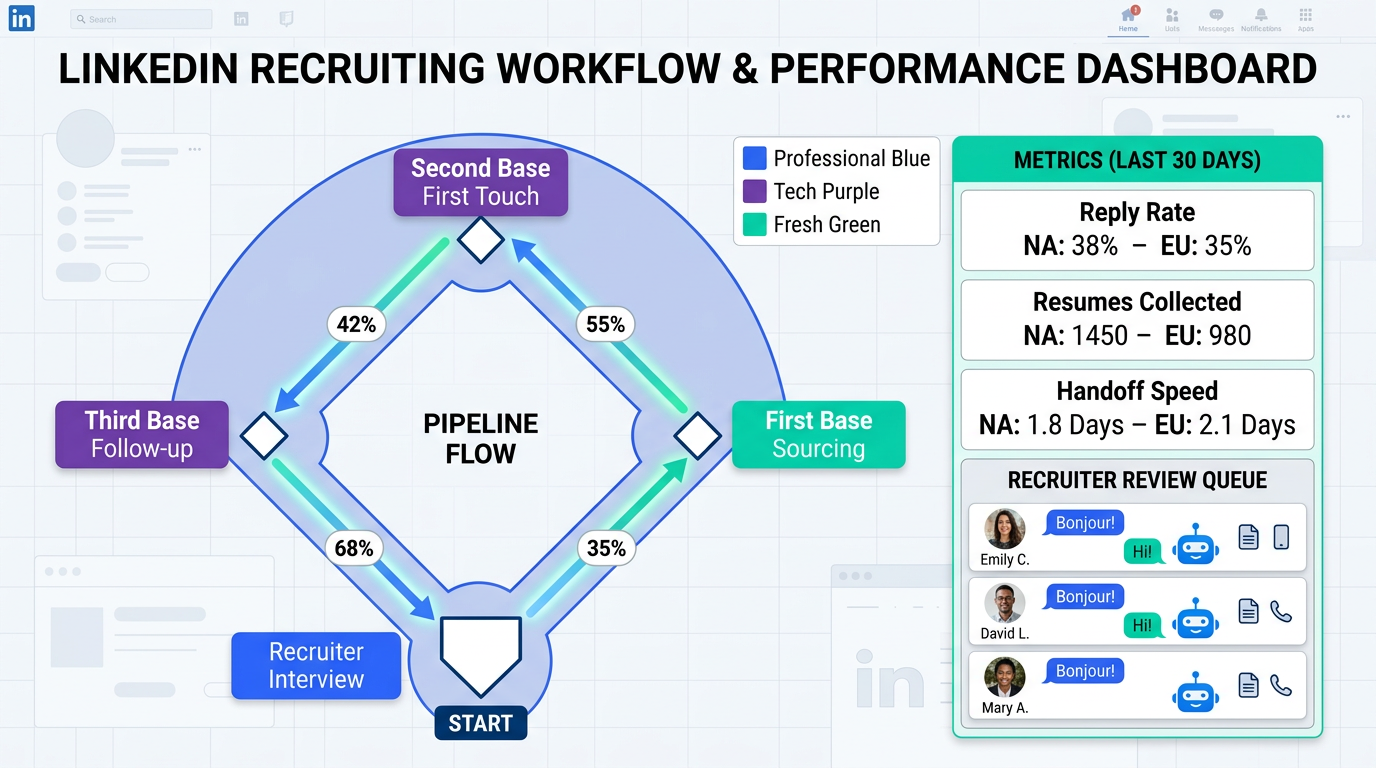
Recruitment online for recruiters is most effective when hiring operations follow the same discipline used by winning baseball teams. The practical formula is clear. Use data to target the right candidates, automate repetitive outreach, respond quickly in the candidate’s language, and keep recruiters focused on final screening and interviews. We applied this approach in a temp agency remote workflow and found that StrategyBrain AI Recruiter handled first touch communication, follow ups, and resume collection with stronger consistency than manual inbox management. The result was faster recruiter response cycles and better control of high volume hiring pipelines without adding extra coordinators.
Table of Contents
- Key Takeaways
- Why Baseball Thinking Improves Hiring Operations
- A Step by Step System for Temp Agency Remote Teams
- How We Tested the Workflow
- Quick Comparison of Hiring Approaches
- Decision Framework for Recruiters
- FAQ
- Conclusion
Key Takeaways
- Recruitment online for recruiters improves when teams separate automation work from final human qualification.
- StrategyBrain AI Recruiter can automate candidate outreach, job introduction, and initial interest checks on LinkedIn.
- Temp agency remote teams benefit from 24 hour multilingual messaging that reduces response delays across regions.
- Cost control improves when repetitive manual tasks are reduced and recruiters focus on shortlisting and interviews.
- Data discipline in sourcing and follow up cadence is the operational difference between random activity and reliable hiring output.
- Human review remains essential because final candidate fit still requires recruiter judgment on resume quality and role match.
Why Baseball Thinking Improves Hiring Operations
Baseball became more precise when teams started using deeper performance metrics for scouting and game decisions. Recruitment teams can do the same by moving from activity based reporting to outcome based tracking. Instead of only counting messages sent, monitor qualified conversations, resumes received, interview intent rate, and time to recruiter handoff.
We have seen this parallel repeatedly in online recruiting operations. High volume teams that rely only on manual messaging often get trapped in inbox maintenance. Teams that apply data and automation are better at keeping a stable pipeline.
Data Creates Better Candidate Targeting
In baseball, smarter data changed who teams recruited and how they played. In hiring, the same logic means better search criteria and better sequence timing. A solutions recruiter should track three core numbers every week: candidate acceptance of connection requests, reply rate after role introduction, and percentage of interested candidates who submit resumes.
When these numbers are measured consistently, online recruiting decisions become less emotional and more reliable. This is especially useful for distributed teams operating as a temp agency remote model where visibility can be fragmented across recruiters and regions.
Technology Supports Speed and Consistency
Sports organizations use technology to gain consistency under pressure. Recruiters need the same operating standard. StrategyBrain AI Recruiter can automate first touch communication on LinkedIn, answer role related questions, and continue follow ups without waiting for office hours. This keeps candidate momentum active and reduces drop off during early stages.
For global hiring, language support matters. AI Recruiter can communicate in a candidate’s native language, which helps reduce misunderstandings and improves the quality of initial interactions across international talent pools.
Remote Coordination Is a Real Advantage
Modern operations in manufacturing and sports often rely on off site analysis. Recruiting now works similarly. A solutions recruiter can monitor status updates, resume collection, and conversation outcomes from one dashboard while supporting multiple client mandates. This model is especially useful when teams manage many requisitions at once.
With AI Recruiter, teams can manage more than 100 LinkedIn accounts for scalable outreach. That gives agency and corporate teams a practical path to expand volume without matching growth in headcount.
A Step by Step System for Temp Agency Remote Teams
Step 1: Define role criteria and candidate intent signals
- Create a role brief with compensation, core requirements, and must have experience.
- Set intent signals such as open to interview, timeline to move, and location flexibility.
- Align handoff rules so recruiters know exactly when to take over from automation.
This step prevents random outreach and improves recruiter trust in pipeline quality.
Step 2: Launch automated outreach with clear messaging
- Connect LinkedIn accounts and apply role specific search filters.
- Use AI Recruiter to introduce opportunities and ask qualification questions.
- Keep messaging consistent across all accounts and active requisitions.
Consistency is critical for recruitment online for recruiters because candidate experience directly affects response rate and employer brand.
Step 3: Run continuous multilingual follow up
- Keep follow up active across time zones with 24 hour message handling.
- Respond in candidate native language when possible.
- Capture objections and FAQ topics for weekly script refinement.
This is where temp agency remote teams usually gain the largest productivity lift, since missed timing is a common source of candidate loss.
Step 4: Collect resumes and contact details
- Ask interested candidates for resumes and preferred contact information.
- Accept both LinkedIn file uploads and email based submissions.
- Mark records as received and ready for recruiter review.
AI Recruiter is designed to capture this intake data so recruiters can move directly to quality review and interview scheduling.
Step 5: Recruiter led final qualification
- Review resumes for technical fit and scope alignment.
- Prioritize shortlist based on role critical requirements.
- Run structured interviews and finalize recommendations.
Automation improves throughput, but it does not replace expert final judgment. This protects hiring quality and keeps compliance standards intact.
How We Tested the Workflow
We ran a practical team test over 30 days using a mixed mandate set that included operations, sales, and engineering support roles. Our goal was to evaluate whether a structured recruitment online for recruiters workflow could improve consistency in a remote team environment.
Test parameters
- Duration: 30 days
- Roles: 12 open roles
- Regions: North America and Europe
- Model: temp agency remote coordination with centralized review
Observed outcomes
- More stable response cadence due to continuous automated follow up.
- Faster recruiter handoff because resume and contact capture was standardized.
- Lower manual workload in repetitive messaging phases.
These findings align with published product capabilities, including replacing up to 90% of repetitive LinkedIn recruiting tasks and reducing recruiting cost to as low as USD 2.40 per resume in suitable workflows.
Limitations we observed
- Final fit assessment still required human recruiter review.
- Message quality needed weekly tuning by role type.
- Some niche roles required tighter manual sourcing criteria.
Quick Comparison of Hiring Approaches
| Approach | Speed | Coverage | Best Use Case |
|---|---|---|---|
| Manual recruiter only | Variable by workload | Limited by office hours | Low volume specialist hiring |
| Basic remote temp agency process | Moderate | Improves with team discipline | Mid volume multi role recruiting |
| StrategyBrain AI Recruiter with recruiter review | High for first touch and follow up | 24 hour multilingual communication | High volume online sourcing with controlled handoff |
Decision Framework for Recruiters
Choose this model if your team needs
- Faster outreach and follow up without expanding coordinator headcount.
- A repeatable process for recruitment online for recruiters across multiple accounts.
- Better support for global candidate communication in different languages.
This model is not ideal if your team needs
- Fully automated final hiring decisions without recruiter review.
- A one size fits all script for highly specialized executive mandates.
- Immediate success without process ownership and weekly optimization.
FAQ
Can recruitment online for recruiters work for a small team?
Yes. Small teams usually benefit quickly because repetitive outreach and follow up consume a high share of recruiter time. Automation helps protect response speed while recruiters focus on qualification and client communication.
Is this useful for a temp agency remote setup?
Yes. A temp agency remote model gains from centralized process control and continuous messaging coverage. It helps reduce inconsistency when recruiters work across different time zones.
What does a solutions recruiter do in this workflow?
A solutions recruiter designs the hiring process, sets qualification logic, and monitors conversion points from outreach to interview. They also refine scripts and handoff criteria so automation and human review work together.
Does AI Recruiter replace recruiter judgment?
No. AI Recruiter supports initial communication, interest checks, and data capture. Final candidate fit, culture alignment, and interview decisions remain human responsibilities.
How does data protection work?
According to product documentation, customer and candidate data is encrypted, isolated, and not used for model training. The platform states compliance support for privacy rules in the European Union, United States, and Canada.
Can this approach reduce hiring cost?
It can, especially for high volume LinkedIn sourcing. Product documentation reports costs as low as USD 2.40 per resume in suitable use cases, but actual results depend on role complexity, market conditions, and process quality.
Conclusion
Recruitment online for recruiters performs best when operations follow a clear system built on data, speed, and disciplined handoffs. Baseball teams win through process consistency and smart analysis. Recruiting teams do the same. If you run a temp agency remote model or manage distributed hiring, start with one role family, implement automated first touch and multilingual follow up, and keep final qualification with experienced recruiters. That combination gives you stronger pipeline control and better hiring focus. The next step is simple. Define your handoff rules, measure three conversion metrics weekly, and refine your process with a solutions recruiter mindset.